Guidelines, Not Godlines

I cringe whenever writers and editors start talking about “rules.”

What I really love about these rules is that there's never anyone around to enforce them.

What I really love about these rules is that there’s never anyone around to enforce them.

The real problem, though, isn’t the innocent little word “rules.” It’s that so many of us grow up thinking that rules are not to be broken. If we break them, bad things will happen. We’ll get a big red X on our paper. We’ll flunk the course. People will laugh at us.

Bending the rules is possible, of course, but it carries the tinge of unethical behavior, if not outright sleaziness.

Instead of rules, I think of conventions and guidelines.

Conventions and guidelines are worth knowing. They’re worth knowing well. They help you write better, and — probably more important — they help make what you write comprehensible to others.

But guidelines are not godlines. They are not graven in stone. Lightning will not strike you dead if you adapt them to your own purposes, or ignore them completely. If you ignore them too completely, however, readers may ignore your writing.

grammar policeCome to think of it, this is yet another way that writing and editing are like driving. Some people observe speed limits and use their turn signals because they’re afraid they’ll get a ticket if they don’t. True, they might — but seriously, how many cops are on the road at any one time? Not enough to ticket more than a tiny percentage of scofflaws.

Most of us figure this out pretty damn quick. We observe speed limits less for fear of getting caught speeding and more because they make it easier to control our vehicle. We use turn signals because they reduce our chance of getting rear-ended.

Learn the conventions and guidelines. Respect them. Internalize them. But bowing and scraping and trembling in fear are all optional. Guidelines aren’t godlines. The choices are yours.

Author’s Voice

I get nervous when editors talk about “preserving the author’s voice.” There’s often a condescending tinge to it, as if “preserving the author’s voice” means putting up with sloppy writing. It doesn’t. It does, however, require a certain flexibility on the editor’s part. It may mean bending “rules” that aren’t rules at all, like “never split an infinitive” or putting a comma where the Chicago Manual of Style says you don’t need one. This makes some editors, especially copyeditors, uncomfortable. (For a rough breakdown of the “levels” of editing, see “Editing? What’s Editing?”)

Travvy, my Alaskan malamute, had no trouble finding his voice. He's very articulate, but he doesn't know beans about punctuation.

Travvy, my Alaskan malamute, had no trouble finding his voice. He’s very articulate, but he doesn’t know beans about punctuation.

I don’t think “author’s voice” had been invented when I started writing, so I never worried about finding mine.

I hope you won’t either.

If you write a lot, you will develop your own style. All the choices you make — about words, sentence structure, punctuation, and paragraphs, and especially about how to put them together — become your style. If you keep writing, it’ll evolve, depending on what you’re writing about.

Reading is crucial here. Read good writers. Pay attention to how they solve problems. If they’re really good, you might not realize that they ever had a problem. Trust me, they did. They do. They deal with awkward transitions, flaccid sentences, unconvincing characters, and all the other stuff that makes you want to tear your hair out and give up.

Even if you don’t have any problems (for the moment), you can pick up new tricks to try. The more tools you’ve got in your toolkit, the better. Go ahead and try writing in the style of an author you like. Or, maybe even better, an author you don’t like.

If you keep writing, you will develop your own style. You’ll find your voice. Trust me on this. It will happen.

Different kinds of writing do impose different requirements. Sometimes the author’s individual voice takes a back seat to the demands of the job. Think reporting. Think technical writing. If you work in such a field, you’ll develop a style that’s suited to it. Your editors will edit your work with the demands of the field in mind. This doesn’t mean you can’t do other kinds of writing as well. The ability to marshal facts and write clearly can come in handy anywhere.

Some useful tools of the writer's trade. They're here to help you, not drive you huts.

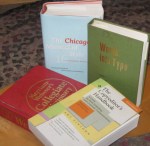
Some useful tools of the writer’s trade. They’re here to help you, not drive you huts.

Yes, you should learn the rules and conventions of whatever language(s) you’re writing in. Contrary to popular belief, these rules were not invented to drive students crazy. They’ve developed over time to facilitate communication between writers and readers. They’re tools. Tools are as important to writers as they are to carpenters and car mechanics. When a writer isn’t comfortable with a particular tool, awkwardness can result.

At the moment I’m copyediting a nonfiction book whose author seems uncomfortable with pronouns. Instead of writing “he” or “him,” “she” or “her,” he repeats the subject’s name — and to avoid repetitiousness he’ll use the first name here, the last name there, and sometimes a nickname if the subject has one. It took me a while to sort out which names belonged to the same person.

If used consciously, this technique can convey nuance and tone. You can refer to a person (including, need I say, a fictional character) by his or her last name in formal situations, then use the first name when s/he’s hanging out with friends. Switching from one to the other will then suggest to your alert readers what mode the person is operating in, what figurative hat s/he has on.

Don’t worry about finding your voice. You’ve already got one. Think of all the ways you use your speaking voice. You can SHOUT. You can whisper. You can sing. You can runwordstogether or you can pause. between. each. one. Addressing a group, you speak more carefully than you do when you’re talking with friends. Your author’s voice can be just as flexible and at the same time just as much you. Keep writing!


Writers’ Groups

Writers’ groups are like workshops, only less compressed and more ongoing. Writers’ groups are generally free. This is a big plus when you don’t have much in the way of disposable income. Unlike workshops and classes, they usually don’t have instructors. They may have a leader, official or unofficial, but that person’s job is generally to keep things on track, not to teach. In writers’ groups we learn from each other.

You may have had bad experiences in writers’ groups. If you hang out with other writers, you’ve almost certainly heard about a Writers’ Group from Hell. I know they’re out there.

Nevertheless, I’ve been in several writers’ groups over the years, formal and informal, and they’ve taught me a lot. If you aspire to write for an audience of more than one, i.e., yourself, a writers’ group can be beneficial in so many ways. Each meeting is a deadline for you to meet — very helpful if your writing is always taking a backseat to everything else going on in your life. The more work you share with other writers, the braver you’ll get about sharing your work. Other writers’ comments can help you see your own work from different angles — and your comments will help them likewise.

My first writers’ group included mostly poets and fiction writers, all women. Our numbers fluctuated, but there were about six regulars. At each meeting we’d talk about how our writerly lives were going and discuss the work of two or three members. Ideally we’d each get copies of our work to the others before the meeting, but this was long before email so this wasn’t always possible. Once we produced a potluck group reading in which more than 60 women crowded into a smallish community space to enjoy good food and good writing. This was the first public reading I’d ever done. It was wonderful.

A group I was in several years later usually met in the cozy kitchen of one of its members. The kitchen had a fireplace; except in the warmest weather, there’d usually be a fire going. We sat around the kitchen table, sipping coffee (and sometimes Black Bush whiskey), nibbling homemade chocolate chip cookies, and discussing our writing, which included short essays, one-act plays, memoir, and fiction.

At each meeting we’d do some freewriting, all with pen or pencil on paper. We took turns giving a starting word or phrase and setting a time limit — usually 10, 15, or 20 minutes. Then we’d read what we’d written aloud. We didn’t have to, but we nearly always did.

The group I’m in now meets weekly in the sitting room of its leader. She provides popcorn and beverages (usually wine, fruit juice, and water, with hot cider in season); members often contribute other goodies. At each meeting, we pass out copies of our work to everyone else and then read it aloud. As we listen, we mark our hardcopies — a check mark or “good!” for things that stand out, a question mark for things we find puzzling, perhaps an alternative word or wording if one pops into our heads. Then we discuss the work, and when everyone’s had their say, we pass the marked-up hardcopies back to the writer.

As you can see, writers’ groups vary a lot.  No one group is going to be everything to all its members. My current group doesn’t lend itself to in-depth critique: we’re all hearing each piece for the first time, and each piece gets about 20 minutes of our attention. Since most of us are writing book-length works — fiction, history, and memoir — we only see a small chunk of it each week. For comments on overall structure, we have to wait till we’ve finished a complete draft, then enlist volunteer readers or a professional editor to read the whole thing. But the weekly deadline has been invaluable, and so is reading my work aloud, and hearing others read theirs.

Yes, I have been in some groups that weren’t so helpful and that sooner or later fell apart. Keeping a group together is a group effort. I could go on, but instead I’ll quote from Marge Piercy’s poem “For the Young Who Want To”: “The real writer is one / who really writes.” If a group is monopolized by writers who talk incessantly about the writing they didn’t do, or were going to do, or mean to do before the next meeting, it will quickly become useless to the writers who are really writing.

So how to find a writers’ group? Libraries and bookstores are a good place to start looking. I know of groups that have spun off from adult ed classes: the course ended, but the writers decided to keep meeting on their own. If you can’t find one, or one that’s currently open to new members — it’s definitely possible for a group to get too big — try starting one. Start small, say with one or two or three writer friends.

And please share your experiences and tips in the comments!

Aside: “The Good, the Bad, and the Ugly, or How to Choose a Writers’ Group,” by the novelist and teacher Holly Lisle, is a wonderfully detailed guide, not just to choosing a group but for starting one.


Like Driving

As a kid I’d ride in the passenger’s seat and watch my mother’s hands on the steering wheel. They were always moving. How did she know when to move her hands? Driving, I thought, must be very difficult.

After I’d been behind the wheel myself a few times, I began to get it: You don’t move your hands on the wheel. The wheel moves your hands. Your hands respond to the road, the car, and what your eyes and other senses tell them.

True, your hands turn the wheel when you want to go left or right, but if you hold your hands still when you’re going down the road, you’ll probably start drifting to one side or the other.

In the last two months I’ve copyedited two demanding nonfiction manuscripts. One was 900 pages long, the other about 550. Yesterday morning I sent the second of the two off to its publisher.

I probably made thousands of editorial decisions for each of those books. Many were easy: insert a comma, remove a comma, correct the spelling of a misspelled word. If you stopped me in the middle of such insertions and deletions, I could explain without hesitation what I was doing and why I was doing it.

With many others, the explanation would take a moment or two. Here I changed “in a small number of instances” to “in a few instances.” Why? Because “instances” was more important than “number,” and we had no idea what that “small number” was. There I deleted “kind of” from “This kind of semi-prosperity.” My author was overly fond of “a number of,” “this kind of,” and “a sort of.” Sometimes they served a purpose. Sometimes they didn’t.

As I work, I make such decisions so quickly it feels as though the manuscript is telling me what to do. I just know. But an awful lot of experience goes into that knowing. That’s why, in retrospect, I can usually explain what I’ve done.

stetIt’s also why sometimes I’ll slam on the brakes a page or two after I’ve made one of those apparently instinctive changes, then go back and stet the author’s version. (“Stet” means “let it stand.” If a writer doesn’t agree with an editor’s change, she can stet the original.) While I’m editing along, evidently I’m also evaluating my editing. How do I do it? Damned if I know.

When I learned to drive, I was conscious of all the steps that went into making a smooth stop just a foot or two behind the car in front. Until I learned to judge distances, and to trust my judgment, I’d leave several feet between my bumper and the other car’s. It also took a while to learn to coordinate clutch and accelerator, especially on inclines. (I learned on a standard and that’s what I still drive.)

On the back roads, trees, curves, and bumps enforce the speed limit.

On the back roads, trees, curves, and bumps enforce the speed limit.

Of course I also learned the rules of the road, not just the written-down ones likely to be on the test but also the informal ones, like it’s usually safe to go five or so miles an hour over the speed limit and if an oncoming car flashes its headlights at you there’s a speed trap up ahead. If the vehicle ahead of you is poking along at ten mph under the speed limit, it may be looking for a crossroad, so be prepared for a sudden and unsignaled turn.

Editing works the same way. So does writing. So does every other skill I can think of. You learn the rules and conventions, they become second nature, then you start to improvise. If you leave the paved road, you don’t have to obey the traffic laws, but you better know know what your vehicle can handle and how to read the terrain. Otherwise you might wind up in a ditch, or worse.

Editing? What’s Editing?

Good question. If you ask half a dozen editors, you’ll get two dozen answers. What’s a writer to do?

grammar policeEditing and writing are closely related, but they aren’t the same. Writing creates something new. Editing rearranges, refines, and otherwise messes with something that’s already been created.

Notice that I’m sticking with the verbs here, rather than trying to define what writers do and what editors do. It’s more complicated than “writers write and editors edit.” Plenty of editors are also writers. Most writers do at least some editing: that’s what second, third, and tenth drafts are about.

I encourage writers to learn as much as they can about editing. It makes us better writers. It gives us more control of our work. It saves us money, because the more we can do ourselves, the less we have to pay others to do. And when the time comes to hire an editor, we’re better able to find one who will do justice to our work.

So what’s editing, beyond messing with something that’s already been written? Here’s where it can get confusing. “Editing” can involve anything from correcting typos and grammar gaffes to rearranging paragraphs and even helping a writer build a book from scratch. So we talk about “levels of editing.” Here’s a rough guide to the levels, starting with “big picture” editing and moving down to what I call the “picky bitch stage”: catching spelling and grammar errors.

Ghostwriting. Ghostwriting is writing, not editing. I include it because I’m not the only editor who’s heard this question: “I’ve got a great idea. Can you help me turn it into a book and we can share the royalties?” The answer is no. Ghostwriting is time-intensive and therefore costly. The chances that the resulting product will earn any royalties are close to nil. My standard answer is “Sell your proposal first and then we can talk.” None of the querents has ever come back.

Developmental editing. Like ghostwriting, this involves building the manuscript from the ground up. For big projects, like textbooks, it can involve multiple authors, researchers, designers, and more. For the individual writer, it’s all the work that goes into creating a coherent complete draft. Most of us do our own developmental editing, often with assistance from writers’ groups and those generous people who volunteer to read our work and give us feedback.

Rewriting. Most of us do our own rewriting too. From the individual writer’s point of view, it’s close kin to developmental editing.

Structural editing. The structure of a work is its skeleton. When the wrist bones are connected to the thigh bones, the body doesn’t work too well. All written works have structure. Structure is what guides readers through the story or the essay. When you decide that a scene in the middle of the book has to come near the beginning or a certain character’s motivation won’t make sense, you’re messing with the work’s structure.

typoStylistic editing. This is called all sorts of things, including content editing, line editing, and copyediting. Here you go through the work line by line, asking whether each sentence, phrase, and word says what you want it to say, and in the best way possible. English is a wonderfully flexible language. Choosing the right word and putting it in the right place can make a big difference. Writers’ groups and volunteer readers (aka “guinea pigs”) can be invaluable here. You know what you meant to say, but until you get feedback from readers it’s hard to know how well it’s coming across.

prooffreadingCopyediting. I hire out as a “copyeditor,” but my work includes plenty of stylistic editing so I have a hard time distinguishing one from the other. Let’s say here that copyediting focuses on the mechanics: spelling, punctuation, grammar, formatting, and the like. With nonfiction, it includes ensuring that footnotes and endnotes, bibliographies and reference lists, are accurate, consistent with each other, and properly formatted.

Proofreading. This level is the most mechanical of all. It means catching the errors that have slipped through despite all the writer’s and editor’s best efforts. (No matter how expert the writer and editor are, there will be errors. Trust me on this. I just caught one in this sentence. No, I won’t tell.)

The Editors’ Association of Canada has a handy page on its website: “Definitions of Editorial Skills.” Other organizations, publishers, and individual editors break the skills down differently, but this list gives a good idea of all the skills that are subsumed under “editing.” Not to worry: Unless you work on big, complex projects, you’re unlikely to need more than a few of them. If you do work on big, complex projects, your team probably has all the skills required, or knows where to find them.

Get Me Rewrite

Many writers hate rewriting. I love it. First-drafting is like breaking trail. Breaking trail is exhausting. (We’ve had a lot of snow this winter. My dog and I have broken a lot of trail. We’re both tired when we get home.)

Rewriting is more like pruning branches, tossing rocks out of the path, and notching trees to mark a trail. Even when it means rerouting a trail to avoid a fallen tree, I’d rather be rewriting than breaking trail.

For now I’m lumping editing and revising in with rewriting, even though they aren’t exactly the same thing. Rewriting means “messing with your first draft.” It can include anything from minor tweaks to a total overhaul.

If you hate rewriting, why should you do it? Good question. Maybe a better question is when should you do it? Not everything needs to be rewritten. Journal entries don’t. Freewriting exercises don’t. Most personal correspondence doesn’t — which is not to say that you shouldn’t reread the letter before you seal the envelope or the email before you hit Send. You should.

Irish playwright Richard Brinsley Sheridan nailed one of the whys with these much-quoted and -misquoted lines:

You write with ease, to shew your breeding;
But easy writing’s curst hard reading.

When you rewrite, you focus on your intended audience. That can be your boss, your publisher, your teacher, your writers’ group, your legion of fans — whoever you want your writing to reach. My audience includes myself. Yours probably does too. (I just learned from a Richard Nordquist column that Sheridan wrote “vile,” not “curst,” but I sort of like “curst” better.)

At the moment I’m taking a break from Squatters’ Speakeasy, the novel in progress, to work on an essay about The Sleepwalker, a statue whose temporary installation at Wellesley College is causing much discussion at Wellesley and elsewhere. No one’s waiting for this essay. I have no deadline and no length limit. I’m writing it because the placement of the statue raises several issues that have fascinated me for a long time, like risk and feminism and the purpose of art.

I’m writing primarily to clarify my own thinking, though if I can inspire other people to consider these issues from different angles, that’s more than OK with me. This purpose is what guides me as I rewrite.

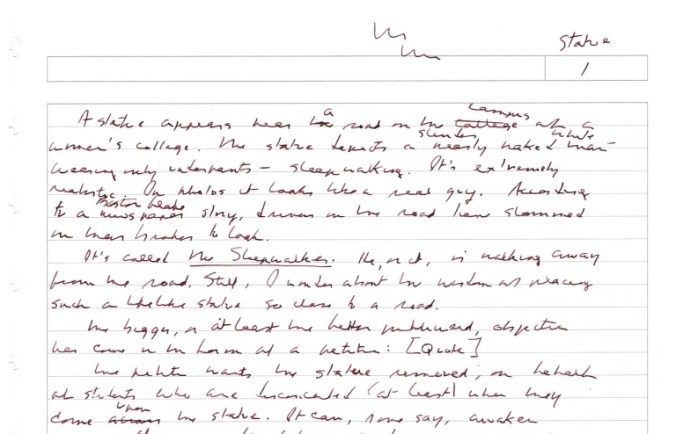
Here’s what the beginning of the first draft looked like:

statue ms

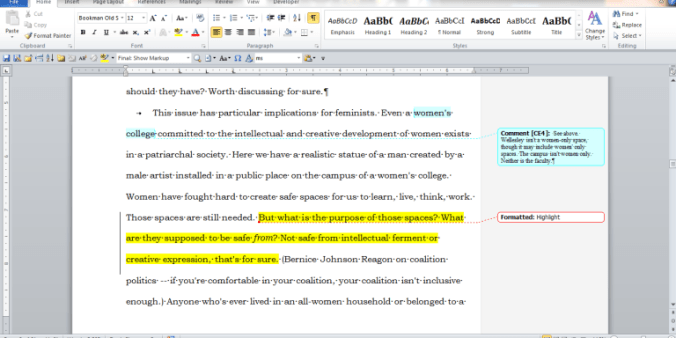
After 13 pages, I figured I had enough good raw material to proceed to the next draft. So I typed my handwritten pages into Word (Word 2010 on a Windows 7 laptop, for those who are wondering). The first two paragraphs look like this:

statue screenshot

The words are almost the same, but they look different, don’t they? Seeing those nice crisp letters, words, and paragraphs triggers my internal editor. At this point, I welcome her on board.

This draft is 21 pages long — considerably longer than its predecessor. At this stage the essay is still expanding. A phrase might trigger an elaboration or a detour: I go with it, not worrying about how it’s going to fit into the final version. At the same time, the internal editor is noting that a paragraph toward the end might be more effective near the beginning, and that I’ve discussed the same point in three different places — could they be consolidated?

Now I’m working on the third draft. My internal editor is having a field day. Word’s various features come in very, very handy. Internal editor is making comments for the writer to consider. She’s highlighting key phrases and sentences that will help structure the next draft. She’s also making additions and deletions, always with changes tracked. Nothing’s set in stone at this point. The writer likes how it looks.

statue screenshot 2

Editing

When I applied for my first editing job, I barely knew what an editor was. Editing was what I did to my own writing and what I did, as a clerical worker, to my various bosses’ memos, letters, and reports.

Historic photo of me, ca. 1980, in my editorial cubicle, American Red Cross publications office, Alexandria, Va.

Historic photo of me, ca. 1980, in my editorial cubicle, American Red Cross publications office, Alexandria, Va.

Once I was officially an editor, I learned that what editors did was not the same as what writers did.

All unwitting, I’d developed serious editorial skills because I thought they were skills that any writer had to have. This was a lucky break for me because in the 35 years since, I’ve mostly supported myself as an editor.

“Even a great writer needs a good editor. A good writer needs a great editor.” This adage circulates in various forms in the publishing world. In principle I agree. In real life, though, good editing isn’t all that easy to find or to recognize, and when you do find it, it’s not cheap. Editing is time-consuming. It can’t be automated or mass-produced. Editors get paid considerably less per hour than mechanics, plumbers, accountants, or lawyers — where I live, house cleaning pays better than editing — but for book-length manuscripts the hours add up.

Whatever money you spend on good editing is money well spent. (It’s not just the editor in me that says that.) Likewise, the time you spend learning to edit your own work is time well spent. When you get to the point where you can’t go any further, and definitely when you’re thinking about either self-publishing or submitting your manuscript for publication, that’s the time to hire a pro.

So, you say, how do I learn to edit my own work?

I’ve got some ideas. I bet you do too. We’ll be talking a lot about this in Write Through It.