Letting Go, Take 2


An editor colleague just asked what to do about a client who’s written a very good novel but wants to keep revising and revising and won’t start querying agents or publishers.

There’s not much you can do, I said.

Aside: “Letting Go,” take 1, was prompted by a similar query. It took off in a somewhat different direction. I suspect that writers and editors never stop dealing with this stuff.

The word “perfectionism” came up.

As a recovering perfectionist — often a recovering-by-the-skin-of-my-teeth perfectionist who wonders if she’s recovering at all — I know a few things about this. Perfectionism can mean that everything you do has to be perfect before you’ll let it out of your sight, but it can and often does mean more than that. Perfectionism is a way of maintaining control. If I do everything right, I won’t get fired, my lover won’t leave, my kids will turn out perfect, and my novel will get made into a top-grossing movie and the world will swoon at my feet.

It often doesn’t work out that way. Deep down we perfectionists suspect this. Deep down we know that once something leaves our hands, the outcome is out of our control. So we don’t let it go.

Which is what I suspect is going on with the novelist who can’t stop revising, mainly because I’ve known many writers over the years who can’t let go of their work. They tell themselves the work isn’t done — they need to do more research, or do one more draft — and nothing anyone tells them can persuade them otherwise. The problem isn’t that the work isn’t done, it’s that the word “done” isn’t in the writer’s vocabulary because “done” means s/he has to let go.

For writers, here is where it gets tricky. Letting go means you’re putting the outcome in the hands of person(s) unknown. Persons who don’t know you and don’t have any particular reason to wish you well — unless, of course, you’ve produced the sort of work that might make lots of money. The overwhelming majority of us have not done this. Competent agents agree to represent only a small fraction of the manuscripts they see. Many of the ones they reject are very good or better.

In other words, if “failure” to you means rejection by an agent, or by a dozen or a hundred agents, your fear of failure is completely justified.

So is your fear of success. Fear of success is the flip side of fear of failure. They both have deep roots in the fear of letting go. Say you do get an agent, the agent sells your book, and there’s actually a book on the market that has your name on the cover. To you it’s a huge deal, as it should be, but most of the world — including your friends, relatives, and casual acquaintances — is going to say, at best, “That’s nice,” and move on.

Am I telling you to give up? Of course not. Read on.

Here’s a little parable: A kid finds a new butterfly struggling to get out of its chrysalis. The kid pulls the chrysalis apart and helps the butterfly get out. But the butterfly’s wings aren’t fully developed. It cannot fly. Moral of story: It’s the struggle to get out of the chrysalis that strengthens the butterfly’s wings so it can fly.

I like this little parable even though some people turn it into a rationale for never helping anybody out. I like it because it applies so well to writing and other creative endeavors. In the struggle to create, we not only become good writers, we also figure out what we want to do with our writing. We create a path forward for ourselves and develop the courage to follow it.

For many of us, this involves seeking out and sharing experiences with other writers. We become better writers, yes, but we also develop two crucial skills: the ability to dissociate ourselves from our creations, and the ability to sort through other people’s comments, edits, and critiques and decide what works for us. In the process, we learn about the many options for getting our work out into the world.

To complete a book-length work without doing this — well, it’s like finding that the road you’ve been on for years ends in a precipitous drop. Or maybe like opening the door from your dark room and being blinded by the light outside.

The very first line of this blog, back in “The Basics,” was “Your writing will teach you what you need to know.”

I believe it.

In that same post, I quoted two of the truest things I’ve ever heard about writing. I believe them too. Here they are again.

”I think writing really helps you heal yourself. I think if you write long enough, you will be a healthy person. That is, if you write what you need to write, as opposed to what will make money, or what will make fame.”
Alice Walker

The real writer is one
who really writes. Talent
is an invention like phlogiston
after the fact of fire.
Marge Piercy

Joan Didion’s Cure for Bankrupt Mornings

Serendipity rules: I read this while I was working on “Restarting.” These days I don’t keep a notebook, but opening the work in progress seems to fill a similar function. Whatever works!

Restarting

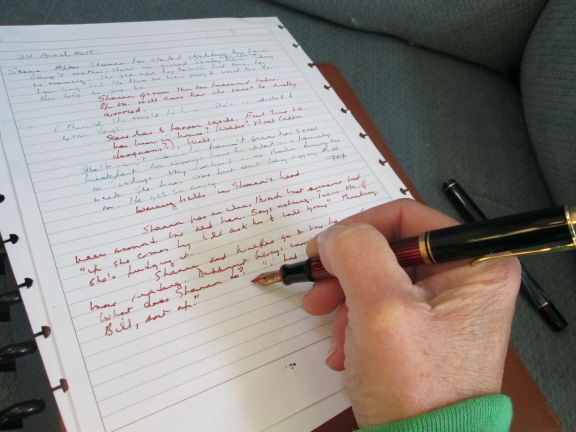
I can revise, rewrite, and edit pretty much any time I’m awake, but for writing, especially early-draft writing, especially writing long and scary projects (like Wolfie, my novel in progress), I’m best in the morning, in the hour or two or three after I wake up.

I’m braver in the morning. I’m less easily distracted by the voices chattering inside my head and by whatever I’m supposed to do that day.

For several recent weeks my early-morning writing time was taken up by work, editing for pay and on deadline — my livelihood.

Another thing: When I’m working on a long and scary project, my mind is usually mulling it over while I’m out walking with my dog, or dropping off to sleep at night, or waking up in the morning. Mental logjams break up when I’m nowhere near my pens or my laptop.

During those several recent weeks, the jobs I was working on took up semi-permanent residence in my head. That’s what my mind kept mulling when I was out walking, or driving, or dropping off to sleep.

Blank paper is scary, but it's full of potential. (That's the scary part.)

Blank paper is scary, but it’s full of potential. (That’s the scary part.)

In short, for about three weeks I did no work on the novel. I barely even blogged.

How to get back in the groove?

Starting is easy (ha ha ha). Blank pages are scary but they’re full of potential.

I’d recently started a second draft. The not-quite complete first draft is more than 225 pages long. (First draft = first draft prime: the real first draft is in longhand, and I always do a little revising as I’m typing it into Word.) When I tried to recall it, it was like looking through the wrong end of a telescope.

More to the point, I was sure that if I actually looked at it, I would realize it was crap. I have had this problem before. It’s why when I’m working on a long and scary project I look at it every day. Five minutes is enough. I don’t have to write anything. I just have to open the file and look at it.

Once I’ve opened it, I always find something to fiddle with, and after I’ve done a little fiddling, I nearly always write something new.

Wolfie‘s title character is a dog. So far the only cat in the story is Schrödinger’s, and of course I don’t know if that cat is alive or dead, real or unreal. Schrödinger’s famous thought experiment hypothesized a cat in a closed box with a vial of lethal radioactive material. The vial may or may not have broken; the cat may be alive or dead. I, outside the box, don’t know what has happened inside the box until I open it. Is the cat alive or dead?

I, sitting at my laptop, am dead certain the novel in progress is crap. If I actually look at it, I will know for sure it is crap and then what will I do with the rest of my life?

But it never works that way. It’s always

looking -> fiddling -> writing

After I’d read a few pages of my second draft, the seed of a new scene took root in my head. The scene comes much later in the novel. I sketched it out in longhand then went back to reading.

So why the dead certainty that the writing has turned to crap in my absence? Interesting question, but it’s going to have to wait. I’m writing.

The moving hand writes and a scene takes root.

The moving hand writes and a scene takes root.


On to Draft 2!

This past weekend I took a very deep breath and started draft 2 of Wolfie, my novel in progress.

The time had come.

I like to take a break between drafts. The longer the work, the longer the break, which means that with a novel or a long essay it can be a few weeks. This time I didn’t exactly take the break: the break took me. In late January I suspended work on the novel to focus my attention on a long, challenging editing job with an impending deadline. That deadline met, I turned to a review assignment whose deadine was also impending. I’d read the book and been thinking about it for weeks, but now I had to write the review. (For some thoughts about reviewing see “Reviewing Isn’t Easy.”)

Wolfie was never far from my mind. To push on with the first draft or to start the second? That was the question.

Draft 1 wasn’t complete. The Word file stood at 227 pages, almost 55,000 words, with a dozen or so handwritten pages yet to be transcribed. I had a pretty good idea of where things were headed. I probably could have forged on through climax to conclusion and then started the second draft . . .

The trouble was, a couple of significant plot threads have only come clear during the writing. One is hinted at in draft 1 but only sketchily developed. The other comes as a backstory dump in the handwritten pages I haven’t transcribed yet. It needs to start much earlier and be woven into the story.

Over the last year I’ve been taking Wolfie installments to my Sunday night writers’ group. This is a first for me. Usually I don’t let anything out in public until it’s in second or third draft — when I’ve gone as far as I can on my own and need some outside eyes. With Wolfie, though, the weekly deadline and my group’s encouragement have kept me going.

So — should I push on and bring the final chapters one by one to the group, explaining that the backstory to this or that wasn’t set up yet and they’d have to wait for the second draft to understand what was going on? I didn’t like that idea at all. I want the writing to stand on its own.

Maybe more important, I don’t really know how those last chapters are going to unfold. It’s going to depend in part on what my characters do and say in the parts I haven’t written yet, and I won’t know that until I’ve written them.

So I opened draft1.doc and saved it as draft2.doc.

old chap 1

Then I deleted Chapter One. It was an experiment that didn’t work out. The tall man is still in the story, but he doesn’t live in that house anymore. He’s no longer a viewpoint character either.

So far, so good. For me revision is usually about 80 percent cutting and rearranging what’s already there. Chapter Two from draft 1 is now Chapter One in draft 2.

new chap 1

My recollection was that this chapter didn’t need much work. It does a pretty good job of introducing one of the two viewpoint characters: Glory, a sixth-grade girl. What I’d forgotten was that somewhere along the way I’d shifted Glory’s sections from past tense to present, but her introduction is still in past tense.

And I’m still not 100 percent sure that present tense is the way to go. Rather than rewrite it now, I made a note in the margin. The muses haven’t given me a clear answer on that one yet.

For the new Chapter Two, I’ve gone back to writing in longhand. The story itself isn’t going to change much, but I need a new way into it — a way that hints at some of the things I didn’t know when I wrote it the first time. What this means is that with Wolfie second-drafting is going to look more like first-drafting than it usually does. It’s going to involve plenty of exploring, digging, and otherwise adding new stuff — writing, in other words.

Travvy

Travvy, on whom Wolfie’s title character is based, takes a break from digging in the snow.

For me, editing is relatively easy. The writing tells me what has to be done, and I do it.

Writing is more like breaking trail through two feet of snow. My dog and I have done a lot of that lately. It’s exhausting, and it takes longer to get anywhere than it does when we’re walking on good old dirt.

But second-drafting already seems less daunting than starting from scratch. This time around my characters are helping — some of them more than others, of course — and so is the story. If I listen carefully, I can hear what’s not being said. I can visualize the scenes that need to be there that aren’t there yet.

My writing will teach me what I need to know if only I keep writing.

Why I Always Read the Acknowledgments

As an editor, I work mostly on completed or nearly completed manuscripts. I straighten out the punctuation here, insert a paragraph break there, invert a couple of sentences here, point out an inconsistency there . . . It’s all in a day’s work.

What I seldom think about is what an astonishing feat it is to complete a 300- or 400- or 600-page manuscript of any kind, to get it to the point where pretty much all it needs is fine-tuning.

As a writer, however, I think about this all the time. It’s the reason the subtitle of Write Through It includes “how to keep going.”

If you don’t manage to keep going, you’ll never have a completed manuscript. It’s hard to keep going. It’s so easy to stop — or to not start at all.

And the authors of all those completed or nearly completed manuscripts managed to do it. Hats off to all of them — all of us. How the hell do we do it?

This is why I eventually turn to the acknowledgments section of every book I work on and every book I read. It’s not so I can find out if my name is there, although sometimes it is. What I want to know is how the author managed to accomplish this amazing thing: completing a manuscript and getting it into print.

Lesson #1: No writer who gets anywhere gets there alone.

Most authors thank their editor(s), agent (if any), and, often, the designer, proofreader, and others involved on the production end. They may thank the parents and teachers who inspired them, and the partners and children who put up with them while they worked on the book. Both fiction and nonfiction writers often acknowledge those who read, commented on, or critiqued various drafts of the manuscript. With academic authors, the list of names can be quite long — and readers familiar with the field will often skim that list in an attempt to ascertain whether the author has done her homework.

Fiction writers often include the friends and acquaintances who gave them crash courses on police procedures, quantum theory, dog training, life in an urban hospital’s ER . . . Writing what we know usually leads us into stuff we don’t know, and there we need some help.

I recently edited a university-press book whose author had done extensive research in several languages and far-flung places. Her acknowledgments section included the people who’d opened their homes to her while she was on the road. I loved it.

Moral of story: Don’t get too caught up in this writing-is-a-solitary-endeavor thing. You may be alone when you write, but you’re not writing in isolation.


Wrung Out

The end of draft #1 of novel #2 is in sight. Not close exactly, but I can see it on the horizon. Plot lines are converging. Things are getting, shall we say, tense.

For instance — two main characters meet by chance in a hardware store. They’re kibitzing about the complexities of modern lightbulbs, though neither one is all that fascinated by lightbulbs. Amira notices that Shannon looks preoccupied. A few moments later Shannon blurts out that she’s just had bad news.

The hardware store aisle isn’t a good place to have this conversation, so they adjourn to a nearby café for coffee (Shannon) and lunch (Amira).

This is the scene I wrote this morning.

Shannon has just learned that her dog has inoperable cancer. She is starting to beat herself up about her failure to (a) notice this earlier, and (b) prevent it.

Amira doesn’t want Shannon to go there. She recounts the story of how her father, visiting his other daughter and her family in Florida, went to the neighborhood convenience store with his four-year-old niece riding on his shoulders. A robbery was in progress. The robbers run out shooting; the niece is hit and dies two days later. Amira’s father never stopped beating himself up with what ifs and if onlys. He has since died.

Amira started down the what if / if only road herself but friends helped pull her back to the land of the living.

I knew this scene was coming but I didn’t know how or where it was going to happen.

I was totally wrung out when I laid my pen down this morning. Could not write another word. So Travvy and I went for our morning walk. With sunshine, brisk air, and steady steps my energy returned. It always does.

It can be scary to look down the road and see that the writing is leading you toward a scene that’s going to wring you out. I’ve been known to do other things — aka “procrastinate” — until I feel ready, even though I never feel entirely ready. Just ready enough.

But those wrung-out moments tell me that I’ve been writing well, and true, and deep. My pen has tapped into something I can’t reach any other way.

Listen to Those Blocks

Creative blocks in rearrangement mode

Creative blocks in rearrangement mode

Ever notice how most of the stuff you learn about writing is stuff you already know?

I’m not talking primarily about grammar, punctuation, spelling, and all the nuts-and-bolts basics. I’m talking about the “how to keep going” part.

Last winter the novel I was working on, The Squatters’ Speakeasy, wasn’t coalescing or developing any momentum. I wouldn’t say I was blocked exactly, but the writing sure got sludgy. I procrastinated a lot before I sat down to write, and fidgeted a lot when I got there.

I also started this blog, and wrote an essay about a controversial statue that was in the news at the time. As I blogged back in April, in “Course Correction”:

 When I got up in the morning, I couldn’t wait to sit down in my chair and start writing. I finished the essay. I kept going with the blog. Whenever I thought about waking Squatters from its winter snooze, I was overcome by an irresistible urge to play endless games of Spider solitaire.

Procrastination was trying to tell me something. Finally I got the message. I put Squatters aside. About a year before I’d written a scene about a dog named Wolfie, a kid named Glory, and Shannon, a character from my first novel, The Mud of the Place. It didn’t fit in Squatters, so I put it aside. Now I pulled it back onto my lap and had another look. My imagination woke up.

Long story short: This blog now has more than a thousand followers. The novel, working title: Wolfie, passed the 50,000-word mark three days ago.

Here comes the bit about how writers keep learning what we already know.

Or, to put it in a slightly less flattering light: “Insanity is doing the same thing over and over again and expecting different results.” However, for some strange reason, it’s always easier to catch your friends doing the same thing over and over again than it is to realize that you’re up to your old tricks again.

Who, me?

Short version: My other blog, From the Seasonally Occupied Territories, was wilting. Running out of steam. I was thinking of wrapping it up, or at least putting it in the indefinite deep freeze. At the same time, there were so many things I wanted to write about that I was thinking of starting another blog.

Sheesh. When I type that, it looks so obvious. I really must have been nuts or in denial or just plain dense not to see that I could do the writing I wanted to do in From the Seasonally Occupied Territories.

If you’re curious about the longer version, you can read it here.

Writers talk about writer’s blocks and procrastination all the time. Most of us have at least a passing acquaintance with both. Many of us have had long-term relationships with one or the other. We dread them, we hate them, we do endless rituals to keep them at bay.

I’m here to remind you — because I know you know this already — that often the blocks and the procrastination are trying to tell you something. Sometimes the back-seat driver is right: Either you’ve missed a turn or you’ve taken one you didn’t want.

The road you want is the one that keeps your pen moving across the paper or your fingers on the keyboard.

Creative blocks, rearranged

Creative blocks, rearranged

Got a Question?

Got a question about writing or editing? Or a suggestion for a topic you’d like to see discussed? Or a topic you’d like to write a guest post on? Use this contact form to send it in! (The You! page on the menu bar contains a contact form too. It’s lonely. Please feel free to pay it a visit any time, day or night.)

← Back

Thank you for your response. ✨


Word Count: Zero

If you’re currently in the throes of NaNoWriMo, you might want to put off reading this post till the middle of next month. If you aren’t, or if you don’t know what NaNoWriMo is, read on.

OTOH, if you are in the throes of NaNoWriMo, what are you doing here in the first place? Maybe you should stick around.

Here’s the shocking truth: I didn’t write any words this morning. Well, OK, I scribbled some words on pages of notes that had already been scribbled on, but really — I didn’t write any words this morning.

My chair

I’ve blogged about how I don’t measure my progress or a day’s success by the number of words I’ve written. This is true. All the same, writing no words is a little scary, especially when I want to have a few pages to take to my writers’ group meeting on Sunday night. Right now I’ve got nothing.

What I did this morning was sit in my writing chair for an hour and a quarter. To my right, three candles were burning. (Usually it’s just two. This morning I needed all three.) To my left, eight pens were at the ready. My laptop was on the floor, still asleep.

A few days ago, Wolfie, my novel in progress, came to a crossroad. Shannon, my protagonist, had just made a big decision — the one it took lots of red ink to get to. She had no idea what happened next.

Neither did I. This was a problem.

Since I’ve got some experience in community theater, when writing fiction I tend to see myself as the stage manager. My characters move around on the stage. I write down what they do and say. Once in a while, I need to prompt one actor, or summon another who’s lollygagging backstage. Then they take over and I go back to transcribing.

Not this time. This time they were standing around waiting for me to tell them what to do.

I have a pretty good idea what’s going to happen. What I didn’t know was how to get my cast of characters moving in a direction that would bring it — or something like it — to pass. I was staring at a big logjam on the river. Nothing was moving.

Little heap of wood

Little heap of wood

I sat in my chair, reread my notes, scribbled some words here and there.

The logjam in my head morphed into a big pile of cut and split logs, like the ones the wood guy would dump in my yard during the years I was heating with a wood stove.

Being a writer and thus wise in the ways of procrastination, I got it. Anne Lamott nailed it in her classic Bird by Bird: Some Instructions on Writing and Life. How do you accomplish a huge project whose boundaries you can’t see, whose completion you can’t imagine? Bird by bird. Word by word. Or, in my case, log by log.

Once I realized that I had to start somewhere, it didn’t really matter where I started. Pick a log, any log.

Turned out I’d known all along what log to start with. After the events that had transpired in the previous twenty-four hours (novel time), the next move was clearly Shannon’s. Well, now it was clearly Shannon’s move. I’d known all along that Shannon had to make a couple of phone calls, but the Internal Editor assured me that this wasn’t enough. How could a couple of phone calls break up that humongous logjam?

Travvy on a mission

Travvy on a mission

By this time it was 8:30 a.m. Time to get out of the chair and go walking with Travvy, my canine companion, on whom Wolfie is based. As I pulled on my socks and hiking shoes, donned vest and cap, and put Travvy’s walking harness on, Shannon was making her phone calls — and lo, the rest of her day lay like a path in front of me, leading toward the plotwise thicket that I knew was up ahead.

Word count: zero, but a breakthrough day nonetheless.

Counting words obviously works for some writers, at least some of the time. For me, the secret is usually to sit down for at least an hour and don’t fidget. I’m writing even if I’m not writing, as long as I’m not balancing my checkbook, answering email, playing on Facebook, or brushing the dog.

Go to the chair. Sit. Rustle papers, scribble words, focus on the work. If the path doesn’t open up today, do the same thing tomorrow.


20141121 woodpile 1


Some Blogs I Like

My m/other blog, my first blog, From the Seasonally Occupied Territories, is read mostly by non-bloggers. Soon after I launched this blog last winter, it started attracting followers who had blogs of their own. Before the end of its second month, Write Through It was Freshly Pressed — featured in WordPress’s ongoing “best of WordPress” feature.

Wow.

I tried to check out the blogs of every blogger who followed Write Through It and every blog that was Freshly Pressed. I was quickly overwhelmed. I cut back and cut back and cut back some more. I still subscribe to more blogs than I can keep up with. All I can say is — there’s an awful lot of good stuff out there.

Several bloggers have nominated Write Through It for various blogging awards or otherwise let me know that they like this blog. Thanks especially to creativewriter, Tempest Rose of Nonsense & Shenanigans, and Susan J. Kroupa.

Rather than nominate other bloggers for awards, I’m listing here a few blogs that I like, along with a few words about why I like them. Not only do I read them regularly, they help keep me going — which is one of the things Write Through It is about. This is nowhere close to an exhaustive list, and it won’t be my last list either. Be warned.

In no particular order:

Off the Beaten Path: Hikes, Backpacks, and Travels: Westerner54, aka Cindy, shares her hikes and travels in glorious photographs and commentary. She’s based in Montana and roams through areas where I’ve never been and probably never will go. (Maybe it’s because I live on Martha’s Vineyard, maximum elevation about 350 feet, but I’m awestruck by mountains.) She shares her knowledge of the places, the flora, and fauna, and her love of the places she visits is contagious.

Speaking of place, the blogger behind Cochin Blogger lives in Kerala, India. His photos, vignettes, and occasional book reviews offer an ongoing introduction to another place I’ll probably never get to.

In Across the Great Dividejournalist Charlie Quimby blogs (all too infrequently these days) about volunteering in a homeless shelter’s preschool. His wonderful first novel, Monument Road, was published late last year. Its vividly evoked characters shape and (more often) are shaped by the less-than-hospitable place they live in — western Colorado.

You may notice a theme emerging here. I’m drawn to blogs that pull me into places and lives I don’t live. This is also true of Charlotte Hoather’s blog. Charlotte is a young woman training to be a classical singer at the Royal Conservatoire of Scotland and aspiring to go on to opera school. She’s got a glorious voice, writes wonderfully, and takes great photos of the places she visits and performers. She recently released a recording of some favorite songs. Of course I bought and downloaded it. It’s excellent.

How to describe Nonsense & Shenanigans? Let’s see: Tempest Rose blogs about daily life, the universe, and being the bipolar (maybe) mother of a young son whose father is in prison. She’s observant, honest, witty, snarky, provocative, and fun. She’s also incredibly prolific. No way I can keep up with her, but I jump into her swift-flowing stream pretty often and always come out refreshed and inspired.

Evelyne Holingue is a French-American writer who blogs about writing, publishing, and traveling, among other things. She’s particularly attentive to the ways cultures and mores combine and collide, a topic that fascinates me too. This is a main theme of her brand-new YA novel, Chronicles from Château Moines, which I’ve just downloaded and started to read. It’s about a California middle-school student who moves to Normandy and has to make a life for himself in a new country and a language he isn’t quite fluent in. Evelyne blogs in both English and French. The French I read slowly and with dictionary at the ready, but it’s one of the attractions of this lively and wonderfully written blog.

And, finally, the Writer Site blog also focuses — surprise, surprise! — on writing, particularly memoir. Blogger Luanne reviews memoirs and is working on one of her own. She blogs about writing, publishing, and other aspects of a writer’s life — and very well too.