Stretching

The nice thing about poetry is that you’re always stretching the definitions of words. Lawyers and scientists and scholars of one sort or another try to restrict the definitions, hoping that they can prevent people from fooling each other. But that doesn’t stop people from lying.

Cezanne painted a red barn by painting it ten shades of color: purple to yellow. And he got a red barn. Similarly, a poet will describe things many different ways, circling around it, to get to the truth.

—  Pete Seeger

I love this quote. Once upon a time poetry was one of my two word mediums. (Nonfiction was the other.) I loved working with traditional forms, especially sonnets, villanelles, and sestinas. They taught me to listen to the words, to say them out loud. Every word had to count, and I had to trust each word to do its job, all the while knowing that I couldn’t control exactly what it did once I let it go.

Gradually my lines got longer and longer. One multi-voice poem turned into a one-act play. From plays I slowly eased into fiction, though I’ve never ceased to think of myself as primarily a nonfiction writer.

It’s been a very long time since I tried to write a poem, but every day I draw on what writing poetry taught me: to listen to the words, to play with them, to let them play with each other.

Am I still “stretching the definitions of words”? Probably not. An essay can include many hundreds of words, a novel many thousands. Too much stretchiness causes ambiguity, which is fine in a work short enough to be read and reread several times but not so fine in a long work whose readers may accept the occasional detour but still expect forward motion.

Still, I do plenty of circling around in both fiction and nonfiction, less with the words themselves than with the images and scenes I create with them. They blend and they clash, they resonate and dissonate. (Two dictionaries think I made “dissonate” up — maybe I’m stretching words after all.) Sometimes they startle me.

Wrote Emily Dickinson, a master of the poet’s art:

Tell all the truth but tell it slant —
Success in Circuit lies

Perhaps the truth really is too blinding to be faced directly. I have no idea. I’ll let you know when I find it. For now, exquisite precision doesn’t seem to be getting me any closer, so I’m putting my faith in slant and indirection.

Chicago Style

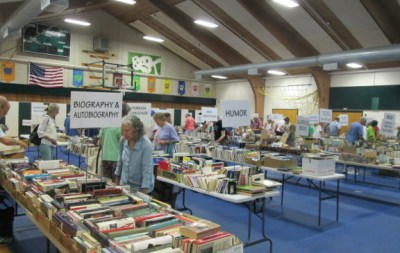
My library’s annual monster book sale was last weekend. Of course I went. Of course I came home with a stack of books, and all for $10.

The book sale takes place in the elementary school gym. All the sorting and shelving is done by volunteers.

The book sale takes place in the elementary school gym. All the sorting and shelving is done by volunteers.

The book sale is a browser’s heaven: tables and tables of books sorted, and occasionally mis-sorted, into general categories, and many with more books in the boxes underneath. I rarely go with a particular book in mind. I always find books I didn’t know I was looking for.

Or they find me.

Browsers cheerfully recommend books to total strangers, and sometimes get into spirited conversations about books they liked or books they thought were overrated. I was poring over one of the history-related tables, head cocked sideways so I could read the spines, when the fellow to my right handed a book to the fellow on my left. The book passing in front of me was The Chicago Manual of Style.

“Are you interested in this?” asked the fellow on the right, who I guessed (correctly) was the father of the fellow on the left.

My constant editorial companions. Clockwise from top: The Chicago Manual of Style, Words into Type, Amy Einsohn's Copyeditor's Handbook, and Merriam-Webster's Collegiate Dictionary.

My constant editorial companions. Clockwise from top: The Chicago Manual of Style, Words into Type, Amy Einsohn’s Copyeditor’s Handbook, and Merriam-Webster’s Collegiate Dictionary.

I’ve been on first-name terms with Chicago since 1979, when it was still called A Manual of Style. Could I remain silent while my old buddy and sometime nemesis changed hands right before my eyes? I could not. “That’s the current edition,” I said. “I’ve got it at home. I’m an editor by trade.”

Dad let on that Son was an aspiring writer. Son seemed a little uneasy with the description. “If you have any interest in mainstream publishing,” I said, “that’s a very  good book to have.”

I don’t know whether they bought it or not, or what they paid for it. It was half-price day at the book sale, so probably not more than a buck or two. But if you have any interest in mainstream publishing, especially in the U.S., it is a very good book to have. Or you can subscribe to the online edition for $35 a year.

In U.S. trade and academic publishing, The Chicago Manual of Style is something of a bible. It contains almost everything writers and editors need to know about book publishing, along with extensive recommendations for further reading in various areas. It includes chapters on grammar, usage, and punctuation. At least half of its 1,026 pages are devoted — as its title might suggest — to style. 

What is “style”? Think of all the myriad choices you make when you’re writing and especially when you’re editing your own work, about capitalization and hyphenation, about the use of quotation marks, boldface, and italics. How to treat titles of movies or titles of songs, and words from other languages, and the English translations of those words. And on and on and on. Style comprises all the decisions made about how to handle these things. “Chicago style” is a collection of particular recommendations. If you italicize book titles and put song titles in quotes, you’re following Chicago style, maybe without knowing it.

Much of the nit-pickery that goes into copyediting is about style. Confronted with the plethora of details that go into Chicago style, or Associated Press (AP) style (widely used by newspapers and periodicals), or American Psychological Association (APA) style (widely used in academic writing, especially the social sciences), the novice writer or editor may find it hard to believe that applying a particular style makes things easier — but it does. Every time I embark on editing a long bibliography, I am profoundly grateful to Chicago for its documentation style and to the authors who apply it consistently. I would hate to have to learn or invent a new documentation style for every bibliography I work on.

That goes for other aspects of style too. Following a style guide in effect automates the minute details and frees your mind to deal with the more interesting stuff like word choice and sentence structure and transitions between paragraphs.

The Chicago Manual of Style came into existence early in the 20th century as the style guide for the University of Chicago Press. Then as now, the press specialized in scholarly works, and the early editions of its style guide reflected that. Now it’s widely used by trade publishers, independent publishers, and self-publishers as well as academic presses.

What this means in practice is that not all of its recommendations are well suited to every type of book, and the further one gets from scholarly nonfiction — say, into the realms of fiction and memoir — the more cause one is likely to have for ignoring some recommendations and improvising on others. This is fine with Chicago‘s compilers but not so fine with some copyeditors, who treat the book’s style recommendations as Rules That Must Be Obeyed.

I think of them as Conventions That Should Be Respected, and Generally Followed in the Absence of a Sensible Alternative. I also advise serious writers to introduce themselves to Chicago style and even get to know it. Automate the petty details and you can focus your attention on the big stuff. You’re also more likely to win an argument with a stubborn copyeditor.

Readers’ Challenge

Charles French nominated me for a “readers’ challenge” award. The whole award thing in the blogosphere is a little weird. As far as I can tell, it’s circle-jerkery, with people nominating each other for awards and some people crowing about every award they get nominated for. I am intimidated by how many blogs some of these people follow. Don’t they have lives? Don’t they have jobs? When do the writers among them do their writing?

To hell with that. I like Charles French’s blog on reading, writing, and teaching, and just as important, the questions in this challenge/survey interest me, mainly because I don’t think they were directed at people like me who are in the word trades and don’t read all that much on the side. So here goes.
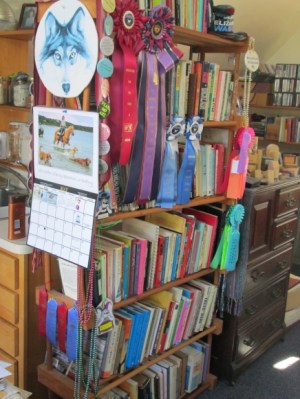
One of my two big bookshelves, freshly culled, dusted, and reorganized, and garnished with a few of my dog's Rally Obedience title ribbons.

One of my two big bookshelves, freshly culled, dusted, and reorganized, and garnished with a few of my dog’s Rally Obedience title ribbons.

You have 20,000 books on your TBR. How in the world do you decide what to read next?

No way in a million years I would ever have 20,000 books on my to-be-read list. I do have a dozen or so hardcopy books on the shelves at the head of my bed and several more on my Nook. How do I decide? Partly it’s what grabs my attention at the moment. If someone I respect recommends a book, it goes to the top of the list. I’m usually reading two or three books at once, but since I do most of my reading in the 20 or so minutes before I fall asleep, I don’t get through them very fast.


You’re halfway through a book and you’re just not loving it. Do you quit or commit?

Quit. Life is too short to waste one’s time reading crappy books. At the moment I’m about halfway through a nonfiction book that I expected great things of. I semi-promised to review it in my Martha’s Vineyard blog, From the Seasonally Occupied Territories. I’m probably going to skim through the rest and bail. No idea how I’m going to review it, because it’s very relevant to that particular blog and because the whys and wherefores of its failures are worth discussing.

I’m an editor by trade. When I start editing while I’m reading, it usually means that something has gone off the rails. This is the case with the nonfiction book I’m reading now. Where was the editor? I wonder. There probably wasn’t one, even though the publisher is legit and shows up fairly often in the bibliographies of books I copyedit. It’s two or three drafts short of done, and the factual errors are glaring and could have been prevented.

The end of the year is coming and you’re so close yet so far away on your GoodReads challenge. Do you quit or commit?

I dabble on GoodReads, but I don’t commit to anything.

The covers of a series you love DO. NOT. MATCH. How do you cope?

Well, I rarely read more than one book in a series, so I doubt I’d notice. If the series is good enough that I read more than one, I probably would have forgotten the cover of the first by the time I started the second. Here’s an interesting question: If books in a series were routinely marketed with non-matching covers and nothing to indicate that they’re part of a series, would anyone pick them up and read them?

Everyone and their mother loves a book you really don’t like. Who do you bond with over shared feelings?

I’m rarely reading what everyone else is reading at the same time they’re reading it. If I read it, it’s five years after they’ve forgotten it. So this doesn’t come up often. Sometimes, though, I’ll hear someone say that a book I didn’t like was overrated. I’ll jump in with a “Same here!” and if it leads to further discussion, so much the better. Ditto when someone says she loved a book that I think was widely overlooked. Bonding is good.

You’re reading a book and you’re about to start crying in public. How do you deal?

Doesn’t bother me at all. The big problem is that I rarely have a hanky handy, so I have to use my sleeve.

A sequel of a book you loved just came out, but you’ve forgotten a lot from the prior novel. Will you re-read the book? Skip the sequel? Try to find a summary on GoodReads? Cry in frustration?

If I really like a book, I’ll probably avoid any sequels unless I’m assured through the grapevine that the sequel is worthy of the original. If I’ve already forgotten a lot from the original, it probably wasn’t all that great. A good book stands on its own even if it’s a sequel or part of a series. In other words, I won’t worry about it.

You don’t want ANYONE borrowing your books. How do you politely tell people “nope” when they ask?

I no longer lend out books that have particular meaning to me, especially when they’ve been inscribed by the author, but I’m more than willing to lend anything else to anyone who asks. I live in a studio apartment. I frequently cull my shelves and donate the good stuff to my town library’s annual book sale. Good books are happier circulating than gathering dust on a bookshelf. All right, so the books aren’t happier — am. Good books have their work to do in the world, and they aren’t doing it cooped up in my apartment.

You’ve picked up and put down five different books in the past month. How do you get over the reading slump?

How is that a “slump”? When the right book comes along, I’ll stick with it. Till then I’ll find other things to do with my time.

There are so many new books coming out that you are dying to read! How many do you actually buy?

There are wonderful new books coming out all the time. I don’t know about most of them. This is a good thing. If the subject is of interest, if I’ve admired the author’s previous work, or if someone I respect recommends it, it’ll go on my mental “to-read” shelf. Maybe I’ll even put it on my GoodReads “to be read” shelf. I rarely buy a book until/unless I know I’m going to (a) read it, and (b) want to keep it around. Scott Anderson’s Lawrence in Arabia was one such. I’m also more likely to buy books from independent presses that I want to support. I bought Shade Mountain Press‘s first two books, Lynn Kanter’s novel Her Own Vietnam and Robin Parks’s story collection Egg Heaven. They’re both wonderful. (I reviewed them both on GoodReads.) I’m looking forward to their fall 2015 titles.

After you’ve bought a new book you want to get to, how long do they sit on your shelf until you actually read them?

I rarely buy new books, and when I do (see above) it’s because I want to read them now. And I do, though it usually takes me a few weeks to finish them. A couple of years ago I bought Margaret Atwood’s Cat’s Eye, which was first published in 1988. For years I was more than a little afraid of that book, partly because Atwood is a demanding writer and partly because the subject, so I’d heard, was girls’ nastiness to other girls. Then in late 2012 I copyedited an academic essay about the book that revived my interest in Cat’s Eye and assured me that it wasn’t just about girls’ nastiness to other girls. I bought and downloaded it right then. It was more than two years before I got around to reading it, but I’m very glad I did. It is demanding, but in all the best ways.

After you’ve bought a new book you want to get to, how long do they sit on your shelf until you actually read them?

See above: I rarely buy new books, period. When I got my Nook, my first e-reader, I did buy a novel on a friend’s recommendation, mainly so I’d have something to read on the road. That was three and a half years ago and I still haven’t read it — but I will, I will! I buy more books electronically than I do in print, mainly because the two bookstores within driving distance rarely have what I’m looking for. The downside is that my ebooks tend to sit around longer because I can’t see them, take them down off the shelf, flip through the pages, and decide “Yeah, it’s time to read this one.”

Nomination time

If you blog and these questions intrigue you, please adopt them and take them home with you.
Clichés, Ruts & Envelopes

A creative writing teacher at San Jose State used to say about clichés: “Avoid them like the plague.” Then he’d laugh at his own joke. The class laughed along with him, but I always thought clichés got a bum rap. Because, often, they’re dead-on. But the aptness of the clichéd saying is overshadowed by the nature of the saying as a cliché.

Khaled Hosseini, The Kite Runner

Yes, I thought when I encountered this passage, in part because the cliché Hosseini’s narrator, Amir, was considering is one I find useful: the elephant in the living room, the huge hulking truth that dominates a situation even though, and because, no one in the vicinity acknowledges its existence. When I first heard it, the image was being used to describe the experience of living with an alcoholic. Not only did it ring true to my own experience, it made me think harder about it. Clichés do not make you stop and think. Quite the contrary: they enable you to blow past something without thinking too hard.

My yes was full of admiration, because Hosseini deftly manages to bring the clichéd image back to life by walking around it with a thoughtful eye. So readers will do likewise — or at least this reader did.

Cliché, interestingly enough, comes from the print trade. Originally, says Merriam-Webster’s Unabridged, it meant “a stereotype or electrotype; especially :  a single stamp of which a number are joined to form a plate for printing a whole sheet of stamps at once.” It’s come, not surprisingly, to mean a phrase, expression, image, theme, or plot whose power has been diminished by overuse.

But as Hosseini’s narrator reminds us, the phrase must have started off useful. Would have been overused otherwise?

Many clichés are phrases that have fallen into ruts. Several words fuse into one: we hear “liketheplague,” not “like the plague,” and how many of us have firsthand experience with plagues anyway? When phrases come adrift from their original, literal meanings, spelling errors frequently result. If you remember that the “rein” in “free rein” is attached to a horse’s bridle, you won’t write of giving “free reign” to your creativity. Likewise the “bridle” in “unbridled passion” — though “unbridaled passion” might come in handy if you know what you’re doing.

And no, you don’t have to have to have firsthand experience with horses to understand where these phrases come from. My experience with elephants is negligible, and I’ve never seen one in a living room, but could I imagine the elephant as representing a huge hulking entity that no one knows how to deal with? Yeah. No problem.

Related to clichés and ruts are what I call “envelope words.” In order to discuss complex situations, concepts, and ideas, we generalize. We have to. Discussions would bog down pretty quickly if we had to describe each concept in detail every time we introduced it. But generalizations quickly become envelopes, and envelopes are opaque: we can’t see what’s in them, and the complexity of all the myriad pieces within is easily forgotten. We mistake the word or words written on the outside of the envelope for the envelope’s contents.

Here’s where knowing your audience(s) becomes important. If your intended audience can be expected to know what’s in the envelope, you don’t have to explain in detail what a given word or concept means. But the more diverse your intended audience — by sex, race, class, generation, culture, religion, place of residence, or any other factor — the less you can take for granted.

Which brings me around to the novel I quoted from at the beginning of this post. Most of The Kite Runner takes place in Afghanistan. When scenes take place in Pakistan or California, Afghanistan is never far away. Thanks to its tragic and bloody recent history, Afghanistan is much in the news. Many of us have stuffed all the visual images and stories into an envelope and labeled it “Afghanistan.”

But as with most news coverage, those stories and images are heavy on war and politics. When war comes to The Kite Runner, readers have already been introduced to life on the ground, to an array of vividly evoked characters and the messy complexities of their intertwined lives. The “Afghanistan” envelope starts to bulge in the middle and maybe split at the seams.

Good writing can do that. It can show readers overused words and concepts in different lights, from different angles. It can reveal the gaps in what we thought we knew. Often it deepens our understanding of the general by focusing on the particular.


I’m Sorry You Scare Me

Writing takes courage — and so does reading. This is a thoughtful post about daring and not daring to read works that may be too challenging, too difficult.

Guest Blogger's avatarThe Brevity Blog

Elizabeth Gaucher Elizabeth Gaucher

For those on our email list, an unfinished version of this post went out yesterday, our fault, not the author’s! Please enjoy the full version.

A guest post from Elizabeth Gaucher:

“I think I have to apologize for something,” the message from my longtime friend read. “At first I thought I need to apologize for not reading your latest published piece, but I think I have to apologize for or admit to something deeper.”

I felt my brows rise. This was coming from one of my oldest and dearest friends, someone who is also a writer, and it felt like a warning flare. I took a deep breath and read on into the mysterious sin. She had in fact finally read my column about the writing life for an online nonfiction journal. She was really moved by it. She apologized for not reading it sooner, admitting she wasn’t…

View original post 675 more words

Reviewing Isn’t Easy

Most of my writing time over last weekend went into an 1,800-word review of a nonfiction book. Monday was the deadline, and Monday I emailed it in to my editor. Editors love it when writers deliver their stuff on time. Trust me on this. They also love it when writers turn in copy that’s well organized and properly punctuated. Trust me on that too.

I’ve done plenty of reviewing over the years, mostly of books but also of local theater performances and the occasional concert or album. Reviewing is hands-down the hardest writing I ever do, which is why I don’t do much of it these days. My other writing has pushed it to the side. I regret this because I think reviewing is important and because I’m pretty good at it.

Reviewing is important. An author or performer puts the work out there, and the reviewer enters into conversation with it — a conversation that includes not only the work and its creator(s) but also the potential audience for that work.

Perhaps most important, reviews let prospective readers know that a book is out there and whether they might be interested in it.

So a review is like PR — free publicity for the book?

In some ways yes, but in other ways very much no. What reviewers write can persuade people to buy the book, but we aren’t part of the production team. Our job is not to persuade people to buy the book or put it on their to-read lists. Our job is to help them make up their minds.

What distinguishes reviews from back-cover blurbs and other promotional copy is that reviewers come to the work from outside. We haven’t been involved in the writing, editing, publishing, or promoting of the book we’re reviewing.

So what’s a review anyway?

Good question! “Review” covers the vast territory between a blurb and the kind of literary criticism that appears in academic journals. A review can be short, long, or somewhere in-between. It can be written down or delivered orally. Usually it describes what the book is about, provides some context — for instance, mentioning the author’s previous works, if any, or recent publications in the same field — and offers some clues as to whether the book is worth your while or not.

Beyond that, it depends — on the reviewer, the review medium (radio, blog, webzine, newspaper, Goodreads, Amazon, etc.), and the intended audience.

My writer friend wants me to review her book. Should I do it?

No. A thousand times no.

Personally I think your writer friend shouldn’t even have asked you. She’s putting you in a terrible position.

Since you’re in that terrible position, ask yourself these questions:

  • Can I tell prospective readers what they deserve to know about this book before they buy it?
  • If I give my honest opinion about my writer friend’s book, will we still be friends?

Of course, if you decline to review the book, the friendship may hit the skids anyway — see what I mean about terrible positions?

If you’re the writer with a forthcoming book, don’t do this to your friends. If your friends write well and want to help out, enlist them to write jacket copy, press releases, and brief synopses for your website. If they’re published authors themselves or have other useful credentials, they can write one of those signed blurbs that appear on the back cover of a print book or in the opening pages of an ebook. No one expects these things to be written by an impartial reviewer.

So what’s “impartial”? When is it OK to review someone’s book?

Good reviewers think about this a lot. We discuss it with other reviewers. In many fields and genres, authors, editors, publishers, and reviewers mingle on a regular basis, in person and/or online. Many of us wear more than one hat. We know each other by reputation even if we haven’t actually met.

Smart authors and publishers, including self-publishers, keep an eye out for reviewers who would be a good match for their books. Authors, especially self-publishing authors, may contact prospective reviewers directly. It’s up to the reviewer to say yes or no, and saying no to someone you know is not always easy, especially when they press you to come up with a reason. (Note to writers: Please don’t do this. It’s OK to take no for an answer. Last month I reblogged this excellent post: “Author Etiquette for Contacting Book Bloggers.” Read it and pass it on.)

How close is too close to write an impartial review? Here are some recommendations. You’re too close —

  • If you’ve seen any draft of the manuscript before it was published. If the author is in your writers’ group or workshop or writing class, you’re too close. If you were a second or third reader, you’re too close. If you critiqued or edited the ms., you’re too close. Possible exception: If you heard the author read from the novel in progress and had no prior relationship with the author, you might not be too close.
  • If you have any professional connection with the publisher, paid or unpaid, staff or freelance. This goes mainly for small presses, independents, and self-publishers. With huge trade-publishing conglomerates and even mid-sized university presses, it’s easy to be several arm’s-lengths away from any particular book.
  • If you’re more concerned with the author’s feelings than with telling prospective readers what they deserve to know.

What about when a book you’re asked to review really sucks?

Forgive my bluntness here, but this is the elephant in the booksellers’ marketplace so let’s not pretend it isn’t there. Some books really do suck, and some of those sucky books are written by people we know and like. You shouldn’t be reviewing books by your friends even if those books are stupendously good and in the running for major awards, but what if you get roped in to reviewing a book that’s really bad — as in, you really don’t think anyone should be wasting their time and money on it?

If you’re working on assignment from a book blog or other review medium, and whoever made the assignment has no personal connection to the author, this usually isn’t too hard. Explain that you don’t think the book is worth reviewing. Ask for another assignment.

If you do know the author, it’s a lot more difficult. You can try procrastinating. Some authors will catch on: Endless procrastination translates into “I really don’t want to do this.” Others won’t. In such cases, if you don’t say something, one of those elephants is going to take up residence in your relationship with the author. Saying something is hard. This is why those elephants aren’t on the endangered species list.

There is almost no good reason to review a really, really bad book, especially when that book is a first novel or a self-published book. If it doesn’t get reviewed, the book will probably sink with nary a trace. This is the best scenario for all concerned, though they probably won’t see it that way. The big exception is when the bad book is written and/or published by someone from whom we’ve got good reason to expect better things. In these cases, readers deserve to be warned off.

Slashing a bad book to ribbons can be fun, but it can — and should — leave a very unpleasant aftertaste. Don’t do it.


Some Blogs I Like

My m/other blog, my first blog, From the Seasonally Occupied Territories, is read mostly by non-bloggers. Soon after I launched this blog last winter, it started attracting followers who had blogs of their own. Before the end of its second month, Write Through It was Freshly Pressed — featured in WordPress’s ongoing “best of WordPress” feature.

Wow.

I tried to check out the blogs of every blogger who followed Write Through It and every blog that was Freshly Pressed. I was quickly overwhelmed. I cut back and cut back and cut back some more. I still subscribe to more blogs than I can keep up with. All I can say is — there’s an awful lot of good stuff out there.

Several bloggers have nominated Write Through It for various blogging awards or otherwise let me know that they like this blog. Thanks especially to creativewriter, Tempest Rose of Nonsense & Shenanigans, and Susan J. Kroupa.

Rather than nominate other bloggers for awards, I’m listing here a few blogs that I like, along with a few words about why I like them. Not only do I read them regularly, they help keep me going — which is one of the things Write Through It is about. This is nowhere close to an exhaustive list, and it won’t be my last list either. Be warned.

In no particular order:

Off the Beaten Path: Hikes, Backpacks, and Travels: Westerner54, aka Cindy, shares her hikes and travels in glorious photographs and commentary. She’s based in Montana and roams through areas where I’ve never been and probably never will go. (Maybe it’s because I live on Martha’s Vineyard, maximum elevation about 350 feet, but I’m awestruck by mountains.) She shares her knowledge of the places, the flora, and fauna, and her love of the places she visits is contagious.

Speaking of place, the blogger behind Cochin Blogger lives in Kerala, India. His photos, vignettes, and occasional book reviews offer an ongoing introduction to another place I’ll probably never get to.

In Across the Great Dividejournalist Charlie Quimby blogs (all too infrequently these days) about volunteering in a homeless shelter’s preschool. His wonderful first novel, Monument Road, was published late last year. Its vividly evoked characters shape and (more often) are shaped by the less-than-hospitable place they live in — western Colorado.

You may notice a theme emerging here. I’m drawn to blogs that pull me into places and lives I don’t live. This is also true of Charlotte Hoather’s blog. Charlotte is a young woman training to be a classical singer at the Royal Conservatoire of Scotland and aspiring to go on to opera school. She’s got a glorious voice, writes wonderfully, and takes great photos of the places she visits and performers. She recently released a recording of some favorite songs. Of course I bought and downloaded it. It’s excellent.

How to describe Nonsense & Shenanigans? Let’s see: Tempest Rose blogs about daily life, the universe, and being the bipolar (maybe) mother of a young son whose father is in prison. She’s observant, honest, witty, snarky, provocative, and fun. She’s also incredibly prolific. No way I can keep up with her, but I jump into her swift-flowing stream pretty often and always come out refreshed and inspired.

Evelyne Holingue is a French-American writer who blogs about writing, publishing, and traveling, among other things. She’s particularly attentive to the ways cultures and mores combine and collide, a topic that fascinates me too. This is a main theme of her brand-new YA novel, Chronicles from Château Moines, which I’ve just downloaded and started to read. It’s about a California middle-school student who moves to Normandy and has to make a life for himself in a new country and a language he isn’t quite fluent in. Evelyne blogs in both English and French. The French I read slowly and with dictionary at the ready, but it’s one of the attractions of this lively and wonderfully written blog.

And, finally, the Writer Site blog also focuses — surprise, surprise! — on writing, particularly memoir. Blogger Luanne reviews memoirs and is working on one of her own. She blogs about writing, publishing, and other aspects of a writer’s life — and very well too.