Stretching

The nice thing about poetry is that you’re always stretching the definitions of words. Lawyers and scientists and scholars of one sort or another try to restrict the definitions, hoping that they can prevent people from fooling each other. But that doesn’t stop people from lying.

Cezanne painted a red barn by painting it ten shades of color: purple to yellow. And he got a red barn. Similarly, a poet will describe things many different ways, circling around it, to get to the truth.

—  Pete Seeger

I love this quote. Once upon a time poetry was one of my two word mediums. (Nonfiction was the other.) I loved working with traditional forms, especially sonnets, villanelles, and sestinas. They taught me to listen to the words, to say them out loud. Every word had to count, and I had to trust each word to do its job, all the while knowing that I couldn’t control exactly what it did once I let it go.

Gradually my lines got longer and longer. One multi-voice poem turned into a one-act play. From plays I slowly eased into fiction, though I’ve never ceased to think of myself as primarily a nonfiction writer.

It’s been a very long time since I tried to write a poem, but every day I draw on what writing poetry taught me: to listen to the words, to play with them, to let them play with each other.

Am I still “stretching the definitions of words”? Probably not. An essay can include many hundreds of words, a novel many thousands. Too much stretchiness causes ambiguity, which is fine in a work short enough to be read and reread several times but not so fine in a long work whose readers may accept the occasional detour but still expect forward motion.

Still, I do plenty of circling around in both fiction and nonfiction, less with the words themselves than with the images and scenes I create with them. They blend and they clash, they resonate and dissonate. (Two dictionaries think I made “dissonate” up — maybe I’m stretching words after all.) Sometimes they startle me.

Wrote Emily Dickinson, a master of the poet’s art:

Tell all the truth but tell it slant —
Success in Circuit lies

Perhaps the truth really is too blinding to be faced directly. I have no idea. I’ll let you know when I find it. For now, exquisite precision doesn’t seem to be getting me any closer, so I’m putting my faith in slant and indirection.

In Marilyn’s Kitchen

Word came last Friday that an old friend had passed. Years ago Marilyn had left Martha’s Vineyard, where I live, to return to her native Canada. She was a phone person; I’m not. I’m an email person; she wasn’t. Communication between us was sporadic, but we did manage to touch base at least once a year.

Marilyn was a retired teacher, and if anyone ever had a richer, more adventurous retirement I can hardly imagine it. She was a master of the fiber arts, spinning and weaving. She loathed Canadian winters and would usually spend the winter months in a warmer place, often in Central or South America, or in Goa, on the west coast of India. She’d come back with fabric ideas and stories about the people she met.

Marilyn was multi-talented. Along with spinning and weaving, she wrote wonderfully, sang in the same chorus I did, and made the world’s best chocolate chip cookies. She also had a genius for bringing together people who wouldn’t have connected otherwise. I was lucky enough to be one of them. She roped me into a group of women who gathered, usually in Marilyn’s kitchen but occasionally elsewhere, to write and share our writing.

Puppy Rhodry tangled up in Marilyn's weaving, ca. February 1995. That's me standing by.

Puppy Rhodry tangled up in Marilyn’s weaving, ca. February 1995. That’s me standing by.

A fire might be burning in the fireplace. Coffee was ready on the counter, a plate of chocolate cookies on the table, and not infrequently we’d have a nip of Black Bush on the side. My half-malamute dog Rhodry sometimes came along. Once when he was a puppy I forgot to keep an eye on him while we were writing. A thump from the living room brought us all out of our seats: little Rhodry had managed to get himself tangled up in one of Marilyn’s looms. I almost panicked, but Marilyn didn’t: she methodically disentangled the puppy from the precious weaving. Nothing was damaged. Then she insisted on recreating the scene so we could get a picture.

I’m an editor by trade and a writer by avocation, but I was hooked on computers by then. I typed on a keyboard and my words appeared on a screen. In Marilyn’s kitchen we wrote in longhand, in pen or pencil on yellow pads of paper. One of us would choose a word or a key phrase, set the timer for 10 or 15 or 20 minutes, and say “Go.” And we’d write write write till the timer went off.

Then we’d read what we’d written aloud to each other. No one had to read what she’d written, but we nearly always did. And what we wrote was amazing, sometimes startling, often beautiful or wry or laugh-out-loud funny, and sometimes all of it at once.

No one was more amazed than I. I’d fallen into the common writerly trap of thinking that writing was synonymous with suffering and angst, and especially that it was inevitably solitary. In Marilyn’s kitchen I learned otherwise. I learned that if I let myself go, I could cover two pages with words in 15 minutes or less, and that there would always be images and insights and whole anecdotes that I could then build on.

While working on my first novel somewhat later, I discovered that the surefire cure for writer’s block was to take pen and paper in hand and leave the computer behind. Later still, with first novel mostly done and me sinking into the writer’s equivalent of postpartum depression, I did Julia Cameron’s Artist’s Way workbook from beginning to end. Morning pages reminded me of the power of writing in longhand, and I’ve been doing most of my first-drafting that way ever since.

But the revelation first came in Marilyn’s kitchen, and another one too: that writing doesn’t always have to be a solitary struggle. Writing together can be exhilarating, and a reminder of what richness can pour from the pens of those who don’t consider themselves writers.

Top 10 Writing Tips

These are good. Several are probably more applicable to fiction than nonfiction, but most apply to all kinds of writing. My favorites are 1, 2, 3, 8, and 9. And maybe 10. I’m not sure about the love or the fun part, but the wonder of words coming through my fingertips? Yeah, that’s a big one. Thanks to Charles French‘s words, reading, and writing blog for the lead.

Lynette Noni's avatarLynette Noni

A few months ago I was asked by the Gold Coast Bulletin to come up with a list of writing tips that they could publish in their newspaper. I really wanted to include those tips in a blog post back then too, but the Bulletin asked me to wait until they’d published them first, which is fair enough. I’d pretty much forgotten about it, but this week my wonderful publicist tracked down the link for the whole article that they wrote up on me back in May in the aftermath of Supanova, which means I can now share my tips with you all!

Top 10 Tips (Portrait) JPEG

Feel free to share the above tips if you find them helpful at all. And if you want to read the whole article (it’s an entire page, which is so cool!), you can do so by clicking on this link to find a screenshot JPEG of it here: 

View original post 44 more words

Notes and More Notes

These days the how-to-write gurus like to divide writers into planners and pantsers. Planners, it’s said, outline everything in advance, then stick to the outline. Pantsers fly by the seat of their pants. They don’t know how the story is going to end until they get there. They make it up as they go along.

Either/or doesn’t work for me. Meticulous outlines make sense for some, but for me they suck the point out of writing. Writing is a journey of discovery. If I know in advance what I’m going to discover, why make the trip? I’m just a sightseer gazing through the windows of a tour bus.

Nevertheless, a story needs forward motion. To maintain forward motion, some sort of structure is required; otherwise you’ve got waves breaking on the shoreline, getting no higher than the high-water mark before they fall back, momentum spent. Last year I set a project aside because it had a surfeit of subplots, characters galore — and no forward motion whatsoever. I kept waiting for something to happen, but nothing did. What it lacked was structure.

Think of structure as the frame of a building or a road through previously untracked wilderness. Either way, your job is to build it. My first novel, The Mud of the Place, started with a character and a problem. I wrote it scene by scene. But though I never made an outline, I scribbled notes here there and everywhere. Years after I finished the final draft, I was still finding yellow pads with notes on them: notes about characters, notes about plot, notes about how I didn’t know what the hell I was doing.

I’m doing the same thing with Wolfie, the novel in progress. Ideas and insights and solutions to plot problems often come to me while I’m walking or kneading bread or falling asleep, but to really explore and develop them I have to keep my hand moving across the page. This time I’m keeping the notes in one place, and in chronological order. When I’m stuck or drifting or just need a jump start, I dip back into them. My old ideas keep giving me new ideas.

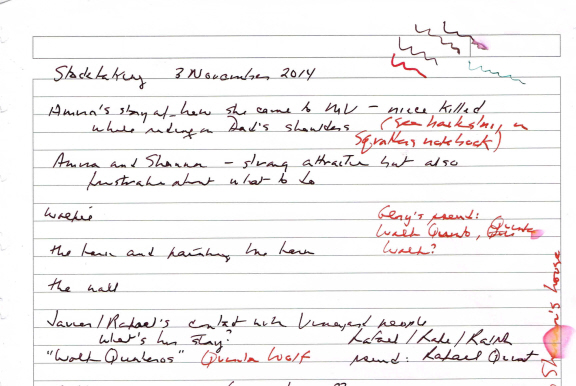
Here’s a sample of what they look like and what I use them for.

In early November I was trying to corral some emerging themes, subplots, and images. I was auditioning names for one character (Javier? Rafael? Rafe? Ralph?) and social media handles for another (for the moment she’s settled on Quinta Wolf). Note also the ink scribbles at the top and the liquid splotch (probably tea, maybe beer) at right. The red notes were added later.

20141107 notes

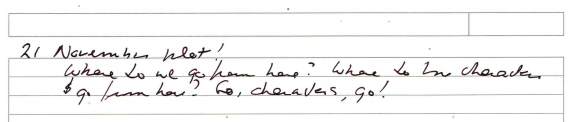
Here the author is trying to figure out what the hell happens next. She does this a lot.

20141121 notes 1

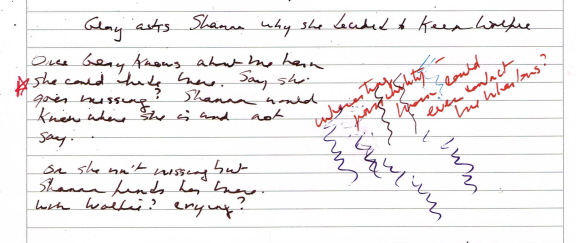
Toward the bottom of the same page, the pen offers an answer — and starts speculating about a possible plot development further down the road. I haven’t got there yet, so I don’t know how it’s going to play out. Note the scribbles. Note taking often involves scribbles.

20141121 notes 2

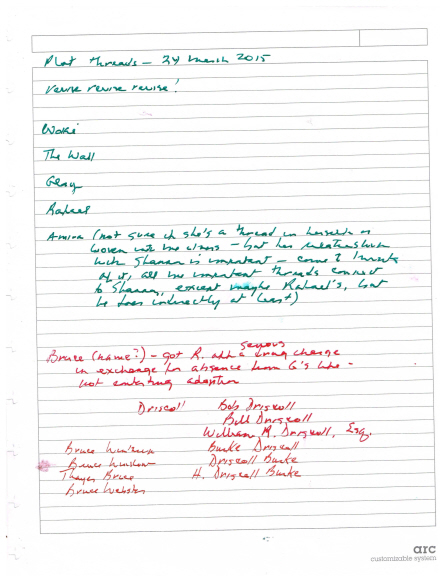
By late February, I had started draft 2, even though I hadn’t finished draft 1. My main plot threads were clear and becoming clearer. I had to build them a trellis to climb on. On March 24, I listed the characters driving each of the threads. “The Wall” is a mural that protagonist Shannon is painting on her living room wall. It has, as these supposedly inanimate objects sometimes do, taken on a life of its own. Amira wandered in from the set-aside novel, where she plays a major role. Her role in Wolfie isn’t settled yet, but it’s definitely important.

At the bottom of the page I’m brainstorming names for my villain. He started off as Bruce McManus, which didn’t feel right. “Bruce” has stuck, but “McManus” is gone. I didn’t want a name with obvious ethnic associations. I did want a name that suggested that what this guy does, though terrible, can be and often is done by ordinary, unexceptional men. His surname is now Smith.

20150324 notes

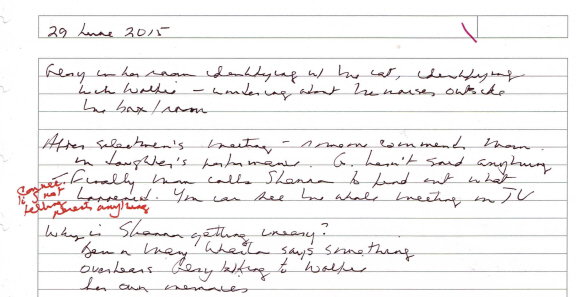
Here — not even three weeks ago! — I’m looking ahead to what follows a key scene (“selectmen’s meeting”). The scene itself is being lifted wholesale from draft 1, but when I first wrote it I hadn’t thought much about what its repercussions and aftershocks might look like. I’m also working out some character motivation: “Why is Shannon getting uneasy?” She is uneasy, and with good reason, but neither she nor I are quite sure why. The tricky thing is that it can’t be too obvious. One of the questions that’s driving this novel for me is “What do you do when you suspect something is very wrong, but you can’t be sure and the stakes are too high to allow for mistakes?” The jury’s still out on that one.

20150628 notes

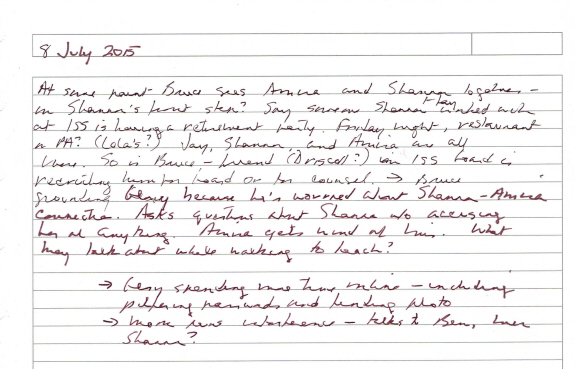
And finally, here’s the sketch for a plot break-through scene. Bruce, an outwardly rational lawyer who weighs the consequences of (almost) everything he contemplates doing, has to make a move that isn’t all that well thought out. He has to be, in other words, on the brink of panic. What would do it? Well, if he realized that Shannon, whom his 11-year-old stepdaughter, Glory, idolizes, knows Amira, who counseled Glory four years earlier when she was in trouble at school, that would do it. How to bring that about? I mulled that over on several walks, then a possibility popped into my head. On July 8, I sketched it out and decided, Yeah, that’ll work. Let’s try it.

20150708 notes

Beyond the Written Word

Words flow through my fingers and onto the paper, onto the keyboard. I take them for granted, even when they’re lumpy or reluctant or stuck. They flow out of my mouth as reliably as tap water (I’m lucky that way). Sometimes I sing them. I’m not a real singer, but I sing regularly, in a pick-up group — all comers welcome — that gets together monthly to sing and also in the Spirituals Choir. The choir is part of the U.S. Slave Song Project. We sing the folk songs sung by African slaves in America between 1619 and 1865.

For more than a decade, between the mid-1980s and the very late 1990s, I was very involved in local theater, first as a reviewer for one of the local papers, then mainly as a stage manager and actor. I even wrote several one-act plays.

Mostly these days, though, my creative life is words on paper and words on screen, writing them and editing them.

A couple of weeks ago, Roberta Kirn, the leader of the pick-up group I sing with and also a dancer, drummer, and teacher, sent round an email to all the singers, drummers, and musically inclined people on her list. An upcoming production at The Yard was looking for singers to form a sort of flash mob in the audience during the performance. Contact information was provided.

Of course I was tempted — but I’m not a real singer: was I a good enough singer to do this, whatever it was? And The Yard is a summer dance colony in the next town over. Of all the creative arts, dance is the one I have the least affinity for. Dance is a language I don’t speak. It’s spoken mostly by skinny people who can contort their bodies in impossible ways. I’m not skinny now, and for a couple of decades I was downright fat. My contortions are all mental. I do them with words.

Poster for "The Queue" at The Yard

Poster for “The Queue” at The Yard

Still, it sounded fun, and a little risky, and an excuse to get out of my head. I signed up. I had to miss the rehearsal; the director said come anyway. Our song was a three-part arrangement of the chorus of Pat Benatar’s “We Belong.” Before Friday night’s performance, we did a run-through with the cast of The Queuedeveloped and performed by the Lucky Plush dance theater company from Chicago. The company began the song onstage, then the half dozen or so of us singers joined in from our scattered seats in the audience. I managed to pick up my note, hold my part, and remember the song even with no one around me to lean on — always a worry of mine.

The big reward was getting to see The Queue twice through. It’s set in an airport. At the beginning, apart from a gay couple setting out on their honeymoon, the seven players don’t know each other. Gradually connections develop and emerge among them. The piece is theater as well as dance. I do speak theater, and I totally forgot that I don’t speak dance. In theater, how the actors use space and their own bodies can be at least as important as what they do with their voices and the words of the script. The Queue draws on slapstick, vaudeville, and the great choral production numbers of yesteryear, among other things, and since the players are trained dancers who can do astonishing things with their bodies, I forgot that dance, music, and theater are supposed to be separate arts involving separate skills.

Well, OK, I already knew that. Thanks to my theater experience, writing often feels like directing or stage-managing to me. My characters are my actors. I watch them, coach them, and sometimes become them. Singing probably makes me even more attentive to sounds, rhythm, and silences than I would be otherwise. But lately I’ve been so exclusively engaged with the written word it’s like I’ve had blinkers on. Or as if I’ve been riding on an escalator focused entirely on the straight-ahead, screening out all the distractions to left and right.

And dance. I was totally ignoring dance. It’s not just for skinny people, and it’s not just a foreign language spoken in places I’ll never visit. I was just part of a dance production, even if all I did was stand up and sing.

Writers are scavengers. We’re the ultimate recyclers and repurposers. Our minds may seem crammed to capacity, but they aren’t. There’s always room for more.

Divide and Conquer (Your Prose)

This focuses specifically on blogging, but the message applies to all kinds of writing, fiction and nonfiction. In my novel in progress, the sections are scenes. Each has a beginning, middle, and end. Each links what precedes to what follows. Check out the two examples cited. They’re good.

Sturgis’s Law #3

Early last month I started an occasional series devoted to Sturgis’s Laws. “Sturgis” is me. The “Laws” aren’t Rules That Must Be Obeyed. Gods forbid, we writers and editors have enough of those circling in our heads and ready to pounce at any moment. These laws are more like hypotheses based on my observations over the years. They’re mostly about writing and editing. None of them can be proven, but they do come in handy from time to time. Here’s #3:

A good sentence is more than the sum of its parts.

We talk about “constructing” sentences as if sentences can be built block by block like houses and bridges, and in a way they can.

We learn the building blocks early on. A sentence must have a subject and a verb. It can then be dressed up with direct objects, indirect objects, prepositional phrases, and clauses of various kinds. The component parts can be dressed up with adjectives and adverbs. Two complete sentences can be linked with a conjunction — the most common ones are and, but, and or — a semicolon, or a colon.

To make matters more complicated, or more fun, depending on how you think of it, sentences are rarely entire of themselves. They exist in relation to other sentences. They can be joined into paragraphs. Even when a sentence stands alone on a line, a paragraph unto itself, the reader connects them as she moves from one to another.

Sentences can be grammatical and unclear at the same time. Here’s a snippet I quoted in “Editing Workshop, 3,” which focused on sentences:

Smith requested and received permission to publish the translation from Jones in 2005. . . . Smith, in an interview, described the text as boring.

This comes from a long nonfiction manuscript I edited earlier this year. I skidded to a halt at the end of that first sentence. It wasn’t the translation that came from Jones but the permission, and the work wasn’t published till 2008. In the second sentence, “in an interview” weakens the connection between subject and verb by coming between them. Here’s my edit:

In 2005, Smith requested and received permission from Jones to publish the translation. . . . In an interview, Smith described the text as boring.

None of the words have been changed. They’ve just been rearranged.

We can critique sentences in isolation, but often we can’t tell what’s unclear or clear enough, what’s more effective and what’s less so, unless we see it in context. Here’s an example from my novel in progress. “She” is a sixth-grader swinging on the school playground. “It” is a dog trotting down the path behind the school. She’s never seen it before.

She watched it as the swing descended and then rose again. Its head snapped to the left, then it took off up the path at a flat-out run.

Nothing wrong with that, although an overly meticulous copyeditor might argue that the “its” at the beginning of the second sentence could be taken to refer to the swing. Most readers know that swings rarely have heads, so this “it” must be the same as the one in the first sentence. But I turned the first sentence around:

As the swing descended and then rose again, she watched it. Its head snapped to the left, then it took off up the path at a flat-out run.

Moving the dependent clause to the beginning emphasizes the motion of the girl on the swing. Then the movement stops for a moment before starting up again, this time following the dog. I also liked the way the revision brought “it” and “its” together.

Play with your sentences. Rearrange them. Read them out loud, in isolation and with the sentences that precede and follow them.

Once in a while I’ll screech to a halt and gawk at a beautifully constructed sentence. Casual readers don’t generally do this, but writers and editors can be forgiven for taking a second look at an admirable sentence.

Or a not-so-admirable one. I don’t know about you, but I probably learn more from the sentences that don’t work than from the sentences that do. Identifying what doesn’t work is easy. Understanding what makes a sentence clear, effective, eloquent, whatever — this is hard. Awkward and unclear sentences clamor for attention. Good sentences just flow on by. This may be one reason editors and teachers get a reputation for being negative and critical: we naturally focus on the sentences that don’t work so well.

Remind me to flag a couple of really, really good sentences in the next manuscript I edit!

Why Editing Matters

The Case of the Disappearing Editor,” which appears in the new issue of the online journal Talking Writing, was sparked by a recent flap over literary journals that require submission fees. (Such journals are primarily staffed by volunteers, and whatever staffers do get paid don’t get paid much.) Author Martha Nichols, Talking Writing‘s editor in chief, identifies a crucial issue that’s being overlooked in the flap:

I’m tired of how much the work of editors is ignored or has become invisible. It’s just as bad as devaluing writers. Actually, it’s worse, because a narrow focus on the payoff for writers ducks the question of how we maintain literary quality in the new media world.

In the battle over submission fees, what troubles me most is the idea that it’s unethical for other writers to subsidize those who do get their work published or the editors who help develop and promote that work. This viewpoint assumes that writers do everything and editors do nothing—or that editors and other publishing professionals shouldn’t care about working for free.

What follows is a thoughtful discussion of what editors and others in the word trades do and why it’s important in the evolving world of publishing and self-publishing.

I especially like this bit:

. . . editing has value to writers and to everybody who cares about quality and a wider audience for literature. I’m talking about literature in the broadest sense of that term: writing that moves people, that makes them think, that informs and illuminates. In a world where anyone can publish unfiltered text online, editing is a bulwark against opacity, fakery, apathy, and socially acceptable stupidity.

The whole thing is well worth reading and pondering.

While you’re there, check out Talking Writing‘s other offerings: essays, first-person journalism, stories, and poetry.

The Name Game

Editing nonfiction, I’m always astonished and delighted by the sheer variety of people’s names. Some are common, others unusual. Many hint at where the individual or his/her forebears might have come from — at least the forebears in the paternal line. The names of women are usually plowed under by marriage, though they may resurface in a child or grandchild’s middle name.

Other names are more generic — which in English-speaking countries means “more Anglo-Saxon” — than the people who bear them. Immigrant names were often changed at the border by immigration officials who found the original unpronounceable or unspellable. Individuals change their own names for an array of reasons. Sometimes the grandchildren of immigrants reclaim the ancestral name, though it means they’ll be continually asked how to spell or pronounce it.

One of the first things a small-town newspaper copyeditor learns is that most readers will forgive the occasional error of fact and rarely notice the grammatical gaffe, but if you misspell their names or, worse, the name of one of their kids, they will remember it forever. The first name of one fellow who appeared occasionally in news stories was Kieth. Yep: i before e. As with Triple Crown champ American Pharoah, the impulse to “correct” it was strong, but once I ascertained that “Kieth” was correct, I didn’t give in to it.

I’m jealous of nonfiction writers. They do have to get the names right, but at least they don’t have to make them up.

Fiction writers do.

Naming characters is like titling the work. Some names come easy. Others come hard.

A character in Wolfie, my novel in progress, appeared as Bruce McManus. “Bruce” has stuck, but “McManus” was a placeholder. His real name didn’t show up on its own. I had to poke around my brain looking for it.

What made this difficult is that Bruce is not a nice man. He’s not-nice in a particularly loathsome way, but his particular kind of loathsomeness is not all that rare.

What was wrong with McManus? Well, I wanted a generic name that would not be associated with a specific ethnic or national group. “Mc-” suggests Irish or maybe Scottish. Bruce comes across as WASP and probably is. When it comes to names, I have a couple of ruts that I regularly fall into, and one of them is names beginning with M. A main character in this novel is Shannon Merrick. Up the road from her is a couple named Morris.

Another of my ruts is trochees — names of two syllables with the accent on the first: Shannon, Merrick, Morris . . . I’ve also got a few three-syllable names going — Segredo, Kelleher, Correia, McDermott — but not many with only one syllable. So I started brainstorming single-syllable, generic names.

Trouble was, nearly all those single-syllable names were good English words: Black, Brown(e), White, Green(e), Stone, Hunt, Young, Pierce . . . Their meanings and connotations were likely to color (sometimes literally) readers’ perceptions of the character, and raise the possibility that this was intentional on my part. Nothing wrong with that: I’ve done it myself. In my first novel, The Mud of the Place, Jay Segredo got his surname for a reason. “Segredo” in Portuguese means “secret.” But with this Bruce character? No.

So while I was out walking one morning and thinking about something entirely different, “Smith” slipped into my conscious mind. Bruce Smith. Bruce Endicott Smith. I had it: a one-syllable surname that was about as generic as you can get in English and that didn’t begin with M. 

Some characters show up with names firmly attached. How to name the ones that don’t? There are plenty of options. Some writers open the phone book at random then let their forefinger do the picking, once for the first name, once for the last. I often discover names by listening to the characters talk, either to themselves or to each other. My novel is set in a particular place — Martha’s Vineyard, Massachusetts, New England, USA — which limits my options somewhat. If your story is set in Croatia, Armenia, Brazil, or Japan, or if one of your characters comes from somewhere else, there are names lists galore on the Web for different places and different languages. If you don’t know the place or language, though, take care: the name you choose may have associations you don’t know about. (“Bush” was not one of the monosyllabic names I considered for Bruce.)

For fantasy and science fiction writers the possibilities might seem endless, but not really: readers have a harder time with names they can’t pronounce or remember easily.

Do names really matter all that much? “A rose by any other name would smell as sweet,” true, but if roses were called rhododendrons, they probably wouldn’t show up in so many poems. The busybody who appeared in the excerpt I quoted in “Free the Scene” didn’t give her name, but it turned out to be Juliet Cavendish Cooper. If that suggests someone who’s imperious and proud of her genealogy, fine with me.

For the important players, though, the name can provide a way into the character’s head and history. How did the person come by that name? Does s/he like it or hate it? Growing up a Susanna, I wanted a name like everybody else’s so I went by Sue or Susan (occasionally spelled Suzan). After high school I decided that Susanna really was much better, even if I often have to spell it out. One of my main characters, given name James, as a kid was widely known as Jimmy. After he left home, he started calling himself Jay. Now only his mother calls him Jimmy.

My friend the prolific mystery writer Cynthia Riggs sometimes donates naming rights to good causes. If you’re the high bidder at a benefit auction, you or your designee gets a namesake in Cynthia’s next novel. This is how Bruce Steinbicker, in Cynthia’s recently released Poison Ivy (St. Martin’s, 2015), got his name. But in the writing Bruce the character took on a personality of his own, as characters are wont to do. This prompted Cynthia to write to Bruce the real guy:

In the Martha’s Vineyard Mystery Series book I’m writing now, Poison Ivy, I intended the character named after you, the TV star Bruce Steinbicker, to make a simple cameo appearance on the porch of Alley’s Store. However, the character insisted that he play a larger role . This is a problem writers often face. A character takes over and there’s not much we can do about it. But since our character, Bruce Steinbicker, decides to have a dalliance with a woman other than his wife, I thought I should let you know in case this might cause problems for you in your personal life. If so, I can give our Bruce S. character an alias.

Please let me know whether or not you’re comfortable with being loosely identified with our naughty Bruce Steinbicker, as I’m in the home stretch.

To which Bruce the real guy replied: “I’m fine with this and when I showed your message to my wife of 49 years, she just laughed.”

Since Cynthia and I are in the same writers’ group and I heard most of Poison Ivy in manuscript, I’m now wondering if that’s where my Bruce’s name came from. Maybe yes, maybe no, maybe yes and no. The writer’s mind steals from here, there, and everywhere, then forgets where the shiny baubles came from.


Letting Go, Take 2


An editor colleague just asked what to do about a client who’s written a very good novel but wants to keep revising and revising and won’t start querying agents or publishers.

There’s not much you can do, I said.

Aside: “Letting Go,” take 1, was prompted by a similar query. It took off in a somewhat different direction. I suspect that writers and editors never stop dealing with this stuff.

The word “perfectionism” came up.

As a recovering perfectionist — often a recovering-by-the-skin-of-my-teeth perfectionist who wonders if she’s recovering at all — I know a few things about this. Perfectionism can mean that everything you do has to be perfect before you’ll let it out of your sight, but it can and often does mean more than that. Perfectionism is a way of maintaining control. If I do everything right, I won’t get fired, my lover won’t leave, my kids will turn out perfect, and my novel will get made into a top-grossing movie and the world will swoon at my feet.

It often doesn’t work out that way. Deep down we perfectionists suspect this. Deep down we know that once something leaves our hands, the outcome is out of our control. So we don’t let it go.

Which is what I suspect is going on with the novelist who can’t stop revising, mainly because I’ve known many writers over the years who can’t let go of their work. They tell themselves the work isn’t done — they need to do more research, or do one more draft — and nothing anyone tells them can persuade them otherwise. The problem isn’t that the work isn’t done, it’s that the word “done” isn’t in the writer’s vocabulary because “done” means s/he has to let go.

For writers, here is where it gets tricky. Letting go means you’re putting the outcome in the hands of person(s) unknown. Persons who don’t know you and don’t have any particular reason to wish you well — unless, of course, you’ve produced the sort of work that might make lots of money. The overwhelming majority of us have not done this. Competent agents agree to represent only a small fraction of the manuscripts they see. Many of the ones they reject are very good or better.

In other words, if “failure” to you means rejection by an agent, or by a dozen or a hundred agents, your fear of failure is completely justified.

So is your fear of success. Fear of success is the flip side of fear of failure. They both have deep roots in the fear of letting go. Say you do get an agent, the agent sells your book, and there’s actually a book on the market that has your name on the cover. To you it’s a huge deal, as it should be, but most of the world — including your friends, relatives, and casual acquaintances — is going to say, at best, “That’s nice,” and move on.

Am I telling you to give up? Of course not. Read on.

Here’s a little parable: A kid finds a new butterfly struggling to get out of its chrysalis. The kid pulls the chrysalis apart and helps the butterfly get out. But the butterfly’s wings aren’t fully developed. It cannot fly. Moral of story: It’s the struggle to get out of the chrysalis that strengthens the butterfly’s wings so it can fly.

I like this little parable even though some people turn it into a rationale for never helping anybody out. I like it because it applies so well to writing and other creative endeavors. In the struggle to create, we not only become good writers, we also figure out what we want to do with our writing. We create a path forward for ourselves and develop the courage to follow it.

For many of us, this involves seeking out and sharing experiences with other writers. We become better writers, yes, but we also develop two crucial skills: the ability to dissociate ourselves from our creations, and the ability to sort through other people’s comments, edits, and critiques and decide what works for us. In the process, we learn about the many options for getting our work out into the world.

To complete a book-length work without doing this — well, it’s like finding that the road you’ve been on for years ends in a precipitous drop. Or maybe like opening the door from your dark room and being blinded by the light outside.

The very first line of this blog, back in “The Basics,” was “Your writing will teach you what you need to know.”

I believe it.

In that same post, I quoted two of the truest things I’ve ever heard about writing. I believe them too. Here they are again.

”I think writing really helps you heal yourself. I think if you write long enough, you will be a healthy person. That is, if you write what you need to write, as opposed to what will make money, or what will make fame.”
Alice Walker

The real writer is one
who really writes. Talent
is an invention like phlogiston
after the fact of fire.
Marge Piercy