In creative writing classes, students often study exemplary essays, stories, poems, and novels. Learn from the masters — makes sense, doesn’t it?
It does indeed. Nevertheless, much can be learned from flawed works as well.
Does that sound paradoxical?
Think about it. A top-notch work seems inevitable. There’s no trace of the earlier drafts, the ones where sentences and whole paragraphs have been deleted or moved around. There’s no hint of all the back-and-forth second-guessing the author did before settling on that word that strikes you as exactly right. A major character may have dwindled draft by draft and finally disappeared entirely. A bit player in the first draft may have wound up the star of the show.
We editors are lucky: we’re continually immersed in works that aren’t done yet. Copyeditors focus primarily on words and sentences. Substantive editors focus on structure. We develop a knack for identifying, diagnosing, and recommending fixes for whatever problems arise. (For a quickie rundown on the various levels of editing, see “Editing? What’s Editing?”) Sometimes the problem is simply an error that needs to be corrected. Other times it’s that something just doesn’t work.
On a recent job, a novel, I was supposed to be focusing on words and sentences, but before long I was acutely aware that the manuscript needed big-picture help. The novel’s title character — let’s call her Renée — has interesting adventures. She’s a spy behind enemy lines in wartime. But the author has chosen to use a first-person narrator for the entire novel — and this narrator has no contact with Renée while she’s having her interesting adventures. As a result, neither does the reader. The most interesting stuff happens off-stage.
Interesting choices open up possibilities. Not-so-interesting choices choke them off.
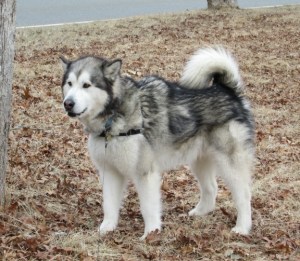
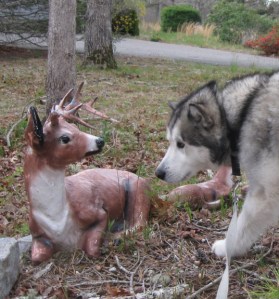
Travvy, whom these days I frequently call Wolfie.
Recently, after forging bravely ahead in Wolfie, my novel in progress, I reached a crossroads — a point where choices have to be made. Wolfie, the title character, is an Alaskan malamute who’s been saved from probable death by Shannon, who already has one dog and does not want another. (See this excerpt in the Writers and Other Animals blog.)
What was Shannon most afraid of?
That Wolfie would get loose again. Wolfie’s life and Shannon’s credibility are on the line.
Well, that made it a no-brainer: Wolfie was going to get loose again. The big question was, What then?
Out walking one morning with Travvy, Wolfie’s inspiration and alter ego, I played with possible choices:
- Wolfie is shot and killed by a farmer.
- Wolfie is shot and disappears into the woods.
I don’t want to kill Wolfie off. He’s my title character, my wild card, and the first draft of the novel isn’t half done yet. He’s not going to die. Shannon’s going to find him first. The question is how. Shannon can’t run nearly as fast as Wolfie, so these were the obvious options:
- The leash he’s trailing snags on a tree and he can’t get loose.
- Wolfie finds Shannon before she finds him.
The second choice startled me: Wolfie comes back of his own accord? I ran with it. It startles Shannon too. It opens up possibilities — the sure sign of a good choice.
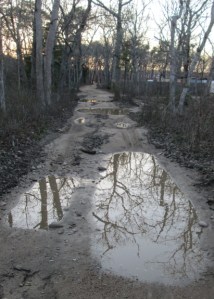
The rougher road often makes the more interesting choice.
Often it’s not till the second or third draft that you recognize that more interesting choices are possible. What if the author of my recent job had thought, “Aha! If I made Renée a point-of-view character, or even a narrator, her wartime experiences would be so much more immediate and vivid”?
It would have been a much more interesting novel.
When you’re first-drafting and you reach a crossroads, ask yourself: What’s the most interesting choice I could make? What do I want to learn about my characters?
Your readers probably want to learn it too.
When you’re revising and a scene falls flat, ask yourself: What am I missing here? Where’s the conflict? Who’s the wild card? How do I make things happen?
You’re in the driver’s seat. It’s your call.


 It gets worse when they learn you’re a writer, a teacher, or (gods forbid) an editor. Some people laugh nervously. Others clam up.
 Readers and writers, teachers and editors, are forever getting them mixed up with rules. How to tell a rule from a shibboleth? Rules usually further the cause of clarity: verbs should agree with their subjects in number; pronouns should agree with the nouns they refer to. Shibboleths often don’t. No surprise there: their main purpose isn’t to facilitate communication; it’s to separate those who know them from those who don’t.
 Hoo boy, did I go wild or what. Anyone who hadn’t mastered the which/that distinction was an ignoramus. I got to look down my snoot at them. I got to educate them.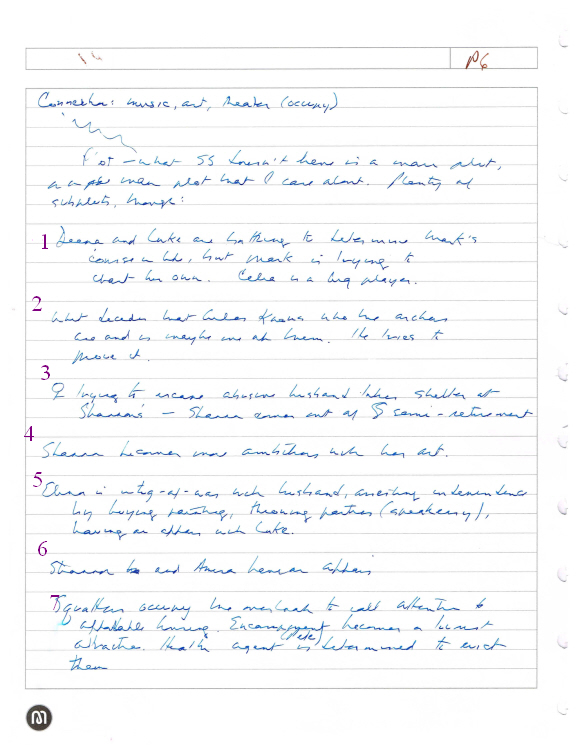


 “We are each other’s angels” goes the song. My teeth start itching at any reference to angels. There’s something about the concept that makes smart people start babbling in clichés. But OK, point taken: we are each other’s guides, teachers, helpers, and so on. But if we’re each other’s angels, we’re also each other’s devils, roadblocks, obstacles. When a character is the hero of her own story but the villain in someone else’s — that’s where things get interesting.


 Write Through It