K Is for Knowledge

You’ve probably heard it so often, repeated with such authority, that you’re ready to throttle the next person who says it: Write what you know.

Likely you’ve also heard, or even yourself said, the common rejoinder, which goes something like That’s crap. Haven’t you ever heard of research?

Well, of course. What we know is fluid, expanding and deepening even without any conscious effort on our part. For writers, research is ongoing. We read, we listen, we travel to a new place, we walk down a street we’ve walked down many times before, noticing some things for the first time.

My hunch is that Write what you know surfaced at least in part as a response to the notion that one could only be a real writer if one had had certain experiences. The requisite experiences — being in combat, for instance — were almost invariably skewed male. At a women’s writing workshop in the late 1980s, a bunch of us got to talking about this. We couldn’t help noticing that experiences common to women, from childbirth to housework to caregiving, weren’t considered worthy subjects for serious literature.

One of us remarked, half-facetiously, that “the only suitable subjects for academic poetry were bullfighting and war,” whereupon several of us set out to write about bullfighting, which, need I say, none of us had ever done. My contribution grew into “The Bullfight Sonnets,” which was published by Sinister Wisdom in 1988. It includes these lines:

. . . Novelists extol
the crowd, the sun, the blood, the kill, the role
of manhood challenged and found worthy. I
am less enthralled. Instead, I wonder why
cerebral critics desperately admire
heroes who hold their shit when under fire.

Can you tell we had Ernest Hemingway on the brain? Not so much Hemingway, however, as the “cerebral critics,” English teachers, and others who held Hemingway’s spare style up as the pinnacle of literary excellence. At the time, writing about New York, published in New York, and taken up by an audience of New York–based literati was also elevated a step or two above “regional” writing. Take that, Willa Cather, Flannery O’Connor, and Eudora Welty.

I think that the English-language “canon” has gotten more regional, more international, and a lot less white since then. Nevertheless, I continue to take Write what you know as encouragement to start wherever we are, in place, time, and subject matter. Themes of universal — or at least widespread — concern can be reached from anywhere.

One of my favorite axioms is Your writing will teach you what you need to know.

A corollary to that is Your readers will teach you what you need to know more about.

I live on Martha’s Vineyard, an island off the coast of New England that you have probably heard of whether you’ve been here or not because it gets written about a lot, by journalists, novelists, poets, and others. Most of them don’t live here year-round, or haven’t lived here long. It’s not hard to tell which of these writers have been listening to the place and the people in it and which either didn’t take the time or just don’t know what they don’t know.

It really is OK to write about places where you haven’t spent much time and people with lives and backgrounds very different from yours. Hell, historians and historical-fiction writers regularly write about times where they’ve never been, and plenty of them do it very well. (On the other hand, if we’ve never been there either, who are we to tell them that they’ve got it wrong?) Research is required for sure, but it can only get us so far: there’s more to recreating a place or time than avoiding anachronisms and getting the street names right. Imagination and empathy are also necessary, along with an awareness that no matter how much we know, there’s always a lot that we don’t.
J Is for Journal/ism

Journal, journalism . . .

Lately while out in the woods with my dog I’ve been pondering the connection. It’s out there in plain sight: both words derive from the Latin diurnus or diurnal, daily, by way of the French jour. So does journey, from the Old French jornée, a day’s travel or a day’s work.

The etymological connection is close and clear, but in practice? Both have to do with writing, but journals are private while journalism is very public, right?

Well, a journal is private while you’re writing in it, but in the historical and biographical nonfiction I copyedit, previously private journals become essential sources for published writing. Public figures and figures who plan to become public often keep journals as an off-the-record record of their journeys, their days’ travel and their days’ work. For anyone who seeks to understand what was going on behind the scenes during important events, these journals become crucial.

With journalism, the journey from private to public happens much faster. It may be almost immediate. Being a rather slow writer myself, I’m continually awed by the speed with which a good reporter can gather information, synthesize it, and spin it into a story that makes sense when heard or read. In a competent news organization the reporter doesn’t do it alone, of course. The tighter the deadline, the more important editors and fact-checkers become.

You can see the problem: In the digital age, deadlines have never been tighter, but unfortunately neither have budgets, and the editorial and fact-checking positions are among the first to get axed. For a writer, going to print without adequate editing is like doing tightrope acrobatics without a safety net. Continuous deadline pressure raises the wire a few yards.

Another casualty of the digital age has been local journalism. Local journalists know their areas well. They develop stories that develop under the radar of regional and big-city news organizations. These stories can and often do become the impetus for regional and national stories — the building blocks, if you will.

And that’s a connection between journals and journalism: as journals can become building blocks — sources — for historians, biographers, and historical-fiction writers, so day-to-day news stories become the foundation for longer series, for informed commentary, and for full-length books. Some of the most important books I’ve read began as the writer’s reporting for a newspaper or magazine. Among the works that come immediately to mind: Seyward Darby’s Sisters in Hate: American Women on the Front Lines of White Nationalism, Ronan Farrow’s Catch and Kill: Lies, Spies, and a Conspiracy to Protect Predators, and Isabel Wilkerson’s The Warmth of Other Suns, about the migration of African Americans from the South into the Northeast, Midwest, and West.

Others rely heavily on the in-depth reporting of others, such as Rachel Maddow’s Blowout: Corrupted Democracy, Rogue State Russia, and the Richest, Most Destructive Industry on Earth.

I recently copyedited two books dealing with Covid-19. One focused on the political and medical aspects of the pandemic; the author had clearly been keeping a detailed record of a year’s worth of developments, while publishing some of it in pieces along the way. The other, by a working journalist, gathered in-depth interviews with individuals variously involved with the pandemic, as patients, health-care workers, local officials, scientists, and so on; earlier versions of most of these interviews had already been published.

So what does all this have to do with you, the writer and/or editor? I see a few possibilities. An obvious one is that news outlets, especially local ones, are a vehicle for getting your words into print and even building an audience. Think letters to the editor, op-eds (opinion pieces that traditionally appear opposite the editoral page), and feature stories, for instance about an individual or organization that’s doing good work in your area.

As local news outlets decline, “citizen journalism” has become more important. Sometimes it’s fostered by existing news organizations; other times it arises from the grass roots, with individuals using social media to report and comment on happenings in their areas. Some practitioners have huge national and international followings. Many more find readers closer to home.

In my area a very large Facebook group has become a conduit for local news, even though we’re lucky enough to still have not one but two weekly newspapers. I think of it as the grapevine on steroids: “news,” such as it is, travels farther faster than old-fashioned gossip ever dreamed of doing, and it can be every bit as inaccurate and even vindictive. But it tells me a lot about the community I live in.

I Is for Imagery

I loved high school English, but after all those in-depth discussions of Shakespeare, Hemingway, Austen, Fitzgerald, and the rest, I went out into the world with some wrong ideas about writing.

I thought images, symbols, and metaphors were like booby traps. Writers embedded them in their stories in order to razzle-dazzle sophisticated readers, and to trick high school students. Why was there a green light at the end of Jay Gatsby’s dock? Why, to drive us crazy, of course.

My English teacher senior year was aware of the problem. She’d ask what an author was trying to do in a particular passage and then, usually after a minute of nervous silence from the class, add, “This is not a trick question.” We didn’t believe her.

For many years, I wrote mostly nonfiction. Nonfiction, I mistakenly thought, was safe from images, symbols, and metaphors. When I started dabbling in poetry, I knew I was in trouble. Poetry is all about images, symbols, and metaphors, isn’t it?

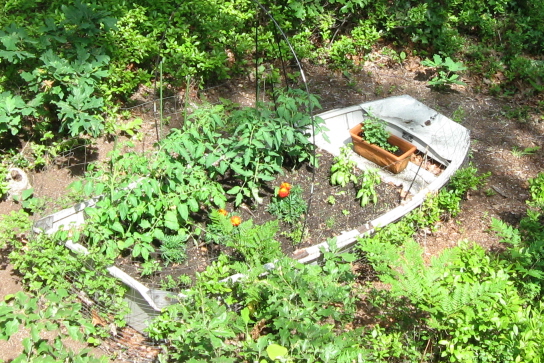
I am not a gardener, but I do have a little garden. It’s in an old dinghy.

Before long, though, I got it: Images, symbols, and metaphors grow out of the writing. They’re gifts, like sprouts in the spring garden. (Look, look! A simile!) The gardener can nourish them and help them grow, or she can decide the row is too crowded and yank some of the seedlings out. (Metaphor!)

A writer I once workshopped with relayed something she’d heard from a poet she knew: “To be a writer, you have to know one thing well.”

The thing you know well is the soil from which your images, symbols, and metaphors grow. Of course there can be more than one thing, and you can always learn more.

When the garden gets too crowded, it’s hard to see what’s going on.

Any story or poem or essay is bound to have lots of images in it. This is fine. Gardens contain lots of plants, don’t they? All sorts of plants. At the same time, if you’ve got too many flowers growing in a limited space, your readers won’t know where to look. They may miss something that you want them to notice. Keep that in mind when you get down to revising your work.

One last thing to keep in mind: Many, many common expressions are metaphors that have long since come adrift from their literal meanings. This can get writers into trouble. Take the phrase “rein in,” as in “rein in one’s ambition.” I sometimes see “reign in” even in the work of pretty good writers. “Rein in” comes from horsemanship. If you keep horses, reins, and bridles in mind, you won’t write “reign” for “rein.” (Come to think of it, I don’t believe I’ve ever come across a reference to “unbridaled passion.” It has possibilities, doesn’t it.)

Metaphors and images can be effectively mixed and matched. They can complement each other or create dissonance. If you use them with care and know where they came from, you won’t inadvertently come up with doozies like “He’s a wolf in cheap clothing” — which also has possibilities, but seriously, you don’t want to do it by mistake, do you?

For a crash course in metaphors, see this post by Richard Nordquist, a retired English professor who is very good at explaining things.

H Is for Habits

Habit: “A recurrent, often unconscious pattern of behavior that is acquired through frequent repetition” or “customary manner or practice.”

When you’re not sure where to start, head for the dictionary. 😉 Those come from the American Heritage Dictionary. There are other “habits,” but I’m not thinking of nun’s habits or riding habits or habits involving narcotics.

Habits are the patterns and practices that can help you create the space that makes your writing possible. Needless to say, they can also create spaces in which writing is difficult if not impossible, so if you’re having a hard time getting down to work, day after day after day, it’s worth taking a hard look at what habits may be getting in the way.

I once wrote a whole poem of ways to avoid writing. I can’t remember any of it, but I’m pretty sure that doing the dishes and vacuuming were in it. The ways to avoid writing are myriad. I can even use writing to avoid writing.

My #1 habit in the sense of “customary manner or practice” is write every day. This started when I was working on my novel. I’d never completed anything longer than 40 pages before. I was desperately afraid I was going to choke. You know where the cartoon character runs straight off a cliff and for a moment is suspended in midair above a chasm, feet still running? That was me.

I made a New Year’s resolution, one of the few New Year’s resolutions I’ve ever made. The resolution was that I would write every day until I had a complete draft. I didn’t specify how many words I would write, or how many hours — only that I would write every day.

I have a candle burning while I write.

Some days, I swear, it would be five minutes to midnight when I sat down at the computer and opened the Word file. That was enough. I’d tweak the last paragraph I’d written and then write another paragraph or two. Just opening the file was enough to reassure me that it hadn’t turned to crap the moment my back was turned. What I’d already written would tell me what to do next.

Ordinarily mornings are my best writing time, especially for first-drafting. In the morning I’m fresh and optimistic. As the day goes on, my mind fills up with distractions, interruptions, and reasons not to write. Editing I can do at other times.

My worst habit, of the “recurrent, often unconscious pattern of behavior that is acquired through frequent repetition” type, is Spider solitaire. Decades ago I played it with real cards, then some fiend decided to bundle it with Windows and I was doomed. If the writing stalls, suddenly Spider is open on my screen and I’m playing another game without knowing how I got there. I am almost certainly powerless over Spider solitaire. I don’t think my life has become unmanageable — yet — but I may be fooling myself.

G Is for Grammar

Grammar scares the hell out of many people. In the very late 1990s, when I started participating in online groups that weren’t oriented to editors and/or writers, people would sometimes apologize to me for their bad grammar or spelling. Once in a while someone would attack me for making them feel inferior. I was mystified. For one thing, their grammar wasn’t bad at all, and for another I wasn’t criticizing anyone’s grammar, spelling, or anything else.

Then I got it: I was using the same sig line I used in online groups of writers, editors, and other word people. It identified me as an editor. I cut “editor” out of my sig line. The apologies and attacks stopped.

Grammar gets a bad rap. (NB: I just took a little detour to look up “bad rap,” like why isn’t it “bad rep,” as in “reputation”? Check it out on the Merriam-Webster’s website.) Plenty of us learned in school that there’s only one right way to write and every other way is substandard. Taken to heart, that’s enough to paralyze anybody.

There’s no shortage of people who’ll sort you into a category according to how you speak or write. (Take a break here if you like to listen to “Why Can’t the English?” from My Fair Lady.) A common assumption seems to be that editors all come from this judgmental tribe. While it’s true that most of us who become editors were language adepts in school — we spot grammatical errors and misspellings as readily as musicians detect sour notes in a concert — the best editors I know put serious effort into learning more about how our language is used in the real world, and how writers use it.

Some grammars are descriptivist: they describe how a language is used by its speakers. Others are prescriptivist: they tell speakers of a language how they ought to be using it. Language changes over time, no doubt about it. It also varies across different populations, which is why both writers and editors need to consider the audience for whatever they’re working on.

Think of grammar as a tool in your toolkit. As tools go, it’s a pretty complex one and takes a while to master — it’s more like a piano than a screwdriver. On the other hand, a sentence has fewer moving parts than the human body, so learning the parts of speech takes a lot less time than learning all the bones and muscles. Understanding how the parts are supposed to work together makes it easier to recognize when a sentence isn’t working, how to fix it, and how to explain it all to someone else.

If you never learned to diagram sentences in school, or even if you did, you might find that diagramming helps you visualize how the parts of a sentence fit together. There are plenty of how-tos online, including this one.

Since my first editorial job four decades ago, my go-to reference for grammar questions has been Words Into Type. It hasn’t been revised in just about that long, so it can be hard to find, so I asked some editorial colleagues what their favorite references were. Here are a few of them:

  • The Copyeditor’s Handbook, 4th ed., by Amy Einsohn and Marilyn Schwartz, University of California Press. I’ve got the 3rd edition, the last one Amy completed solo before her death in 2014. And no, it’s not just for copyeditors.
  • Good Grief, Good Grammar: The Business Person’s Guide to Grammar and Usage, by Dianna Booher, Ballantine Books
  • The Blue Book of Grammar and Punctuation, by Jane Straus, Lester Kaufman, and Tom Stern, Wiley
  • The Gregg Reference Manual, by William Sabin, McGraw-Hill
  • The Little, Brown Handbook, by H. Ramsey Fowler, Jane E. Aaron, and Michael Greer, Pearson
  • The Chicago Manual of Style, 17th ed., University of Chicago Press. Also available by subscription online. I’ve been using it since the 12th edition, when it was still called A Manual of Style.
My go-to reference books

E Is for Editing

Me editing in my EDITOR T.

What did you expect E to be for? 😉 As an editor, I don’t exactly breathe editing but I spend a lot of time doing it, thinking about it, and writing about it in this blog and elsewhere. In fact, just yesterday in my new T-Shirt Chronicles blog I posted about my first staff editor job and how I got my orange EDITOR T-shirt.

Editing is a big topic so here I’m going to focus on two questions that writers often ask: (1) Do I really need an editor? and (2) What kind of editing am I looking for?

Do I really need an editor?

Many editors insist that any writer who aspires to any kind of publication needs an editor. This is not surprising, because editors need paying clients to make a living. They have a point. Every writer, and every piece of writing that aspires to be read, could use or would benefit from good editing. That includes the editor-writers among us: no matter how much experience we’ve got, we can’t bring a fresh eye to our own work.

I part company with these editors when they emphasize the necessity of editing by likening editors to plumbers or car mechanics. You need a plumber when a pipe bursts in your basement. You need a mechanic when your rear brakes start to fail. You don’t need an editor with quite the same urgency. In the real world where funds are not unlimited, the flooding basement and the failing brakes, not to mention the groceries, rent, and utilities, take precedence over the unedited manuscript.

One-on-one editing is time-intensive. It does not come cheap. It does pay for itself, but rarely in hard currency. Even if you get your book, essay, or story published, the financial returns probably won’t cover what you shelled out for editing. Unless your book is very popular, it won’t begin to compensate you for all the hours you spent working on it either. But consider it this way: If you were looking primarily for a tangible return on your investment, you probably would have gone into plumbing or car mechanics, right?

If you’re serious about your writing, and especially if you self-publish, the time will probably come when the value of good editing will be worth the money you spend on it. Worth it to you.

I encourage writers to learn as much as they can about editing. It makes us better writers. It gives us more control of our work. It saves us money, because the more we can do ourselves, the less we have to pay others to do. And when the time comes to hire an editor, we’re better able to find one who will do justice to our work. Join a writers’ group or workshop. Attend a writers’ conference. Find a couple of fellow writers to share work with. Read widely and read critically; pay close attention to how the writers you respect do what they do. (Keep in mind that they’ve probably had editorial assistance along the way.) And by all means keep writing.

What kind of editing am I looking for?

Like many of the editors I know, I’m sometimes asked by novice writers what it would cost to “proofread” their work. Aside from the fact that to give a good estimate, it’s best to actually see the work, what these writers are looking for is invariably editing, not proofreading.

So what’s editing, beyond messing with something that’s already been written? Here’s where it can get confusing. “Editing” can involve anything from correcting typos and grammar gaffes to rearranging paragraphs and even helping a writer build a book from scratch. So we talk about “levels of editing.” Here’s a rough guide to the levels, starting with “big picture” editing and moving down to what I call the “picky bitch stage”: catching spelling and grammar errors.

Ghostwriting. Ghostwriting is writing, not editing. I include it because I’m not the only editor who’s heard this question: “I’ve got a great idea. Can you help me turn it into a book and we can share the royalties?” The answer is no. Ghostwriting is even more time-intensive than editing and even more costly. The chances that the resulting product will earn any royalties are close to nil. My standard answer is “Sell your proposal first and then we can talk.” None of the querents has ever come back.

Developmental editing. Like ghostwriting, this involves building the manuscript from the ground up. For big projects, like textbooks, it can involve multiple authors, researchers, designers, and more. For the individual writer, it’s all the work that goes into creating a coherent complete draft. Most of us do our own developmental editing, often with assistance from writers’ groups and those generous people who volunteer to read our work and give us feedback.

Rewriting. Most of us do our own rewriting too. From the individual writer’s point of view, it’s close kin to developmental editing.

Structural editing. The structure of a work is its skeleton. When the wrist bones are connected to the thigh bones, the body doesn’t work too well. All written works have structure. Structure is what guides readers through the story or the essay. When you decide that a scene in the middle of the book has to come near the beginning or a certain character’s motivation won’t make sense, you’re messing with the work’s structure.

Stylistic editing. This is called all sorts of things, including content editing, line editing, and copyediting. Here you go through the work line by line, asking whether each sentence, phrase, and word says what you want it to say, and in the best way possible. English is a wonderfully flexible language. Choosing the right word and putting it in the right place can make a big difference. Writers’ groups and volunteer readers (aka “guinea pigs”) can be invaluable here. You know what you meant to say, but until you get feedback from readers it’s hard to know how well it’s coming across.

Copyediting. I hire out as a “copyeditor,” but my work includes plenty of stylistic editing so I have a hard time distinguishing one from the other. Let’s say here that copyediting focuses on the mechanics: spelling, punctuation, grammar, formatting, and the like. With nonfiction, it includes ensuring that footnotes and endnotes, bibliographies and reference lists, are accurate, consistent with each other, and properly formatted.

Proofreading. This level is the most mechanical of all. It means catching the errors that have slipped through despite all the writer’s and editor’s best efforts. (No matter how expert the writer and editor are, there will be errors. Trust me on this. I just caught one in this sentence. No, I won’t tell.)

Before the digital age, edited manuscripts had to be typeset, i.e., completely retyped, and printed out as a galley proof. Proofreaders would read this proof against the manuscript to make sure the manuscript had been followed exactly and also to flag any errors in the ms. that the typesetter had missed. Nowadays the proofs are prepared from the edited manuscript. Because nothing has to be reset, each version is cleaner than its predecessor. Most proofreading is “cold reading”: reading the page proofs to catch any errors that slipped through in earlier stages.

D Is for Deadline

You know we’re off to a good start: I’m writing this at half past noon on the day after it was supposed to be up. Never mind what the button says: Blowing off deadlines is not good practice if you value your income and/or reputation.

But if there’s a writer or editor out there who’s never missed a deadline, I’d be surprised.

And if there’s a writer or editor out there who’s never used deadlines as an excuse, I’d be even more surprised. In the last month I’ve avoided two or three events by saying “I’m on deadline.”

It wasn’t a lie. I had three editing deadlines to meet in a two-week period, all on substantial book-length jobs. The real story is a little more complicated. I took on one job with a more-than-reasonable deadline: a little over 200 pages in about four weeks. The deadline was so reasonable that I accepted another job. And then another.

So I was on deadline, but I could have finished that first job in two weeks easy if I hadn’t taken on the other two.

I bitch about deadlines, but in truth I like them. They help me stay relatively organized. And the adrenaline surge can be, well, a rush. For the better part of a decade, from the late 1980s to the late ’90s, I worked for a weekly newspaper, the Martha’s Vineyard Times. Key ingredients in the weekly rush to deadline:

  • Martha’s Vineyard is an island.
  • The printer was off-island.
  • The “boards” from which the paper would be printed had to reach the printer by a certain time to ensure that the finished copies would arrive on the island early the next morning.
  • In the days before digital transmission, there were only two ways to get the boards to the printer: by ferry or by plane.
  • Ferries and planes have fixed schedules.

The paper came out on Thursday, so Wednesday was deadline day. The boards had to be on the 5:00 ferry, without fail. No matter how much writing, editing, and paste-up got done earlier in the week — the features sections generally went to bed by Tuesday night — Wednesdays were synchronized chaos: stories breaking, reporters writing, advertisers begging to change their ads or get a new one in, and everything having to be edited, proofread, and pasted up.

Me checking the boards on my last day as features editor, October 1993. In 1996 I returned as one-woman copy desk, where I remained till I went full-time freelance in mid-1999.

I loved it. I loved the way we all came through under escalating pressure, right up to the moment that the finished boards were zipped into the big black carrying case and the editor in chief headed out the door.

After that we crashed, of course, and it was a groggy bunch of campers who showed up for staff meeting the next morning. But the camaraderie and the sense of achievement was real. We knew we could depend on each other to come through under pressure.

On the subject of pressure — I was the paper’s main theater reviewer in those days. Theater reviews had to run by opening night, which was usually our publication day or the day after. This often meant that I’d review the last or next-to-last dress rehearsal.

The deadline curbed my perfectionist tendencies, but on one occasion I froze. The play was Samuel Beckett’s Happy Days. The lead actress was excellent — but I had no idea what the play was about. I couldn’t watch the play again, or interview the director, or even read up on Beckett. (This was before the World Wide Web, so research options in my small town were limited.) I had to write something, so I riffed on the notes I’d taken, trying to understand what was going on.

Into the paper went my review, and after the paper came out on Thursday, the lead actress told me I’d “gotten it.” I knew her pretty well and don’t think she was just being nice. It was a major life lesson to realize I could wing it under that kind of pressure and not wind up with egg on my face.

Working on a big project without a set deadline is hard. When Covid-19 hit in March 2020, my writers group stopped meeting. Well into the fourth draft of my second novel, I hadn’t realized how much I depended on those meetings to keep going. Sunday night was my weekly deadline. When it stopped, so did I.

Meetings resumed in warm weather, when we could meet, socially distanced, outside. In the fall we finally made the transition to Zoom. By then I’d put the novel aside and taken up another project: The T-Shirt Chronicles, a blog organized around my formidable T-shirt collection. Will I pick the novel up again? Not sure, but as time goes on I’ve been thinking that maybe the weekly deadline was getting in the way, and what I needed was time to step back and consider the structure of the thing. The novel’s ingredients are all fine, but the whole isn’t doing what I want it to. I’m not even sure I know what I want it to do.

Short version: Deadlines can be powerful motivators, and that includes the ones you set for yourself if you take them as seriously as the ones others set for you. But pacing yourself so that every deadline doesn’t become a crunch is important too. Leave your mind time to meander a little off the track, to follow up on leads that might take a while to bear fruit. And when you meet a deadline and know you’ve done a good job, pat yourself on the back.

B Is for Blogs & Bookstores

Some letters are friendlier to the Blogging from A to Z Challenge than others. Which is to say I could get through the month on maybe eight letters and never run short of topics. Other letters, however . . . On my brainstorm list I’ve got no shortage of Cs, Fs, and Ss but blanks for K, L, N, O, U, V, X, Y, and Z. Not to worry: one thing you learn and keep relearning as a writer to trust the process and don’t panic. The muses will come through if you let them.

I came to blogging rather late in the game, like early in 2011. My first blog was From the Seasonally Occupied Territories, about being a longtime year-round resident of Martha’s Vineyard. Most widely circulated writing about the Vineyard is done by people who haven’t spent enough time here to know what they don’t know, so I wanted to do my bit to correct the imbalance.

Maybe three years later I started this blog, Write Through It. Since 1997 I’d been an active contributor to online editors’ groups, first Copyediting-L and eventually the Editors’ Association of Earth groups on Facebook. It dawned on me that not only was I learning a lot from these ongoing discussions — they’re great continuing education for freelancers — I’d been editing and writing long enough to have a lot to offer my colleagues. Why not put some of it in a blog?

The cataclysmic U.S. election year of 2016 redirected my energies in a big way. My blogging output is way down, I’m not actively following nearly as many blogs as I used to, and most of the people who’ve subscribed to mine in the last few years have no apparent connection with the subjects. But it’s still a pretty good way to get your words out there and maybe start developing an audience.

As a matter of fact, a little over a month ago I started a new blog: The T-Shirt Chronicles. My more than 190 T-shirts span my life back to 1976, so I’m using them to organize a sort of memoir. Perhaps it’ll eventually turn out to be the rough draft for a book, but for now it’s a work in its own right.


The T-Shirt Chronicles haven’t gotten to Lammas yet, but they will.

During the first half of the 1980s I was the book buyer at Lammas, D.C.’s feminist bookstore. Bookstores testify to the the power of the written word. I had a personal relationship with every book on the shelves. It was there because I’d ordered it, and like as not I’d unpacked it, logged it into inventory, and shelved it. Whether I’d read it or not, I knew enough about it to point customers toward it if they might be interested in the subject or the author.

And almost every day I got to listen to customers talk about how a particular book or story had affected them, or even changed their life

Though I left both the job and D.C. in 1985, and though the store — like so many feminist and other independent bookstores — no longer exists, it’s my experience there that gets me through the times when my faith falters and I’m sure that writing doesn’t matter. If you’re lucky enough to live within reach of a real live bookstore, you probably already know the feeling. Clicking through the options at Mega Online Retailer doesn’t come close.

A Is for Audience

OK, it’s day 1 of the 2021 Blogging from A to Z Challenge. 🙂 My theme is Getting the Words Out, and since I’m both a writer and an editor, I’m going to be approaching this from several directions:

  • Getting the words out of your head and onto paper or screen
  • Getting those words into places where other people can see them

So here goes . . .

Listen to musicians, actors, public speakers, and almost anyone who performs in front of live audiences and they’ll often tell you that their performance is affected by how that audience is being affected by them.

In face-to-face conversations or discussions (remember those?), we consciously or subconsciously respond to how our listeners are responding to us. Are they nodding in agreement or are they starting to fidget? Are they itching to interrupt? We adjust our words, tone, and/or body language to engage them or keep them from blowing up or walking away.

Most of the time when we’re writing, there’s no one else around. (We may have had to shut a door or two to get ourselves a little peace and quiet.)

But we’ve still got an audience, and it’s not limited to the people we hope at some future date will read or hear whatever we’re working on. Someone’s paying attention from inside our head. Whether we’re aware of them or not, they’re influencing the words that appear on paper or screen.

Whether you write fiction or nonfiction, a character or a person you’re writing about may have interrupted to say, No, it didn’t happen that way or That doesn’t sound like me.

A poet friend, once asked who she wrote for, replied, “I write for the woman who told me my poems make her work so hard but it’s always worth it.”

The word audience comes from the present participle of the Latin verb audīre, to hear. Think audio and audible. Your audience is whoever’s listening, and whoever you want to listen.

When I write reviews, or essays, or, come to think of it, blog posts like this one, I’m usually trying to figure out what I think about some topic that interests me. I’ll stick to it till I’m satisfied. Sometimes that’s enough. Other times I want to communicate knowledge I think is important or persuade others to consider a different perspective. In those cases I’ll often have a specific person or two in mind. Ideally that person is willing to put some effort into it.

Handwriting sample, or Why I write first drafts in longhand

It doesn’t help if that person is hyper- and often prematurely critical. For me a big challenge of being both a writer and an editor is not letting the editor mess with early-draft writing. I get around this by doing much of my first-drafting in pen and ink. My handwriting is messy enough that my internal editor has a hard time reading it. Crisp, perfectly formed letters on the computer screen, on the other hand, expose every typo and grammar gaffe.

Having an editor on call who works pro bono is a huge asset when the time comes, but timing is everything. Ideally she comes when called but not until then.


If you decide to make public what you’ve written, you’ll be making conscious decisions about audience: Who is my audience, and how do I reach them? In publishing, this is what marketing and distribution are all about, but publishing isn’t the only way to get your words out. This will come up again in subsequent posts. Watch this space.


As an editor who edits writing by other people, I let the intended audience guide my decisions about what vocabulary is appropriate and what ideas need how much explanation. A primarily academic audience specializing in a particular subject will not need as much historical background as the general audience for a book on that same subject. Fantasy, science fiction, horror, mystery, and romance (etc.) each has its own tropes and conventions that don’t need explaining. A novel intended to cross over into a more general audience will have to navigate the middle ground between explaining too little and explaining too much. We’ll come back to this, I promise.

Theme Reveal: #atozchallenge

I really want to wake this blog up, and I figure a surefire way to do it is to take part in the Blogging from A to Z April Challenge. I did it with Write Through It in 2017 and in From the Seasonally Occupied Territories in 2018.

The idea is to blog every day for the month of April, starting with A on April 1, B on April 2, and so on. You get Sundays off because April has more days than there are letters in the alphabet.

My theme for the month: Getting the Words Out

That includes both getting them out of your head and getting them out into the world so they can get into other people’s heads.

Come along for the ride!