Point of View

If you go web-surfing or pick up a couple of how-to-write books, you can learn almost everything you need to know — and a great deal more — about point of view (POV).

What you have to figure out for yourself is what works best for whatever you’re working on.

First off, a short lecture: Everything created by humans has a point of view. Even the formal, scholarly stuff that pretends it doesn’t. Even the photographs that are supposedly worth a thousand words because you’re supposedly seeing the real thing, not someone’s possibly inaccurate, incomplete, or biased description of it. What you’re seeing is what the photographer saw and wants you to see. This was true long before Photoshop, and it’s true now.

Visual images have a literal point of view: a place where the viewer is standing, sitting, hovering in space. This affects what you see. You can’t see the dark side of the moon from Earth. You can’t see the backside of whatever the photographer’s showing you the front of. You can’t see what’s above or below, to the right or left of it either.

Here, though, we’re talking about writing, particularly fiction writing.

Fron Cover MockupMy #1 goal for my first novel, The Mud of the Place, was to show how the place I live in works. I live on Martha’s Vineyard. Martha’s Vineyard is in the news a lot, especially in the summer, especially when the president comes to visit. If you see Martha’s Vineyard on the news, you generally see what the reporters see: the summer resort, the quaint tourist attractions, the celebrities. I wanted to show what goes on backstage. The reporters and the summer people rarely see this stuff, and when they see it, they don’t really understand what’s going on.

In short, I wanted to tell stories about people who aren’t considered newsworthy. How to do it?

Mud wanted to be an ensemble piece. So it’s all in third person, with several POV characters. (Yes, I know they all sprang from my first-person mind, but bear with me here.)

Each scene has a single POV. Sometimes an interaction or a conversation can be glimpsed from both sides, but there’s always a scene break where the POV shifts. I learned a lot about each character from seeing him or her through other characters’ eyes. Sometimes a sequence of events remained out-of-focus because the POV character involved didn’t think or say anything about it, and the other POV characters didn’t know what had happened. I liked that a lot.

At one point in my first draft, a non-viewpoint character told my protagonist something my protagonist hadn’t suspected. I didn’t like that so much. In fact, it scared the hell out of me, because I had to drastically overhaul the plot and I was already afraid I’d never finish the thing. But I did, and Mud was much the better for the overhaul. I’d thought I was writing a tragedy. Turns out I was writing a comedy, in which nearly everyone is better off at the end than they were at the beginning.

Moral of story: Non-POV characters have a way of getting their perspectives into the tale. Don’t discount them just because you’re not watching the action through their eyes.

Wolfie talks a lot, but he isn't telling the story.

Wolfie talks a lot, but he isn’t telling the story.

Wolfie, my novel in progress, is set on that same island, but it’s not an ensemble piece. Like Mud, it’s all in third person, but it’s got a tighter focus. At present it’s got two viewpoint characters. One is a woman in her mid-fifties — Shannon from Mud of the Place, if you’ve read novel #1. The other is an 11-year-old girl. The title character is a dog. No scenes are told from his POV, but he’s as essential to the story as the woman and the girl.

The big challenge is the girl. She’s smart and observant, but what’s going on in her family is key, and she can’t see or understand a lot of it. More, she doesn’t have conscious access to some of her own memories. So in first draft her POV sections are being told in third person, present tense. I’m not a big present-tense fan, so this is a challenge. I also have to work out ways to weave this girl’s backstory into the novel. She doesn’t remember a lot of it, and the one character who does isn’t telling.

Come to think of it, the girl isn’t the biggest challenge. The biggest challenge is the character who knows but doesn’t tell. I hate him. I don’t understand how a person could do what he almost certainly did, and is probably going to do again, and still look himself in the mirror. But plenty of people manage, and if/when their monstrosity is revealed, a popular reaction is disbelief. Creating believable villains is hard. I had a couple of villainous characters in Mud of the Place, but I managed to keep them at arm’s length. I can’t do it with this guy.

There’s also a somewhat mysterious fellow hovering in the wings. I know who he is. He’s important. Is he a POV character? I’m not sure yet. A key scene’s coming up that involves him and another non-POV character. One of them has to become a POV character or I’ve got to figure out another way to get that scene into the story.

This is what I love about using just a few viewpoint characters, none of whom has the whole picture. It challenges me as a writer. I have to plumb those characters more deeply than I would otherwise. I have to come up with incidents that will prompt them to say or think things that readers will need to know. Sometimes they say or think things that even I didn’t suspect. That’s how I know I’m tapping into the deep place that the stories worth writing come from.


Word Count: Zero

If you’re currently in the throes of NaNoWriMo, you might want to put off reading this post till the middle of next month. If you aren’t, or if you don’t know what NaNoWriMo is, read on.

OTOH, if you are in the throes of NaNoWriMo, what are you doing here in the first place? Maybe you should stick around.

Here’s the shocking truth: I didn’t write any words this morning. Well, OK, I scribbled some words on pages of notes that had already been scribbled on, but really — I didn’t write any words this morning.

My chair

I’ve blogged about how I don’t measure my progress or a day’s success by the number of words I’ve written. This is true. All the same, writing no words is a little scary, especially when I want to have a few pages to take to my writers’ group meeting on Sunday night. Right now I’ve got nothing.

What I did this morning was sit in my writing chair for an hour and a quarter. To my right, three candles were burning. (Usually it’s just two. This morning I needed all three.) To my left, eight pens were at the ready. My laptop was on the floor, still asleep.

A few days ago, Wolfie, my novel in progress, came to a crossroad. Shannon, my protagonist, had just made a big decision — the one it took lots of red ink to get to. She had no idea what happened next.

Neither did I. This was a problem.

Since I’ve got some experience in community theater, when writing fiction I tend to see myself as the stage manager. My characters move around on the stage. I write down what they do and say. Once in a while, I need to prompt one actor, or summon another who’s lollygagging backstage. Then they take over and I go back to transcribing.

Not this time. This time they were standing around waiting for me to tell them what to do.

I have a pretty good idea what’s going to happen. What I didn’t know was how to get my cast of characters moving in a direction that would bring it — or something like it — to pass. I was staring at a big logjam on the river. Nothing was moving.

Little heap of wood

Little heap of wood

I sat in my chair, reread my notes, scribbled some words here and there.

The logjam in my head morphed into a big pile of cut and split logs, like the ones the wood guy would dump in my yard during the years I was heating with a wood stove.

Being a writer and thus wise in the ways of procrastination, I got it. Anne Lamott nailed it in her classic Bird by Bird: Some Instructions on Writing and Life. How do you accomplish a huge project whose boundaries you can’t see, whose completion you can’t imagine? Bird by bird. Word by word. Or, in my case, log by log.

Once I realized that I had to start somewhere, it didn’t really matter where I started. Pick a log, any log.

Turned out I’d known all along what log to start with. After the events that had transpired in the previous twenty-four hours (novel time), the next move was clearly Shannon’s. Well, now it was clearly Shannon’s move. I’d known all along that Shannon had to make a couple of phone calls, but the Internal Editor assured me that this wasn’t enough. How could a couple of phone calls break up that humongous logjam?

Travvy on a mission

Travvy on a mission

By this time it was 8:30 a.m. Time to get out of the chair and go walking with Travvy, my canine companion, on whom Wolfie is based. As I pulled on my socks and hiking shoes, donned vest and cap, and put Travvy’s walking harness on, Shannon was making her phone calls — and lo, the rest of her day lay like a path in front of me, leading toward the plotwise thicket that I knew was up ahead.

Word count: zero, but a breakthrough day nonetheless.

Counting words obviously works for some writers, at least some of the time. For me, the secret is usually to sit down for at least an hour and don’t fidget. I’m writing even if I’m not writing, as long as I’m not balancing my checkbook, answering email, playing on Facebook, or brushing the dog.

Go to the chair. Sit. Rustle papers, scribble words, focus on the work. If the path doesn’t open up today, do the same thing tomorrow.


20141121 woodpile 1


Whatever Works

Are you a “plotter” or a “pantser”? For many writers this is a far hotter topic than liberals versus conservatives, dogs versus cats, or Macs versus PCs. Plotters work it all out in advance. Pantsers — you’re way ahead of me here — fly by the seat of their pants.

The other day I learned about “swoopers” and “bashers.” Swoopers dive in and write write write till they run out of steam. Bashers knock each sentence into shape before they move on to the next. Their first drafts are polished and almost ready to go.

Some how-to guides emphasize planning. If you fly by the seat of your pants, they warn, it’ll take a lot longer. You may never finish at all.

If you’re writing to a deadline, whether imposed from without — say there’s a contract involved — or within — say you’re participating in NaNoWriMo and trying to write a novel this month, time is of the essence and “longer” is a liability.

I’m not writing to a deadline, beyond producing a few new pages for each week’s meeting of my writers’ group, but there’s no question in my mind: planning has its uses. Last spring my novel-in-progress (working title: The Squatters’ Speakeasy) ran out of steam. It was all sprawl and no trail. I pushed it to one side and went to work on Wolfie, the current project. Eventually I diagnosed the Squatters problem as a “surfeit of subplots.” There wasn’t a main plot in sight.

Some planning is clearly called for.

At the same time — Wolfie started as one of those multitudinous subplots. It appeared when I was flying by the seat of my pants. It’s taken on a life of its own.

Planning has its uses. So does flying by the seat of your pants. So do swooping and bashing. Whatever works — and when it stops working, try something else.

steering coverAs usual, Ursula K. Le Guin got there long before me. Her Steering the Craft (Portland, OR: Eighth Mountain Press, 1998) is my favorite how-to book. Sometimes I open to a page at random, as if I were casting the I Ching or laying out tarot cards. The other day I was flipping through looking for advice on plot. This is what I found:

“Somebody asked Willie Nelson where he got his songs, and he said, ‘The air’s full of melodies, you just reach
out. . . .’ The world’s full of stories, you just reach out.

“I say this in an attempt to unhook people from the idea that they have to make an elaborate plan of a tight plot before they’re allowed to write a story. If that’s the way you like to write, write that way, of course. But if it isn’t, if you aren’t a planner or a plotter, don’t worry. The world’s full of stories. . . . All you need may be a character or two, or a conversation, or a situation, or a place, and you’ll find the story there. You think about it, you work it out at least partly before you start writing, so that you know in a general way where you’re going, but the rest works itself out in the telling.”

About her “steering the craft” image, which organizes the book (and which I love), she adds: “The story boat is a magic one. It knows its course. The job of the person at the helm is to help it find its own way to wherever it’s going.”

In Wolfie the other day, my main character, Shannon, was sailing along on course. She knew where she was heading. Then two things happen, boom, boom, one right after the other. The first shakes her certainty; the second tells her she’s heading in the wrong direction. She’s got to do something, but she doesn’t know what.

I generally depend on my characters to tell me what’s what. I was no help — but I’m at the helm and lingering in irons in the middle of the bay is not an option.

So I picked out a pen that hadn’t seen much use lately and filled it with red ink. (For days I’d been cruising in more somber colors — gray, brown, black cherry. Red woke me up.) With a sheaf of my new blank paper in my lap, I slipped into Shannon’s head and we wrote, and wrote, and wrote. Now she knows what she’s going to do, and I’ve got a pretty good idea. We’re back on course.

Red ink collage

Red ink collage

Heroes & Villains

I can’t plot my way out of a paper bag.

plot book

By the late Ansen Dibell (aka Nancy Ann Dibble)

Actually this may not be true, since I managed to write a novel that more than one reviewer called “tightly plotted.” Let’s just say that plotting doesn’t come easy. One of the few how-to books I consult from time to time is called, simply, Plot.

My internal editor is forever nixing the kind of scene that makes for an exciting plot. She thinks they’re melodramatic or unbelievable. This is probably because my life has a meandering plot that would be deadly dull in fiction, though it leads through some interesting scenes and encounters some very interesting characters.

Evidently other writers are plot-challenged too. There are at least a gazillion websites out there to teach us how to plot.

Many of them start with protagonist(s) and antagonist(s). The main characters (i.e., the ones you like and want your readers to identify with and care about) want to get somewhere. The antagonist(s) get in their way and have to be overcome or neutralized somehow.

Call them heroes and villains, good guys and bad guys.

I get it, but there’s nothing that turns me off faster than a character whose sole purpose is to mess with the hero’s head and/or life. Why are these characters messing with the hero’s life? Because they’re villains, that’s why. Because they’re evil. Because the author needs a bad guy or two to give the good guys a hard time because otherwise there would be no plot.

Um, no.

“Everyone’s the hero of their own story.” I can’t remember where I picked up this brilliant insight, but it applies both to real life and to writing. It’s especially important when you’re creating (or giving birth to) characters you don’t like who are going to mess with the characters you do like. Nearly all of them have their own stories. Some of their stories are muddled or inchoate or otherwise incomprehensible to a rational person. Some are crystal clear: If you interrupt them in mid-stride, they can tell you exactly where they’re going and what they plan to do when they get there. Sometimes the story is driving the bus and the character is along for the ride, maybe willingly, maybe not.

devil“We are each other’s angels” goes the song. My teeth start itching at any reference to angels. There’s something about the concept that makes smart people start babbling in clichés. But OK, point taken: we are each other’s guides, teachers, helpers, and so on. But if we’re each other’s angels, we’re also each other’s devils, roadblocks, obstacles. When a character is the hero of her own story but the villain in someone else’s — that’s where things get interesting.

And more than a little scary.

When we call someone “evil,” it’s often because we can’t imagine what story they’re the hero of. We don’t want to. The story is probably icky. Maybe we’re so sure we’re on the side of the angels (oops) that we just don’t care why the other guy does what he does.

Writing well means grappling with the icky, in other people and in ourselves. So far all my less-than-heroic or downright nasty characters have been facets of my own self: I understand their impulses, I’ve often thought their thoughts; I just haven’t acted on them either because I haven’t had the opportunity or I didn’t have the nerve. There but for fortune . . .

In Wolfie, my novel in progress, I seem to be walking toward my first real villain, a man I’m sorely tempted to call evil. He’s a successful lawyer, and he sexually abused his stepdaughter over a period of time when she was seven years old. She’s now eleven, and it looks to me as if he’s going to try it again.

At the moment I can’t imagine what story he’s the hero of. Well, no: I know a good chunk of the story. What I don’t know is how sexually molesting a seven-year-old fits into it. What does he see when he looks in the mirror? When he looks at his wife, who is the girl’s biological mother? When he looks at the girl herself? Statistics suggest that he may have been abused himself growing up. Was he? By whom? A family member, a neighbor, a teacher, a priest?

So far I can’t see out of this man’s eyes, but when I’m doing dishes or walking in the woods glimpses of him appear in my peripheral vision. He’s taking shape.

Part of me wants to stuff him back into my imagination, turn the lock, and pile heavy stones on the lid.

In her essay “From Elfland to Poughkeepsie” (1973; reprinted in The Language of the Night) Ursula K. Le Guin was writing about fantasy, but much of what she says applies to other writing as well, both fiction and nonfiction. This is how the essay ends:

“A fantasy is a journey. It is a journey into the subconscious, just as psychoanalysis is. Like psychoanalysis, it can be dangerous; and it will change you.

What she said.


Who’s Driving This Bus?

I’ve been thinking a lot about characters lately. Fictional characters, particularly the fictional characters that show up on the paper in front of me. They rise in the compost that is my mind, slide down my arm and into my pen, and manifest in colored ink on a lined white page.

No doubt about it: writing is weird.

Essential tools for character development

Essential tools for character development

“Write what you know,” say the sages. Characters are forever showing me how much I don’t know. No sooner does my protagonist set off down a footpath than I’m scrambling for the name of the pretty blue flower she sees over there. She’s an artist and a website designer. I know more about pigment and graphics than I did when she first showed up, but I still couldn’t play a painter on TV.

Necessity is the mother of invention — and research.

The other day, another character’s almost-five-year-old brother was watching a movie on his family’s big-screen TV. What was he watching? No clue. I don’t know any five-year-olds. It’s been a long time since I was five. I do hear car sounds from the hallway, and I know that when he’s not watching TV the kid likes pedaling his racing car around the driveway. I could leave it at “a movie” and come back to it later, after consulting parent and grandparent friends, but I want to know now, goddammit.

Google can be the world’s worst procrastination tool, but right now it’s my friend. I start typing: Popular movies for k . . . Google fills in kindergarteners. Sounds good: this kid will be in kindergarten next year. After consulting a couple of “top ten” lists, I slip Chitty Chitty Bang Bang into the DVD player. Or maybe it’s a Blu-ray player? I’m a total idiot about all things cinematic, unless they were made before 1980. DVD vs. Blu-ray can wait. Maybe the movie won’t turn out to be Chitty Chitty Bang Bang after all, but for now it is and that’s good enough.

My first novel, The Mud of the Place, took an unexpected turn when a minor character told my protagonist something she didn’t know. I hadn’t known it either. It changed everything.

First-drafting is like watching actors on a stage. I’m the stage manager: I write down what they’re doing and saying. If someone’s standing around looking lost, I send someone else in her direction. That usually stirs things up. Sometimes a ker-thunk offstage signals that interesting stuff is happening just out of sight. I pull back the curtain: “Gotcha!”

All these years I’ve been saying confidently that my fiction is “character-driven.” But of course! I watch my characters move around. I shamelessly eavesdrop on their conversations. If my characters aren’t driving my fiction, who is? The opposite of “character-driven” is “plot-driven.” “Plot-driven” means that the characters serve the plot; “character-driven” means that they create it. Right?

While I was procrastinating the other day, a website informed me that I had it wrong: “A plot-driven novel,” it said, “has a recallable plot and not-so-recallable characters; a character-driven novel has recallable characters, and a not-so-recallable plot.”

Other writers and editors have different ideas, I discovered. I also discovered that there’s no shortage of advice out there about how to create memorable characters and memorable plots.

Sometimes Google is my friend. Sometimes Google is a trickster. Sometimes I need to stop Googling and get back to work.

Back in March I blogged that editing is like driving. So’s writing. The author’s driving the bus — she’s the only one with a valid license — but there’s all sorts of acting and interacting going on behind her. Sometimes she stops to pick up a hitchhiker. She thinks she knows where she’s going, but she’s open to other ideas.

And in case you wondered where this bus image came from, I walk past the West Tisbury School parking lot at least once every day. This is what I see. The dog is my Travvy. He’s a character too.

The backside of the buses, seen from our usual route. In early May, a brushfire scorched the woods hereabouts.

The backside of the buses, seen from our usual route. In early May, a brushfire scorched the woods hereabouts.

Travvy talks to the school buses.

Travvy talks to the school buses.

Flashbacks Happen

A flashback is a trip back in time. The story leaves the main narrative line to tell a tale that happened before the narrative began. Flashbacks come in handy in both fiction and nonfiction, but they can be confusing to the reader. An excess of them may mean that the author couldn’t figure out more graceful ways to incorporate bits of backstory into the narrative.

This is an area where editors and guinea pigs (also known as second readers) can be helpful, but I digress: This post isn’t about flashbacks in a finished work. This is about the kind of flashback that happens when you’re in the throes of first-drafting.

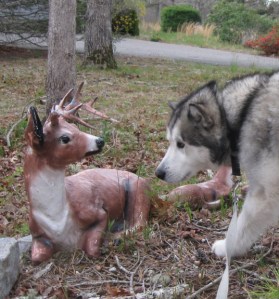
The fictional Wolfie is based on the very real Travvy. He wooed at the deer, but the deer wouldn't move.

The fictional Wolfie is based on the very real Travvy. He wooed at the deer, but the deer wouldn’t move.

The other day I was cruising along in Wolfie, the novel in progress, when my mind started to wander. The scene up ahead looked boring. I didn’t want to write it. In it my protagonist, Shannon, and her sixth-grade protégée, Glory, run a temperament test on Wolfie, the Alaskan malamute they’ve rescued from getting shot. One option was to describe the test step by step. I yawned just thinking about it. I’m writing a novel, not a dog-training manual.

Much as I love to write scenes in order, I’ve learned that it’s OK to skip over or skirt the scenes that just aren’t happening. So I sent Glory home to look after her little brother, Matt, while their parents are otherwise occupied.

So the next morning my trusty Pelikan was laying down line after line of brown ink on the page. It wasn’t terribly interesting — sibling interactions that probably won’t survive the first draft — but I had this idea that Glory might try to temperament-test her brother and that sounded like fun. They were out in the driveway. Glory had set up some plastic cones. Matt was pedaling his racing car  around them. Then Matt decides he wants to play on the swing set. He leaves his pedal car in the middle of the driveway. Glory reminds him — with more than a dash of big-sister exasperation — that it has to be put away. Matt scowls —

— and Glory is thrown back a couple of hours, to Shannon’s living room, where she and Shannon are temperament-testing Wolfie.

Oh my. The brown ink flowing out of my Pelikan created A Scene. It did everything I want a scene to do: show my characters in (inter)action, move the plot forward, and turn the heat up — raise the stakes, if you will, for the characters, for future readers, and of course for me. It didn’t sound a bit like a dog-training manual.

I write my first drafts in longhand because my handwriting is barely legible and my zealous Internal Editor can’t fuss at what she can’t read. My writers’ group meets every Sunday night, and since my fellow writers can’t read my handwriting either, I’m typing this first draft into Word as I go along. I edit lightly while I type, but I don’t second-guess myself about the big stuff; I do make notes about things to consider when I launch into serious rewrite. This typescript isn’t really a second draft. I think of it as version 1.5.

In Wolfie 1.5, however, that serendipitous scene will appear in Shannon’s living room, not in Glory’s driveway. Wolfie will be there. Little brother won’t.

Why didn’t that scene show up in its chronological order? Damned if I know. Writing is full of mysteries, and like the songwriter Iris DeMent, I’m content to “let the mystery be.” (Great song, by the way. Take a break and Google it.) Some scenes don’t show up in order. They show up when they’re ready. All you have to do is keep your hand moving across the page, or your fingers on the keyboard.


Furry Dog Story

An excerpt from my novel in progress, working title Wolfie, has just been posted to the Writers & Other Animals blog.

Writers & Other Animals features regular guest bloggers, most of whom are writing about animals — especially dogs! While you’re over there, browse the previous posts. You’ll make the acquaintance of some good writers, and probably pick up a few ideas for further reading.

The excerpt, “Close Call,” features both Shannon and Pixel from my first novel, The Mud of the Place. This takes place about 10 years later. Pixel is based on the late, great Rhodry Malamutt and Wolfie (who isn’t named in the story) is based on my Travvy. Trav was born the day after Rhodry died, so the only way I could introduce them to each other was in fiction.

I usually don’t let my writing out in public until it’s pretty close to done. Wolfie is nowhere close to done: I’m maybe 50 pages into a first draft. “Close Call” represents about four of those pages. Since it comes near the beginning, it doesn’t need a lot of explanation, and it’s self-contained enough to stand on its own.

See what you think!

Travvy woos at the waves, Lambert's Cove Beach, January 2014

Travvy woos at the waves, Lambert’s Cove Beach, January 2014

Rhodry and Dis Kitty, Malabar Farm, ca. 2005

Rhodry and Dis Kitty, Malabar Farm, ca. 2005

Monologue

Writing stalls for myriad reasons. Sometimes the glass is empty, and when you peer down into the well there’s nothing there either. Maybe the secret of avoiding writer’s block is to catch yourself in a stall before it gets worse?

Last week I stalled. The well wasn’t dry — the words were flowing, but they were breaking around the scene I wanted to write. The scene I wanted to write sat on a little island in the middle of a stream. I kept floating on by, over and over. It was opaque. I couldn’t see inside. The outside told me nothing.

In the scene, an 11-year-old girl bikes home after helping a neighbor save a loose dog from being shot. Her long hair is flying, the helmet she’s supposed to be wearing is swinging from her handlebars. I’m getting to know this kid pretty well. She calls herself Glory. Her mother calls her Gloria. Already I don’t like her mother.

But the scene froze as soon as she turned in to her driveway. I could see her house. I couldn’t see inside it.

Time to do some research. Sometimes, in fiction as well as nonfiction, this means looking things up, or going somewhere in person, or interviewing someone who’s got the information you need. In this case the information was in my imagination. Freewriting is my most reliable tool for tapping into my imagination.

Too reliable. That‘s why I was stalling. I’ve glimpsed enough of where my story is going to not want to know what’s going on in that house.

Time to start getting acquainted with Glory’s mother.

I sat down in my chair with lined paper, an old-fashioned notebook, and a fountain pen loaded with the Tropical Blue ink I hadn’t used for a while.

I met Bruce at a fundraiser for a conservation group — they were raising money for rainforests in Brazil or mustangs in the Wild West, I can’t remember. I’m not into all that — life is overwhelming enough in the here and now, don’t you think?

Pen, blotter, and the first page of Glory's mother's monologue

Pen, blotter, and the first page of Glory’s mother’s monologue

Hot damn. I hadn’t even known her husband’s name. Then Glory’s mother confirmed what I’d begun to suspect: that this Bruce fellow is her second husband, and not Glory’s biological father. Glory looks so unlike her parents that her best friend asked if she was adopted. I’d been wondering the same thing.

Javier and I were talking about separating, so it’s OK that I went out for a nightcap with Bruce afterward, don’t you think?

Glory’s mother kept talking. We were at a party — or maybe I was her new therapist? She didn’t tell me her name. I didn’t ask, because I thought I was supposed to know it already. Bruce may not be Bruce either, or or Javier, Javier. That doesn’t matter. Some characters come with names firmly attached — Glory did, that’s for sure — but other names take time to settle in.

What matters is that now I knew enough about Glory’s family to see inside the house. The film started rolling again. Glory walked her bike into the garage and leaned it against the wall, noting that her mom’s car was there but her dad’s car wasn’t. She wasn’t surprised: her dad works off-island (my novel is set where I live, on Martha’s Vineyard) and often isn’t home during the week.

None of Glory’s mother’s monologue is likely to end up in the novel. If I were counting words, would these six handwritten pages count toward my quota? No idea. What counts is that I had to write them before I could write Glory’s next scene.