What Makes a Real Writer?

Stacey, who follows Write Through It and blogs at Diary of a Ragamuffin, posed this question: “What makes one a real ‘writer’?”

She added:

My reason for asking:  After 15 years of teaching, I decided to change careers and have begun a job as a reporter for my small-town newspaper (that is owned by a not-so-small-town corporation).  They knew I had no journalism experience when they hired me.  After four  months, I’m beginning to wonder if just anyone could do the job I do.

I’m not sure if what I do each day is what I had hoped it would be.  Often there is not enough time to write reflectively, and when there is, there’s no one qualified to critique it (in my opinion).

The answer is that there’s no answer, but you know I’m not going to stop there, right?

First off, I worked eight years for a small-town newspaper, the Martha’s Vineyard Times, in a succession of overlapping capacities: proofreader, features editor, features writer, theater reviewer, copyeditor. Reporting wasn’t my forte, but I did a little of that, mostly covering stories when no “real” reporter was available.

So I’m here to assure Stacey: The job you do can’t be done by just anyone, or by just any writer either. The fact that you’re wondering probably means that you’re good at it. You’ve got the knack. You learn fast. You’re able to apply your experience in other jobs to your journalism job.

Been there, done that. I wasn’t a journalist either when I got drafted to fill in for an editorial typesetter who was going on sick leave. I was scared to death I’d screw up, but I needed the work. I could type, I could proofread, I could write, and I had several years’ editorial experience. Short version: I loved it, I was good at it, and pretty soon the paper hired me as a part-time proofreader.

The tricky thing about job description “writer” is that it covers so many different kinds of writing. Reporter. Novelist. Columnist. Essayist. Poet. Diarist. Blogger. Biographer. Academic. Copywriter. Technical writer. And so on and on. No writer does all of them. No writer I’ve ever met wants to do all of them.

I know some crackerjack journalists who won’t cop to being writers. In their minds, writers write books, or fiction, or literary criticism. What writers don’t do is write for newspapers. You see the paradox here? If real writers don’t write for newspapers, then the writing in newspapers isn’t real writing.

Of course it is. If it isn’t, what the hell is it?
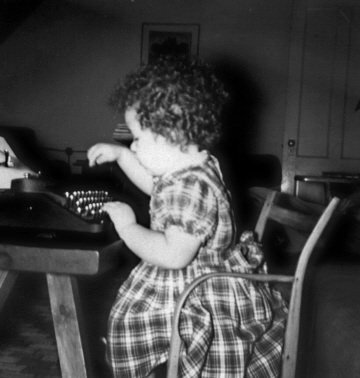
That's me, long before I knew what an editor was.

That’s me, long before I knew what an editor was.

In my teens and twenties, I assumed that a real writer had to know grammar and punctuation backwards and forwards and be a world-class speller besides. So I developed those skills. It wasn’t until I got a job as an editor in the publications office of a big nonprofit that I realized that in the real world these skills made me an editor. I hadn’t even known what an editor was. Some editorial skills belong in every writer’s toolkit, but you don’t have to be an editor to be a real writer.

Poets & Writers is a venerable organization that publishes a bimonthly magazine of the same name. Doesn’t the name imply that category “poets” isn’t included in category “writers”? It does to me. Plenty of poets either don’t call themselves writers or are semi-apologetic when they do: “I just write poetry. I’m not a real writer.”

Same deal as with journalists: If what poets write isn’t writing, what is it? And if the people who write it aren’t writers, what are they?

About her journalism job Stacey noted: “Often there is not enough time to write reflectively, and when there is, there’s no one qualified to critique it.”

This is true. Journalism means writing to deadlines, and deadlines don’t stand around waiting for the writer to get it perfect.

Deadlines don’t wait for editors either. Accuracy is more important than a perfectly crafted sentence. Spell a kid’s name wrong and her parents and grandparents will remember it forever.
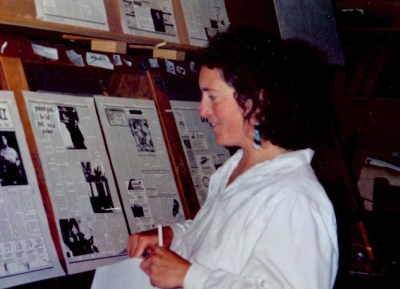
Me, checking the boards at the Martha's Vineyard Times. You can tell it was back in the Pleistocene because the paste-up was pre-digital. October 1993.

Me, checking the boards at the Martha’s Vineyard Times. You can tell it was back in the Pleistocene because the paste-up was pre-digital. October 1993.

Working for the newspaper made me a better writer and a better editor in more ways than I can count. I learned I could write and edit with phones ringing off the hook and people bringing me press releases 12 hours after deadline. I learned that endings don’t have to be perfect because the last two or three inches of a story would often be lopped off when a late ad came in. I learned that writers who can turn out prose like yard goods may write sloppy sentences but they sure come in handy when a scheduled story doesn’t show or an ad gets pulled. I learned that in the work of novice writers the lead paragraph is often buried a third of the way down. I learned that I can turn out a coherent theater review even when I haven’t a clue what the play was about. (It was Beckett’s Happy Days, in case you’re wondering.)

I learned that “good enough” often is good enough, and it’s actually pretty damn good, though for sure you could do better at a writers’ retreat. For a congenital perfectionist like me this was huge.

So what makes someone a “real writer”?

Marge Piercy nailed it in “For the Young Who Want To”:

The real writer is one
who really writes. Talent
is an invention like phlogiston
after the fact of fire.
Work is its own cure. You have to
like it better than being loved.


That’s the last verse. Read the whole thing. Read it often. You don’t have to be young.

Letting Go

Recently a colleague posted to an online editors’ forum: “How do you tell a client who keeps tinkering to just stop?” Her client’s tinkering was not improving the manuscript. In some cases it was making things worse.

Her client was having a hard time letting go, and with good reason: letting go is hard. Off the top of my head I can think of several excellent manuscripts that are languishing in their authors’ desk drawers or on their hard drives because their authors can’t let them go.

The subject has been on my mind lately because I’m in the process of making an ebook out of my novel, The Mud of the Place. The print version came out in 2008. My final draft was a Word file. The proofs were in PDF. Plenty of corrections and tweaks were made on the proofs. My first step was to transfer all of them to the final-draft Word file. Now I’m proofreading the Word file from which the ebook will be created.

In proofreading mode I’m looking for typos and stylistic inconsistencies. I am not looking to change or rearrange any of the words. Yes, a few times I’ve paused at a word and thought that another word might be better. But I want the text of the ebook edition to be identical to that of the print edition. If I find an error — a genuine, bona fide error — I will fix it.

But the time for tinkering is past, long past.

The urge to keep tinkering is often a sign that Perfectionista is gripping your shoulder and scaring you half to death with her what-ifs. What if you’ve left something out? What if you’ve made a mistake? What if your whole book is a mistake? What if everyone hates your book? What if everyone thinks you’re stupid?

Sometimes Perfectionista keeps you from writing. Other times she wants you to tinker endlessly with what you’ve already written. Whatever she’s up to, the way to loosen her grip is the same: Lower your standards. And no, that doesn’t mean “do shoddy work.” It means that no matter how much tinkering you do, your work is never going to be perfect — and even if it is, someone‘s not gonna like it. You can’t control what anybody else thinks.

Letting go takes practice. You’ve got to have confidence in your work — that takes practice too. If you’ve been sharing your work in a workshop or a writers’ group or with readers who’ll give you honest feedback, you’re well on the way. Sharing your work, after all, is a kind of letting go.

Deadlines can be a big help. When the clock or the calendar says you’re done, you’re done. The train is leaving the station and your story’s on it. When you see your story in print, a few hours or days or weeks later, you probably see something you would have done differently, but the chances are excellent that it’s fine as is.

Especially if you have a good editor acting as your safety net.

And one last thing: It’s easier to let go of one work when you’re hard at work on something new. The new story or essay or book probably won’t leave you much energy to obsess about the one that’s ready to leave home. Kiss it goodbye and move on.

Not ready to let go: The late Rhodry (1994–2008), right, and his buddy Rosie.

Not ready to let go: The late Rhodry (1994–2008), right, and his buddy Rosie.


Make Room

Place matters.

Places help shape the things that happen there.

A classroom doesn’t look like an office doesn’t look like a church. All classrooms (etc.) don’t look alike either. They aim to shape different things. Some work better than others.

Some people can write anywhere, anytime. When you’re stalled or stuck or feeling balky, though, having place on your side can be very helpful. Classrooms, offices, and churches help people focus on whatever they’ve come to do: learn, teach, work, worship, whatever. Your writing place can do likewise.

It doesn’t have to be a separate room with a door that closes, though if you live with other people this might help.

When my workspace is messy, it means things are happening there. That's Travvy, one of my muses, on the left.

When my workspace is messy, it means things are happening there. That’s Travvy, one of my muses, on the left.

It doesn’t have to be a place you use only for writing either. Plenty of good writing happens at kitchen tables. I write in the chair where I also sit to edit or read. When I sit down to write, I light a candle or two. If a candle is burning, it’s writing time.

Particular objects and rituals can help turn ordinary time into writing time, an ordinary place into a writing place. Experiment. Pay attention to all your senses. Candles, incense, music, a favorite glass or cup or mug, a special photo — any or all can help create the place where writing happens.

Actually writing in that place makes the place more conducive to writing. That might be the most important factor of all. So don’t obsess too much about making the place perfect. (Perfectionista is always lurking in the background, waiting for a way to get into your head.) If writing doesn’t happen immediately in your writing place — just write. Write anything. Write the same sentence over and over again. Do it for 10 minutes. Then do it again tomorrow.


Lower Your Standards!

The shrieking you hear is Perfectionista in the background. “Lower my standards? Never! You want me to write dreck?”

Etc., etc., etc.

No, dear. I want you to write, period.

Expectations are good. Goals are good. When they’re unrealistic, however, they’re not so good. When I’m stuck or stalled, unrealistic expectations are usually the source of my troubles.

Consider: You’ve resolved to write for two hours a day, but day after day you don’t do it because you can’t find two hours to write in.

Revise your goal. You’ll write for one hour a day. If you can’t find one hour a day to write in, make it 30 minutes. Or 15. Or 5. When you’re meeting your goal, start revising it upward. Be sneaky if you have to.

After I’d completed a draft of The Mud of the Place, I freaked out. OMG, thought I. I might actually finish this thing.

This raised all sorts of scary questions, like “What if it sucks?” and “What next?” I dillied, I dallied, I stalled.

I made a resolution: I will write every day until it’s done. At that point I knew myself well enough not to specify a length of time or a number of words. Just I will write every day until it’s done.

And I did. Sometimes I didn’t start till 11:30 at night. A few times I didn’t open the file till five minutes to midnight. But I wrote every day till it was done. In the process I learned that when I’m working on a long or scary project, writing every day is important. Hell, just looking at the thing every day is important. If I don’t, I quickly convince myself that whatever I’m working on is unsalvageable crap. Then I don’t dare look at it. What if I look at it and discover I’m right?

Thanks to Travvy, my Alaskan malamute, I got into dog training. He needed it. So, as it turned out, did I. One of the basic principles of the training I do is Make it easy for your dog to succeed. If your dog isn’t learning what you’re trying to teach, try breaking the task down into smaller parts. When the dog gets one part, move on to the next.

Works for writing too. Try it.


When? Now

I can revise, rewrite, and edit at any time of day or night. First-drafting, however, I have to do in the morning, the earlier the better. The writer in me is a morning person. The editor wakes up later. Perfectionista sleeps like a dog. The slightest rustle wakes her up, and once she’s awake she won’t shut up.

So, a dilemma: I’m on day 4 of a nine-day dog-and-pony-sitting gig. This involves two drive-bys a day, a.m. and p.m. The morning drive-by — feed dog, hay pony, pick out stall and paddock, take dog for walk — eats up my best writing time.

If it were just for  a weekend, I might skip writing, but for nine days? No. And I’m looking at a string of critter-sitting gigs that stretches into mid-March. All involve being somewhere else by 8 a.m. What to do, what to do?

This morning I was out of bed and dressed by 7. I zapped the remnants of yesterday’s tea  in the microwave and put on the kettle for a fresh pot. I sat down in my chair, lit a candle, and pulled over the pages I’d been working on: a character sketch for the novel in progress, Squatters’ Speakeasy, that may be turning into a scene. And I wrote. A page and a half of dialogue that looked pretty good when I reread it three hours later.

All in 35 minutes.

Perfectionista is sure that if I don’t have at least an hour blocked out, it’s not worth sitting down to write.

Not true.

My workspace. It's rather more cluttered now. That's a good sign.

My workspace. It’s rather more cluttered now. That’s a good sign.