Many writers hate rewriting. I love it. First-drafting is like breaking trail. Breaking trail is exhausting. (We’ve had a lot of snow this winter. My dog and I have broken a lot of trail. We’re both tired when we get home.)
Rewriting is more like pruning branches, tossing rocks out of the path, and notching trees to mark a trail. Even when it means rerouting a trail to avoid a fallen tree, I’d rather be rewriting than breaking trail.
For now I’m lumping editing and revising in with rewriting, even though they aren’t exactly the same thing. Rewriting means “messing with your first draft.” It can include anything from minor tweaks to a total overhaul.
If you hate rewriting, why should you do it? Good question. Maybe a better question is when should you do it? Not everything needs to be rewritten. Journal entries don’t. Freewriting exercises don’t. Most personal correspondence doesn’t — which is not to say that you shouldn’t reread the letter before you seal the envelope or the email before you hit Send. You should.
Irish playwright Richard Brinsley Sheridan nailed one of the whys with these much-quoted and -misquoted lines:
You write with ease, to shew your breeding;
But easy writing’s curst hard reading.
When you rewrite, you focus on your intended audience. That can be your boss, your publisher, your teacher, your writers’ group, your legion of fans — whoever you want your writing to reach. My audience includes myself. Yours probably does too. (I just learned from a Richard Nordquist column that Sheridan wrote “vile,” not “curst,” but I sort of like “curst” better.)
At the moment I’m taking a break from Squatters’ Speakeasy, the novel in progress, to work on an essay about The Sleepwalker, a statue whose temporary installation at Wellesley College is causing much discussion at Wellesley and elsewhere. No one’s waiting for this essay. I have no deadline and no length limit. I’m writing it because the placement of the statue raises several issues that have fascinated me for a long time, like risk and feminism and the purpose of art.
I’m writing primarily to clarify my own thinking, though if I can inspire other people to consider these issues from different angles, that’s more than OK with me. This purpose is what guides me as I rewrite.
Here’s what the beginning of the first draft looked like:
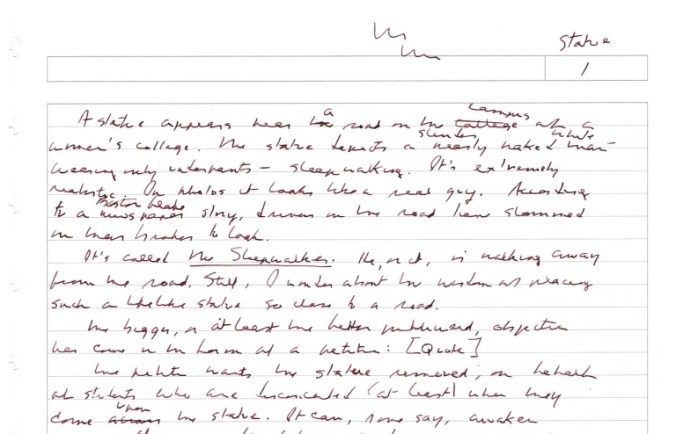
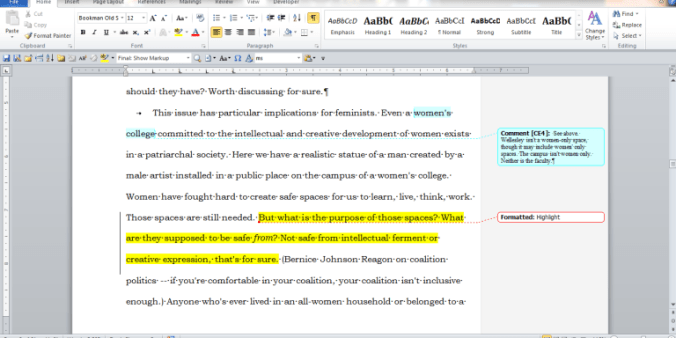
After 13 pages, I figured I had enough good raw material to proceed to the next draft. So I typed my handwritten pages into Word (Word 2010 on a Windows 7 laptop, for those who are wondering). The first two paragraphs look like this:

The words are almost the same, but they look different, don’t they? Seeing those nice crisp letters, words, and paragraphs triggers my internal editor. At this point, I welcome her on board.
This draft is 21 pages long — considerably longer than its predecessor. At this stage the essay is still expanding. A phrase might trigger an elaboration or a detour: I go with it, not worrying about how it’s going to fit into the final version. At the same time, the internal editor is noting that a paragraph toward the end might be more effective near the beginning, and that I’ve discussed the same point in three different places — could they be consolidated?
Now I’m working on the third draft. My internal editor is having a field day. Word’s various features come in very, very handy. Internal editor is making comments for the writer to consider. She’s highlighting key phrases and sentences that will help structure the next draft. She’s also making additions and deletions, always with changes tracked. Nothing’s set in stone at this point. The writer likes how it looks.

 Write Through It