I get nervous when editors talk about “preserving the author’s voice.” There’s often a condescending tinge to it, as if “preserving the author’s voice” means putting up with sloppy writing. It doesn’t. It does, however, require a certain flexibility on the editor’s part. It may mean bending “rules” that aren’t rules at all, like “never split an infinitive” or putting a comma where the Chicago Manual of Style says you don’t need one. This makes some editors, especially copyeditors, uncomfortable. (For a rough breakdown of the “levels” of editing, see “Editing? What’s Editing?”)

Travvy, my Alaskan malamute, had no trouble finding his voice. He’s very articulate, but he doesn’t know beans about punctuation.
I don’t think “author’s voice” had been invented when I started writing, so I never worried about finding mine.
I hope you won’t either.
If you write a lot, you will develop your own style. All the choices you make — about words, sentence structure, punctuation, and paragraphs, and especially about how to put them together — become your style. If you keep writing, it’ll evolve, depending on what you’re writing about.
Reading is crucial here. Read good writers. Pay attention to how they solve problems. If they’re really good, you might not realize that they ever had a problem. Trust me, they did. They do. They deal with awkward transitions, flaccid sentences, unconvincing characters, and all the other stuff that makes you want to tear your hair out and give up.
Even if you don’t have any problems (for the moment), you can pick up new tricks to try. The more tools you’ve got in your toolkit, the better. Go ahead and try writing in the style of an author you like. Or, maybe even better, an author you don’t like.
If you keep writing, you will develop your own style. You’ll find your voice. Trust me on this. It will happen.
Different kinds of writing do impose different requirements. Sometimes the author’s individual voice takes a back seat to the demands of the job. Think reporting. Think technical writing. If you work in such a field, you’ll develop a style that’s suited to it. Your editors will edit your work with the demands of the field in mind. This doesn’t mean you can’t do other kinds of writing as well. The ability to marshal facts and write clearly can come in handy anywhere.
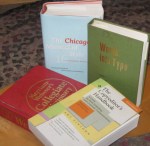
Some useful tools of the writer’s trade. They’re here to help you, not drive you huts.
Yes, you should learn the rules and conventions of whatever language(s) you’re writing in. Contrary to popular belief, these rules were not invented to drive students crazy. They’ve developed over time to facilitate communication between writers and readers. They’re tools. Tools are as important to writers as they are to carpenters and car mechanics. When a writer isn’t comfortable with a particular tool, awkwardness can result.
At the moment I’m copyediting a nonfiction book whose author seems uncomfortable with pronouns. Instead of writing “he” or “him,” “she” or “her,” he repeats the subject’s name — and to avoid repetitiousness he’ll use the first name here, the last name there, and sometimes a nickname if the subject has one. It took me a while to sort out which names belonged to the same person.
If used consciously, this technique can convey nuance and tone. You can refer to a person (including, need I say, a fictional character) by his or her last name in formal situations, then use the first name when s/he’s hanging out with friends. Switching from one to the other will then suggest to your alert readers what mode the person is operating in, what figurative hat s/he has on.
Don’t worry about finding your voice. You’ve already got one. Think of all the ways you use your speaking voice. You can SHOUT. You can whisper. You can sing. You can runwordstogether or you can pause. between. each. one. Addressing a group, you speak more carefully than you do when you’re talking with friends. Your author’s voice can be just as flexible and at the same time just as much you. Keep writing!

 Come to think of it, this is yet another way that writing and editing are like driving. Some people observe speed limits and use their turn signals because they’re afraid they’ll get a ticket if they don’t. True, they might — but seriously, how many cops are on the road at any one time? Not enough to ticket more than a tiny percentage of scofflaws.
 It’s also why sometimes I’ll slam on the brakes a page or two after I’ve made one of those apparently instinctive changes, then go back and stet the author’s version. (“Stet” means “let it stand.” If a writer doesn’t agree with an editor’s change, she can stet the original.) While I’m editing along, evidently I’m also evaluating my editing. How do I do it? Damned if I know.
 Write Through It