The Name Game

Editing nonfiction, I’m always astonished and delighted by the sheer variety of people’s names. Some are common, others unusual. Many hint at where the individual or his/her forebears might have come from — at least the forebears in the paternal line. The names of women are usually plowed under by marriage, though they may resurface in a child or grandchild’s middle name.

Other names are more generic — which in English-speaking countries means “more Anglo-Saxon” — than the people who bear them. Immigrant names were often changed at the border by immigration officials who found the original unpronounceable or unspellable. Individuals change their own names for an array of reasons. Sometimes the grandchildren of immigrants reclaim the ancestral name, though it means they’ll be continually asked how to spell or pronounce it.

One of the first things a small-town newspaper copyeditor learns is that most readers will forgive the occasional error of fact and rarely notice the grammatical gaffe, but if you misspell their names or, worse, the name of one of their kids, they will remember it forever. The first name of one fellow who appeared occasionally in news stories was Kieth. Yep: i before e. As with Triple Crown champ American Pharoah, the impulse to “correct” it was strong, but once I ascertained that “Kieth” was correct, I didn’t give in to it.

I’m jealous of nonfiction writers. They do have to get the names right, but at least they don’t have to make them up.

Fiction writers do.

Naming characters is like titling the work. Some names come easy. Others come hard.

A character in Wolfie, my novel in progress, appeared as Bruce McManus. “Bruce” has stuck, but “McManus” was a placeholder. His real name didn’t show up on its own. I had to poke around my brain looking for it.

What made this difficult is that Bruce is not a nice man. He’s not-nice in a particularly loathsome way, but his particular kind of loathsomeness is not all that rare.

What was wrong with McManus? Well, I wanted a generic name that would not be associated with a specific ethnic or national group. “Mc-” suggests Irish or maybe Scottish. Bruce comes across as WASP and probably is. When it comes to names, I have a couple of ruts that I regularly fall into, and one of them is names beginning with M. A main character in this novel is Shannon Merrick. Up the road from her is a couple named Morris.

Another of my ruts is trochees — names of two syllables with the accent on the first: Shannon, Merrick, Morris . . . I’ve also got a few three-syllable names going — Segredo, Kelleher, Correia, McDermott — but not many with only one syllable. So I started brainstorming single-syllable, generic names.

Trouble was, nearly all those single-syllable names were good English words: Black, Brown(e), White, Green(e), Stone, Hunt, Young, Pierce . . . Their meanings and connotations were likely to color (sometimes literally) readers’ perceptions of the character, and raise the possibility that this was intentional on my part. Nothing wrong with that: I’ve done it myself. In my first novel, The Mud of the Place, Jay Segredo got his surname for a reason. “Segredo” in Portuguese means “secret.” But with this Bruce character? No.

So while I was out walking one morning and thinking about something entirely different, “Smith” slipped into my conscious mind. Bruce Smith. Bruce Endicott Smith. I had it: a one-syllable surname that was about as generic as you can get in English and that didn’t begin with M. 

Some characters show up with names firmly attached. How to name the ones that don’t? There are plenty of options. Some writers open the phone book at random then let their forefinger do the picking, once for the first name, once for the last. I often discover names by listening to the characters talk, either to themselves or to each other. My novel is set in a particular place — Martha’s Vineyard, Massachusetts, New England, USA — which limits my options somewhat. If your story is set in Croatia, Armenia, Brazil, or Japan, or if one of your characters comes from somewhere else, there are names lists galore on the Web for different places and different languages. If you don’t know the place or language, though, take care: the name you choose may have associations you don’t know about. (“Bush” was not one of the monosyllabic names I considered for Bruce.)

For fantasy and science fiction writers the possibilities might seem endless, but not really: readers have a harder time with names they can’t pronounce or remember easily.

Do names really matter all that much? “A rose by any other name would smell as sweet,” true, but if roses were called rhododendrons, they probably wouldn’t show up in so many poems. The busybody who appeared in the excerpt I quoted in “Free the Scene” didn’t give her name, but it turned out to be Juliet Cavendish Cooper. If that suggests someone who’s imperious and proud of her genealogy, fine with me.

For the important players, though, the name can provide a way into the character’s head and history. How did the person come by that name? Does s/he like it or hate it? Growing up a Susanna, I wanted a name like everybody else’s so I went by Sue or Susan (occasionally spelled Suzan). After high school I decided that Susanna really was much better, even if I often have to spell it out. One of my main characters, given name James, as a kid was widely known as Jimmy. After he left home, he started calling himself Jay. Now only his mother calls him Jimmy.

My friend the prolific mystery writer Cynthia Riggs sometimes donates naming rights to good causes. If you’re the high bidder at a benefit auction, you or your designee gets a namesake in Cynthia’s next novel. This is how Bruce Steinbicker, in Cynthia’s recently released Poison Ivy (St. Martin’s, 2015), got his name. But in the writing Bruce the character took on a personality of his own, as characters are wont to do. This prompted Cynthia to write to Bruce the real guy:

In the Martha’s Vineyard Mystery Series book I’m writing now, Poison Ivy, I intended the character named after you, the TV star Bruce Steinbicker, to make a simple cameo appearance on the porch of Alley’s Store. However, the character insisted that he play a larger role . This is a problem writers often face. A character takes over and there’s not much we can do about it. But since our character, Bruce Steinbicker, decides to have a dalliance with a woman other than his wife, I thought I should let you know in case this might cause problems for you in your personal life. If so, I can give our Bruce S. character an alias.

Please let me know whether or not you’re comfortable with being loosely identified with our naughty Bruce Steinbicker, as I’m in the home stretch.

To which Bruce the real guy replied: “I’m fine with this and when I showed your message to my wife of 49 years, she just laughed.”

Since Cynthia and I are in the same writers’ group and I heard most of Poison Ivy in manuscript, I’m now wondering if that’s where my Bruce’s name came from. Maybe yes, maybe no, maybe yes and no. The writer’s mind steals from here, there, and everywhere, then forgets where the shiny baubles came from.


Less Is (Often) More

In the late 1980s and through the 1990s, I was much involved in local theater, as stage manager, actor, reviewer, PR person, playwright, and all-around flunky. In the years since I’ve drawn heavily on that experience as both writer and editor. Here’s an example, brought to mind by something another editor was wrestling with.

My colleague was editing a novel in which a 20-something character texted to another character a acronym-laden message that my colleague found incomprehensible. She’s not an avid texter, so she asked an online editors’ forum for feedback. Would the acronyms be readily understood by text-savvy readers?

The answer was a nearly unanimous no. Even the avid texters had trouble figuring it out. It didn’t sound like a plausible text either.

What to do, what to do?

One possibility was that the 20-something character was being intentionally obscure. This, however, didn’t seem to be the case. There was general agreement that translating the acronyms into plain English was out of the question. Footnotes are fine in a scholarly work but not so fine in a novel, and working the translation into the text was going to look contrived no matter how gracefully it was done.

Aside: Something like 20 percent of War and Peace is in French. There’s a point to this. Tolstoy is showing us how the French-speaking Russian aristocracy is estranged from the Russian-speaking rest of the country, at a time when the French-speaking Napoleon is threatening Moscow. In the original Russian, Tolstoy provided translations in the footnotes. Translators Richard Pevear and Larissa Volokhonsky kept the French (and a smattering of German) in their translation and provided English translations in the footnotes. It worked. I loved it. But I know for a fact that I am not Tolstoy, and you probably aren’t either.

This brought to mind something I learned as an amateur actor who occasionally had to speak with a foreign accent or in an English dialect not my own. My teacher was the late Dr. Louise Gurren, a retired professor of linguistics who’d been an avid theater buff all her life. She was the language consultant on almost every production I worked on, and many more besides.

When we actors went to her to learn to speak southern or English or Russian or Australian, her method went like this: First she’d teach the accent as authentically as possible. Once we had that down, she’d point out that if we spoke that way, the audience would have a hard time understanding what we were saying. So she’d then teach us to “back off” enough so that we sounded authentic but were still comprehensible to a general audience.

Travvy picture

Any excuse for a Travvy picture, right? Travvy loves to jump. Note the retrieve object in his mouth. He’s working hard!

Excruciating accuracy is a must if you’re conducting an experiment or reporting a news story, but on the stage and in fiction it can get in the way.

I suggested to my colleague that a similar approach might serve her client well: In text messages, use enough acronyms and emoticons to sound authentic but not so many that readers are left scratching their heads.

This might apply as well to the research and technical know-how you bring to your story. In my novel in progress, I’m drawing on what I’ve learned training my dog, but I’m not writing a dog-training manual. My goal is to sound like I know what I’m talking about without boring my readers — especially the less dog-obsessed among them — to tears with esoterica that isn’t important to the story.

Less is (often) more. Thank you again, Dr. Gurren.

Free the Scene!

Here’s a revision tip for you. I’m currently working on the second draft of my second novel, and it just came in handy (again).

When reading your early drafts, keep an eye out for the potentially interesting scene that happens off-stage. Maybe you were in a hurry when you wrote that part. Maybe you didn’t see the possibilities. Maybe you did, but they were a little bit unsettling and you didn’t want to go there — yet.

Open the door. Let the scene out. Give it room to breathe. See what happens.

These things are little gifts from the Muses, or your subconscious, or wherever you think your writing comes from. They’re the treasures you find at the bottom of a heap at the thrift shop, or in your own closet.

Here’s one of mine. In draft #1, Shannon, one of the novel’s two viewpoint characters, gets a phone call. It goes like this:

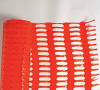
Meanwhile, Shannon had had a call from some busybody on the conservation commission, whose members apparently cruised around looking for unsightly objects that detracted from what they called “the character of the town.” The busybody objected to the snow fencing Shannon and Ben [Shannon’s next-door neighbor] had put up to reinforce the post-and-rail fence in the back yard. Shannon explained about Wolfie [the dog she’s just rescued], and how the post-and-rail alone wouldn’t keep Wolfie in for a minute. The busybody was not impressed: the fence did not conform to the town’s fence bylaw and that was that.

This phone call had the makings of a fun scene, and I was ready for a little comic relief. What if the busybody showed up in person? What if she caught Shannon in the act of installing the fence?

snow fence 1Consulting the town’s zoning bylaws — the scene takes place in the town I live in — I discovered that the snow fencing didn’t violate any bylaws, but this wouldn’t stop some of the busybodies I’ve run into in my time. I also decided that she wasn’t actually on the conservation commission. She had appointed herself guardian of the character of a neighborhood she didn’t even live in.
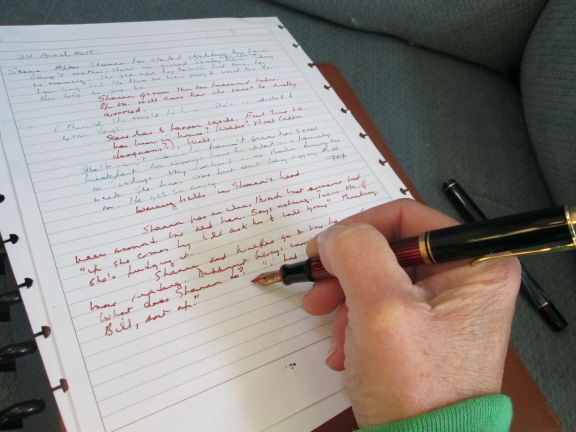
This is what the phone call turned into this morning. Note that I’m still in early-draft mode. I strongly suspect that the scene will appear in the novel’s final draft, but I don’t know what it will look like. Will this woman appear again? No idea. It’s up to the Muses.

[Shannon] was halfway done when a white Honda Pilot passed on the road, heading toward the intersection with the Edgartown Road. She didn’t recognize it. Not that she knew every vehicle that lived between here and Sepiessa, but her mind half-consciously sorted them into familiar and unfamiliar and this one she’d never seen before.

Even more unusual, two minutes later it passed by again in the opposite direction. Shortly after that it rolled to a halt on the grassy shoulder opposite her driveway. Looking for directions?

The driver got out of the car, looked both ways, and crossed the road. She carried a cane but walked briskly, barely tapping it on the pavement. Her mostly gray hair was done up in a french twist and her garb said “country gentry”: heavy wool cardigan with leather elbow patches, an ample wool skirt that hung just below the knee, and sturdy walking shoes, all in autumnal browns and russets. She did not look lost. She caught Shannon’s eye briefly then rapped the top rail of the roadside fence with her cane.

Taking this as a summons, Shannon wiggled the stake she had just driven into the ground to make sure it was steady, laid mallet and zip ties on the ground, and walked up to greet the visitor.

The visitor wasted no time on introductions. “Do you have a permit for that fence?” she asked, in a clipped accent that sounded somewhat English but wasn’t.

Loaded for bear, thought Shannon, but with no bears in sight. “That fence has been there for over fifteen years,” she said pleasantly. “I don’t believe I need a permit.”

“That orange fence” — the woman pronounced the word with obvious distaste — “has not been there for fifteen years. You are just now putting it up.”

Caught red-handed, Shannon thought. “I don’t believe I need a permit for that either,” she said. “It’s temporary. I’m fostering a dog for a few days, and I don’t want him getting loose.” She resisted the temptation to tell the woman why she didn’t want Wolfie getting loose. Maybe the woman did know someone on the road. Maybe she kept chickens.

“It is unsightly,” said the woman. “It is not in keeping with the character of the neighborhood.” She rapped the railing with the head of her cane for emphasis.

snow fence 2

In Shannon’s fourth grade Sister Mary Clement had habitually rapped her eighteen-inch ruler on the desktop while fixing the latest class miscreant with a glare that promised trouble. Shannon hadn’t thought of her in twenty years. Her visitor wasn’t a nun but she was cast from the same mold.

Shannon conceded that the blaze-orange snow fencing was not especially attractive but noted that it was only visible from the road if you slowed down to about five miles an hour and stared out the passenger-side window. She did not ask the woman if she’d ever been down this road before, and if not, how she knew so much about the character of the neighborhood. The character of this neighborhood was more disturbed by big gray dogs running loose than by blaze-orange snow fencing in someone’s back yard.

“The town bylaws are quite clear what sorts of fence are allowed,” the woman said, “and this is not one of them.”

Shannon had no idea what the town bylaws said about fences, but Ben had once served on the zoning board. If he thought snow fencing might be a problem, he wouldn’t have suggested it. Besides, it was past the middle of October. No one who came down this road at this time of year would be bothered by snow fencing. Those with more delicate sensibilities had mostly gone home. “I’ll see what I can do,” said Shannon, turning back toward her interrupted labor.

“I intend to communicate this to the conservation commission,” the woman called after her.

“You do that,” Shannon muttered, not quite audibly. She heard the staccato whack whack whack of the woman’s cane on the asphalt. The car door opened and slammed shut. A moment later the engine rumbled. Shannon zip-tied the snow fencing to the new post and set about pounding the next one into the ground.

Restarting

I can revise, rewrite, and edit pretty much any time I’m awake, but for writing, especially early-draft writing, especially writing long and scary projects (like Wolfie, my novel in progress), I’m best in the morning, in the hour or two or three after I wake up.

I’m braver in the morning. I’m less easily distracted by the voices chattering inside my head and by whatever I’m supposed to do that day.

For several recent weeks my early-morning writing time was taken up by work, editing for pay and on deadline — my livelihood.

Another thing: When I’m working on a long and scary project, my mind is usually mulling it over while I’m out walking with my dog, or dropping off to sleep at night, or waking up in the morning. Mental logjams break up when I’m nowhere near my pens or my laptop.

During those several recent weeks, the jobs I was working on took up semi-permanent residence in my head. That’s what my mind kept mulling when I was out walking, or driving, or dropping off to sleep.

Blank paper is scary, but it's full of potential. (That's the scary part.)

Blank paper is scary, but it’s full of potential. (That’s the scary part.)

In short, for about three weeks I did no work on the novel. I barely even blogged.

How to get back in the groove?

Starting is easy (ha ha ha). Blank pages are scary but they’re full of potential.

I’d recently started a second draft. The not-quite complete first draft is more than 225 pages long. (First draft = first draft prime: the real first draft is in longhand, and I always do a little revising as I’m typing it into Word.) When I tried to recall it, it was like looking through the wrong end of a telescope.

More to the point, I was sure that if I actually looked at it, I would realize it was crap. I have had this problem before. It’s why when I’m working on a long and scary project I look at it every day. Five minutes is enough. I don’t have to write anything. I just have to open the file and look at it.

Once I’ve opened it, I always find something to fiddle with, and after I’ve done a little fiddling, I nearly always write something new.

Wolfie‘s title character is a dog. So far the only cat in the story is Schrödinger’s, and of course I don’t know if that cat is alive or dead, real or unreal. Schrödinger’s famous thought experiment hypothesized a cat in a closed box with a vial of lethal radioactive material. The vial may or may not have broken; the cat may be alive or dead. I, outside the box, don’t know what has happened inside the box until I open it. Is the cat alive or dead?

I, sitting at my laptop, am dead certain the novel in progress is crap. If I actually look at it, I will know for sure it is crap and then what will I do with the rest of my life?

But it never works that way. It’s always

looking -> fiddling -> writing

After I’d read a few pages of my second draft, the seed of a new scene took root in my head. The scene comes much later in the novel. I sketched it out in longhand then went back to reading.

So why the dead certainty that the writing has turned to crap in my absence? Interesting question, but it’s going to have to wait. I’m writing.

The moving hand writes and a scene takes root.

The moving hand writes and a scene takes root.


On to Draft 2!

This past weekend I took a very deep breath and started draft 2 of Wolfie, my novel in progress.

The time had come.

I like to take a break between drafts. The longer the work, the longer the break, which means that with a novel or a long essay it can be a few weeks. This time I didn’t exactly take the break: the break took me. In late January I suspended work on the novel to focus my attention on a long, challenging editing job with an impending deadline. That deadline met, I turned to a review assignment whose deadine was also impending. I’d read the book and been thinking about it for weeks, but now I had to write the review. (For some thoughts about reviewing see “Reviewing Isn’t Easy.”)

Wolfie was never far from my mind. To push on with the first draft or to start the second? That was the question.

Draft 1 wasn’t complete. The Word file stood at 227 pages, almost 55,000 words, with a dozen or so handwritten pages yet to be transcribed. I had a pretty good idea of where things were headed. I probably could have forged on through climax to conclusion and then started the second draft . . .

The trouble was, a couple of significant plot threads have only come clear during the writing. One is hinted at in draft 1 but only sketchily developed. The other comes as a backstory dump in the handwritten pages I haven’t transcribed yet. It needs to start much earlier and be woven into the story.

Over the last year I’ve been taking Wolfie installments to my Sunday night writers’ group. This is a first for me. Usually I don’t let anything out in public until it’s in second or third draft — when I’ve gone as far as I can on my own and need some outside eyes. With Wolfie, though, the weekly deadline and my group’s encouragement have kept me going.

So — should I push on and bring the final chapters one by one to the group, explaining that the backstory to this or that wasn’t set up yet and they’d have to wait for the second draft to understand what was going on? I didn’t like that idea at all. I want the writing to stand on its own.

Maybe more important, I don’t really know how those last chapters are going to unfold. It’s going to depend in part on what my characters do and say in the parts I haven’t written yet, and I won’t know that until I’ve written them.

So I opened draft1.doc and saved it as draft2.doc.

old chap 1

Then I deleted Chapter One. It was an experiment that didn’t work out. The tall man is still in the story, but he doesn’t live in that house anymore. He’s no longer a viewpoint character either.

So far, so good. For me revision is usually about 80 percent cutting and rearranging what’s already there. Chapter Two from draft 1 is now Chapter One in draft 2.

new chap 1

My recollection was that this chapter didn’t need much work. It does a pretty good job of introducing one of the two viewpoint characters: Glory, a sixth-grade girl. What I’d forgotten was that somewhere along the way I’d shifted Glory’s sections from past tense to present, but her introduction is still in past tense.

And I’m still not 100 percent sure that present tense is the way to go. Rather than rewrite it now, I made a note in the margin. The muses haven’t given me a clear answer on that one yet.

For the new Chapter Two, I’ve gone back to writing in longhand. The story itself isn’t going to change much, but I need a new way into it — a way that hints at some of the things I didn’t know when I wrote it the first time. What this means is that with Wolfie second-drafting is going to look more like first-drafting than it usually does. It’s going to involve plenty of exploring, digging, and otherwise adding new stuff — writing, in other words.

Travvy

Travvy, on whom Wolfie’s title character is based, takes a break from digging in the snow.

For me, editing is relatively easy. The writing tells me what has to be done, and I do it.

Writing is more like breaking trail through two feet of snow. My dog and I have done a lot of that lately. It’s exhausting, and it takes longer to get anywhere than it does when we’re walking on good old dirt.

But second-drafting already seems less daunting than starting from scratch. This time around my characters are helping — some of them more than others, of course — and so is the story. If I listen carefully, I can hear what’s not being said. I can visualize the scenes that need to be there that aren’t there yet.

My writing will teach me what I need to know if only I keep writing.

Wrung Out

The end of draft #1 of novel #2 is in sight. Not close exactly, but I can see it on the horizon. Plot lines are converging. Things are getting, shall we say, tense.

For instance — two main characters meet by chance in a hardware store. They’re kibitzing about the complexities of modern lightbulbs, though neither one is all that fascinated by lightbulbs. Amira notices that Shannon looks preoccupied. A few moments later Shannon blurts out that she’s just had bad news.

The hardware store aisle isn’t a good place to have this conversation, so they adjourn to a nearby café for coffee (Shannon) and lunch (Amira).

This is the scene I wrote this morning.

Shannon has just learned that her dog has inoperable cancer. She is starting to beat herself up about her failure to (a) notice this earlier, and (b) prevent it.

Amira doesn’t want Shannon to go there. She recounts the story of how her father, visiting his other daughter and her family in Florida, went to the neighborhood convenience store with his four-year-old niece riding on his shoulders. A robbery was in progress. The robbers run out shooting; the niece is hit and dies two days later. Amira’s father never stopped beating himself up with what ifs and if onlys. He has since died.

Amira started down the what if / if only road herself but friends helped pull her back to the land of the living.

I knew this scene was coming but I didn’t know how or where it was going to happen.

I was totally wrung out when I laid my pen down this morning. Could not write another word. So Travvy and I went for our morning walk. With sunshine, brisk air, and steady steps my energy returned. It always does.

It can be scary to look down the road and see that the writing is leading you toward a scene that’s going to wring you out. I’ve been known to do other things — aka “procrastinate” — until I feel ready, even though I never feel entirely ready. Just ready enough.

But those wrung-out moments tell me that I’ve been writing well, and true, and deep. My pen has tapped into something I can’t reach any other way.

Point of View

If you go web-surfing or pick up a couple of how-to-write books, you can learn almost everything you need to know — and a great deal more — about point of view (POV).

What you have to figure out for yourself is what works best for whatever you’re working on.

First off, a short lecture: Everything created by humans has a point of view. Even the formal, scholarly stuff that pretends it doesn’t. Even the photographs that are supposedly worth a thousand words because you’re supposedly seeing the real thing, not someone’s possibly inaccurate, incomplete, or biased description of it. What you’re seeing is what the photographer saw and wants you to see. This was true long before Photoshop, and it’s true now.

Visual images have a literal point of view: a place where the viewer is standing, sitting, hovering in space. This affects what you see. You can’t see the dark side of the moon from Earth. You can’t see the backside of whatever the photographer’s showing you the front of. You can’t see what’s above or below, to the right or left of it either.

Here, though, we’re talking about writing, particularly fiction writing.

Fron Cover MockupMy #1 goal for my first novel, The Mud of the Place, was to show how the place I live in works. I live on Martha’s Vineyard. Martha’s Vineyard is in the news a lot, especially in the summer, especially when the president comes to visit. If you see Martha’s Vineyard on the news, you generally see what the reporters see: the summer resort, the quaint tourist attractions, the celebrities. I wanted to show what goes on backstage. The reporters and the summer people rarely see this stuff, and when they see it, they don’t really understand what’s going on.

In short, I wanted to tell stories about people who aren’t considered newsworthy. How to do it?

Mud wanted to be an ensemble piece. So it’s all in third person, with several POV characters. (Yes, I know they all sprang from my first-person mind, but bear with me here.)

Each scene has a single POV. Sometimes an interaction or a conversation can be glimpsed from both sides, but there’s always a scene break where the POV shifts. I learned a lot about each character from seeing him or her through other characters’ eyes. Sometimes a sequence of events remained out-of-focus because the POV character involved didn’t think or say anything about it, and the other POV characters didn’t know what had happened. I liked that a lot.

At one point in my first draft, a non-viewpoint character told my protagonist something my protagonist hadn’t suspected. I didn’t like that so much. In fact, it scared the hell out of me, because I had to drastically overhaul the plot and I was already afraid I’d never finish the thing. But I did, and Mud was much the better for the overhaul. I’d thought I was writing a tragedy. Turns out I was writing a comedy, in which nearly everyone is better off at the end than they were at the beginning.

Moral of story: Non-POV characters have a way of getting their perspectives into the tale. Don’t discount them just because you’re not watching the action through their eyes.

Wolfie talks a lot, but he isn't telling the story.

Wolfie talks a lot, but he isn’t telling the story.

Wolfie, my novel in progress, is set on that same island, but it’s not an ensemble piece. Like Mud, it’s all in third person, but it’s got a tighter focus. At present it’s got two viewpoint characters. One is a woman in her mid-fifties — Shannon from Mud of the Place, if you’ve read novel #1. The other is an 11-year-old girl. The title character is a dog. No scenes are told from his POV, but he’s as essential to the story as the woman and the girl.

The big challenge is the girl. She’s smart and observant, but what’s going on in her family is key, and she can’t see or understand a lot of it. More, she doesn’t have conscious access to some of her own memories. So in first draft her POV sections are being told in third person, present tense. I’m not a big present-tense fan, so this is a challenge. I also have to work out ways to weave this girl’s backstory into the novel. She doesn’t remember a lot of it, and the one character who does isn’t telling.

Come to think of it, the girl isn’t the biggest challenge. The biggest challenge is the character who knows but doesn’t tell. I hate him. I don’t understand how a person could do what he almost certainly did, and is probably going to do again, and still look himself in the mirror. But plenty of people manage, and if/when their monstrosity is revealed, a popular reaction is disbelief. Creating believable villains is hard. I had a couple of villainous characters in Mud of the Place, but I managed to keep them at arm’s length. I can’t do it with this guy.

There’s also a somewhat mysterious fellow hovering in the wings. I know who he is. He’s important. Is he a POV character? I’m not sure yet. A key scene’s coming up that involves him and another non-POV character. One of them has to become a POV character or I’ve got to figure out another way to get that scene into the story.

This is what I love about using just a few viewpoint characters, none of whom has the whole picture. It challenges me as a writer. I have to plumb those characters more deeply than I would otherwise. I have to come up with incidents that will prompt them to say or think things that readers will need to know. Sometimes they say or think things that even I didn’t suspect. That’s how I know I’m tapping into the deep place that the stories worth writing come from.


Plotting

I just discovered this in From the Seasonally Occupied Territories, my blog about living year-round on Martha’s Vineyard. When I blogged it, in June 2013, I wasn’t even thinking of starting a writing-and-editing blog. Or maybe I was. I’ve updated it a bit, but not much.

Plotting fiction is like making rock candy. Left to itself, boiled sugar water just sits there. Nothing happens. Well, yes, things happen, but they take so long that it’s a rare soul who’ll just sit there and watch.

For me "how-to-write" books are mostly a procrastination technique, but this is one I actually find useful.

For me “how-to-write” books are mostly a procrastination technique, but this is one I actually find useful.

Not the stuff of plot.

Day-to-day life on Martha’s Vineyard is like boiled sugar water. Things happen, but most of them unfold
s-l-o-w-l-y. Even when the results are noteworthy, the steps taken to get there are mundane, quotidian, dull. Follow the newspapers for a few months if you don’t believe me.

No surprise, then, that most novels written about Martha’s Vineyard are murder mysteries. Killing someone off is like dropping a string in the sugar water. Formless liquid crystallizes around the string. Murder shakes people out of their day-to-day routines. They say and do things they wouldn’t do otherwise.

Homicides are rare here. Fiction writers are all in the alternate-reality business, especially if we write about real places, but though I’m happy to read about alternate Martha’s Vineyards where murder happens several times a year, I don’t want to create one. As a plot device, murder makes me just a little bit queasy. My fictional alternate reality is a sort of psychic map of Martha’s Vineyard. I want it to mesh with the Vineyard (I think) I live on.

Dramatic events do happen, of course. Once in a while a quiet undercurrent will explode into a headline. A loose dog jumps a fence and chases down and kills a miniature horse. An on-leave police officer obstructs the firefighters who shows up to extinguish a fire at her home. Such incidents are like strings in the sugar water, good grist for plot, but they have their own challenges. Have you ever really listened to how we recount such incidents for someone who wasn’t there?

“So Jane parked in front of her sister’s house — you know her sister, right? You met her at Cynthia’s Groundhog Day party — no, that’s her older sister; this was the younger one, Margaret — no, you don’t want to call her Peggy, that’s their mother’s name and the two of them barely speak — Is that what happened? I hadn’t heard that — this sister lives in Edgartown, back behind the gas station — yeah, there’s been some trouble there, I’m getting to that — Jane just sat in the car because there was a young guy standing there with a wool cap on even though it’s August — isn’t this heat outrageous? Yeah, I know it’s how they dress, but Jane never saw him before and he had a skateboard under one arm — really, I almost hit one last year when he came shooting into Five Corners from the post office . . .”

Every little thing that happens has at least half a dozen stories feeding into it. Trying to prune and shape these into a plot that readers can follow is, to put it mildly, a challenge.

When I started Mud of the Place, my first and so far only novel, I couldn’t plot my way out of a paper bag. I learned by trial and error, and with the help of a couple of books: Plot, pictured above, and Beginnings, Middles & Ends, by sf writer Nancy Kress.

I didn’t kill anyone off in Mud, but the string I dropped into the sugar water involved a shooting that could have got someone killed. All sorts of interesting stuff crystallized around that shooting.

Wolfie, the canine protagonist of my novel in progress, comes close to killing some sheep. He’s suspected of killing several chickens. Several citizens of his town — which bears the same name as my town — wouldn’t mind taking a shot at him. Some plot has coalesced around that.

There’s also a human character in this novel that I wouldn’t mind taking a shot at, but I haven’t.

Yet.

It’s Your Call

In creative writing classes, students often study exemplary essays, stories, poems, and novels. Learn from the masters — makes sense, doesn’t it?

It does indeed. Nevertheless, much can be learned from flawed works as well.

Does that sound paradoxical?

Think about it. A top-notch work seems inevitable. There’s no trace of the earlier drafts, the ones where sentences and whole paragraphs have been deleted or moved around. There’s no hint of all the back-and-forth second-guessing the author did before settling on that word that strikes you as exactly right. A major character may have dwindled draft by draft and finally disappeared entirely. A bit player in the first draft may have wound up the star of the show.

We editors are lucky: we’re continually immersed in works that aren’t done yet. Copyeditors focus primarily on words and sentences. Substantive editors focus on structure. We develop a knack for identifying, diagnosing, and recommending fixes for whatever problems arise. (For a quickie rundown on the various levels of editing, see “Editing? What’s Editing?”) Sometimes the problem is simply an error that needs to be corrected. Other times it’s that something just doesn’t work.

On a recent job, a novel, I was supposed to be focusing on words and sentences, but before long I was acutely aware that the manuscript needed big-picture help. The novel’s title character — let’s call her Renée — has interesting adventures. She’s a spy behind enemy lines in wartime. But the author has chosen to use a first-person narrator for the entire novel — and this narrator has no contact with Renée while she’s having her interesting adventures. As a result, neither does the reader. The most interesting stuff happens off-stage.

Interesting choices open up possibilities. Not-so-interesting choices choke them off.

Travvy, whom these days I frequently call Wolfie.

Travvy, whom these days I frequently call Wolfie.

Recently, after forging bravely ahead in Wolfie, my novel in progress, I reached a crossroads — a point where choices have to be made. Wolfie, the title character, is an Alaskan malamute who’s been saved from probable death by Shannon, who already has one dog and does not want another. (See this excerpt in the Writers and Other Animals blog.)

What was Shannon most afraid of?

That Wolfie would get loose again. Wolfie’s life and Shannon’s credibility are on the line.

Well, that made it a no-brainer: Wolfie was going to get loose again. The big question was, What then?

Out walking one morning with Travvy, Wolfie’s inspiration and alter ego, I played with possible choices:

  • Wolfie is shot and killed by a farmer.
  • Wolfie is shot and disappears into the woods.

I don’t want to kill Wolfie off. He’s my title character, my wild card, and the first draft of the novel isn’t half done yet. He’s not going to die. Shannon’s going to find him first. The question is how. Shannon can’t run nearly as fast as Wolfie, so these were the obvious options:

  • The leash he’s trailing snags on a tree and he can’t get loose.
  • Wolfie finds Shannon before she finds him.

The second choice startled me: Wolfie comes back of his own accord? I ran with it. It startles Shannon too. It opens up possibilities — the sure sign of a good choice.

The rougher road often makes the more interesting choice.

The rougher road often makes the more interesting choice.

Often it’s not till the second or third draft that you recognize that more interesting choices are possible. What if the author of my recent job had thought, “Aha! If I made Renée a point-of-view character, or even a narrator, her wartime experiences would be so much more immediate and vivid”?

It would have been a much more interesting novel.

When you’re first-drafting and you reach a crossroads, ask yourself: What’s the most interesting choice I could make? What do I want to learn about my characters?

Your readers probably want to learn it too.

When you’re revising and a scene falls flat, ask yourself: What am I missing here? Where’s the conflict? Who’s the wild card? How do I make things happen?

You’re in the driver’s seat. It’s your call.


A Surfeit of Subplots

While procrastinating thinking about doing research on plot the other day, I came upon the Writers’ Workshop website. They’re in Oxford, England. They offer a variety of editorial services for pay. There’s also a lot of great free stuff on their website. I landed on this particular page.

Under the heading “What Does a Perfect Plot Look Like?” it outlines the plot and subplots of Jane Austen’s Pride and Prejudice. (They spelled Lizzie Bennet’s surname with two t‘s — Jane Austen didn’t — but let this be a lesson to you: solid work can survive one copyeditorial goof, or even two or three.)

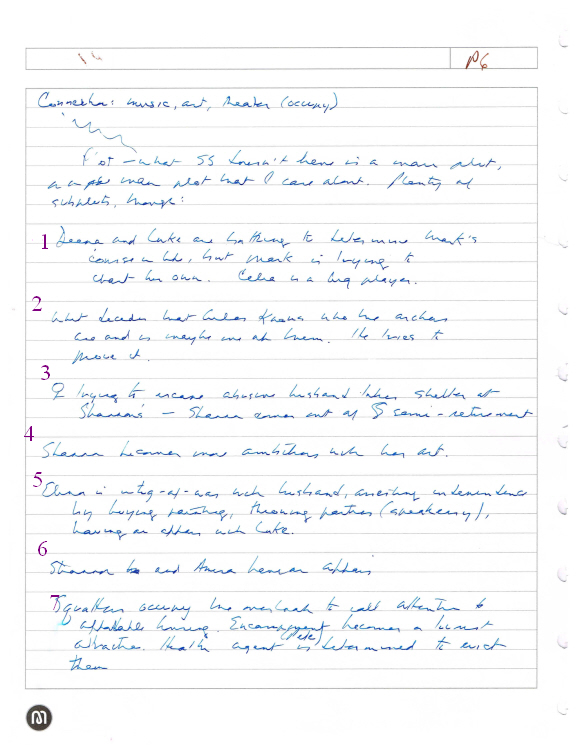
Squatters’ Speakeasy, the novel I set aside, is all sprawl and no momentum. It’s the ocean with no trace of a Gulf Stream. I took out my Squatters notebook, grabbed a pen, and tried to outline its plot.

Subplots

Subplots

What I discovered was that Squatters’ Speakeasy has no fewer than seven subplots but no sign of a main plot anywhere. It’s drowning in subplots. Maybe one of the subplots is really the main plot, but at the moment none of them is jumping up and down and yelling “Me, me, me!”

Wolfie, in marked contrast, has three plot threads going, and I’m engrossed in all of them:

  • Shannon tries to find a new home for a dog in trouble, assisted by Glory, an 11-year-old neighbor.
  • Glory is being sexually abused by her stepfather.
  • Glory’s biological father is using social media to make contact with her.

If you ask me what this book is about, I’ll rattle off something like “Shannon gets pulled into rescuing first a dog and then a girl, and the dog and the girl help rescue each other.” Ask me what Squatters’ Speakeasy is about and I’ll grab hold of one subplot and mumble for 10 minutes. What Squatters does have is plenty of raw material. It’s waiting for me to plot it into some kind of coherent structure.

Travvy looks for a plot

Travvy looks for a plot