Grow Your Images

I loved high school English, but after all those in-depth discussions of Shakespeare, Hemingway, Austen, Fitzgerald, and the rest, I went out into the world with some wrong ideas about writing.

I thought images, symbols, and metaphors were like booby traps. Writers embedded them in their stories in order to razzle-dazzle sophisticated readers, and to trick high school students. Why was there a green light at the end of Jay Gatsby’s dock? Why, to drive us crazy, of course.

My English teacher senior year was aware of the problem. She’d ask what an author was trying to do in a particular passage and then, usually after a minute of nervous silence from the class, add, “This is not a trick question.” We didn’t believe her.

For many years, I wrote mostly nonfiction. Nonfiction, I mistakenly thought, was safe from images, symbols, and metaphors. When I started dabbling in poetry, I knew I was in trouble. Poetry is all about images, symbols, and metaphors, isn’t it?
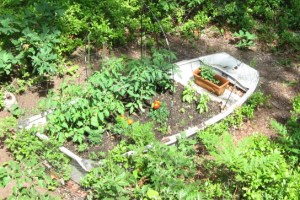
I am not a gardener, but I do have a little garden. It's in an old dinghy.

I am not a gardener, but I do have a little garden. It’s in an old dinghy.

Before long, though, I got it: Images, symbols, and metaphors grow out of the writing. They’re gifts, like sprouts in the spring garden. (Look, look! A simile!) The gardener can nourish them and help them grow, or she can decide the row is too crowded and yank some of the seedlings out. (Metaphor!)

A writer I once workshopped with relayed something she’d heard from a poet she knew: “To be a writer, you have to know one thing well.”

The thing you know well is the soil from which your images, symbols, and metaphors grow. Of course there can be more than one thing, and you can always learn more.

We humans have five senses: sight, hearing, smell, taste, and touch. Think how often we use them figuratively, as opposed to literally. A sighted person can be blind to her talents. A blind person can have vision. I was touched by his concern. That story smells funny.
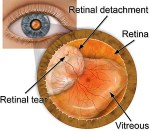
When my retina detached, I barely knew what a retina was.

When my retina detached, I barely knew what a retina was.

Almost 10 years ago, the retina in my right eye detached. In traveling back and forth to Boston, I saw firsthand the changes wrought in the wake of 9/11, which I’d managed to mostly ignore for three years because I don’t travel much and don’t have a TV. Over the following years I wrote an essay about the experience: “My Terrorist Eye.” My main images are right there in the title. They were there from the beginning.

You’ve probably heard the saying “Sometimes a cigar is just a cigar.” This is true. It’s aimed at Freudians who want to turn everything of a certain shape into a phallic symbol. At the same time, the cigar may have significance beyond the literal. If one of your characters recoils from the smell of cigar smoke — well, there may be a story behind it.
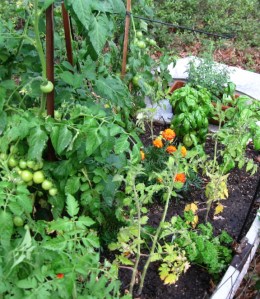
When the garden gets too crowded, it's hard to see what's going on.

When the garden gets too crowded, it’s hard to see what’s going on.

Any story or poem or essay is bound to have lots of images in it. This is fine. Gardens contain lots of plants, don’t they? All sorts of plants. At the same time, if you’ve got too many flowers growing in a limited space, your readers won’t know where to look. They may miss something that you want them to notice. Keep that in mind when you get down to revising your work.

One last thing to keep in mind: Many, many common expressions are metaphors that have long since come adrift from their literal meanings. This can get writers into trouble. Take the phrase “rein in,” as in “rein in one’s ambition.” I sometimes see “reign in” even in the work of pretty good writers. “Rein in” comes from horsemanship. If you keep horses, reins, and bridles in mind, you won’t write “reign” for “rein.” (Come to think of it, I don’t believe I’ve ever come across a reference to “unbridaled passion.” It has possibilities, doesn’t it.)

Metaphors and images can be effectively mixed and matched. They can complement each other or create dissonance. If you use them with care and know where they came from, you won’t inadvertently come up with doozies like “He’s a wolf in cheap clothing” — which also has possibilities, but seriously, you don’t want to do it by mistake, do you?

For a crash course in metaphors, see this post by Richard Nordquist, a retired English professor who is very good at explaining things.
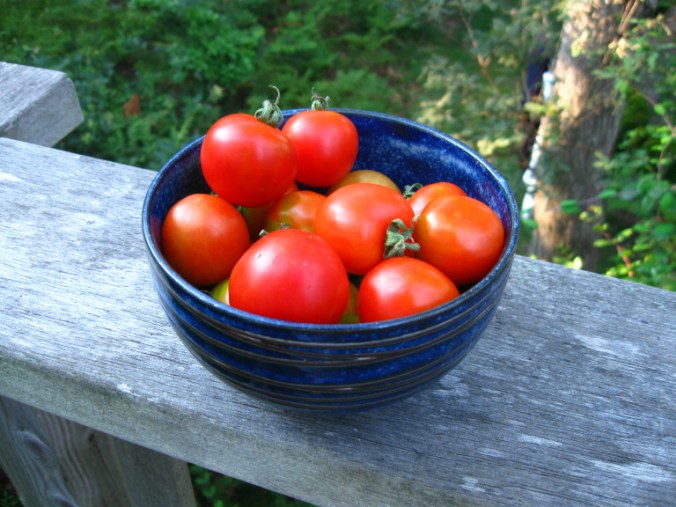
 

My writing may be a garden, but I'd rather eat tomatoes than words.

My writing may be a garden, but I’d rather eat tomatoes than words.

Workshop

In the summer of 1984, having saved my pennies and summoned my courage, I headed off to Ithaca, New York, for the Feminist Women’s Writing Workshop. Was I ready? Was I good enough?

My poetry chapbook (1989). Cover design by Maggie MacCarty.

I’d never been to a workshop. I’d never taken a writing class. I didn’t know what to expect. Junior year of high school, though, I’d won the school’s writing prize. Since then I’d done lots and lots of self-teaching. The college newspapers had published my op-eds and reviews. More recently, my reviews and essays had appeared in feminist and gay publications. I’d written most of the poems that eventually appeared in my chapbook, Leaving the Island (1989). I was working on a novel.

Maybe most important of all, I was the book buyer for Lammas, Washington, D.C.’s feminist bookstore. For years I’d been immersed in a movement, a community, for which books and magazines and newspapers were crucial, life-sustaining stuff. I saw it every day at work: women discovering words that inspired them, strengthened them, and even changed their lives.

Words were my only instrument, writing and editing my only useful skills. It was time, I thought, to test my vocation.

Me standing on the boathouse deck during a break, ca. 1987

Me standing on the boathouse deck during a break, ca. 1987

The heart of the workshop was our morning critique sessions. At each two-hour session, an hour would be devoted to the work of one participant. In those days the workshop was held at Wells College in tiny Aurora, New York, about 30 miles from Ithaca. These meetings were held on the second floor of the boathouse, overlooking Cayuga Lake.

The day before, the scheduled writers would put copies of their work out for everyone to read. (“Copies” meant paper in those days. In 1984 we all still had typewriters.) We took our homework seriously. When we gathered in a big circle at 9 every morning, everyone was prepared. The scheduled writers were usually at least a little bit nervous.

The ground rules were simple. For the first part of the session, the writer was invisible. Critiquers were to discuss the work with each other, as if she weren’t there. Her job was to listen. She wasn’t to speak. The workshop director got the discussion going by asking a question about the work, then she’d keep the discussion on track by asking more questions, making comments, and when necessary reminding us of the ground rules. With 10 or 15 minutes to go in the hour, she’d close the discussion and give the floor to the writer. The writer could then answer whatever questions had been raised, ask some of her own, and generally respond to the comments made.

Talking writing on the Wells College lawn, ca. 1987

Talking writing on the Wells College lawn, ca. 1987

Taking part in these sessions morning after morning was a powerful experience. As the writer being critiqued, I listened to 18 of my peers focusing all their attention on my work. My work had to stand on its own, apart from me. Sometimes my peers would argue about a particular line. They’d disagree, sometimes heatedly, about what it meant and whether it worked. Gradually it dawned on me that I couldn’t take any single comment, supportive or critical, as the final word. I had to sort through all the feedback and decide how to use it.

As a critiquer, this meant my job was to tell the writer whatever I could about her work, even if I thought my idea was off-the-wall or too personal or even negative. “I don’t understand what’s going on here” is my take on the work, no more, no less. Maybe the writer will find it useful, maybe not. Either way it’s her call. Sometimes as a critique session began, I’d be on the verge of panic because a work had left me cold, or angry, or frustrated. Some works were more polished than others. I learned that I could nearly always come up with something the writer might find useful.

For better or worse, my vocation passed the test. I returned to the workshop for the next three years as one of two assistant directors. By 1988, however, I’d been sucked into the seasonal economy of Martha’s Vineyard, to which I’d moved in 1985, and could no longer escape for 10 days in the summer. The Feminist Women’s Writing Workshop no longer exists, but the critique process I learned there can be replicated anywhere — if the workshop leader (if there is one) and participants are willing to create a safe space for critiquing and being critiqued.

Words

Back in the days before online dictionaries — back, for that matter, before the World Wide Web was ready for prime-time — I was the features editor for a weekly newspaper. Editors and reporters worked together in the newsroom. The American Heritage Dictionary sat on top of a midsize bookshelf, within easy reach of everybody.

Some tools of the word trade. Clockwise from top: the Chicago Manual of Style, 16th ed.; Words into Type, my favorite usage and grammar guide; The Copyeditor's Handbook (3rd ed.), by Amy Einsohn; and Merriam-Webster's Collegiate Dictionary, 11th ed.

Some tools of the word trade. Clockwise from top: the Chicago Manual of Style, 16th ed.; Words into Type, my favorite usage and grammar guide; The Copyeditor’s Handbook (3rd ed.), by Amy Einsohn; and Merriam-Webster’s Collegiate Dictionary, 11th ed.

Most of my colleagues consulted it, at most, once or twice a day. I, on the other hand, was out of my seat and flipping through its pages so often that I finally brought my own AHD from home. When I was at my desk, it was almost always open on my lap.

My colleagues were nothing if not quick. If they wanted to know how to spell something, or whether a certain word was right for their sentence, they’d holler to me from their desks. I’d holler back. Usually I had the answer in my head. Sometimes I’d look it up to make sure I was right. Other times I’d look it up just because I was curious.

When I left that job, one reporter wrote on my farewell card: “You saved me a year’s wear and tear on my dictionary.”

Ask a writer what tools she uses and she might list her favorite dictionary, usage guide, computer, and so on. (I, of course, would include fountain pens and bottles of ink.) But really our absolutely most essential bottom-line sine qua non tool is words.

Recently I edited a very long nonfiction book whose author had done a commendable job of organizing complex material and marshalling a daunting number of references. On the word level, however, he was somewhat challenged. He regularly confused “affect” and “effect,” which are on just about everyone’s Frequently Confused Words list, but his troubles went well beyond that. An example, chosen at random and tweaked slightly to conceal the original:

These actions revealed the official’s willingness to adjust to complaints about public intoxication. They also  underscored his constancy.

I’ve bolded the words that stopped me in my tracks. Uh, no, thought I. Close but not close enough. For “adjust to” I suggested “accommodate” and for “constancy” “consistency.”

A good copyeditor will catch less-than-felicitous word choices and suggest improvements, but why let the editor have all the fun? The English language is full of vivid, precise, flexible, wonderful words. While you’re writing your first million words, learn as many as you can, Play with them. Notice how words often take on different shadings depending on where you put them. Then go on to your second million and third million words.

While you’re doing it, read a gazillion words. Listen to people talk, even if you never intend to write dialogue — but especially if you do.

Read, and listen to, poetry. Listen to songs. Poets and songwriters are really, really good at making words count because poems and songs don’t have all that many words in them. Try your hand at poetry or songwriting. (No need to write a new tune: pick a traditional one.) I can just about guarantee that your prose will be the stronger for it.