The Usefulness of Poetry | Talking Writing

A really wonderful essay by Gloria Heffernan. It’s not just about the usefulness of poetry; it’s about the usefulness of all the writing that isn’t done primarily for money or a wide audience.

Check out Talking Writing too. It’s a very good e-zine that approaches writing from all different angles. The newest issue focuses especially on teaching.

Source: The Usefulness of Poetry | Talking Writing

Backstory Happens

Standard advice for fiction writers usually includes “Start in the middle.” Good advice, for the most part, but how do you work in all the important stuff that’s happened before the story starts, the backstory?

Backstory often gets a bad rap. It’s associated with info dumps, superfluous prologues, and abrupt jumps back in time.

But backstory is crucial, not just the backstory for the situation but the backstory of each character. (Come to think of it, these overlap so heavily that they might almost be the same thing.) Lately I’ve become a huge fan of Sally Wainwright, the British screenwriter who’s largely responsible for such series as Last Tango in Halifax, Scott and Bailey, and Happy Valley. She’s created some of the most three-dimensional, complex, recognizable characters I’ve ever seen on small screen or large — or in novels, for that matter.

A big reason is that Wainwright’s characters have pasts. Where they’ve come from helps shape who they are, yes, but their histories also help drive the plot. Unexpected events in the present trigger memories of the past; those memories affect how they respond to the events. Their friends and co-workers see them in a different, perhaps surprising light.

Most of us have memories that we would rather keep in the closet, safe from prying eyes — including our own. When events force them into the open, we have plot.

In “Notes and More Notes” I wrote that for me “writing is a journey of discovery. If I know in advance what I’m going to discover, why make the trip? I’m just a sightseer gazing through the windows of a tour bus.”

In Wolfie, the novel in progress, much of what I’m discovering is about backstory. I already knew that protagonist Shannon fled her violently alcoholic family as a teenager. Now, in the late stages (I hope) of draft #2, I, along with Shannon, am learning what happened after she left, thanks to an unexpected phone call from Shannon’s estranged younger sister. As a result, draft #3 is going to have a plot thread that’s completely absent from the first three-quarters of draft #2.

This might drive a careful planner nuts. Planners often want to know a character’s history cold before they get down to writing. What happens when unruly backstory starts to erupt out of the carefully planned tale?  Maybe it doesn’t happen. Maybe serendipity doesn’t bother to knock where it knows it won’t be welcome.

If I were on deadline, if I had to deliver a final draft to a publisher by, say, the end of April, I probably wouldn’t hear the knocking. Or maybe I’d scream so loud at the intrusion that serendipity would cower in the shadows and hesitate to come back. This is part of why I’ve never aspired to write for a living, though I wouldn’t turn down fame, fortune, and/or more time if they came knocking.

But I’m not on deadline, and for the moment I’m grateful. I knew almost at once that this particular plot thread was meant to be in the novel. It fits. It’s been exerting a sort of gravitational pull on Shannon all her adult life, but for a long time Shannon wasn’t dealing with it so I didn’t have a clue. Other events flushed it out of hiding.

Backstory happens if you let it happen. Your characters will help you with this. They’ll say or do something that makes you wonder: Where did that come from? And in a few moments you have the kernel of an earlier incident that will become part of the character’s backstory.

These incidents may loom large in the character’s memory long after everyone else in the vicinity has forgotten them. When I was 13, I was told by another kid in my church choir that I always sang off-key. No one else ever told me that, and I didn’t even like this kid, but I was so afraid she was right that I stopped singing for almost 20 years. Most of us have had experiences like that. So have our characters. In our heads we’re often arguing with people who passed out of our lives years or even decades earlier. Listen.


Do I Own My Story? But What If It’s Also Your Story, and You Don’t Want Me To Tell It?

A thoughtful discussion of a crucial issue for most of us who write nonfiction about real people. Read the comments too.

Having come up through the feminist movement, written for feminist publications, and worked in a feminist bookstore, I know how important it is to tell our stories. If we don’t, our stories don’t get told. Taking their place in the public arena are stories about us told by others. At best these are incomplete; at their all too common worst, they’re self-interested distortions and outright lies.

At the same time, writing confers power, especially when it comes with access to a large audience. Some glibly say “Let the people I’m writing about tell their own stories,” ignoring that those people usually don’t have our skill, our will, or our access to print. This goes for journalists as well as memoirists, personal-essayists, and all of us whose writing involves real places and people. These are big questions, and they deserve better than glib, self-serving answers.

Guest Blogger's avatarThe Brevity Blog

zz hertzel Laurie Hertzel

By Laurie Hertzel

Like any good student, I sat in the front row, took diligent notes, and believed, for a while, everything my teachers said. As a young newspaper reporter, I had ambitions beyond daily journalism, so for years I attended as many workshops and seminars as possible, studying narrative writing, fiction, and, eventually, memoir.

“I own my story,” I obediently jotted during a memoir lecture—or words to that effect. “No one has the right to tell me what I can or can’t write.”

But when I began working on my first memoir, I realized that it’s not that simple. Yes, I own my story—that is, I have the right to tell the stories of my life.  But I don’t live in a vacuum, and in order to tell my stories I cannot help but tell the stories of others. Do I have that right? Do I have the…

View original post 895 more words

Squeaky Clean

Sturgis’s Law #4 warns editors to be skeptical when anyone comes to them swearing that “all this manuscript needs is a light edit.”

The skepticism is warranted, but in all fairness — light edits do happen. I’m working on one now. In my post about Sturgis’s Law #4 I wrote that light edits “are generally prepared by fairly experienced writers who have already run them by a few astute colleagues for comments and corrections.” This particular manuscript was prepared by extremely experienced writers, and it’s being published by a reputable trade house. I copyedit regularly for this house, but this ms. is clean even by their standards.

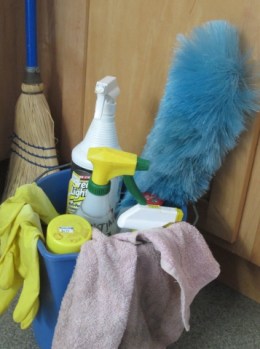
Cleaning bucket

Cleaning bucket

To editors and others engaged in the publishing process, “clean” means, more or less, in very good shape. Whether edited on paper or on screen, the ms. doesn’t have a lot of markup showing. If an editor who’s reviewed your ms. tells you it’s very clean, that’s high praise. It doesn’t mean that the ms. won’t benefit from editing, but it does mean that the editing will mostly involve fine-tuning and polishing, not a remedial overhaul.

“Squeaky clean” to me goes a step further. A squeaky clean ms. could probably go straight to press without embarrassing anybody. No, it’s not perfect. Yes, I’ve caught a few typos and formatting glitches, a missing endnote, and one instance where a character is 17 years old on one page and 16 a few pages later. But this is not stuff that most readers notice. In gravity or quantity, these are not errors that would prompt even the perfectionists among us to toss the book aside as sloppily edited. The writing is just too good.

Squeaky clean mss., like well-edited proofs, can be a little scary. That perfectionist in the back of my head is sure I’m missing something. Maybe my eyesight has deteriorated overnight?

They also lead us into temptation — the temptation to fiddle where fiddling is not called for. The impulse to make our mark runs strong in most of us, and the manuscript where minimal marking is needed can be profoundly frustrating.  Doesn’t it mean that all the knowledge of grammar, punctuation, usage, and sentence structure crammed into our heads is going to waste?

No, it doesn’t. I adapted the familiar Serenity Prayer for editorial use. It goes like this: “Grant me the serenity to recognize the prose I should not change, the ability to improve the prose I can, and the wisdom to know the difference.”

That wisdom, and the self-restraint that comes with it, is an essential editorial skill. Most of us take a while to develop it. Novices are notorious for fiddling with what doesn’t need fiddling with, usually because we’re afraid we’re not doing our job if we aren’t making marks on page or screen. (When this persists and spins out of control, I call it “piss-on-fire-hydrant syndrome.” One of these days I should blog about that.)

Over the years I’ve come to realize that these squeaky clean manuscripts are a gift. When the prose is already clear and graceful, attentive to sound, pacing, and nuance, I get to focus on the finest of the fine points: Does this particular word, though definitely OK, perhaps have connotations that get in the way? How about a comma here, to slow somewhat the headlong rush to the end of the sentence?

With a ms. this clean, the competent editor quickly comes to trust the writer’s judgment, and even to sense why the writer has phrased something this way and not that. At the same time — well, this particular ms. is almost 500 pages long and contains more than 180,000 words. Even the most experienced and careful stylists can’t devote equal attention to every one of those words. So I suggest the occasional change, suspecting that the writer will appreciate the suggestion even if s/he decides not to act on it.

serenity prayer

Resolutions

I did make a New Year’s resolution once. When I was working on my first novel, The Mud of the Place, and desperately afraid that I’d never finish it, I resolved that I would work on it every day until it was done.

Note that I did not vow to write a thousand words or two thousand words or any number of words. Nor did I vow to write for an hour or two hours or for any set time.

Just every day.

mud cover2This turned out to be a brilliant move. There were days when I was so panicky, so sure that everything I’d done so far was crap, that I didn’t work up the nerve to open my Word file till ten minutes before midnight. And this was enough. Just opening the file and reading what I’d already written was enough to reassure me that this thing was good, this thing was worthwhile, I really needed to keep going till I finished this thing.

And that was enough to encourage me to add a few words, and sometimes to keep going till two in the morning.

Had I vowed to write so many words or for so many hours, there would have been no point to opening the file at ten minutes to midnight.

I haven’t made a New Year’s resolution since.

How Many Is Too Many?

An editor was asking how to explain to a client that he was overusing a particular word.

Writers, even experienced writers, have our pet constructions, our favorite words. Often we don’t realize we’re overusing them. When I’m in revision mode, I’ll pause on a word and realize I’ve seen it pretty recently. I hit CTRL+F (that’s the Windows version — it’s COMMAND + F for you Mac folks), put the word in the search bar, and search upward. Recently I discovered I’d used “stage-whispered” twice in three pages. One of them wasn’t necessary. I got rid of it.

The editor’s query wasn’t unusual, but then the editor wanted to know if there was a “rule of thumb” for how many repetitions of a word was too many.

I replied that I went by the “rule of gut”: as an experienced editor and writer, I know that when something stops me in my tracks, it’s worth a second look.

Other editors pointed out that it depended on the word. Unusual words call attention to themselves. “Stage-whispered” isn’t exactly exotic, but as a dialogue tag it’s not all that common either. Twice in three pages struck me as once too often. Other words are so distinctive that if you encounter one on page 251, you may remember that you saw it a hundred pages earlier.

Aside: In my many years of editing on paper, without CTRL+F to fall back on, I developed a sixth sense for this. I also noted unusual words, variant spellings, and personal and place names on my style sheet, along with the applicable page number. When the Katherine on page 73 became Katharine on page 228, I usually noticed. CTRL+F has spoiled me rotten. I’m not as good at this as I used to be, but I’m still not bad.

The inquiring editor took all this in and finally asked how, if there was no rule, she could explain to the client that he was overusing a word. Had anyone done any studies on how often is too often? she wondered.

Then someone suggested telling the client that his readers would notice and not like it. Back in September I blogged about editors and other gatekeepers who hide behind “readers won’t like it if . . .” Editors who hide behind an “authority” that can’t be contradicted or even verified are treading on unsteady ground.

“Good editors don’t need to hide,” I wrote. “We’ll say things like ‘I stumbled over this bit’ or ‘Given the conventions of [insert genre here], you might consider picking up the pace in chapter one.'”

I’ve learned over the years that anything that trips a reader up is worth a second look. Especially if the reader is someone whose opinion I respect and whose honesty I want to encourage. Perceptive readers who’ll give you their honest opinion about your work in progress aren’t all that easy to find. Encourage them by paying attention to what they tell you.

You don’t have to act on all of it: of course not. Perhaps the most valuable lesson I learned at the first writing workshop I ever attended is that readers are a diverse lot. One might love a turn of phrase that another finds trite or confusing. Two might interpret a character’s actions in one scene in two different ways — and have equally valid reasons for doing so. Readers bring their own unique experiences and expectations to your work. They aren’t going to read it the same way no matter what you do. Listen to what they tell you, then make up your own mind.

So back to the original question: “How many is too many?” Well, if someone notes that a particular word or phrase or construction comes up a lot in your story or essay, take a critical look at it. Use CTRL+F or COMMAND+F to find out just how often you’re using a word or phrase. Even better, read the passage aloud. The word “audience” comes from the Latin verb audīre, to hear. For many of us, repetitiousness is easier to hear than to see.

Learn what your own literary tics are. You don’t have to avoid them completely: just come up with some alternatives.

And keep in mind that repetition can be an effective device. Sometimes it’s 100% intentional. Here’s an example from my novel in progress:

Shannon knew what the message said. It had been playing when she walked through the door twenty minutes ago. She’d dropped onto the sofa and been sitting there ever since, as the room grew darker and both dogs gave up on being fed early. If she got up, she’d have to decide: play the message back or deep-six it, like she’d deep-sixed the last one and the ones before it.

The last deep-six had been on impulse and she’d been regretting it ever since. . . .

“Deep-six” occurs three times in two adjacent sentences, and in the third instance the verb has turned into a noun. Horrors! Is this too many? Should one of those deep-sixes be deep-sixed?

For the moment, no. I like the way the passage reads. The repetition suggests that Shannon is obsessing about what she’s done and wondering what to do next. Will it survive into the next draft? That I can’t tell you. What seems just right now may seem like too many tomorrow — or vice versa. That’s writing for you, and it’s why I trust my rules of gut more than other people’s rules of thumb.


Sturgis’s Law #6

This past spring I started an occasional series devoted to Sturgis’s Laws. “Sturgis” is me. The “Laws” aren’t Rules That Must Be Obeyed. Gods forbid, we writers and editors have enough of those circling in our heads and ready to pounce at any moment. These laws are more like hypotheses based on my observations over the years. They’re mostly about writing and editing. None of them can be proven, but they do come in handy from time to time. Here’s #6:

Your writing will teach you what you need to know.

Every aspiring writer has heard it: “Write what you know.” It’s a terrible cliché.

Well, no, it’s not so terrible, because there’s truth in it. There’s truth in most clichés. The trouble with clichés isn’t their lack of truth. It’s the way they become ossified into conventional wisdom and, gods forbid, rules.

Think about it. If you write what you don’t know, people are going to find you out — unless your skill is such that you can persuade them that you do know it, even if it contradicts what they know, or think they know. This means that you actually know quite a bit.

You probably didn’t start out with all the skills you needed to tell that story either. You developed them on the way.

travvy in field

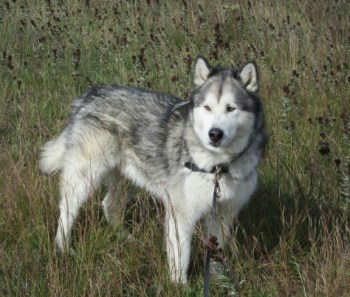
This is Travvy. The fictional Wolfie looks like his twin brother, but they’ve got different stories to tell.

Knowing stuff is great. Some imagery and a major plot thread of Wolfie, my novel in progress, has grown from what I know about dogs, specifically Alaskan malamutes, particularly Travvy, the Alaskan malamute I live with, on whom the title character is based.

Both Wolfie and my first novel, The Mud of the Place, are set on Martha’s Vineyard, which is where I live. Any plot can take place anywhere, but the places where it unfolds will affect how it happens and who the characters are. People are influenced by our surroundings, both past and present. The better you know your settings — both those that exist in real time and those you make up, and those that are a combination of the two — the more you’ll know about your characters.

On the other hand, when you set out to write a history of X or a biography of Y, you rarely know everything there is to know about the subject. I’ll go out on a limb and say you never know everything there is to know about the subject — and when the book is in print and getting great reviews (let’s be optimistic for a moment here), there’s still more to be learned.

The same goes for memoirs and novels. Memoirs are about your own life, and in fiction you get to make stuff up, so maybe you don’t have to know so much? Ha ha ha. There’s nothing like writing to show you how much you don’t know, and how much of what you do know is incomplete or not quite right or even downright wrong. So memoirists and fiction writers do what historians and biographers do to correct the errors and fill in the gaps: research.

Memoirists may interview family members, reread old letters, or cross-check remembered facts and dates with written records. Mystery writers don’t generally start off knowing a hundred ways to commit murder, or what a body looks like when it’s been shot at close range, or what police officers do at a crime scene. And so on.

Think of writing as a journey of discovery. Don’t limit yourself to what you know. Write what you want to find out, what you’re curious about. If you’re a “planner” — you like to plot everything out in advance — choose a destination that intrigues you. With my first novel, The Mud of the Place, I thought I knew where I was going, but that’s not where I ended up.

Wolfie started with a fairly simple “what if?”: What if a dog like Travvy was running loose in my town, hassling and probably killing livestock? That was answered pretty quickly, but not before it had segued into a question I’ve long been obsessed with but haven’t dared think too hard about. It goes something like this: Hindsight is 20/20, but what do you do when you begin to suspect something bad has happened and maybe is still happening, there’s no way of finding out for sure, and the price of being wrong is very, very high?

Well, I, like my characters, am still somewhat in the dark, and I, like them, have been drawn into unsettling territory: the powerlessness of children, the trickiness of memory, the barriers we throw up against what we can’t afford to know. I’m having conversations with teachers, therapists, and others who’ve been confronted with comparable dilemmas. I’ve read and reread many accounts of adults who have managed to survive similar situations.

Perhaps the strangest thing that’s happened so far is that one supporting character is an animator: he works on animated films with computer-generated graphics. Where the hell did that come from? I’m not a big moviegoer, and apart from a book I worked on some years ago about Pixar Animation Studios, I knew zip about animation. But I knew, immediately and intuitively, that the fact that this guy was an animator could be significant. So I’ve been reading up on animated films, and particularly what animators do.

No way am I ever going to be an animation expert, though I certainly know more about the subject than I did two months ago. I don’t know everything there is to know about Martha’s Vineyard either, but I do know it well enough to know what I don’t know. And that’s enough.

P.S. Here’s an article I turned up while procrastinating researching this blog post. Bret Anthony Johnston’s “Don’t Write What You Know” from TheAtlantic.com. It’s very good.

Logjam

For the last week or so I’ve been writing around a logjam in the novel, nudging at it from time to time but not trying to break it up.

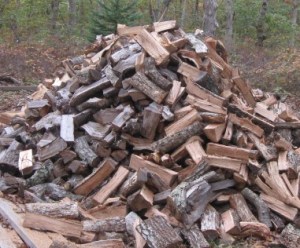
This is a log pile, not a logjam, but you get the idea.

This is a log pile, not a logjam, but you get the idea.

Imagine logs massing where the river widens, jostling each other to fit through a narrow gap and float on downstream. These logs aren’t wide around like tree trunks, or all that long either. They’re small enough to fit in your woodstove or fireplace, but that’s big enough to create a logjam.

Morning is my writing time, from whenever I get out of bed till 9 or so. The novel was jammed, but I kept writing. You may have noticed that my bloggish output has increased in the last week.

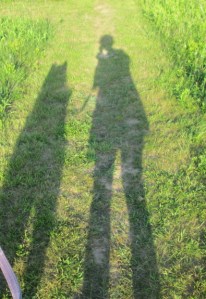
It's hard to take a selfie of me and Trav walking, so here are our shadows.

It’s hard to take a selfie of me and Trav walking, so here are our shadows.

Images and ideas, scenes and snatches of dialogue, often come to me when I’m out walking with Travvy. Forward motion is all the more important when the novel is stuck, so this is where I did most of my nudging.

But “nudging” isn’t really the right word. What I was doing was listening — listening to Shannon, one of my viewpoint characters, listen to what’s going in her head. It’s pretty cacophonous: much has happened in the last 24 hours, and her own childhood has been pounding on a long-locked door. I knew what she was going to do next, but I didn’t know how she was going to get there.

This morning when I sat down in my chair, Shannon was waiting. Pixel, her old dog, was curled up next to her on the sofa. Wolfie, her recently rescued younger dog, was stretched out on the rug. The November sun has long since set; the living room is dark except for the power lights on her computer monitors, the red “on” light on the coffeemaker in the kitchen — and the blinking red light on the answering machine. The message was playing when she walked in the door half an hour earlier. It’s her younger sister, with whom she’s had little contact in 30 years. She’s about to listen to the message and return the call.

That’s the log that jostled itself loose from the jam, slipped through the gap, and started on down the river. The rest of the logs will follow in good time.

When Trav and I headed out for our walk, this song was running through my head. Different kind of logjam, very different solution, but you get the idea. Slaid Cleaves singing his “Breakfast in Hell.” Now that’s a story.


Dot Comma

This is part 2 of “Sturgis’s Law #5.” I got carried away with hyphens and didn’t get around to commas till the word count was edging toward the stratosphere. Here’s Sturgis’s Law #5 redux.

Hyphens are responsible for at least 90 percent of all trips to the dictionary. Commas are responsible for at least 90 percent of all trips to the style guide.

Commas drive people crazy. They’re small but they’re powerful. They can be used for so many things. Teachers, editors, and the authors of style guides often try to wrangle them into some sort of order, which is fine, but when the guidelines harden into rules, writers and other editors may get feisty.

I suspect that it’s not the poor commas that drive people crazy; it’s the notion that there are a gazillion iron-clad rules about the right and wrong way to use them and if you get any of them wrong someone will think you’re stupid.
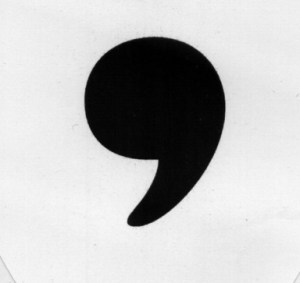
Context matters. Is this a comma or an apostrophe? Actually it's the bottom half of a semicolon, but it's impersonating a comma.

Context matters. Is this a comma or an apostrophe? Actually it’s the bottom half of a semicolon, but it’s impersonating a comma.

Take my sentence above: “They’re small but they’re powerful.” To comma or not to comma? It’s actually OK either way: convention sensibly advises a comma before the conjunction that separates two independent clauses, but an equally sensible corollary notes that the comma may be dropped when the clauses are short.

So I went back and forth a half-dozen times between “They’re small, but they’re powerful” and “They’re small but they’re powerful.” To avoid settling on one or the other, I actually contemplated “They’re small but powerful” and “They’re small — but they’re powerful.” All four options are well within the pale of acceptable usage, but each reads a little differently.

Sentences like this can send us running to the style guide, and when the oracle responds with “It depends,” that’s when we start to lose it.

This, however, is no reason to throw the comma conventions out. Writing that consists of long comma-less sentences is devilish hard to read, and besides, we usually talk in phrases, emphasizing some words and not others. Commas, and punctuation generally, help shape your sentences so they’ll be read, understood, and heard the way you want them to be. Learn the basics so well that they become your default settings. At that point you’re ready to change the defaults when it best serves your writing.

Here’s a short paragraph plucked at random from my novel in progress. Shannon is explaining to the selectmen in her town* why Wolfie, a dog who’s been running amok and maybe killing livestock, should be allowed to remain in her house. No surprise, the paragraph has a lot of commas in it, doing common comma duties.

Shannon smiled. “You might say so,” she said. “When Wolfie’s confined to a crate, he tries to get out, and when he can’t get out, he howls. We’re making progress on that, but, well, I don’t think he would do well at the kennel.”

The first comma is standard in punctuating dialogue in American English (AmE). Use a comma before or after a dialogue tag, depending on its placement in the sentence. If you want, you can turn that sentence around:

She said, “You might say so.”

The second comma follows a dependent clause at the beginning of a sentence. Commas are also used to set off introductory phrases, especially when they’re fairly long. How long? I remember learning that any introductory phrase or clause of at least seven words should be followed by a comma, but please, don’t be making your decisions on word count alone. The main purpose of that comma is to keep the introductory phrase or clause from bleeding into the main sentence.

The third comma, the one before and, separates two independent clauses. The fourth, like the second, sets off an introductory clause. This sentence is both compound (it comprises two independent clauses) and complex (it includes dependent clauses). In such sentences, commas help the reader figure out what goes with what.

Next comes another before-the-conjunction comma, and then we’ve got an interjection: well. When interjections — well, oh, good heavens, and the like — come at the beginning of a sentence they are almost always followed by a comma. When they come in the middle, you usually want commas fore and aft. Say the sentence out loud. You pause before and/or after the interjection, right?

Good writers often use commas to help pace our sentences, perhaps to signal a slight pause. I hear a subtle difference between She shut the door then opened it again and She shut the door, then opened it again. In the former, the opening follows hard on the shutting. In the latter she hesitates; maybe she’s had second thoughts. Some people don’t hear any difference at all between the two. When an editor who doesn’t hear the difference meets up with a writer who does, things can get ugly.

When they approach commas that can’t be neatly explained by one of “the rules,” some editors ask “Is it necessary?” When I’m editing, my own work or someone else’s, I ask instead “Is it useful?” and “What purpose is it serving?” If it’s serving a purpose, I generally leave it alone.

This is not to say that I pause to ponder every comma I come to. In most book-length copyediting jobs I put a bunch in and take a bunch out on the fly. If asked, though, I can nearly always explain what I did and why: this is a knack that comes with experience, lots of experience.
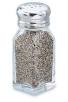
Commas ready for recycling

Commas ready for recycling

Some writing, even good writing, is peppered with commas. I remove the excess and save them in a pepper shaker, so I’ll have them on hand when I come to a work with too many long, breathless sentences.

When a sentence or whole passage is overpunctuated — it contains so many commas and other punctuation marks that you barely notice the words — this is often a sign that the sentence itself needs work. The writer is trying to tame the sentence with commas when the real problem lies with the words, phrases, and/or clauses and the arrangement thereof.

OK? Commas may be small and powerful, but they don’t have to be scary. Play around with them. See what works and what doesn’t. And if you’ve got a comma question or observation, post it in the comments or use the “Got a Question?” form at the top of this page.


* This town, like most small to middling towns in New England, runs by the town meeting system. Town meeting, in which all the town’s registered voters can participate, functions like a legislature. In addition to the big annual town meeting, usually in the spring, there are usually two or three special town meetings during the year. The board of selectmen takes care of business in between.

Recognition Rocks

bloggerrecognitionaward

Ordinarily I don’t do awards, but hey, recognition is good, especially when it comes from a fellow writer, so thank you for nominating me, Gavin Zanker. I recently started following Gavin’s blog, but already I get the impression that he’s making it up and figuring it out as he goes along, which is pretty much what I do. More power to us.

I have two blogs, this one and From the Seasonally Occupied Territories, about being a year-round resident of Martha’s Vineyard. As both writer and editor I’m mostly self-taught, which is to say I’ve learned a tremendous amount from my peers, a couple of mentors, and reading master writers but I haven’t gone to school for any of it. Write Through It is part of my attempt to give something back and keep learning at the same time.

Advice to bloggers, especially bloggers who do other kinds of writing: Your writing will teach you what you need to know. Just keep doing it — and be prepared for unexpected detours and forks in the road.

Here are my nominees, in no particular order. All these blogs expand my world, albeit in different ways. Some of these bloggers don’t do awards, but check out their blogs anyway. They’re special.

The TomPostPile • Tom lives up the road from me. I already knew he was a musician and a master sign painter, but until he started his blog I knew nothing about Wishetwurra Farm. Here’s your intro. He also takes wonderful photos of both here and “away” — sometimes as close as Woods Hole but other times considerably more distant.

Charlotte Hoather • Charlotte Hoather is a gifted young soprano pursuing her music studies in Scotland. She also writes wonderfully.

Cochin Blogger • I “met” Cochin Blogger on an international editors’ list we both subscribe to. His words and wonderful photos have introduced me to daily life in Kerala, which is where he lives.

The Immortal Jukebox  • Thom Hickey’s “blog about music and popular culture.” Every post is a musical adventure, complete with embedded videos.

Evelyne Holingue • Evelyne is a novelist who grew up in France and now lives in the U.S. She’s witty, observant, and perceptive, and she blogs in both English and French. Earlier this year she worked her way through the alphabet, looking for the English equivalents of common French idioms. Her readers joined in. It was wonderful.

The Glass Bangle • Thoughtful, perceptive, funny — this is my window into the world of a writer, poet, and avid reader in India who’s raising two daughters.

MV Obsession • Joan has known the Vineyard for longer than I have, but she sees it from the perspective of someone who doesn’t live here year-round. When I start getting snarky about “summer people,” I think about Joan and all the others who have their feet in the mud of this place too.

What Matters • Janee Woods doesn’t post all that often, but everything she does post is essential reading for anyone trying to understand how privilege works and why dealing with it is important.

Self-Published Authors Helping Other Authors • Absolutely crucial for writers thinking of self-publishing, and for those who want to put their own experiences to good use.

Off the Beaten Path: Hikes, Backpacks, and Travels • Just what it sounds like. I’m a lifelong East Coast girl, and Cindy’s wonderful photos of wildlife, mountains, and places you can’t reach by car transport me to parts of the U.S. that I may never see in person.

Alex Palmer: Your Man in the Field • Sports is terra incognita to me, mostly by choice, but Alex writes so well that I might turn into a sports fan in spite of myself. He just launched this blog a few months ago, so check it out. P.S. Not only does Alex live on the Vineyard, he grew up in the same off-island town I did.