Sturgis’s Law #2

Earlier this month I started an occasional series devoted to Sturgis’s Laws. “Sturgis” is me. The “Laws” aren’t Rules That Must Be Obeyed. Gods forbid, we writers and editors have enough of those circling in our heads and ready to pounce at any moment. These laws are more like hypotheses based on my observations over the years. They’re mostly about writing and editing. None of them can be proven, but they do come in handy from time to time. Here’s #2:

Given enough time to fill, even the most intelligent commentator will wind up making stupid statements.

When I was growing up, we had the news at 6 and the news at 10 (or 11), and it didn’t last more than an hour. On Sunday we had talking-head shows like Meet the Press. They didn’t last more than an hour either.

With the advent of cable TV came channels that delivered news and commentary 24/7. The quantity increased, but not the quality. Blather is cheap. Investigation and analysis are hard. There’s good stuff out there for sure, but you have to wade through a flood of drivel to find it.

Print journalism, like print in general, imposes limits. The space available is finite and the words have to fit into it. In my newspaper days, ads would often come in or be cancelled at the last minute. I’d have to cut a story on the fly to make room or figure out how to fill the hole. I learned, among other things, that no matter how well-written and well-edited a story was, I could nearly always cut two or three or four column inches out of it without doing serious harm.

sufferedThe web doesn’t impose space limits. Bloggers and others writing for the web could theoretically go on forever — but we don’t. Paradoxically perhaps, when it comes to the web the standard advice is “keep it short.” We could go on forever, but most readers won’t stick with us that long. There are limits, but they aren’t spatial.

We writers like to kick against the restrictions imposed on us by circumstance and by (you’re way ahead of me) editors, but restrictions are often a good thing. Think about it.

Tasks with deadlines usually get done before tasks without.

Cutting a 3,000-word draft to fit a 1,000-word limit often sharpens the focus and tightens the prose.

Poets make every word count because they have to. Not only do poems usually have fewer words than stories and essays (even flash fiction and nonfiction), they’re also shaped by the limitations of rhyme, rhythm, and/or meter.

Early drafts can sprawl. Sprawling is good — it sure beats being blocked. But it’s revising and editing that make the piece, whether poetry or prose, by shaping and focusing — by imposing limits.

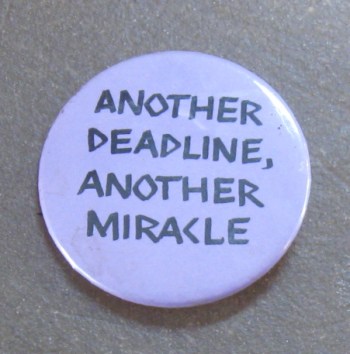
deadline miracle

Free the Scene!

Here’s a revision tip for you. I’m currently working on the second draft of my second novel, and it just came in handy (again).

When reading your early drafts, keep an eye out for the potentially interesting scene that happens off-stage. Maybe you were in a hurry when you wrote that part. Maybe you didn’t see the possibilities. Maybe you did, but they were a little bit unsettling and you didn’t want to go there — yet.

Open the door. Let the scene out. Give it room to breathe. See what happens.

These things are little gifts from the Muses, or your subconscious, or wherever you think your writing comes from. They’re the treasures you find at the bottom of a heap at the thrift shop, or in your own closet.

Here’s one of mine. In draft #1, Shannon, one of the novel’s two viewpoint characters, gets a phone call. It goes like this:

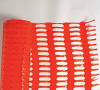
Meanwhile, Shannon had had a call from some busybody on the conservation commission, whose members apparently cruised around looking for unsightly objects that detracted from what they called “the character of the town.” The busybody objected to the snow fencing Shannon and Ben [Shannon’s next-door neighbor] had put up to reinforce the post-and-rail fence in the back yard. Shannon explained about Wolfie [the dog she’s just rescued], and how the post-and-rail alone wouldn’t keep Wolfie in for a minute. The busybody was not impressed: the fence did not conform to the town’s fence bylaw and that was that.

This phone call had the makings of a fun scene, and I was ready for a little comic relief. What if the busybody showed up in person? What if she caught Shannon in the act of installing the fence?

snow fence 1Consulting the town’s zoning bylaws — the scene takes place in the town I live in — I discovered that the snow fencing didn’t violate any bylaws, but this wouldn’t stop some of the busybodies I’ve run into in my time. I also decided that she wasn’t actually on the conservation commission. She had appointed herself guardian of the character of a neighborhood she didn’t even live in.

This is what the phone call turned into this morning. Note that I’m still in early-draft mode. I strongly suspect that the scene will appear in the novel’s final draft, but I don’t know what it will look like. Will this woman appear again? No idea. It’s up to the Muses.

[Shannon] was halfway done when a white Honda Pilot passed on the road, heading toward the intersection with the Edgartown Road. She didn’t recognize it. Not that she knew every vehicle that lived between here and Sepiessa, but her mind half-consciously sorted them into familiar and unfamiliar and this one she’d never seen before.

Even more unusual, two minutes later it passed by again in the opposite direction. Shortly after that it rolled to a halt on the grassy shoulder opposite her driveway. Looking for directions?

The driver got out of the car, looked both ways, and crossed the road. She carried a cane but walked briskly, barely tapping it on the pavement. Her mostly gray hair was done up in a french twist and her garb said “country gentry”: heavy wool cardigan with leather elbow patches, an ample wool skirt that hung just below the knee, and sturdy walking shoes, all in autumnal browns and russets. She did not look lost. She caught Shannon’s eye briefly then rapped the top rail of the roadside fence with her cane.

Taking this as a summons, Shannon wiggled the stake she had just driven into the ground to make sure it was steady, laid mallet and zip ties on the ground, and walked up to greet the visitor.

The visitor wasted no time on introductions. “Do you have a permit for that fence?” she asked, in a clipped accent that sounded somewhat English but wasn’t.

Loaded for bear, thought Shannon, but with no bears in sight. “That fence has been there for over fifteen years,” she said pleasantly. “I don’t believe I need a permit.”

“That orange fence” — the woman pronounced the word with obvious distaste — “has not been there for fifteen years. You are just now putting it up.”

Caught red-handed, Shannon thought. “I don’t believe I need a permit for that either,” she said. “It’s temporary. I’m fostering a dog for a few days, and I don’t want him getting loose.” She resisted the temptation to tell the woman why she didn’t want Wolfie getting loose. Maybe the woman did know someone on the road. Maybe she kept chickens.

“It is unsightly,” said the woman. “It is not in keeping with the character of the neighborhood.” She rapped the railing with the head of her cane for emphasis.
snow fence 2

In Shannon’s fourth grade Sister Mary Clement had habitually rapped her eighteen-inch ruler on the desktop while fixing the latest class miscreant with a glare that promised trouble. Shannon hadn’t thought of her in twenty years. Her visitor wasn’t a nun but she was cast from the same mold.

Shannon conceded that the blaze-orange snow fencing was not especially attractive but noted that it was only visible from the road if you slowed down to about five miles an hour and stared out the passenger-side window. She did not ask the woman if she’d ever been down this road before, and if not, how she knew so much about the character of the neighborhood. The character of this neighborhood was more disturbed by big gray dogs running loose than by blaze-orange snow fencing in someone’s back yard.

“The town bylaws are quite clear what sorts of fence are allowed,” the woman said, “and this is not one of them.”

Shannon had no idea what the town bylaws said about fences, but Ben had once served on the zoning board. If he thought snow fencing might be a problem, he wouldn’t have suggested it. Besides, it was past the middle of October. No one who came down this road at this time of year would be bothered by snow fencing. Those with more delicate sensibilities had mostly gone home. “I’ll see what I can do,” said Shannon, turning back toward her interrupted labor.

“I intend to communicate this to the conservation commission,” the woman called after her.

“You do that,” Shannon muttered, not quite audibly. She heard the staccato whack whack whack of the woman’s cane on the asphalt. The car door opened and slammed shut. A moment later the engine rumbled. Shannon zip-tied the snow fencing to the new post and set about pounding the next one into the ground.

Sturgis’s Law #1

I’m taking a hint from one of my favorite bloggers, Evelyne Holingue. She’s a native French speaker who now lives in the U.S. During the month of April she went through the alphabet A to Z. For each letter, she chose a French idiom then gave its literal meaning, its idiomatic meaning, and its nearest English equivalent. It was great fun — playing with language always is! — and (dare I say it) educational.

I loved the idea of doing some kind of series. Not about idioms but about — what?

Over the years I’ve been compiling observations about writing and editing. I call them Sturgis’s Laws. Not “rules.” No way. We’ve got enough rules already. There are 17 so far, plus one unnumbered law that isn’t really a law at all — I’ll save that one for last.

So here begins an occasional series with, of course, Sturgis’s Law #1:

If you stare at any sentence long enough, it will look wrong.

Sturgis’s Law #1 has an obvious corollary. Call it Law #1a:

If you stare at any word long enough, it will look wrong.

In the editors’ forums I frequent, editors often post sentences we’re having problems with. Is this construction OK? we ask. Would you use this word in American English (AmE) or is it mostly British? Is a comma enough here, or should it be a dash? What the hell does this sentence mean?

And so on. Usually the question is answered pretty quickly, but the editorial tribe rarely stops there. We rip the sentence apart, rearrange the words, change the punctuation, and come up with clever ways of misreading a phrase that was perfectly clear at first glance.

20130227 birthday bone

If only more sentences were this tasty . . .

We’re a pack of vultures or a dog with a bone — take your pick. I’m partial to the dog-and-bone metaphor myself.

The editor who posted the query, if s/he is wise, has long since moved on, leaving the rest of us to our gnawing.

There’s much to be learned from these gnaw-fests, but at some point Sturgis’s Law #1 comes into play. If you stare at any sentence long enough, it will look wrong — and the longer you stare at it, the more things you’ll find to fiddle with.

Hesitate too long at one sentence or one word and you’ll never finish the job.

How many sentences in the typical short story, academic paper, or full-length book? How many words? How long does the typical reader linger over a typical sentence, a typical word?

Moral of story: Don’t linger too long over this sentence or that word. As the poet said, “the Moving Finger writes; and, having writ / Moves on.”

It’s good advice.

typo

Joan Didion’s Cure for Bankrupt Mornings

Serendipity rules: I read this while I was working on “Restarting.” These days I don’t keep a notebook, but opening the work in progress seems to fill a similar function. Whatever works!

Restarting

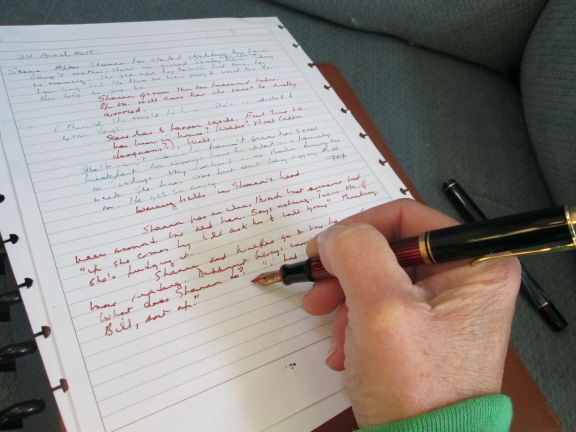
I can revise, rewrite, and edit pretty much any time I’m awake, but for writing, especially early-draft writing, especially writing long and scary projects (like Wolfie, my novel in progress), I’m best in the morning, in the hour or two or three after I wake up.

I’m braver in the morning. I’m less easily distracted by the voices chattering inside my head and by whatever I’m supposed to do that day.

For several recent weeks my early-morning writing time was taken up by work, editing for pay and on deadline — my livelihood.

Another thing: When I’m working on a long and scary project, my mind is usually mulling it over while I’m out walking with my dog, or dropping off to sleep at night, or waking up in the morning. Mental logjams break up when I’m nowhere near my pens or my laptop.

During those several recent weeks, the jobs I was working on took up semi-permanent residence in my head. That’s what my mind kept mulling when I was out walking, or driving, or dropping off to sleep.

Blank paper is scary, but it's full of potential. (That's the scary part.)

Blank paper is scary, but it’s full of potential. (That’s the scary part.)

In short, for about three weeks I did no work on the novel. I barely even blogged.

How to get back in the groove?

Starting is easy (ha ha ha). Blank pages are scary but they’re full of potential.

I’d recently started a second draft. The not-quite complete first draft is more than 225 pages long. (First draft = first draft prime: the real first draft is in longhand, and I always do a little revising as I’m typing it into Word.) When I tried to recall it, it was like looking through the wrong end of a telescope.

More to the point, I was sure that if I actually looked at it, I would realize it was crap. I have had this problem before. It’s why when I’m working on a long and scary project I look at it every day. Five minutes is enough. I don’t have to write anything. I just have to open the file and look at it.

Once I’ve opened it, I always find something to fiddle with, and after I’ve done a little fiddling, I nearly always write something new.

Wolfie‘s title character is a dog. So far the only cat in the story is Schrödinger’s, and of course I don’t know if that cat is alive or dead, real or unreal. Schrödinger’s famous thought experiment hypothesized a cat in a closed box with a vial of lethal radioactive material. The vial may or may not have broken; the cat may be alive or dead. I, outside the box, don’t know what has happened inside the box until I open it. Is the cat alive or dead?

I, sitting at my laptop, am dead certain the novel in progress is crap. If I actually look at it, I will know for sure it is crap and then what will I do with the rest of my life?

But it never works that way. It’s always

looking -> fiddling -> writing

After I’d read a few pages of my second draft, the seed of a new scene took root in my head. The scene comes much later in the novel. I sketched it out in longhand then went back to reading.

So why the dead certainty that the writing has turned to crap in my absence? Interesting question, but it’s going to have to wait. I’m writing.

The moving hand writes and a scene takes root.

The moving hand writes and a scene takes root.


My Characters, My Selves

The other day a writer-editor friend on Facebook posted a quote from Truman Capote: “You can’t blame a writer for what the characters say.”

An interesting discussion ensued. The first comment took issue with the word “blame.” So do I. But characters come out of a writer’s head somehow, even when they’re based on real people. I’m not my characters and my characters aren’t me, but whatever my characters do or say rises in my mind, travels down my arms, and is transmitted to paper or screen by my fingers.

“Homo sum, humani nihil a me alienum puto,” as the old guy said — I’m a human being; nothing human is alien to me.

I’m not my characters, my characters aren’t me, but I’ve imagined them. I’ve brought them to some kind of life.

Creating characters is probably the weirdest thing about writing fiction or plays. It’s totally juju. Joan of Arc’s voices don’t seem strange to me. I sometimes wonder if I might stumble off the edge and forget that my characters are characters. What if I ventured into my fictional world and couldn’t find my way back?

Can writers create believable characters if we don’t have the seeds of those characters in our heads? I suspect not. Whether we dare acknowledge and nurture those seeds into fully developed characters is a whole other question. A character in my novel in progress is a man who has sexually abused his stepdaughter and may do so again. He’s not a viewpoint character. I don’t want to get into his head, and I’m not sure I could.

Actually, now that I think of it, what I’m really afraid of is that I can get into his head. This fellow has appeared in a couple of scenes already. He acts like a trial lawyer at the family dinner table. His wife steps gingerly to avoid triggering his temper. Hmm. I recognize this. I grew up with something similar. I learned from my father how to intimidate people with words.

paperwhites

That’s me on the right, ca. 1993, in rehearsal. I was playing a rather timid nursing-home volunteer. Words came out of my mouth in an English accent that isn’t mine. I wasn’t her, but we definitely had a connection.

Characters often do things that their creators would never do, and say things that their creators don’t believe, or wouldn’t say in public if they did. Do authors really hide behind despicable characters to say the despicable things they believe but don’t dare say under their own names? I’m sure it happens, but I’m equally sure that if you want clues to what the author believes, you have to look at the whole work, not just the words or deeds of one or two characters.

Good actors can be so persuasive playing despicable characters. They have to connect with some despicable kernel in themselves to be that persuasive. When they’re really persuasive, viewers may feel an unsettling connection with that despicable character. Writers both create the characters and watch them in action. That can be pretty unsettling too.

When a really horrendous act is reported on the news, a common response is “how could anybody do something like that?” Me, I’m immediately working out a hypothetical trajectory in my head: how did this person get from birth to the point where he (it’s usually a he, but not always) could do this terrible thing? Into the cauldron of my mind go whatever sketchy details are available and everything I’ve read, heard, or experienced about, say, war, poverty, hopelessness, anger, addiction, fanaticism, denial, the way that humans tend to get swept away by what the other humans around them are doing . . .

Homo sum, humani nihil a me alienum puto. I’m a human being; nothing human is alien to me.

I’m still having a hard time with that abusive stepfather.


Editing Workshop, 3

This one’s about sentences.

I just finished copyediting a long nonfiction book on a tight schedule. The author has many years of high-pressure writing experience, but this is his first book. The manuscript felt like it was a couple of drafts short of final — not uncommon when a rush to deadline is involved. A glaring symptom of this was sloppy sentences. If sentences come out sloppy in early drafts, it’s no big deal. You’ll clean them up when you start revising — right? right??

In this particular manuscript, the author probably didn’t have the time to make them clearer or more effective. So yours truly the copyeditor did it, pruning some elements, rearranging others, and querying whatever I couldn’t figure out either from context or from a quick Google search.

There are plenty of books out there on how to construct a sentence. You know the basics: subjects, verbs, and objects, phrases and clauses. The tricky thing is that sentences can be grammatically impeccable and at the same time unclear, ambiguous, or downright misleading.

Here are some hints on how to make sentences more effective, whether you’re writing, revising your own work, or editing someone else’s.

Clotheslines tend to droop in the middle. So do long sentences.

Clotheslines tend to droop in the middle. So do long sentences.

Sentences are like clotheslines: they tend to droop in the middle. In the middle of a long sentence, the reader’s attention starts to wander. So if you’re trying to get across an important point or detail, don’t bury it in the middle. Placed at the beginning and the end, it’s more likely to catch the reader’s attention, and to connect with the sentences before and after.

This is also true of paragraphs, by the way. Paragraphs that take up a whole page of text are daunting. KEEP OUT! they say. Or maybe WELCOME TO THE LABYRINTH.

What poets do with line and stanza breaks, prose writers can do with sentences and paragraphs.

I love long loopy sentences, but when one long loopy sentence follows another and another and another, nothing stands out. It’s also easier for subjects and verbs, or nouns and pronouns, to come adrift from each other. Confusion often results.

The closer together words are in a sentence, the stronger — and clearer — the relationship between them. The opposite is also true: the further apart they are, the more tenuous the connection. Here’s an example adapted from the book I just edited:

Smith requested and received permission to publish the translation from Jones in 2005. . . . Smith, in an interview, described the text as boring.

I skidded to a halt at the end of the first sentence: who? what? when?

It took me a few moments to sort it out: It wasn’t the translation that came from Jones but the permission, and what happened in 2005 wasn’t the publishing but the requesting and receiving of permission. (It was made clear elsewhere that the work was published in 2008.) In the second sentence, the parenthetical “in an interview” unnecessarily separates subject from verb.

Here is my edit:

In 2005, Smith requested and received permission from Jones to publish the translation. . . . In an interview, Smith described the text as boring.

Be especially careful with pronouns. “Antecedent unclear” and “unclear referent” are among the most common editorial queries, in both fiction and nonfiction. They mean we can’t figure out for sure whom a he, she, it, or they is referring to. In the job I just finished, the vast majority of the players were men — as is often the case in books about politics and international affairs, which this one was.  Often a he, his, or him could have referred to either of the two fellows mentioned in the preceding clause or sentence.

Authors often miss these unclear antecedents because the antecedents aren’t unclear to them. They know exactly who’s being referred to. Readers, however, aren’t in the same loop. We need a little help. Better to repeat a name than leave it ambiguous. This is one reason second readers can be so important: they come to the manuscript without knowing what you mean. They just read what’s there.

Have you got an unruly sentence that could use some untangling, or one that you’ve successfully untangled yourself? Send it along! The best way to develop an eye for what works and what doesn’t is to pay close attention to how sentences work. We can do this in our reading, in our writing, and in our revising.

← Back

Thank you for your response. ✨

To Enfilade or Not to Enfilade

From the biography I’m copyediting: In an assassination attempt, “a remote-controlled bomb exploded, enfilading the car with shrapnel.”

Well, I had a pretty good idea what the car looked like, but “enfilading”? I had to look it up.

“Enfilade” is both a noun and a verb. In Merriam-Webster’s Collegiate Dictionary (online), the first definition of the noun is “an interconnected group of rooms arranged usually in a row with each room opening into the next.”

Um, no.

The second? “Gunfire directed from a flanking position along the length of an enemy battle line.”

Now we’re getting somewhere.

“Enfilade” the verb: “to rake or be in a position to rake with gunfire in a lengthwise direction.”

The American Heritage Dictionary (online) gets right to the point: “to rake with gunfire.”

The AHD entry includes an image of the architectural “enfilade,” along with this definition: “A linear arrangement of a series of interior doors, as to a suite of rooms, so as to provide an unobstructed view when the doors are open.”

By this point I’d totally forgotten the assassination attempt and the bullet-riddled Mercedes. I barely noticed that though the target of the attempt survived, his driver was decapitated.

“Enfilading,” I decided, meant precisely what the author intended, but it was not the best word for the sentence in question.

What’s wrong with it? you may be asking. If it means what the author meant, why change it? Readers can always look it up if they don’t know the word. This is what “dumbing down” is about: pandering to people who are too lazy to look things up.

Good question, and one I devoted some thought to. I’ve got a pretty big and flexible vocabulary. It’s probably my single most valuable tool — more valuable than dictionaries, more valuable even than my laptop. If I didn’t recognize “enfilading,” I had to assume that many intelligent, well-read readers won’t either. Most of them will guess — correctly — at the meaning and move on. As a casual reader, I might do likewise.

But when I’m editing, I’m not a casual reader. I’m paying close attention to the construction of sentences, the choice of words in those sentences, and the spelling of those words. When a word or a phrase stops me in my tracks, I take a second look.

“Enfilading” stopped me in my tracks. It threw me out of the text I was reading and sent me to the dictionary. Nothing wrong with that, of course — and sometimes you want a word or phrase to call attention to itself, to make readers screech to a halt and ponder or marvel at what they’ve just read.

But this is a biography, not a poem or a short story or a memoir. It contains nearly 600 pages of text, followed by almost 100 pages of notes and bibliography. More than 200,000 words altogether. The narrative is more important than the words used to create it. The words are means to that end, not ends in themselves.

Nevertheless, if “enfilade” was the only English verb that could describe what was done to that car, I’d leave it alone. But it’s not. Over the years I’ve read many, many accounts of vehicles shot up by gunfire, and every single one of them managed to get the idea across without “enfilade.” Another, less unusual word could be pressed into service without diminishing the narrative.

When I contemplate changing something that isn’t wrong grammatically or according to the dictionary, I ask myself a question: Did the author consciously settle on this word, or phrase, or way of constructing the sentence? 

Some writers are more careful stylists than others. Some of us sweat blood over almost every word. Others of us just want to tell the story. Most of us probably rework some passages a dozen or more times and let others flow by without a second glance.

Editors can’t know for sure what was in an author’s head, but within a dozen or so pages of starting a job, a capable editor generally has a pretty good idea how careful a stylist its author is. By the time I got to “enfilading,” I was 99 percent sure that my author’s focus was on marshalling facts and opinions into a coherent narrative, not on the particular words used to do it.

I also suspected that he was overusing a thesaurus to fill in gaps in his vocabulary. Not infrequently he’d employ a word that had the right dictionary definition but whose connotations or associations that didn’t suit the particular context. I had a very strong hunch that “enfilade” had come from a thesaurus, not from the author’s working vocabulary.

To enfilade or not to enfilade?

I made my decision: not. After some thought, and with a strong assist from the American Heritage Dictionary, I settled on “rake”: “a remote-controlled bomb exploded, raking the car with shrapnel.”

The author can stet his original if he wants, but I don’t think he will.

The Act of Revision

I recently began the second draft of my second novel so this post is especially timely. Revising does involve re-vision — seeing your work in new ways, from different angles. And there’s no one way to go about it. Whatever works!

frenchc1955's avatarcharles french words reading and writing

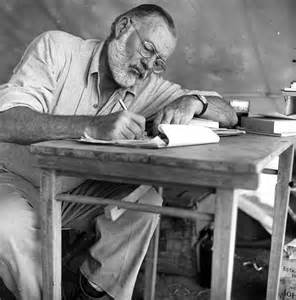
heminwaywriting

Interviewer: How much rewriting do you do?
Hemingway: It depends. I rewrote the ending of Farewell to Arms, the last page of it, 39 times before I was satisfied.
Interviewer: Was there some technical problem there? What was it that had stumped you?
Hemingway: Getting the words right.
(Ernest Hemingway, “The Art of Fiction,” The Paris Review Interview, 1956) 1

Writing-revision

The act of revision is an absolutely necessary part of writing, no matter what kind. Essays, stories, novels, books all require that the author not be satisfied with initial drafts. “Re-vision” means to re-see, or to look at the work from another perspective. This idea is something I try to teach my students in College First Year Writing classes, and it is crucial that I apply the ideas myself to my own work.

When I look back over my writing of the last few years, I can see that…

View original post 201 more words

Clichés, Ruts & Envelopes

A creative writing teacher at San Jose State used to say about clichés: “Avoid them like the plague.” Then he’d laugh at his own joke. The class laughed along with him, but I always thought clichés got a bum rap. Because, often, they’re dead-on. But the aptness of the clichéd saying is overshadowed by the nature of the saying as a cliché.

Khaled Hosseini, The Kite Runner

Yes, I thought when I encountered this passage, in part because the cliché Hosseini’s narrator, Amir, was considering is one I find useful: the elephant in the living room, the huge hulking truth that dominates a situation even though, and because, no one in the vicinity acknowledges its existence. When I first heard it, the image was being used to describe the experience of living with an alcoholic. Not only did it ring true to my own experience, it made me think harder about it. Clichés do not make you stop and think. Quite the contrary: they enable you to blow past something without thinking too hard.

My yes was full of admiration, because Hosseini deftly manages to bring the clichéd image back to life by walking around it with a thoughtful eye. So readers will do likewise — or at least this reader did.

Cliché, interestingly enough, comes from the print trade. Originally, says Merriam-Webster’s Unabridged, it meant “a stereotype or electrotype; especially :  a single stamp of which a number are joined to form a plate for printing a whole sheet of stamps at once.” It’s come, not surprisingly, to mean a phrase, expression, image, theme, or plot whose power has been diminished by overuse.

But as Hosseini’s narrator reminds us, the phrase must have started off useful. Would have been overused otherwise?

Many clichés are phrases that have fallen into ruts. Several words fuse into one: we hear “liketheplague,” not “like the plague,” and how many of us have firsthand experience with plagues anyway? When phrases come adrift from their original, literal meanings, spelling errors frequently result. If you remember that the “rein” in “free rein” is attached to a horse’s bridle, you won’t write of giving “free reign” to your creativity. Likewise the “bridle” in “unbridled passion” — though “unbridaled passion” might come in handy if you know what you’re doing.

And no, you don’t have to have to have firsthand experience with horses to understand where these phrases come from. My experience with elephants is negligible, and I’ve never seen one in a living room, but could I imagine the elephant as representing a huge hulking entity that no one knows how to deal with? Yeah. No problem.

Related to clichés and ruts are what I call “envelope words.” In order to discuss complex situations, concepts, and ideas, we generalize. We have to. Discussions would bog down pretty quickly if we had to describe each concept in detail every time we introduced it. But generalizations quickly become envelopes, and envelopes are opaque: we can’t see what’s in them, and the complexity of all the myriad pieces within is easily forgotten. We mistake the word or words written on the outside of the envelope for the envelope’s contents.

Here’s where knowing your audience(s) becomes important. If your intended audience can be expected to know what’s in the envelope, you don’t have to explain in detail what a given word or concept means. But the more diverse your intended audience — by sex, race, class, generation, culture, religion, place of residence, or any other factor — the less you can take for granted.

Which brings me around to the novel I quoted from at the beginning of this post. Most of The Kite Runner takes place in Afghanistan. When scenes take place in Pakistan or California, Afghanistan is never far away. Thanks to its tragic and bloody recent history, Afghanistan is much in the news. Many of us have stuffed all the visual images and stories into an envelope and labeled it “Afghanistan.”

But as with most news coverage, those stories and images are heavy on war and politics. When war comes to The Kite Runner, readers have already been introduced to life on the ground, to an array of vividly evoked characters and the messy complexities of their intertwined lives. The “Afghanistan” envelope starts to bulge in the middle and maybe split at the seams.

Good writing can do that. It can show readers overused words and concepts in different lights, from different angles. It can reveal the gaps in what we thought we knew. Often it deepens our understanding of the general by focusing on the particular.