My Voice! Where’s My Voice?

There’s a lot of gobbledygook out there about “the writer’s voice,” also known as “the author’s voice.” Writers worry about finding their voice, and about not finding it, and about not knowing whether they’ve found it or not.

Copyeditors worry about interfering with the author’s voice, often without being too clear on what an author’s voice is, what a particular author’s voice sounds like, and when it’s OK to mess with it.

Agents and acquisitions editors often claim that it’s the writer’s voice that lifts a manuscript from the slush pile and into the elite ranks of the Traditionally Published. What exactly do they mean by that?

When I hear writers talk about finding their voices, this is the image that comes to mind: "His Master's Voice."

When I hear writers talk about finding their voices, this is the image that comes to mind: “His Master’s Voice,” the voice coming out of the record player. Where the hell did my voice go? Who’s talking?

Time to cut through the obfuscation and mystification. Your writer’s voice isn’t something you find, like the prize at the end of a treasure hunt or the pot of gold at the end of the rainbow. It’s something you develop on the journey.

If you’re writing in English, you start with pretty much the same rules and conventions as everybody else. The way you use, abuse, ignore, and stretch those rules and conventions will be influenced by the things you choose to write about, the audience(s) you’re writing for, your traveling companions, the places you pass through and sojourn in, and so on and on.

Think about it: Our speaking voices are flexible. We can whisper or we can shout. The foul-mouthed among us can clean up our language when we’re in polite company or interviewing for a job. Our writing voices can be likewise.

In some kinds of writing, the writer’s individual voice takes a back seat. News reporting, technical writing, scientific writing, the writing in textbooks and legal documents: these don’t generally show much personality. They’re not supposed to. They’re supposed to communicate clearly and, often, concisely. The writers write and the editors edit with this in mind. It takes tremendous skill to do this well.

Note, however, that some lawyers and academics write novels, journalists write memoirs, business people write poetry, and scientists write essays for the popular press. The novels don’t sound like legal briefs, the memoirs don’t sound like front-page news stories, the poems don’t sound like annual reports, and the newspaper op-eds don’t sound like scientific papers, even though they’re written by the same person.

Even though the writers are almost certainly applying the skills they’ve developed in one milieu to the writing they’re doing in another.

Travvy

My malamute, Travvy, has a flexible voice. Here he is trying to persuade a tractor to move.

These writers have flexible voices that can be adapted to different kinds of writing. I know a bit about this because over the years I’ve written reviews, essays, poems, news stories, op-eds, newspaper features, short stories, one-act plays, and a novel, not to mention something like 500 blog posts. Some forms I’m more comfortable with than others, some I’m better at than others, but they’re all coming out of the same well of words, opinions, and experiences that is contained in my brain.

Flexibility is especially important for fiction writers and writers of “creative nonfiction” — which seems to mean by definition nonfiction that encourages a distinctive authorial voice. Characters speak in different voices, and all those voices come out of the writer’s head.

The writers of memoir and travelogue often have occasion to quote actual people. This requires first the ability to listen attentively and then the ability to translate the other person’s voice onto the printed page. Sometimes this means putting words in the other person’s mouth that the other person never said. If the other person is dead or fictitious, he or she won’t sue for libel — but astute readers often know when a character steps out of character. When the lapse is obvious enough, the reader may lose confidence in the character, the story, and the author.

My editorial diet is similarly varied. Most of it is nonfiction, but it ranges from scholarly books and dissertations to memoirs, essay collections to book-length works by journalists. Most of the novels I edit are stand-alones: they aren’t part of a series, and they don’t belong to a recognizable genre. Each genre and kind of writing has its own conventions and its own objectives, and in most cases some flexibility is allowed — even encouraged.

In the early pages and chapters — I work primarily on book-length works — I listen for the author’s voice. Sometimes it’s distinctive; often it’s fairly subtle. I notice the words and constructions that the author is particularly fond of. These are perfectly OK in themselves, but used to excess they can become cloying. Some authors (like me) like long sentences and write them well, but that doesn’t mean that the occasional long sentence doesn’t get tangled enough to trip even a careful reader up.

I do this pretty much without thinking. If you asked me at the end of a job to describe the author’s voice, I’d have a hard time doing it — until I went back with a more analytical eye and identified the various components that make up the author’s style. As a result, I can be a little suspicious when agents, acquisitions editors, and writing teachers go on and on about the importance of that mystical, mystifying entity, “the writer’s voice.”

A few weeks back, though, I was reminded of just how important a writer’s voice can be. A writer I didn’t know asked me to critique his just-completed novel. Like many another editor upon receiving a similar request, I was wary. Most such manuscripts turn out to need serious work before they become publishable, or even readable. “Serious work” translates into serious time, which means serious money. The writer doesn’t have it, or doesn’t want to spend it, and I can’t afford to work for nothing.

So I asked to see a chapter or two. I was already bracing myself for frustration.

Then I started reading. Sure, the punctuation needed work and some of the word choices were a little off, but it was clear almost immediately that the author was one hell of a storyteller and that he had one hell of a story to tell.

Send me the whole thing, I said.

Since then that storyteller’s voice has conjured scenes I couldn’t imagine, taken me places I didn’t want to go, and made me laugh at the same time. This voice isn’t my voice, but it’s so strong and distinctive that I’ve had no trouble slipping inside it and hearing it while I meddle with the punctuation, rearrange the occasional sentence, and ask questions about things that aren’t clear.

Editing doesn’t get much better than this.

When this novel makes it into print, you will hear about it. I promise.
 

Write for a Living?

I just finished a long and demanding editing job, right on deadline. For the last 10 days or so, it’s been taking up seven or eight hours of every waking day. I’ve learned over the years that my daily capacity for demanding word work is about seven or eight hours. Beyond that my brain goes on auto-pilot.

deadline miracleWriting and editing aren’t the same, but they both qualify as “demanding word work.” Over the last year or so, I’ve managed to maintain a pretty good balance: edit for five or six hours a day, write for up to two. The writer grabs the first two hours after waking, my absolute best creative time. (I’m an early riser, but my internal editor tends to sleep late. I’m also easily distracted by the events of the day once they start unfolding.)
So for 10 days or so, I’ve neither blogged nor worked on the novel. My writing has consisted of a few emails and the occasional post to Facebook. This is scary. The further I get from the practice of daily writing, the more certain I am that I’ll never get back to it. My writing, I fear, is like a fire in the woodstove. If it goes long untended, it will go out.

If only I didn’t have to work! I think. If only I could write for a living!

The same thought has probably crossed your mind. Maybe more than once. Maybe whenever life — specifically your paid job — gets in the way of the writing that you’d much rather be doing. Sound familiar?

When time-pressed writers imagine writing for a living, or at least writing as part of their job, they often aren’t thinking about going into journalism or academia. They aren’t thinking about writing lengthy reports for think tanks or government agencies, or how-to manuals for computer software and hardware. They definitely aren’t thinking of writing ad copy and jingles, although this may pay better than most of the other possibilities.

The fantasy is usually about making a living writing what we want to write. The big attraction is getting paid to do what we want to do.

I get it. Most of my life I’ve been able to make my living doing work that I enjoy, that I’m good at, and that seems useful to other people and sometimes even the world at large. It has nearly often involved the written word — but it’s rarely involved writing. During my several years working for a weekly newspaper, I got to write pretty much what I wanted to write — stories about interesting people and events — but my job description was “editor.” Editing has been my bread and butter, and occasionally my beer and chocolate, since the late 1970s.

If you’re determined to write for a living, or even for a substantial chunk of your living, I know I can’t talk you out of it. I’m not going to try. For sure some writers manage to do it. If you look closely, though, you’ll often see that other factors are helping them stay afloat economically: maybe a partner with a well-paying job, maybe a trust fund, maybe gigs teaching writing in one way or another. Take a hard look at your own resources before you even think of quitting your day job.

Think about this too: For me to make my living as a freelance editor, someone has to be willing and able to pay money for what I’m selling. The same goes for writing. The money coming into your checking account has to come from somewhere. It may come from a publisher. It may come direct from readers who are dying to read your books. It may come from newspapers, magazines, or online media that want to buy your feature articles and maybe send you off on assignment to write more.

These things are not going to fall into your lap. You’re going to have to hustle — to do all the research and self-promotion necessary to reach those willing and able to pay for what you’re selling, then to persuade them to part with their money. While you’re hustling, you probably aren’t writing what you what you write. You’re writing proposals, synopses, query letters, and press releases. Is it starting to sound like a day job yet?

Here’s another question: How often do you spend your hard-earned money on other writers’ writing? How often do you take a chance on a novel by someone you’ve never heard of? Will you do it for $9.99? for $2.99? for free? What would make people who’ve never heard of you take a chance on your book? This applies to attracting agents, editors, and publishers as well as to engaging individual readers in the emerging online marketplace. Perhaps even more so: If an agent, editor, or publisher takes you on, s/he will wind up investing far, far more than $9.99 in you and your work.

The real bottom line here is that if you want to make a living writing, you have to write what people are willing to pay money for, and you have to keep doing it. You’ll have deadlines that can’t be blown off. Your fallow periods and blocks will become even scarier than they are now because they’ll threaten your livelihood as well as your sanity and your sense of self-worth.

Writing, in short, will become your job.

And it may well get in the way of your writing.

What Is Editing Worth?

Ask a bunch of editors what good editing is worth and they’ll probably reply that it’s invaluable, priceless, and indispensable.

Listen to us talk for a while and we’ll probably get around to the books we’ve read that were either abysmally edited or (probably) not edited at all. What’s the matter with those writers? we wonder. How can they put their names on something that’s so disorganized or riddled with typos and grammatical errors?

Being both a writer and an editor, I think about this a lot. “Value” is a shifty word in English. “Valuable” and “invaluable” mean more or less the same thing. Plenty of value can’t be measured in money, but when you have to pay for it, money has to be considered. Editing has monetary value to me as an editor because it pays the rent. For me as a writer, whatever I spend on editing is money I can’t spend on book design, cover illustration, and marketing. Besides, I can do it pretty well myself.

The inescapable fact is that editing can’t be automated. If some outfit promises to “edit” your 300-page manuscript for a dollar a page, you can be sure that they’re not doing much more than running a spellchecker and a grammar checker through it, and maybe cleaning up the formatting. In my book that’s not editing: it’s word-processing.

Depending on what level of editing is called for, editing involves going through your manuscript page by page, line by line, even word by word. This is not like reading for pleasure. It takes time. For a book-length work, it takes a lot of time. Hypothetical example: Take a 300-page,  75,000-word manuscript. (In publishing, a page is conventionally reckoned at 250 words.) If the ms. is well written and has no structural problems, a good copyeditor might be able to clock 10 pages per hour. That’s 30 hours’ worth of work. Say the copyeditor is charging $30 an hour. (Some charge more, some charge less, but you can get a good copyeditor for $30/hour.) That’s $900 right there.

A manuscript that, as we say in the trade, “has problems” will take longer to edit. At 5 pages/hour, that’s 60 hours. At $30/hour, that’s $1,800. If the problems are serious enough, you may have trouble finding an editor who’ll work for only $30/hour. There are few things more frustrating than being asked to copyedit a manuscript that has structural problems. It’s like frosting a cake that’s collapsed in the middle and didn’t taste all that good to start with.

I don’t know about you, but $1,800 would put a huge dent in my budget, even if I could pay it off over time. I’m never surprised when a writer has sticker shock at an estimate for editing. Editors can say that editing is “priceless” and “invaluable” because we’re not paying for it. When a service costs that much, “priceless” and “invaluable” go out the window. Writers who are paying out of pocket — and this includes me — are up against a harder question: “What is editing worth to me?”

It depends. It really is OK to say “not much” or “I’d love to hire an editor but I have to win the lottery first.” Here are some things to think about:

  • Do you want your work to be read by people who don’t have to read it? Do you want them to spend their hard-earned money on your book?

If the answer to these questions is no, you don’t need an editor, so editing may not be worth all that much to you. On the other hand, it might be. I spend my hard-earned money on things I don’t need. (Ask me about the two fountain pens I just scored off eBay. And don’t ask me how much money I’ve spent over the years on training and competing with my dog.)

If the answer is yes, or maybe, or “I’m not sure,” consider the following questions.

  • How good are you at spelling and punctuation?
  • How much experience have you got? How good are you, period? (Be honest now.)
  • Are you in a good writers’ group or otherwise sharing your work with competent and honest writers?
  • What are your plans for your work?
  • Is your work likely to bring in any money? Enough money to make editing worthwhile from a financial standpoint? (Be realistic here. If you’re writing fiction or poetry, the answer is probably no.)
  • What are your goals and priorities as a writer?

And here are some strongly held personal opinions on the subject:

If you aren’t a crackerjack speller and/or you aren’t confident with punctuation, you need help — especially if you plan to submit work to journals, agents, or publishers. These gatekeepers are swamped with far more submissions than they can use. They are looking for reasons to reject incoming manuscripts. Sloppy spelling and punctuation is painfully easy for a competent editor or agent to spot. You might be able to get the help you need from a talented amateur who won’t charge for her time. It depends on how talented and how generous your friends are.

An old printer’s adage: “Cost, speed, quality: Pick any two.” This means, for example, that if you spring for a low price and a fast turn-around time, the quality will probably be less than stellar. If you want a high-quality job done ASAP, expect to pay a premium price for it. This applies to writing too. If you the writer are willing to put in the time, in classes, writers’ groups, and/or self-study, you can get by with less editing. You will also be better able to choose the right editor for your work if you decide to hire one. Just sayin’ . . .

And here’s some free advice for anyone working solo on a book-length manuscript, fiction or nonfiction. Even if you’re cheap, even if your disposable income is barely in positive numbers — think seriously about hiring a pro to critique it. Critiquing costs a lot less than editing because the critiquer is reading your manuscript the way a reviewer might, not going through it line by line. The critiquer will identify both strengths and problems. She’ll probably have suggestions about fixing the problems — but it’s up to you to do the work.

I’ve read several novels in the last year or so that read like good first drafts. Lots of good raw material, but plot holes abounded. Characters did implausible things just because the author said so. Backstory was dumped here, there, and anywhere. Tantalizing leads were introduced — and then dropped. And so on. These are things that can be dealt with in revision, but these novels all went to press in various states of disarray. One of these novels, by the way, was published by a major trade publisher, probably on the strength of the author’s reputation in nonfiction.

Maybe that’s “good enough”? Maybe it is. But ask yourself: When you start reading a book and realize that the author has cut corners, do you keep reading? If you get through to the end, do you recommend the book to a friend? Do you write a glowing online review?

Good editing is expensive, but sometimes it really is worth the money. Your call.


Editing Workshop, 2

Cherie O’Boyle asked: “When I am using a proper company name in my fiction, for example, when my character buys all her clothes mail order from Lands’ End, or spends Sunday morning reading the New York Times, should those names be italicized?”

Names of companies, like Lands’ End (note the placement of the apostrophe: they goofed when they registered the name, and it’s been their tradename ever since), aren’t italicized. They’re treated like the names of places and people. Names of newspapers are italicized. The Chicago Manual of Style recommends lowercasing the “the” before a newspaper’s name and setting it in roman (not italic), even when it’s part of the name. The Associated Press (AP) style manual wants the title styled exactly the way the newspaper does it. For most fiction and nonfiction, Chicago‘s style is fine: it saves you having to verify each newspaper’s “real” name.

Italics or roman? Quotes or no quotes? These questions come up often, but they don't have to drive you nuts.

Italics or roman? Quotes or no quotes? These questions come up often, but they don’t have to drive you nuts.

How to style these names? Italics or roman type? Quotation marks or no quotation marks? Like other copyeditors, I’ve got a truly terrifying number of such details stuffed into my brain. Ask the right question and out they come, almost as fast as the hits in a Google search.

But you don’t have to memorize a pesky plethora of picky details. (Sorry about that: I’m feeling alliterative this morning.) Learn the general principles for your kind of writing and you’ll get it right at least 95 percent of the time. Here are some common conventions for styling proper nouns and the titles of works in general fiction and nonfiction.

Names

The names of places, pets, brand-name products, businesses, organizations, government agencies, and the like are styled like the names of people: roman type, initial caps on each major word. My name is Susanna J. Sturgis, my dog’s name is Masasyu’s Fellow Traveller (his friends call him Trav or Travvy), I shop at Reliable Market, I buy clothes from Duluth Trading (and other places), etc.

When you’re using the name of a real place, person, or company, spell it right. Look it up even if you’re 100 percent sure you already know how to spell it. Some names of products and companies style their names in unconventional ways. WordPress is one word with a cap in the middle. (That’s popularly called a “camel cap.”) The other day I bought a fountain pen on eBay. I don’t have an iPad or an iPod but some of my friends do. I and most editors avoid putting such names at the beginning of a sentence, because both “EBay is an auction site” and “eBay is an auction site” look weird.

Companies often create distinctive logos from their names. You do not have to style a name in ALL CAPS just because the company’s logo is in ALL CAPS. You don’t need to use a backwards “R” in Toys R Us. You don’t need to use the ™ (trademark) or © (copyright) symbol just because the company does — unless you’re working for the company, in which case you follow company policy.

The names of ships, however, are generally italicized. Go figure.

Titles of Works

Style guides devote lots of space to the styling of names and titles. If you do a lot of your own editing, they'll teach you what styles are common for your kind of writing.

Style guides devote lots of space to the styling of names and titles. If you do a lot of your own editing, they’ll teach you what styles are common for your kind of writing.

As noted above, the names of newspapers, magazines, academic journals, and newsletters are italicized. So are the names of comparable online publications, like blogs. This blog is Write Through It. Writers and editors are still feeling our way toward a consistent way of styling online entities. At present, websites are often treated like places: initial caps, roman type. But blogs are treated like publications: initial caps, italics.

In general, books, full-length plays and musical works, record albums, and the like are italicized. Shorter works, like poems, songs, one-act plays, essays, and short stories, are styled in roman type and enclosed in double quotation marks (if you’re writing American English, that is; British English would use single quotes here). So are particular blog posts, like “Editing Workshop, 2.”

There’s plenty of gray area here. For instance, when a novella (which can be thought of as either a long short story or a short novel) is published by itself, its title is often italicized. Ebooks can be any length, from a few pages to several hundred. Classical music has its own naming conventions. If you write about classical music, they’re worth getting to know — and the chances are good that you’ve already picked them up from your reading.

That’s the key: Get to know the conventions in whatever field or genre or discipline you’re working in. And look stuff up even when you already know it.


Selling Books at the Artisans’ Fair

Sorry for long silence — I’ve had deadline-itis in a bad way.

This past Thursday’s deadline wasn’t a surprise. It wasn’t a rush — not until I turned it into one by spending 10 a.m. to 4 p.m. last Friday and Saturday at the Thanksgiving Artisans’ Fair. Along with three other local writers, I was part of “Writers’ Row.” (I blogged about the fair in From the Seasonally Occupied Territories: “A Saner Way to Shop.”)

So I was selling my novel, The Mud of the Place, and my colleagues were selling their books, and it dawned on me that, hey, not only had I written my book, I’d edited at least one of each of theirs.

This made me happy. These books were all good before I got hold of them, but I was proud to have had a hand in making each one a little bit better than it would have been otherwise. Editors are even more invisible than writers. Usually we finish a job, wave bye-bye, and never see the book or paper or story again. It was downright satisfying to see the finished books on display and hear people talk about them.

Not to mention — I know those books inside and out, love them all, and have no qualms about encouraging people to buy them.

vineyard cats smLynn Christoffers is a wonderful photographer. Cats are her favorite subject, so Cats of Martha’s Vineyard was a natural. But she did more than photograph a hundred cats. She interviewed their people and turned those interviews into a book. I’m a chronic dog person, but I still think it’s cool.

cover scan smShirley Mayhew moved to Martha’s Vineyard as a young bride in 1947 and has been here ever since. Her personal essays, collected in Looking Back, not only chronicle a quietly remarkable life; they provide a window into the last six-going-on-seven decades in this particular place — a place that’s often seen from the outside but rarely from within.

Cynthia RiggsMURDER ON C-DOCK cover sm took up mystery writing at age 70, after a career that included writing for the National Geographic Society and the Smithsonian, running a ferryboat company on the Chesapeake Bay, rigging boats on Martha’s Vineyard, and raising five children. The 11th book in her Martha’s Vineyard Mystery Series is due out from St. Martin’s Press in the spring. The previous ten were all for sale on Writers’ Row, but pride of place went to Murder on C-Dock, which is hot off the press (official pub date isn’t till next month) and which I copyedited. It begins a new series, drawing on the author’s 12 years living on a houseboat on the Washington, D.C., waterfront. It’s got such a stupendous cover that I’m determined to hire the artist, Elizabeth R. Whelan, to do the cover of my novel in progress.

Cynthia, by the way, contributed “On Being Edited” to this blog back in October. Her account of an Edit from Hell has been viewed more times and received more comments than any other Write Through It post. Good! I’m here to report that to my mind Cynthia is an ideal client: she writes well, takes her writing seriously, and appreciates careful editing. She also hosts the writers’ group that both Shirley and I belong to.

Writers usually work in isolation, so face-to-face contact with readers and prospective readers is exhilarating. It can also be exhausting: The Artisans’ Fair was busy from the time the doors opened at 10 till they closed at 4, which meant we were “on” for six consecutive hours. This is why I didn’t come straight home, go for a walk with the dog, then buckle down to editing. My brain needed a break.

At odd moments I wondered if we writers really belonged among the weavers, jewelers, leatherworkers, printmakers, and other crafters who work wonders with media more tangible than words. For sure no one objected to our presence, and all of us had a great time. My life is pretty much devoted to words: writing them, editing them, reading them, reviewing what others have written. It’s a little disorienting to be reminded that words aren’t everything, that creativity comes in myriad forms, and that there are plenty of things that words just can’t do.


Got a Question?

Got a question about writing or editing? Or a suggestion for a topic you’d like to see discussed? Or a topic you’d like to write a guest post on? Use this contact form to send it in! (The You! page on the menu bar contains a contact form too. It’s lonely. Please feel free to pay it a visit any time, day or night.)

← Back

Thank you for your response. ✨


Editing Workshop, 1

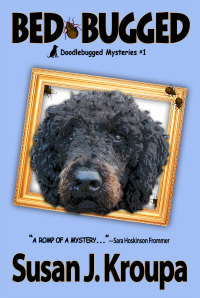
bedbugged coverAuthor Susan Kroupa has several good questions about her almost-done novel in progress. All of them are about punctuating dialogue, which presents some challenges not generally encountered in straight narrative. (The novel is the fourth in Susan’s Doodlebugged mystery series, about the adventures of Doodle, a bedbug-hunting Labradoodle; Molly, his 10-year-old human cohort; and Josh Hunter, Molly’s father, who needs all the patience he can get. A must for dog-loving mystery readers and mystery-loving dog people!)

Where to put the period?

She’s the type of person Miguel, my old trainer, calls a “charmer”. Or a “charmer.”

My dad likes to say that the certification means he’s not ‘just some guy with a business license and a dog’.”
Or “. . . and a dog.'”

This is a point where American English (AmE) differs from British English (BrE). In AmE, periods and commas nearly always go inside the close quotation marks, both single and double. Even when the element enclosed in quotes is something less than a complete sentence. So:

She’s the type of person Miguel, my old trainer, calls a “charmer.”

Same deal with the “My dad” sentence. Notice, however, that this sentence is missing something. See it?

My dad likes to say that the certification means he’s not ‘just some guy with a business license and a dog.'”

Single quote marks are used for quotations within quotations. (BrE does the opposite: the primary quotation is set off with single quote marks, the quotation within with doubles.) The period is followed by both a close single quote and a close double quote. This means that somewhere in the preceding copy there should be both an open double quote and an open single quote. This sentence has an open single quote mark — but no open double. This sentence has been lifted from its context, so the missing open double quote mark is probably in an earlier sentence, but I’m going to ask Susan to check to make sure.

By the way — if I were copyediting, I’d suggest losing the quote marks around “charmer.” They aren’t wrong, but they aren’t necessary either. They do come in handy with distinctive phrases. If Miguel habitually called this type of person a “two-faced charmer,” I’d keep the quotes.

With the stronger terminal punctuation marks, question marks and exclamation points, placement is a little more complicated. Does the question mark or exclamation point go with the quoted bit? If so, it goes inside the close quote. If not, it goes outside. Here’s a variation on Susan’s first sentence:

Would Miguel call her a “charmer”?

The question mark applies to the whole sentence, not just “charmer,” so it goes outside the quote marks. Here’s an example of the opposite:

As a child she was taught to greet grownups with “How do you do?”

The whole sentence isn’t a question, but the quoted bit — “How do you do?” — is. So here the question mark goes inside the close quote.

Exclamation points work the same way. Imagine that the dad in Susan’s second sentence has been accused of being “just some guy with a business license and a dog.” He might reply, “I am not ‘just some guy with a business license and a dog’!” The exclamation point goes inside the double close quotes because the whole reply is an exclamation. (He’s a little miffed at the suggestion.) But it goes outside the single close quote because that quoted bit isn’t an exclamation.

How to write stuff the way people say it

“Find it on our website, states of affairs slash low down news dot com.”
Or add dashes between the words? This is being heard over the radio.

In writing it’s a no-brainer: the URL is statesofaffairs/lowdownnews.com. Actually that doesn’t look quite right to me — did I say I’ve been learning Dreamweaver in my spare time? lowdownnews.statesofaffairs.com would be more like it, or lowdownnews.com/statesofaffairs, or statesofaffairs.com/lowdownnews. The domain name comes first, and the folders follow the slash.

But I digress. The challenge is to translate something written into something oral, using the written word to do it. Writers and editors have various opinions on this. Some think that numbers should always be spelled out in dialogue because we can’t pronounce numbers. And some numbers, notably those dealing with money and time, can be pronounced in different ways. How does a character pronounce “10:45”? “Ten forty-five” or “quarter to eleven” or “a quarter of eleven”? How does he say he’s got $6.35 in his pocket? “Six thirty-five” or “six dollars thirty-five” or “six bucks and thirty-five cents”? If you hear a character saying it a certain way, by all means spell it out. That way your readers will be more likely to hear it the same way.

But suppose my character says, “My dog was born in twenty-oh-eight.” I don’t know about you, but I have to look twice at that to realize it’s a year. I had the same problem with “states of affairs slash low down news dot com”: It didn’t say “URL” to me till I’d screeched to a halt and gone “Huh?” Verisimilitude is nice, but not if it makes things unnecessarily hard for the reader. So my character would say “My dog was born in 2008” and Susan’s newscaster would say “Find it on our website, statesofaffairs/lowdownnews.com” — after checking to make sure that the bogus URL has the syntax of a real one.

Dashing dialogue

I use dashes a lot and am uncertain whether this structure for quotes and dashes is correct:
“Absolutely. I have my reputation to think about. With the public—” she meets her son’s eye—“and with you.”

Dashes are a handy way to work body language, intonation, or thoughts into dialogue. Both dashes can go inside the quotation marks or both dashes can go outside. This sample has one inside and one outside. One of them needs to be moved — but which one? Depends on how Susan hears the dialogue, and how she wants her readers to hear it.

#1: “Absolutely. I have my reputation to think about. With the public—” she meets her son’s eye “—and with you.”

#2: “Absolutely. I have my reputation to think about. With the public”—she meets her son’s eye—“and with you.”

What’s the difference? In #1, the dash inside the quotation marks suggests that there’s a pause in the speaking. In #2, the speech itself isn’t interrupted, so she’s meeting her son’s eye (or “eyes”?) while she’s speaking.

Note that in conventional AmE typography the em dash is usually set solid (i.e., without extra space) to whatever precedes and follows it. Hence there’s no space around “she meets her son’s eye” in #2 but there is in #1.

Also note that if you’re using “smart” or curly quotes, dashes often fool automated typesetting systems into making the quote marks go in the wrong direction: the system thinks that a quote mark following a dash has to be a close quote, but as you can see in #2, this often isn’t true.

Got a question about editing, writing, or how to keep going? Ask away! There’s a contact form on the You! page. See the menu bar at the top of this page.


On Being Edited

Being both a writer and an editor, I get to listen to writers bitching about editors, and to editors bitching about writers. I’ve been known to blow off some steam myself, sometimes wearing a writer’s hat, other times an editor’s. On the whole, though, I wish writers and editors would spend more time listening to each other instead of just bitching to their colleagues. So a few months ago a friend of mine, the mystery writer Cynthia Riggs, was on the receiving end of an Edit from Hell. (I saw the edited ms. As an editor, I was embarrassed. As a writer, I was outraged.) I asked if she’d be willing to write about the experience for this blog. This is what she wrote. — SJS

By Cynthia Riggs

Is it always the writer who’s being unreasonable? Or could it be the editor?

After ten books and the deft editing of Ruth Cavin, the doyenne of mystery editors, I and my eleventh book were turned over to an editorial assistant in her first real job out of college.

I understand the heady feeling of a first editing job. The more changes an editor makes, the better, right? That will show how conscientious one is. It takes a while for a new editor to recognize that less is more.

The paper manuscript for my eleventh book came to me through the mail, along with a two-page letter from Jane Doe (as I’ll call her). “I think if he [the serial killer] murders a few less people — perhaps 5 instead of 11,” she advised me, ” it would make the murders more meaningful.”

I promised myself to think about it.

stetOn to the manuscript itself. I am accustomed to electronic editing, so in order for me to work with Jane’s extensive comments, I transcribed the first 64 pages of her penciled notes from the paper copy to my computer. Once I got that far, I decided I’d better stop there and write my own comments. The first 153 edits took me up to page 58. Of the 153, I accepted three and rejected 150. I explained each and every one of the 150 I rejected.

She changed ellipses to em dashes, added adverbs, such as “said dismissively” and “snorted derisively,” confused its and it’s, turned sentences around, had my characters react in ways unlike them in past books, and, in general, trashed my manuscript.

Should I, the writer, be teaching Jane, the editor, how to edit?

The last straw was on page 58. Jane had changed my sentence, “The Steamship Authority would require a passenger ticket for the corpse, even one in this condition,” to “Even in it’s [sic] condition, the Steamship Authority would require a passenger ticket for the corpse.” (Actually, the Steamship Authority is in pretty good condition.)

That’s where I decided to quit.

Now, I’m not an inexperienced writer. Or editor. I have an MFA in Creative Writing from Vermont College. I was tutored by editors at the National Geographic Society, where I worked for a time, and wrote two chapters in one of the NGS books, which I also edited. I was editor of the Marine Technology Society Journal, edited and wrote for Petroleum Today, the quarterly publication of the American Petroleum Institute, and have more than a hundred published articles and short stories to my credit. I have been teaching writing for 13 years, since Jane was ten years old.

There are things an editorial assistant in her first job can tell me that I can profit from, but not when she hasn’t read any of the previous books, doesn’t know grammar, doesn’t know the basics of copyediting, and is rewriting my work so it sounds comfortable to her.

We editors often can get defensive about a writer’s rejection of all the work we put into improving a manuscript. But more often than we editors like to think, the writer is right.

  * * *

Cynthia Riggs. Photo by Lynn Christoffers.

Cynthia Riggs.
Photo by Lynn Christoffers.

Cynthia Riggs is the author of the Martha’s Vineyard Mystery Series, whose protagonist, the indomitable Victoria Trumbull, is based on Cynthia’s mother, the late, equally indomitable Dionis Coffin Riggs.  She recently launched Martha’s Vineyard Mysteries, a lively blog about her life at Cleaveland House, which has been in her family since about 1750.


Hyphenalia

Policy maker, policy-maker, or policymaker? Pre-eminent or preeminent? First grader or first-grader? E-mail or email?

Hyphens can be tricky, but that's no reason to tear your hair out.

Hyphens can be tricky, but that’s no reason to tear your hair out.

According to Sturgis’s Law #5: “Hyphens are responsible for at least 90 percent of all trips to the dictionary. Commas are responsible for at least 90 percent of all trips to the style guide.”

The tricky thing here is that the dictionary will only tell you what to do if your word is in there. Often it isn’t. If it is, you’re in luck — as long as you don’t notice that (1) dictionaries are wildly inconsistent when it comes to hyphenation, and (2) dictionaries often disagree with each other.

Merriam-Webster Unabridged doesn’t list “policy-maker” or “policymaker.” This may be taken to mean that MW considers it two words: “policy maker.” The American Heritage Dictionary, however, lists “policymaker” as one word, no hyphen. And while we’re at it, MW thinks “policyholder” is one word. “Slaveholder” is one word, but “slave owner” is two.

For several editions now, the Chicago Manual of Style has been trying to impose method on the hyphenation madness. In section 7.85 of the 16th edition you’ll find a handy-dandy several-page chart. It sorts compounds by category, parts of speech, and specific words; gives examples of each subcategory; and then summarizes the “rule.”

It’s useful, it really is. I refer to it often. But it too will lead you into inconsistency, not least when you notice that British English uses hyphens more liberally than American English and the sky hasn’t fallen in yet. Chicago “prefers a spare hyphenation style.” So do the Merriam-Webster dictionaries. The operative word here is “style.” In matters of style, there’s generally a big gray area where choices have to be made.

What editors and teachers and style guides tend to forget is that hyphens serve a purpose — beyond driving editors crazy, that is. Hyphens are joiners: they link words into temporary compounds and attach prefixes and suffixes to root words. Over time temporary compounds may become permanent if they’re used enough. A few years ago “e-mail” was generally hyphenated, but these days it’s often one word: “email.”

“Policy maker” and “policy making” are in transition. That’s why one dictionary makes them two words and another closes them into one, and you’ll sometimes see “policy-maker” and “policy-making.” I suspect that the words are closing up fastest among people who write about public policy. They and their readers think of “policymaker” as one word, not two.

If you read books that were published a century, or even a few decades, ago, you’ll probably find hyphens where they’re seldom found today. “Rail road” was once two words, then it was hyphenated, then it fused into one: “railroad.” Other compounds have split into two distinct words: “no-one” is still out there, but “no one” is now standard. The hyphen is no longer needed to tell readers that “no” and “one” are a unit.

What if the potential for confusion still exists? That’s part of the gray area. A readership of educators and parents of young children will probably realize at first glance that a “first grader” is a kid in first grade. A more general audience might need a little help. I generally hyphenate “first-grader” myself, but when I’m editing, I’ll nearly always go with the author’s choice.

How about “high school student”? Yes, it is possible to read that to mean a school student on drugs, but this generally involves some contortion on the reader’s part or (more likely) an affection for puns. If your readers are familiar with the term “high school,” you can safely omit the hyphen.

Once in a while, though, the little hyphen is crucial. Chickens live in a coop; people buy food at a co-op. Newspaper columns are op-eds (an abridgment of “opposite the editorial page”), not opeds.  Merriam-Webster’s hyphenates “co-ed” as both noun and adjective; American Heritage says it can go either way: “co-ed” or “coed.”

Which brings up another handy thing about hyphens: they can join, but they can also separate. In “co-op,” “op-ed,” and “co-ed,” the hyphen tells you to read or pronounce each word as two syllables, not one. This is why plenty of writers use a hyphen in words like “pre-eminent”: to signify that “pre-” is a prefix and that the first syllable of the word is not “preem.”

Merriam-Webster’s and Chicago don’t like such hyphens, so rule-following copyeditors routinely strike them out, whether they’re useful or not. I don’t know about you, but I can’t look at “reignite” without seeing “reign-ite” or “coworker” without seeing “cow-orker,”  so I’m inclined to deal with hyphens on a case-by-case basis. Be wary of “one size fits all” rules when it comes to hyphens, or anything else for that matter.

A hyphen between prefix or suffix and root word can also subtly call attention to the root. The authors I edit often hyphenate “pro-,” “anti-,” and “non-” words. Whether they’re doing it instinctively or by choice, I suspect this is why they do it — because I do it myself. To me “pro-choice” is stronger than “prochoice,” “anti-liberal” than “antiliberal,” and so on.

The author of a current copyediting job hyphenates “desert-like.” Chicago says “-like” compounds should be closed if they’re closed in Webster’s, and sure enough, “desertlike” is given in the entry for “desert.” Is that a good reason to close up “desert-like”? I don’t think so. “Desert-like” calls a little more attention to “desert,” and the passage it’s part of is a little more vivid as a result. So I entered “desert-like” on my style sheet, so the proofreader will realize it’s intentional, and moved on.

Hyphens are handy, versatile little buggers. Sure, they can be overused, but so can anything else.  Do learn whatever conventions prevail in your field or genre, but don’t worry about hyphens when you’re first-drafting. Even if the whole world will think you’re stupid because you put a hyphen in the wrong place, you don’t have to worry about it yet. Not until you’re ready for the whole world — or at least your writers’ group, or an editor — to have a look at your ms.

When you get to your second and subsequent drafts, that’s soon enough to think about whether this or that hyphen serves a purpose.


What’s a Style Sheet?

I knew nothing about style sheets when I started copyediting books for trade publishers and university presses. Before long I thought style sheets were the greatest thing since mocha chip ice cream — well, almost.

So what’s a style sheet? More important, if you’re a writer, not an editor, why should you care?

English is a richly diverse language. British English (BrE) and American English (AmE) often spell the same word differently: spelt/spelled, labour/labor, tyre/tire. In AmE, some words can be spelled in more than one way, like ax and axe, or façade and facade. Others have variations that are pronounced differently but mean the same thing: amid and amidst, toward and towards.

And hyphens! Don’t get me going about hyphens. One of these days I’ll devote a whole blog post to hyphens. Sometimes a hyphen is crucial: consider, for instance, the difference between coop and co-op. Often the hyphen is helpful but not crucial. When I look at reignite, the first thing I see is reign. If an author wants to hyphenate it, re-ignite, that’s fine with me. For most readers, the hyphen in living-room sofa isn’t essential, but if the author has written it that way, I’ll generally leave it alone — and insert a hyphen in dining-room table if the author has left it open.

A style sheet collects all such choices into one handy list: choices not only about how words are spelled but about how they’re styled. Hyphenation is often a matter of style rather than spelling. When do you spell out numbers and when do you use figures? Are abbreviations OK? When the dictionary notes that a word is “often capped” or “usually capped,” which does the writer prefer?

It’s a rare author who submits a style sheet with his or her manuscript. A recent job included Arabic and Urdu terms transliterated into English, and many personal and place names that are transliterated in myriad ways. The author did include a style sheet with his preferred spellings and stylings, and I was profoundly grateful. It saved me a lot of online research and second-guessing.

In fact-checking another recent job, a novel, I quickly discovered discrepancies between the names of some real-life places and the way my author was spelling them. Other names were faithful to the actual place. I’m still not sure whether these discrepancies were intentional or not. If the job had come with a style sheet, I would have known — and I wouldn’t have spent so much time trying (unsuccessfully) to verify the author’s versions.

Why should you, the writer, keep a style sheet?

Maintaining consistency in a novel or long nonfiction work is a challenge. Sure, if you’re working on the computer, you can use the search function to find earlier instances of a word or name — or you could just consult your style sheet. If you’re writing a series involving the same locations and characters, a style sheet will be even more useful.

Whether you self-publish or publish with a trade, academic, indy, or small press, your style sheet means your copyeditor doesn’t have to start from scratch. If she finds inconsistencies in the ms., she’ll be able to go with your preference instead of guessing what you want.

Several books that appear frequently in my "Primary References" section

Several books that appear frequently in my “Primary References” section

I find that keeping a style sheet makes me more conscious of my choices, whether I’m editing or writing. Plenty of choices are “six of one, half dozen the other.” Others are a matter of style: for instance, do you prefer diacritics in words like façade and résumé and naïve? And sometimes, especially with proper nouns, it’s a matter of right and wrong. In the very well written nonfiction book I just finished copyediting, Katherine Hepburn’s name was so spelled. I’ve seen it so often (mis)spelled that way, I didn’t have to look it up (but I did anyway): it’s Katharine, with an a. Before you enter a name on your style sheet, verify the spelling.

If you write fantasy or science fiction, with made-up names that can’t be verified online, a style sheet can be especially useful. Same goes if, in either fiction or nonfiction, you’re dealing with names from other languages, especially languages that don’t use the Roman alphabet. Transliteration systems differ. Accents and diacritics and other spelling conventions can be confusing to someone who doesn’t know the language.

You can organize your style sheet in any way that makes sense to you and whatever you’re working on. Here are the major categories and subcategories in the style sheet I made for a just-completed job, with a brief explanation of each. Most of mine follow a similar format.

Primary References

Here’s where I put whatever dictionaries, style guides, and other reference works I’m using. This keeps my word list (see below) under control: it means I only have to list spellings and stylings that differ from the dictionary’s or style guide’s recommendation.

General

This section is for style choices that apply to the whole book. Number 1 is nearly always “serial comma.” Number 2 usually specifies either “which/that distinction observed” or “which OK for restrictive clauses.” (Anyone want a crash course on the which/that distinction??)

This particular style sheet had subsections for Capitalization, Hyphens & Dashes, Quotes & Italics, and Slashes. Most also have a Numbers subsection, but not this one.

Words

Word lists can be short or long. They should include choices made where alternatives exist, e.g., axe rather than ax, or vice versa. They’ll probably include plenty of words where capitalization, hyphenation, the use of italics, or the styling of numbers is at issue. Their #1 purpose is to help me keep my choices and the author’s straight.

Among the words and phrases in my list were the following (with the reason I included each one):

Braille (can be lowercased)

carpe diem (like other foreign-language expressions listed in the dictionary, it’s usually not italicized)

coauthor (commonly hyphenated)

 decision-making (n.) (decision making and decisionmaking are also possible)

 not-yet-imagined, the (coinage by the author)

 rebbe (variant spelling of rabbi)

transparence (variant of transparency)

Trickster tales (Trickster capped as an archetype)

Western (cultural); western (n.; genre): compass directions are usually lowercased, except when they take on a more-than-geographical meaning. Eastern and Western may signify large cultural groupings. During the Cold War, they had political significance. (North and South are generally capped in reference to the sides in the U.S. Civil War.) And western the genre is sometimes capped and sometimes not. Could drive you crazy, no?

Names

Some copyeditors list the names of virtually every person mentioned in a book. As a proofreader, I don’t find such exhaustive lists useful. So I don’t list familiar names that are easily verified — unless they are frequently misspelled (like Katharine Hepburn) or the author is inconsistent. It can be hard to verify names with particles (von, van, de, etc.), partly because styling varies from family to family and because online references aren’t always as authoritative as they think they are. So it’s worth putting them on the style sheet.

serenity prayer

A good style sheet helps editors and proofreaders recognize what should be changed and what’s fine as it is.