Revision as Improv

I’m in deep revision mode on Wolfie, the novel in progress, so ‘ve been thinking a lot about how I know what needs to be added or subtracted or completely rewritten.  The truth is, I don’t know. In an early Write Through It post, I write that editing was “Like Driving.” Revision is like that too.

Early this year, I started a second draft before I’d finished the first. As I blogged in “On to Draft 2!” a couple of plot threads had emerged in the writing. Those threads were going to affect the novel’s climax and conclusion, but until I developed them more fully I wouldn’t know how.

A sound foundation

A sound foundation

The same thing happened with my first novel, The Mud of the Place. I thought I was writing a tragedy. Then around page 300 of the first draft, a minor character said something that took me by surprise. Suddenly I could see a way out for a main character who was digging himself deeper and deeper into a hole. I tried to keep going — “I’ll fix the first 300 pages in the next draft,” I told myself — but I couldn’t. It was like building a house on a crumbling foundation.

So I went back to the beginning and started again. The rewriting wasn’t as hard as I’d feared. I didn’t have to throw everything out. That minor character’s words revealed new possibilities in the story that was already unfolding; they’d always been there, but I hadn’t noticed.

Since I can’t tell you how to revise, I’ll start by telling you how not to revise: Don’t return to page one and immediately start fiddling with punctuation and word choice. Revision starts with the big picture: structure, organization, plot and character development, that sort of thing. The little stuff is frosting on the cake. Mix the batter and bake the cake first.

To see the big picture, you have to step back — to approach your own work as if you’ve never seen it before. Of course you have seen it before, but if you let it sit for a while — a couple of weeks, maybe even a couple of months — you may be amazed how different it looks when you come back to it.

While you’re letting it sit, start a new project or wake up one that’s gestating in a notebook or computer file somewhere. If nothing tempts you, use your usual writing time to scribble whatever pops into your head. Chances are it’ll lead somewhere interesting.

If the work is far enough long, you might even draft a colleague or two to read and comment on it at this point. We all have different ideas of when the best time is to do this. I generally wait till I’ve gone as far as I can on my own.

When you’re ready, save your current draft with a new filename. The old draft is your safety net. Then start reading. Read like a reader or a reviewer — and not the kind of reader who pounces on every typo! Notice where you get impatient, or confused, or curious.  I’m always on the alert for clues that something interesting is happening offstage. This is like walking by a closet and suddenly there’s loud pounding and thumping coming from behind the closed door. Something is demanding to be let out. See “Free the Scene!” for more about this.
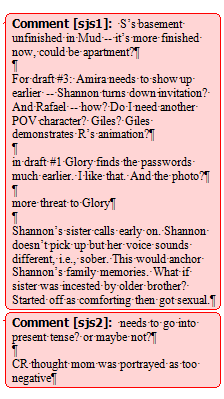
Word's Comments feature is a handy way to make notes for revision. Here I'm looking forward to draft #3 while working on #2.

Word’s Comments feature is a handy way to make notes for revision. Here I’m looking forward to draft #3 while working on #2.

Make notes as you’re working about scenes that need trimming, or expanding, or moving to somewhere else. If you know what needs doing, go ahead and do it. Microsoft Word’s Track Changes feature enables you to make tentative additions and deletions, then revisit them later.

Look for “soft ice” — the words, sentences, and whole paragraphs that don’t carry their own weight. Look for the pathways that led you into a scene but that become less important once you know where you are. They’re like ladders and scaffolding: crucial to the construction process, but dispensable when the job is done.

You’ve heard the standard advice “Kill your darlings,” right? It means different things to different people, and I’ve got mixed feelings about it. I’ve got mixed feelings about most “standard advice.” Most of it’s useful on occasion, but none of it is one-size-fits-all. Take what you like and leave the rest.

But sooner or later when you’re revising you will come to a stretch of drop-dead perfect dialogue or a scintillating anecdote and realize that it just doesn’t belong in the manuscript. Maybe it’s too much of a digression. Maybe it calls too much attention to itself. Maybe it duplicates something better said earlier. It’s hard to let these things go. Track Changes comes in especially handy here. You can zap it provisionally and gradually get used to the idea that it really does have to go.

When you’re slash-and-burning and filling in gaps, don’t worry too much about the transitions between paragraphs and scenes. If the right segue comes to you, by all means go with it, but if it doesn’t, move on. You can smooth it out later.

If you can’t solve a problem while you’re staring at it, stop staring, make a note, and move on. My thorniest problems tend to solve themselves when I’m out walking or kneading bread, falling asleep or just waking up. Solutions sometimes appear for problems you haven’t come to yet. Writing is weird.

When I started draft #2, I swore I’d get to the end before I started draft #3, but now, at page 238, I’m pretty sure I won’t. At present I’ve got  two viewpoint characters. To develop an important but currently underdeveloped plot thread, I need to add a third. He’s already a player, but adding his point of view is going to change the book’s balance a lot.

There’s also an incident I need to stage near the beginning of the book: my central character, Shannon, listens to an answering-machine message from her long-estranged younger sister. Shannon never picks up or returns these calls because her sister is always drunk or strung out. This time, however, her sister sounds sober and lucid. Shannon doesn’t pick up this time either, but the call ripples through the narrative. The ripples were already there; I just didn’t know what had prompted them.

So I’ve got a little farther to go in draft #2, then it’s back to the beginning to start on draft #3.
Why I Proofread

Most of what I do for a living is content editing, also called stylistic editing, line editing, and copyediting.

For more about the different levels of editing, see “Editing? What’s Editing?

I go through each manuscript line by line, asking whether each sentence says what the author wanted it to say, and in the most effective way possible. (Good editors are at least a little bit psychic: usually we can figure out what the author was getting at even when the words get in the way.) Along the way I catch spelling mistakes, awkward punctuation, and usage gaffes, sure, but this is only part of the job.

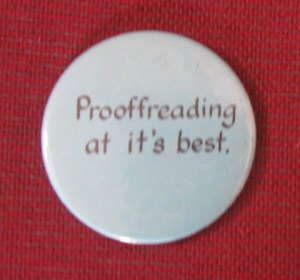
prooffreadingIn the last few months I’ve had two big proofreading gigs. When I’m proofreading, catching spelling mistakes, missing words, awkward punctuation, and dubious usage is what the job is about. You don’t have to be psychic to be a good proofreader. When you’re proofreading, the book is in proofs, meaning the pages look pretty much the way the reader will see them. The book has already been edited, and the editor was not you.
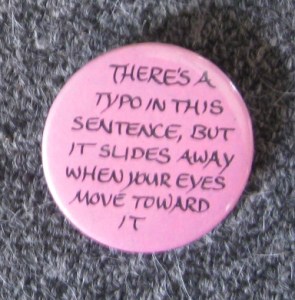
In other words, you want to change as little as possible.

For more about what proofreading is and isn’t, see “Proofreading 101.”

Proofreading generally pays a little less per hour than the editing I usually do, so why do I bother with it? I ask myself that whenever I accept a proofreading job. Here are some of my answers.

• When I’m editing, I often have to untangle snarly sentences. This can be exhausting. When I’m proofreading, someone else has done it for me.

• Proofreading demands that I focus on each and every word. When I’m editing, I often catch myself focusing on the sentences and overlooking the words that make them up. Proofreading reminds me that each word is important.

• When I’m proofreading, I’m following in another editor’s footsteps. Editors rarely get to see each other’s work. One of my recent proofreading jobs was a novel that included plenty of street slang and police shoptalk. Not only did I learn a few new words, I noted how author and editor had punctuated the kind of dialogue that isn’t covered in standard style guides. It gave me some ideas.

• Like many editors, I’m often tempted to meddle where meddling is not called for. Proofreaders must keep meddling to a minimum. I consider this a valuable spiritual practice.

• I get to proofread stuff that I wouldn’t be qualified to edit. A just-completed job was a multi-author essay collection dealing with the aftermath of the Arab Spring. I’ve edited a fair number of works, fiction and nonfiction, dealing with the Arab world, but this one included charts, tables, and lots of statistics. I’m in the “real life can’t be quantified” camp, but I don’t mind statistics too much when I’m proofreading.

That said, the next couple of months look like editing, editing, and more editing. Toward the end of November, I will definitely be ready for another proofread.

typo

Readers Won’t Like It If . . .

“Readers won’t stand for it.”

“It’ll trip readers up.”

“Readers expect mysteries to start off with a bang.”

Hang around editors for any length of time and you’ll hear umpteen variations on the theme: readers demand this and they won’t put up with that. You may even hear it from the editor you’ve engaged to work on your manuscript.

Here’s why you should take generalizations about “readers” with about a half ton of salt.

When editors, agents, teachers, and other gatekeepers claim to speak for “readers,” they’re hiding behind an authority that doesn’t exist. Readers are not homogeneous. They do not constitute a godlike authority that must be obeyed and can’t be contradicted or even verified.

Good editors don’t need to hide. We’ll say things like “I stumbled over this bit” or “Given the conventions of [insert genre here], you might consider picking up the pace in chapter one.” Take your editor’s observations and suggestions seriously, but remember that the choice is yours —

Unless, of course, a desirable contract hangs in the balance. When dubious advice is backed up by threat, it’s often best to take it. It’s still your call. Most experienced writers have gone along with editorial decisions that we didn’t agree with. The work survived, and so did we. And sometimes in hindsight the decision looks better than it did at the time.

When an editor tells you that readers won’t stand for something, don’t be afraid to talk back and stand your ground.

My mystery-writing friend Cynthia Riggs was told by her editor that readers would balk at a character’s using the word “bastard” in Bloodroot, the forthcoming title in her Martha’s Vineyard Mystery Series. Not one to take this lying down, Cynthia created a table of the “naughty words” used in the (so far) 12-book series. “Bastard” has appeared 41 times in the series, and 14 of them were in one particular book.

naughty words

True,  Cynthia did once receive an email from a fan who wrote that she didn’t “enjoy the language used by the police.” This reader also noted that she had already read four books in the series and had started on her fifth, so the use of strong language doesn’t seem to have been a deal-breaker for her.

For sure it may be a deal-breaker for some. All of us have likes, dislikes, and expectations that will prompt us to put a book down or never pick it up in the first place. Editors can’t predict how “readers” will respond to a particular scene or character or word because “readers” as a generic category doesn’t exist.

Neither can writers. When we attempt to please all of the readers all of the time — or even all of the readers in a particular sub-subgenre — our writing tends to become formulaic and predictable. Fortunately, and whether we know it or not, many of us have a more specific reader in mind. That’s who we’re writing for. Often this reader looks at least somewhat like us.

Left to our own devices, writers are hard to pigeonhole. So are readers. So are books. Unfortunately, we aren’t left to our own devices. Books can be unique, unpredictable, hard to describe in 25 words or less. This makes them hard to market.  Widgets, in contrast, are easy to sell because, being mass-produced, they’re consistent and predictable.  Aha! thought the commercial publishers. We’ll treat books like widgets!

And for several decades they’ve been doing exactly that: sorting books into genres, subgenres, and sub-subgenres so that customers can — so the thinking goes — buy books the way they buy toilet paper. (For more about this, see “Genres and Dump Dogs.”)

In my bookselling days, I found this endlessly frustrating. Where to shelve books that fit into two, three, or more categories? Shelving a book in one place would make it easier for some readers to find, but what about the readers who wouldn’t think to look there? What about the readers who were convinced that no book in that section could possibly interest them?

The marketing departments have trained us well. Many readers make a beeline for [insert subgenre here] and won’t stray from it. Writers whose top priority is selling, maybe even writing for a living, ignore this at their financial peril — but if they heed it, what happens to their writing? Often it becomes predictable — like a good widget. If they want to do something different, they’ll often do it under a pseudonym, to avoid disappointing their widget-hunting readers.

So when an editor or an agent or a writer you admire tells you that “readers won’t stand for it,” they may mean well, or think they do. It’s still your call. Readers aren’t homogeneous. Write for the ones who are willing to take chances. Write for yourself.

Go Set a Watchman

Plenty of people have reviewed or written about Harper Lee’s Go Set a Watchman, but my friend and mystery writer Cynthia Riggs pinpoints what I think is the most important issue raised by the contrast between Watchman and the classic that grew from it, To Kill a Mockingbird: the importance of editing. Not just copy and line editing, but the kind of editing that sees the potential in a manuscript that isn’t “there” yet and then coaxes, browbeats, and otherwise persuades the writer to make it real.

It’s rare these days that a publisher will invest this kind of time and expertise in a book, especially a first novel. Writers have to do much of the work ourselves, with the help of workshops and writers’  groups and, if we’ve got the money and can find the right person, an editor. But it’s always possible to improve even the drafts that we’re sure are done.

Cynthia Riggs's avatarMartha's Vineyard Mysteries

To All Who Plan to Read or Have Read “Go Set a Watchman”:

Cynthia and Howie comparing copies of Cynthia and Howie compare “Go Set a Watchman” with “To Kill a Mockingbird”
photo by Lynn Christoffers

“Go Set a Watchman” was Harper Lee’s first book, and first books are usually unpublishable, as was “Watchman.”  While it has brilliant writing in patches, it has inconsistencies, improbable passages, repetitions, unnecessary divergences, too much back story, ramblings, boring passages, too much overwriting, and almost every error a new writer can make.

Tay Hohoff, an editor at Lippincott, saw promise in the work, saying the “spark of the true writer flashed in every line.”  She urged Harper Lee to scrap “Watchman” and start all over, write a new book with an entirely different story.  Hohoff saw Scout’s young voice, one of several back stories in “Watchman,” as the potential for a great book once it was rewritten, and, of course…

View original post 208 more words

Sturgis’s Law #4

This past spring I started an occasional series devoted to Sturgis’s Laws. “Sturgis” is me. The “Laws” aren’t Rules That Must Be Obeyed. Gods forbid, we writers and editors have enough of those circling in our heads and ready to pounce at any moment. These laws are more like hypotheses based on my observations over the years. They’re mostly about writing and editing. None of them can be proven, but they do come in handy from time to time. Here’s #4:

“The check’s in the mail,” “I gave at the office,” “All this manuscript needs is a light edit”: Caveat Editor.

If you’ve forgotten all the Latin you ever learned or never studied it in the first place, “Caveat” means, roughly, “Watch out!”

brochure cover cropWhen someone tells you “The check is in the mail” or “I gave at the office,” your most likely response is skepticism. You know this because you have used variations on the same excuses yourself, right? I sure have.
It is true that all some manuscripts need is a “light edit.” These manuscripts are generally prepared by fairly experienced writers who have already run them by a few astute colleagues for comments and corrections.

When I and most of the working editors I know roll our eyes at “All this manuscript needs is a light edit,” it’s because the manuscript in question usually needs considerably more.

So what does “light edit” mean?

Nothing associated with editing has one clear-cut, hard-and-fast, universally understood definition, but “light edit” generally means copyedit, as described in “Editing? What’s Editing?”:

Let’s say here that copyediting focuses on the mechanics: spelling, punctuation, grammar, formatting, and the like. With nonfiction, it includes ensuring that footnotes and endnotes, bibliographies and reference lists, are accurate, consistent with each other, and properly formatted.

Once one starts dealing with matters of style and structure — snarly sentences, internal inconsistency, abrupt paragraph transitions, missing information, and so on — one has moved beyond the realm of the light edit.

Most of us are not the best judges of our own work. Good writers know this. When we think a story or essay is done, the very best we can do, we set it aside for a week or a month. When we come back to it, we see it with fresh eyes. Problems we missed before are now glaringly obvious, from typos to dangling participles to plot holes that could swallow a truck.  Often the fixes are just as obvious, thank heavens.

Outside editors come to the work with even fresher eyes, along with considerable experience in identifying and fixing problems in all sorts of manuscripts. They haven’t seen the previous drafts. They don’t know what you meant to say. They see only what’s there on the page.

So when you approach a prospective editor, don’t lead off with “All this manuscript needs is a light edit.” Describe the work and let the editor know what you want to do with it: submit it to a literary magazine or academic journal? find an agent? self-publish?

With a book-length work, fiction or nonfiction, an evaluation or critique is often the best place to start. Editing a book-length work takes time. This means it isn’t cheap. A good critique will point out the strengths of your ms. as well as any weaknesses that may exist. It will identify problems that you can fix yourself. It will let you know if this particular editor is a good match for you and your manuscript.

And if you’re an editor, the next time a prospective client approaches you with “All this manuscript needs is a light edit,” don’t snigger, raise your eyebrows, or roll on the floor laughing.

Because this time the author may be right.

Chicago Style

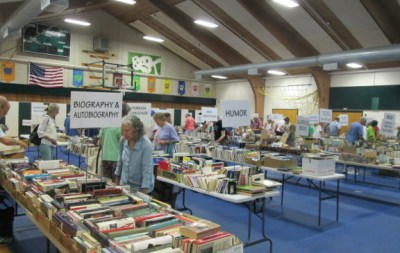
My library’s annual monster book sale was last weekend. Of course I went. Of course I came home with a stack of books, and all for $10.

The book sale takes place in the elementary school gym. All the sorting and shelving is done by volunteers.

The book sale takes place in the elementary school gym. All the sorting and shelving is done by volunteers.

The book sale is a browser’s heaven: tables and tables of books sorted, and occasionally mis-sorted, into general categories, and many with more books in the boxes underneath. I rarely go with a particular book in mind. I always find books I didn’t know I was looking for.

Or they find me.

Browsers cheerfully recommend books to total strangers, and sometimes get into spirited conversations about books they liked or books they thought were overrated. I was poring over one of the history-related tables, head cocked sideways so I could read the spines, when the fellow to my right handed a book to the fellow on my left. The book passing in front of me was The Chicago Manual of Style.

“Are you interested in this?” asked the fellow on the right, who I guessed (correctly) was the father of the fellow on the left.

My constant editorial companions. Clockwise from top: The Chicago Manual of Style, Words into Type, Amy Einsohn's Copyeditor's Handbook, and Merriam-Webster's Collegiate Dictionary.

My constant editorial companions. Clockwise from top: The Chicago Manual of Style, Words into Type, Amy Einsohn’s Copyeditor’s Handbook, and Merriam-Webster’s Collegiate Dictionary.

I’ve been on first-name terms with Chicago since 1979, when it was still called A Manual of Style. Could I remain silent while my old buddy and sometime nemesis changed hands right before my eyes? I could not. “That’s the current edition,” I said. “I’ve got it at home. I’m an editor by trade.”

Dad let on that Son was an aspiring writer. Son seemed a little uneasy with the description. “If you have any interest in mainstream publishing,” I said, “that’s a very  good book to have.”

I don’t know whether they bought it or not, or what they paid for it. It was half-price day at the book sale, so probably not more than a buck or two. But if you have any interest in mainstream publishing, especially in the U.S., it is a very good book to have. Or you can subscribe to the online edition for $35 a year.

In U.S. trade and academic publishing, The Chicago Manual of Style is something of a bible. It contains almost everything writers and editors need to know about book publishing, along with extensive recommendations for further reading in various areas. It includes chapters on grammar, usage, and punctuation. At least half of its 1,026 pages are devoted — as its title might suggest — to style. 

What is “style”? Think of all the myriad choices you make when you’re writing and especially when you’re editing your own work, about capitalization and hyphenation, about the use of quotation marks, boldface, and italics. How to treat titles of movies or titles of songs, and words from other languages, and the English translations of those words. And on and on and on. Style comprises all the decisions made about how to handle these things. “Chicago style” is a collection of particular recommendations. If you italicize book titles and put song titles in quotes, you’re following Chicago style, maybe without knowing it.

Much of the nit-pickery that goes into copyediting is about style. Confronted with the plethora of details that go into Chicago style, or Associated Press (AP) style (widely used by newspapers and periodicals), or American Psychological Association (APA) style (widely used in academic writing, especially the social sciences), the novice writer or editor may find it hard to believe that applying a particular style makes things easier — but it does. Every time I embark on editing a long bibliography, I am profoundly grateful to Chicago for its documentation style and to the authors who apply it consistently. I would hate to have to learn or invent a new documentation style for every bibliography I work on.

That goes for other aspects of style too. Following a style guide in effect automates the minute details and frees your mind to deal with the more interesting stuff like word choice and sentence structure and transitions between paragraphs.

The Chicago Manual of Style came into existence early in the 20th century as the style guide for the University of Chicago Press. Then as now, the press specialized in scholarly works, and the early editions of its style guide reflected that. Now it’s widely used by trade publishers, independent publishers, and self-publishers as well as academic presses.

What this means in practice is that not all of its recommendations are well suited to every type of book, and the further one gets from scholarly nonfiction — say, into the realms of fiction and memoir — the more cause one is likely to have for ignoring some recommendations and improvising on others. This is fine with Chicago‘s compilers but not so fine with some copyeditors, who treat the book’s style recommendations as Rules That Must Be Obeyed.

I think of them as Conventions That Should Be Respected, and Generally Followed in the Absence of a Sensible Alternative. I also advise serious writers to introduce themselves to Chicago style and even get to know it. Automate the petty details and you can focus your attention on the big stuff. You’re also more likely to win an argument with a stubborn copyeditor.

Divide and Conquer (Your Prose)

This focuses specifically on blogging, but the message applies to all kinds of writing, fiction and nonfiction. In my novel in progress, the sections are scenes. Each has a beginning, middle, and end. Each links what precedes to what follows. Check out the two examples cited. They’re good.

Why Structure Matters

This is a review I just wrote of Martha’s Vineyard Basketball (Lanham, MD: Rowman & Littlefield, 2015). Even if you have zero interest in Martha’s Vineyard or basketball, the comments on structural editing might be useful, especially to nonfiction writers. Moral of story: Your research may be impeccable and your sentences reasonably well crafted, but if your book isn’t sensibly organized your readers are going to have a hard time getting through it.

Susanna J. Sturgis's avatarFrom the Seasonally Occupied Territories . . .

Slightly adapted from the review I just posted on Goodreads . . .

MV Basketball coverNo, I’m not a sports fan, but my fascination with the Vineyard and anything related to race and class is insatiable, so I had such hopes for this book. Class is a shifty thing on Martha’s Vineyard. It doesn’t look like what one reads about in textbooks or sees in urban areas. Here, as elsewhere in the U.S., we bend over backwards to avoid seeing it. It’s complicated by the distinction between the year-round population and the “summer people”; by the ethnic groups with deep roots here (especially Wampanoag, Anglo, Portuguese, and Cape Verdean); and by the long history of African Americans on the island.

What a great idea, I thought: to explore “notions of race and class” by focusing on basketball, specifically the summer basketball program that started in 1970. Basketball does bring together people from…

View original post 639 more words

Sturgis’s Law #3

Early last month I started an occasional series devoted to Sturgis’s Laws. “Sturgis” is me. The “Laws” aren’t Rules That Must Be Obeyed. Gods forbid, we writers and editors have enough of those circling in our heads and ready to pounce at any moment. These laws are more like hypotheses based on my observations over the years. They’re mostly about writing and editing. None of them can be proven, but they do come in handy from time to time. Here’s #3:

A good sentence is more than the sum of its parts.

We talk about “constructing” sentences as if sentences can be built block by block like houses and bridges, and in a way they can.

We learn the building blocks early on. A sentence must have a subject and a verb. It can then be dressed up with direct objects, indirect objects, prepositional phrases, and clauses of various kinds. The component parts can be dressed up with adjectives and adverbs. Two complete sentences can be linked with a conjunction — the most common ones are and, but, and or — a semicolon, or a colon.

To make matters more complicated, or more fun, depending on how you think of it, sentences are rarely entire of themselves. They exist in relation to other sentences. They can be joined into paragraphs. Even when a sentence stands alone on a line, a paragraph unto itself, the reader connects them as she moves from one to another.

Sentences can be grammatical and unclear at the same time. Here’s a snippet I quoted in “Editing Workshop, 3,” which focused on sentences:

Smith requested and received permission to publish the translation from Jones in 2005. . . . Smith, in an interview, described the text as boring.

This comes from a long nonfiction manuscript I edited earlier this year. I skidded to a halt at the end of that first sentence. It wasn’t the translation that came from Jones but the permission, and the work wasn’t published till 2008. In the second sentence, “in an interview” weakens the connection between subject and verb by coming between them. Here’s my edit:

In 2005, Smith requested and received permission from Jones to publish the translation. . . . In an interview, Smith described the text as boring.

None of the words have been changed. They’ve just been rearranged.

We can critique sentences in isolation, but often we can’t tell what’s unclear or clear enough, what’s more effective and what’s less so, unless we see it in context. Here’s an example from my novel in progress. “She” is a sixth-grader swinging on the school playground. “It” is a dog trotting down the path behind the school. She’s never seen it before.

She watched it as the swing descended and then rose again. Its head snapped to the left, then it took off up the path at a flat-out run.

Nothing wrong with that, although an overly meticulous copyeditor might argue that the “its” at the beginning of the second sentence could be taken to refer to the swing. Most readers know that swings rarely have heads, so this “it” must be the same as the one in the first sentence. But I turned the first sentence around:

As the swing descended and then rose again, she watched it. Its head snapped to the left, then it took off up the path at a flat-out run.

Moving the dependent clause to the beginning emphasizes the motion of the girl on the swing. Then the movement stops for a moment before starting up again, this time following the dog. I also liked the way the revision brought “it” and “its” together.

Play with your sentences. Rearrange them. Read them out loud, in isolation and with the sentences that precede and follow them.

Once in a while I’ll screech to a halt and gawk at a beautifully constructed sentence. Casual readers don’t generally do this, but writers and editors can be forgiven for taking a second look at an admirable sentence.

Or a not-so-admirable one. I don’t know about you, but I probably learn more from the sentences that don’t work than from the sentences that do. Identifying what doesn’t work is easy. Understanding what makes a sentence clear, effective, eloquent, whatever — this is hard. Awkward and unclear sentences clamor for attention. Good sentences just flow on by. This may be one reason editors and teachers get a reputation for being negative and critical: we naturally focus on the sentences that don’t work so well.

Remind me to flag a couple of really, really good sentences in the next manuscript I edit!

Why Editing Matters

The Case of the Disappearing Editor,” which appears in the new issue of the online journal Talking Writing, was sparked by a recent flap over literary journals that require submission fees. (Such journals are primarily staffed by volunteers, and whatever staffers do get paid don’t get paid much.) Author Martha Nichols, Talking Writing‘s editor in chief, identifies a crucial issue that’s being overlooked in the flap:

I’m tired of how much the work of editors is ignored or has become invisible. It’s just as bad as devaluing writers. Actually, it’s worse, because a narrow focus on the payoff for writers ducks the question of how we maintain literary quality in the new media world.

In the battle over submission fees, what troubles me most is the idea that it’s unethical for other writers to subsidize those who do get their work published or the editors who help develop and promote that work. This viewpoint assumes that writers do everything and editors do nothing—or that editors and other publishing professionals shouldn’t care about working for free.

What follows is a thoughtful discussion of what editors and others in the word trades do and why it’s important in the evolving world of publishing and self-publishing.

I especially like this bit:

. . . editing has value to writers and to everybody who cares about quality and a wider audience for literature. I’m talking about literature in the broadest sense of that term: writing that moves people, that makes them think, that informs and illuminates. In a world where anyone can publish unfiltered text online, editing is a bulwark against opacity, fakery, apathy, and socially acceptable stupidity.

The whole thing is well worth reading and pondering.

While you’re there, check out Talking Writing‘s other offerings: essays, first-person journalism, stories, and poetry.