Blottings

I have more fountain pens than any girl needs. More bottles of ink too. But hey, since I do nearly all my first-drafting in longhand, the pens and the ink get a good workout when I’m working.

Which I am, huzzah, huzzah.

To write with fountain pen and ink, you can’t mind ink stains on your fingers. You also need a blotter, to wipe the excess ink off the point after you’ve filled the pen. I use paper towels, folded into a more-or-less square. Then I use the folded squares as coasters for my tea mug (morning) and beer stein (evening).

Sometimes the towels have patterns. Sometimes they’re plain white.

After a few days, the coasters get grungy and have to be replaced, but in the meantime they’re awfully pretty. Here are a few recent ones.


ink blot

ink blot 2

20140408 blotter

20140718 blotter

Monologue

Writing stalls for myriad reasons. Sometimes the glass is empty, and when you peer down into the well there’s nothing there either. Maybe the secret of avoiding writer’s block is to catch yourself in a stall before it gets worse?

Last week I stalled. The well wasn’t dry — the words were flowing, but they were breaking around the scene I wanted to write. The scene I wanted to write sat on a little island in the middle of a stream. I kept floating on by, over and over. It was opaque. I couldn’t see inside. The outside told me nothing.

In the scene, an 11-year-old girl bikes home after helping a neighbor save a loose dog from being shot. Her long hair is flying, the helmet she’s supposed to be wearing is swinging from her handlebars. I’m getting to know this kid pretty well. She calls herself Glory. Her mother calls her Gloria. Already I don’t like her mother.

But the scene froze as soon as she turned in to her driveway. I could see her house. I couldn’t see inside it.

Time to do some research. Sometimes, in fiction as well as nonfiction, this means looking things up, or going somewhere in person, or interviewing someone who’s got the information you need. In this case the information was in my imagination. Freewriting is my most reliable tool for tapping into my imagination.

Too reliable. That‘s why I was stalling. I’ve glimpsed enough of where my story is going to not want to know what’s going on in that house.

Time to start getting acquainted with Glory’s mother.

I sat down in my chair with lined paper, an old-fashioned notebook, and a fountain pen loaded with the Tropical Blue ink I hadn’t used for a while.

I met Bruce at a fundraiser for a conservation group — they were raising money for rainforests in Brazil or mustangs in the Wild West, I can’t remember. I’m not into all that — life is overwhelming enough in the here and now, don’t you think?

Pen, blotter, and the first page of Glory's mother's monologue

Pen, blotter, and the first page of Glory’s mother’s monologue

Hot damn. I hadn’t even known her husband’s name. Then Glory’s mother confirmed what I’d begun to suspect: that this Bruce fellow is her second husband, and not Glory’s biological father. Glory looks so unlike her parents that her best friend asked if she was adopted. I’d been wondering the same thing.

Javier and I were talking about separating, so it’s OK that I went out for a nightcap with Bruce afterward, don’t you think?

Glory’s mother kept talking. We were at a party — or maybe I was her new therapist? She didn’t tell me her name. I didn’t ask, because I thought I was supposed to know it already. Bruce may not be Bruce either, or or Javier, Javier. That doesn’t matter. Some characters come with names firmly attached — Glory did, that’s for sure — but other names take time to settle in.

What matters is that now I knew enough about Glory’s family to see inside the house. The film started rolling again. Glory walked her bike into the garage and leaned it against the wall, noting that her mom’s car was there but her dad’s car wasn’t. She wasn’t surprised: her dad works off-island (my novel is set where I live, on Martha’s Vineyard) and often isn’t home during the week.

None of Glory’s mother’s monologue is likely to end up in the novel. If I were counting words, would these six handwritten pages count toward my quota? No idea. What counts is that I had to write them before I could write Glory’s next scene.


Praisesong for the Semicolon

My T-shirt collection probably numbers close to 180 by now, but I’ve stopped swearing that I’ll neither buy nor accept new T-shirts. The newest shirt is pale yellow. It sports a large semicolon on the front and on the back it says: “The semicolon is not used enough; the comma is used too often.”
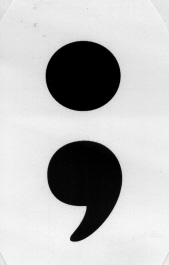
semicolon2Along with the T-shirt I bought two oval semicolon stickers, one for my car, the other for the semicolon hater in my writers’ group. She accepted hers with grace but promptly drew an international “NO” symbol on it with a red Sharpie.

Anti-semicolonism isn’t rare among writers and even among editors, but I don’t understand it. A writer who favors simple, usually short subject-verb-object sentences will seldom have need of semicolons, but is that any reason to hate them?

I suspect that sometimes anti-semicolonism may be a cover for the fear and loathing of complex sentences: “I hate complex thoughts” sounds rather anti-intellectual, but “I hate semicolons” sounds literarily discerning. To have a strong opinion about semicolons implies that one knows what a semicolon is, and that alone is enough to shut many people up.

As a writer and editor, I love a well-stocked toolkit. Every sentence I encounter, the ones I wrote as well as the ones someone else did, has its own needs. Punctuation marks are tools for shaping sentences, and many sentences can be shaped in different ways. Here’s an example, pulled from an essay of mine: “I’m an editor and writer; without functioning eyes, I can’t work.”

This not especially long or complex sentence could be punctuated in several ways, all of them perfectly correct:

#1: I’m an editor and writer. Without functioning eyes, I can’t work.
#2: I’m an editor and writer: without functioning eyes, I can’t work.
#3: I’m an editor and writer — without functioning eyes, I can’t work.

The first is the most matter-of-fact. To my ear it’s the most staccato, and probably the most emphatic. It leaves the reader to connect the two statements in her own way.

In #2, the colon sets up a cause-and-effect relationship between the two parts of the sentence. The colon suggests because or therefore without adding a word.

The em dash in #3 also conveys cause-and-effect, but more expansively — literally: em dashes take up more space than colons or semicolons and push the elements on either side of it further apart. Like the two-sentence option in #1, an em dash lets the reader make her own connections, but it gives her more room to do it in. To get a feel for em dashery, read a few of Emily Dickinson’s poems the way she wrote them and then with “standard” punctuation imposed. (This was done in some early published versions of Dickinson’s work.)

I read most everything I write aloud. Often I read aloud what I’m editing. I highly recommend the practice. When one reads aloud, the punctuation functions like musical notation: it signals pauses, breaks, and phrasing. I read each of the above options a little differently. In this particular sentence, period + new sentence imposed too much separation between the two thoughts. Neither colon nor dash quite worked because I wanted to downplay the cause-and-effect connection — it’s there, of course, but it’s suggested rather than stated.

Hence option #4:

#4: I’m an editor and writer; without functioning eyes, I can’t work.

Plenty of readers will swear up and down that they read all four sentences exactly the same way and don’t see an iota of difference among them. Some writers will swear likewise. Maybe they’re right, but maybe — at least some of the time — the punctuation works subconsciously.

When I’m reading for pleasure I often don’t notice what punctuation marks the writer has used, or even what word she’s chosen in preference to the various alternatives. When I’m editing, or reviewing, or just rereading to figure out How did she do that? — then I notice. Craft is often self-effacing and invisible to the casual observer, but that doesn’t mean it’s unimportant.

So my toolkit is amply stocked with semicolons, and I keep them near the front where they won’t get lost. If yours drift toward the back, or get buried under commas and dashes and colons, that’s fine with me. But don’t banish them altogether. A writer who eschews semicolons is like a carpenter who doesn’t have a Phillips head screwdriver (several of them!) in her toolbox. Sure, you can often make do with the tools you’ve got, but you can achieve more precision and (dare I say it?) elegance if you’ve got exactly the right tool for the job.

P.S. for semicolon fans: Semicolon T-shirts, mugs, stickers, and tote bag can be had on Cafepress.


Author’s Voice

I get nervous when editors talk about “preserving the author’s voice.” There’s often a condescending tinge to it, as if “preserving the author’s voice” means putting up with sloppy writing. It doesn’t. It does, however, require a certain flexibility on the editor’s part. It may mean bending “rules” that aren’t rules at all, like “never split an infinitive” or putting a comma where the Chicago Manual of Style says you don’t need one. This makes some editors, especially copyeditors, uncomfortable. (For a rough breakdown of the “levels” of editing, see “Editing? What’s Editing?”)

Travvy, my Alaskan malamute, had no trouble finding his voice. He's very articulate, but he doesn't know beans about punctuation.

Travvy, my Alaskan malamute, had no trouble finding his voice. He’s very articulate, but he doesn’t know beans about punctuation.

I don’t think “author’s voice” had been invented when I started writing, so I never worried about finding mine.

I hope you won’t either.

If you write a lot, you will develop your own style. All the choices you make — about words, sentence structure, punctuation, and paragraphs, and especially about how to put them together — become your style. If you keep writing, it’ll evolve, depending on what you’re writing about.

Reading is crucial here. Read good writers. Pay attention to how they solve problems. If they’re really good, you might not realize that they ever had a problem. Trust me, they did. They do. They deal with awkward transitions, flaccid sentences, unconvincing characters, and all the other stuff that makes you want to tear your hair out and give up.

Even if you don’t have any problems (for the moment), you can pick up new tricks to try. The more tools you’ve got in your toolkit, the better. Go ahead and try writing in the style of an author you like. Or, maybe even better, an author you don’t like.

If you keep writing, you will develop your own style. You’ll find your voice. Trust me on this. It will happen.

Different kinds of writing do impose different requirements. Sometimes the author’s individual voice takes a back seat to the demands of the job. Think reporting. Think technical writing. If you work in such a field, you’ll develop a style that’s suited to it. Your editors will edit your work with the demands of the field in mind. This doesn’t mean you can’t do other kinds of writing as well. The ability to marshal facts and write clearly can come in handy anywhere.

Some useful tools of the writer's trade. They're here to help you, not drive you huts.

Some useful tools of the writer’s trade. They’re here to help you, not drive you huts.

Yes, you should learn the rules and conventions of whatever language(s) you’re writing in. Contrary to popular belief, these rules were not invented to drive students crazy. They’ve developed over time to facilitate communication between writers and readers. They’re tools. Tools are as important to writers as they are to carpenters and car mechanics. When a writer isn’t comfortable with a particular tool, awkwardness can result.

At the moment I’m copyediting a nonfiction book whose author seems uncomfortable with pronouns. Instead of writing “he” or “him,” “she” or “her,” he repeats the subject’s name — and to avoid repetitiousness he’ll use the first name here, the last name there, and sometimes a nickname if the subject has one. It took me a while to sort out which names belonged to the same person.

If used consciously, this technique can convey nuance and tone. You can refer to a person (including, need I say, a fictional character) by his or her last name in formal situations, then use the first name when s/he’s hanging out with friends. Switching from one to the other will then suggest to your alert readers what mode the person is operating in, what figurative hat s/he has on.

Don’t worry about finding your voice. You’ve already got one. Think of all the ways you use your speaking voice. You can SHOUT. You can whisper. You can sing. You can runwordstogether or you can pause. between. each. one. Addressing a group, you speak more carefully than you do when you’re talking with friends. Your author’s voice can be just as flexible and at the same time just as much you. Keep writing!


Creative Blocks

block pile

built blocks 1

built blocks 2

Another view. At upper left is a photo of the late Adrienne Rich, poet, lesbian feminist theorist, and one of my icons. At lower right is Travvy, Alaskan malamute. He is waiting patiently to take me for a walk. Photo was taken by JEB in the early 1980s.

Words

Back in the days before online dictionaries — back, for that matter, before the World Wide Web was ready for prime-time — I was the features editor for a weekly newspaper. Editors and reporters worked together in the newsroom. The American Heritage Dictionary sat on top of a midsize bookshelf, within easy reach of everybody.

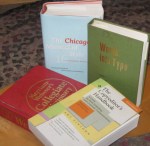
Some tools of the word trade. Clockwise from top: the Chicago Manual of Style, 16th ed.; Words into Type, my favorite usage and grammar guide; The Copyeditor's Handbook (3rd ed.), by Amy Einsohn; and Merriam-Webster's Collegiate Dictionary, 11th ed.

Some tools of the word trade. Clockwise from top: the Chicago Manual of Style, 16th ed.; Words into Type, my favorite usage and grammar guide; The Copyeditor’s Handbook (3rd ed.), by Amy Einsohn; and Merriam-Webster’s Collegiate Dictionary, 11th ed.

Most of my colleagues consulted it, at most, once or twice a day. I, on the other hand, was out of my seat and flipping through its pages so often that I finally brought my own AHD from home. When I was at my desk, it was almost always open on my lap.

My colleagues were nothing if not quick. If they wanted to know how to spell something, or whether a certain word was right for their sentence, they’d holler to me from their desks. I’d holler back. Usually I had the answer in my head. Sometimes I’d look it up to make sure I was right. Other times I’d look it up just because I was curious.

When I left that job, one reporter wrote on my farewell card: “You saved me a year’s wear and tear on my dictionary.”

Ask a writer what tools she uses and she might list her favorite dictionary, usage guide, computer, and so on. (I, of course, would include fountain pens and bottles of ink.) But really our absolutely most essential bottom-line sine qua non tool is words.

Recently I edited a very long nonfiction book whose author had done a commendable job of organizing complex material and marshalling a daunting number of references. On the word level, however, he was somewhat challenged. He regularly confused “affect” and “effect,” which are on just about everyone’s Frequently Confused Words list, but his troubles went well beyond that. An example, chosen at random and tweaked slightly to conceal the original:

These actions revealed the official’s willingness to adjust to complaints about public intoxication. They also  underscored his constancy.

I’ve bolded the words that stopped me in my tracks. Uh, no, thought I. Close but not close enough. For “adjust to” I suggested “accommodate” and for “constancy” “consistency.”

A good copyeditor will catch less-than-felicitous word choices and suggest improvements, but why let the editor have all the fun? The English language is full of vivid, precise, flexible, wonderful words. While you’re writing your first million words, learn as many as you can, Play with them. Notice how words often take on different shadings depending on where you put them. Then go on to your second million and third million words.

While you’re doing it, read a gazillion words. Listen to people talk, even if you never intend to write dialogue — but especially if you do.

Read, and listen to, poetry. Listen to songs. Poets and songwriters are really, really good at making words count because poems and songs don’t have all that many words in them. Try your hand at poetry or songwriting. (No need to write a new tune: pick a traditional one.) I can just about guarantee that your prose will be the stronger for it.