Author Etiquette for Contacting Book Bloggers

Having been at various times a reviewer, an anthology editor, a newspaper features editor, and a few other things, I think this is excellent advice for any writer who is trying to get another writer to do something for free. Online, offline, anywhere!

Tricia Drammeh's avatarAll I Have to Say

Hello, everyone! It’s me again with another author advice post. Warning: This post isn’t for everyone. If you’re an author who finds etiquette posts tiresome, this post isn’t for you. If you’re already an expert on book marketing, this post will probably seem pretty basic, but I hope you’ll read on and add your advice in the comment section. This post is for people like me – people who came into the writing world with limited social media knowledge. It’s for people who didn’t realize book bloggers existed until they were told to go out and promote their book. If you’re intimidated or overwhelmed by the idea of contacting reviewers and bloggers, or if you’ve sent requests to bloggers and only received a lukewarm response, this post is for you.

  1. DO read the blogger’s FAQs, Policies, or Submission Guidelines. Each blogger is different. Some bloggers want you to contact them by email. Others have…

View original post 1,456 more words

Je ne suis pas Charlie

This is from my other blog, but it’s about writing. Oh yeah, it’s definitely about writing.

Susanna J. Sturgis's avatarFrom the Seasonally Occupied Territories . . .

Three gunmen attacked the editorial offices of the French satire magazine Charlie Hebdo on Wednesday. When they left, 12 were dead and 11 injured. In the days since, at least five more have died: four hostages and a police officer. Two of the Charlie Hebdo suspects — two brothers with links to jihadist groups — and a third jihadist have been killed in shoot-outs with police.

I deplore the act and grieve for the victims, but I am not Charlie.

It’s not because I can’t imagine being targeted because of what I do or where I work. When I worked for the Martha’s Vineyard Times, we gathered like clockwork every Thursday morning to critique the issue just published and start planning for next week’s edition. Any passerby could see us through the office’s big front window. If someone had chosen to take violent exception to one of us, to something…

View original post 649 more words

Got Dialogue?

I use a lot of dialogue in my fiction. I’m pretty good at it. (My writers’ group says so. <g>) I’m planning to blog about it in the not-too-distant future, and probably more than once, so here’s a request:

If you’ve got a short (say 50–75 words) snippet of dialogue that you’d like feedback on, send it along. Use the comment form in this post or the one in Got a Question? above. They both go to the same place. If you like, I’ll include a link to your blog or website along with your question, but if you prefer to remain anonymous, that’s fine too.

← Back

Thank you for your response. ✨

Write On, and On, and On

Happy New Year to all, and may your writing flourish and lead you along interesting paths.

If you look up at the menu bar, you’ll see it’s been streamlined. The five Ws — Who, What, When, Where, and Why — and their first cousin How are now all on the same page.

The “You!” page is now “Got a Question?” It includes a comment form to make it easy for you to ask questions, share your experience, offer suggestions, whatever.

If you’re on Facebook, Write Through It has its own page. If you “like” it (and maybe even if you don’t), you can make comments and ask questions there too.

Write Through It now has 1,060 followers, and it’s not even a year old yet. I’m amazed. Welcome aboard, and special thanks to all who’ve commented, liked various posts, and otherwise supported this blog. You’re keeping it, and me, going.

P.S. I just added four new ink colors to my collection: sepia brown, suede blue, copper burst, and velvet black. No, I didn’t need any more ink, but ink, like pens and blank paper, is faith in the future. It’s going to be a good writing year. Here’s the current collection.

The four new bottles are on the left. You can tell they're new because they're so clean. I don't know why I up-ended Travvy's bone behind the tableau, but I like it.

The four new bottles are on the left. You can tell they’re new because they’re so clean. I don’t know why I up-ended Travvy’s bone behind the tableau, but I like it.

What Makes a Real Writer?

Stacey, who follows Write Through It and blogs at Diary of a Ragamuffin, posed this question: “What makes one a real ‘writer’?”

She added:

My reason for asking:  After 15 years of teaching, I decided to change careers and have begun a job as a reporter for my small-town newspaper (that is owned by a not-so-small-town corporation).  They knew I had no journalism experience when they hired me.  After four  months, I’m beginning to wonder if just anyone could do the job I do.

I’m not sure if what I do each day is what I had hoped it would be.  Often there is not enough time to write reflectively, and when there is, there’s no one qualified to critique it (in my opinion).

The answer is that there’s no answer, but you know I’m not going to stop there, right?

First off, I worked eight years for a small-town newspaper, the Martha’s Vineyard Times, in a succession of overlapping capacities: proofreader, features editor, features writer, theater reviewer, copyeditor. Reporting wasn’t my forte, but I did a little of that, mostly covering stories when no “real” reporter was available.

So I’m here to assure Stacey: The job you do can’t be done by just anyone, or by just any writer either. The fact that you’re wondering probably means that you’re good at it. You’ve got the knack. You learn fast. You’re able to apply your experience in other jobs to your journalism job.

Been there, done that. I wasn’t a journalist either when I got drafted to fill in for an editorial typesetter who was going on sick leave. I was scared to death I’d screw up, but I needed the work. I could type, I could proofread, I could write, and I had several years’ editorial experience. Short version: I loved it, I was good at it, and pretty soon the paper hired me as a part-time proofreader.

The tricky thing about job description “writer” is that it covers so many different kinds of writing. Reporter. Novelist. Columnist. Essayist. Poet. Diarist. Blogger. Biographer. Academic. Copywriter. Technical writer. And so on and on. No writer does all of them. No writer I’ve ever met wants to do all of them.

I know some crackerjack journalists who won’t cop to being writers. In their minds, writers write books, or fiction, or literary criticism. What writers don’t do is write for newspapers. You see the paradox here? If real writers don’t write for newspapers, then the writing in newspapers isn’t real writing.

Of course it is. If it isn’t, what the hell is it?

That's me, long before I knew what an editor was.

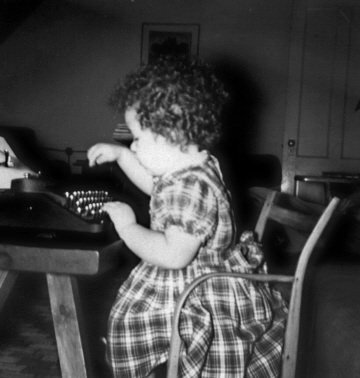
That’s me, long before I knew what an editor was.

In my teens and twenties, I assumed that a real writer had to know grammar and punctuation backwards and forwards and be a world-class speller besides. So I developed those skills. It wasn’t until I got a job as an editor in the publications office of a big nonprofit that I realized that in the real world these skills made me an editor. I hadn’t even known what an editor was. Some editorial skills belong in every writer’s toolkit, but you don’t have to be an editor to be a real writer.

Poets & Writers is a venerable organization that publishes a bimonthly magazine of the same name. Doesn’t the name imply that category “poets” isn’t included in category “writers”? It does to me. Plenty of poets either don’t call themselves writers or are semi-apologetic when they do: “I just write poetry. I’m not a real writer.”

Same deal as with journalists: If what poets write isn’t writing, what is it? And if the people who write it aren’t writers, what are they?

About her journalism job Stacey noted: “Often there is not enough time to write reflectively, and when there is, there’s no one qualified to critique it.”

This is true. Journalism means writing to deadlines, and deadlines don’t stand around waiting for the writer to get it perfect.

Deadlines don’t wait for editors either. Accuracy is more important than a perfectly crafted sentence. Spell a kid’s name wrong and her parents and grandparents will remember it forever.

Me, checking the boards at the Martha's Vineyard Times. You can tell it was back in the Pleistocene because the paste-up was pre-digital. October 1993.

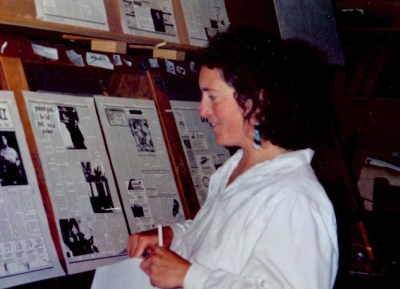
Me, checking the boards at the Martha’s Vineyard Times. You can tell it was back in the Pleistocene because the paste-up was pre-digital. October 1993.

Working for the newspaper made me a better writer and a better editor in more ways than I can count. I learned I could write and edit with phones ringing off the hook and people bringing me press releases 12 hours after deadline. I learned that endings don’t have to be perfect because the last two or three inches of a story would often be lopped off when a late ad came in. I learned that writers who can turn out prose like yard goods may write sloppy sentences but they sure come in handy when a scheduled story doesn’t show or an ad gets pulled. I learned that in the work of novice writers the lead paragraph is often buried a third of the way down. I learned that I can turn out a coherent theater review even when I haven’t a clue what the play was about. (It was Beckett’s Happy Days, in case you’re wondering.)

I learned that “good enough” often is good enough, and it’s actually pretty damn good, though for sure you could do better at a writers’ retreat. For a congenital perfectionist like me this was huge.

So what makes someone a “real writer”?

Marge Piercy nailed it in “For the Young Who Want To”:

The real writer is one
who really writes. Talent
is an invention like phlogiston
after the fact of fire.
Work is its own cure. You have to
like it better than being loved.


That’s the last verse. Read the whole thing. Read it often. You don’t have to be young.

Listen to Those Blocks

Creative blocks in rearrangement mode

Creative blocks in rearrangement mode

Ever notice how most of the stuff you learn about writing is stuff you already know?

I’m not talking primarily about grammar, punctuation, spelling, and all the nuts-and-bolts basics. I’m talking about the “how to keep going” part.

Last winter the novel I was working on, The Squatters’ Speakeasy, wasn’t coalescing or developing any momentum. I wouldn’t say I was blocked exactly, but the writing sure got sludgy. I procrastinated a lot before I sat down to write, and fidgeted a lot when I got there.

I also started this blog, and wrote an essay about a controversial statue that was in the news at the time. As I blogged back in April, in “Course Correction”:

 When I got up in the morning, I couldn’t wait to sit down in my chair and start writing. I finished the essay. I kept going with the blog. Whenever I thought about waking Squatters from its winter snooze, I was overcome by an irresistible urge to play endless games of Spider solitaire.

Procrastination was trying to tell me something. Finally I got the message. I put Squatters aside. About a year before I’d written a scene about a dog named Wolfie, a kid named Glory, and Shannon, a character from my first novel, The Mud of the Place. It didn’t fit in Squatters, so I put it aside. Now I pulled it back onto my lap and had another look. My imagination woke up.

Long story short: This blog now has more than a thousand followers. The novel, working title: Wolfie, passed the 50,000-word mark three days ago.

Here comes the bit about how writers keep learning what we already know.

Or, to put it in a slightly less flattering light: “Insanity is doing the same thing over and over again and expecting different results.” However, for some strange reason, it’s always easier to catch your friends doing the same thing over and over again than it is to realize that you’re up to your old tricks again.

Who, me?

Short version: My other blog, From the Seasonally Occupied Territories, was wilting. Running out of steam. I was thinking of wrapping it up, or at least putting it in the indefinite deep freeze. At the same time, there were so many things I wanted to write about that I was thinking of starting another blog.

Sheesh. When I type that, it looks so obvious. I really must have been nuts or in denial or just plain dense not to see that I could do the writing I wanted to do in From the Seasonally Occupied Territories.

If you’re curious about the longer version, you can read it here.

Writers talk about writer’s blocks and procrastination all the time. Most of us have at least a passing acquaintance with both. Many of us have had long-term relationships with one or the other. We dread them, we hate them, we do endless rituals to keep them at bay.

I’m here to remind you — because I know you know this already — that often the blocks and the procrastination are trying to tell you something. Sometimes the back-seat driver is right: Either you’ve missed a turn or you’ve taken one you didn’t want.

The road you want is the one that keeps your pen moving across the paper or your fingers on the keyboard.

Creative blocks, rearranged

Creative blocks, rearranged

My New Pens

So earlier this month one of my most favorite fountain pens died. I think I killed it: twisted the piston fill too hard. It jammed. When I tried to unjam it, something broke.

pens & blotter All the king’s horses and all the king’s men couldn’t put Humpty Dumpty together again, and I couldn’t fix my pen either.

Hope didn’t spring eternal, but it did froth and bubble for a while. I Googled “Pelikan pen repair” — the broken pen was a Pelikan 200 — and corresponded with an authorized Pelikan pen repair outfit.

My injured pen, it seemed, could not be easily or cheaply fixed.

I faced the music, or bit the bullet, and consigned my dear trusty amber Pelikan 200 demonstrator model to the wastebasket.

Sniff.

Now, as I’ve written several times before, I have more fountain pens than any girl — even one who does all her first-drafting in longhand — needs. This was still true. I had eight pens filled with various colors of ink and ready to go. I only have two hands, and of the two only one can write legibly. The goddess Durga might make use of eight pens simultaneously, but not me.

But late one night, when desire was strong and inhibition weak, I wandered toward eBay, whence most of my pens have come. A “Christmas model” Pelikan 200 was up for bids, the price was reasonable, and the auction closed within the hour. “Christmas model” did not mean garish. The cap was translucent red, the body translucent green, but you have to hold them up to the light to see the color clearly.

I have given myself away. The eBay screen did not tell me this. I learned it later.

To make a long story short, I bid, and bid again, and bid yet again. The closing price wasn’t quite as reasonable as it had been when I logged on, but it was still pretty good. The pen was mine. (It’s the top one in the photo. See what I mean? It’s not garish at all. It’s currently filled with green ink.)

Well, there’s something about eBay that’s just a little bit compelling. Once upon a time a friend gave me a scratch ticket as a birthday present. I got totally hooked. I lost less than ten bucks before I realized I was in over my head and got out of the pool. I checked out other Pelikan 200 auctions that were closing in the next day or so. I put a couple of them on my watch list.

An email reminded me the next day that one of the auctions had only an hour to go. A-OK. I was working away on my laptop. I opened my browser, went to eBay, and found the auction.

Another long story short: I snagged it, at an even better price. It’s the bottom one in the photo. It’s filled with the plum-colored ink that you can see on the blotter. I’d never used this particular plum-colored ink before. It seems to have been waiting for this particular pen.

Now, of course, I’m haunting the Fahrney’s website for new ink colors.

And so it goes.

Frugal is good. I’m frugal to a fault. But self-denial gets old if you’ve living on a shoestring, and it has its way of bursting into extravagance when least expected. Deny yourself ice cream and pretty soon you’ll be able to think of nothing else.

My theory is that the occasional self-indulgence makes living on a shoestring not only bearable but fun. Every once in a while it’s OK to act as if price is no object, even if it is.

What Is Editing Worth?

Ask a bunch of editors what good editing is worth and they’ll probably reply that it’s invaluable, priceless, and indispensable.

Listen to us talk for a while and we’ll probably get around to the books we’ve read that were either abysmally edited or (probably) not edited at all. What’s the matter with those writers? we wonder. How can they put their names on something that’s so disorganized or riddled with typos and grammatical errors?

Being both a writer and an editor, I think about this a lot. “Value” is a shifty word in English. “Valuable” and “invaluable” mean more or less the same thing. Plenty of value can’t be measured in money, but when you have to pay for it, money has to be considered. Editing has monetary value to me as an editor because it pays the rent. For me as a writer, whatever I spend on editing is money I can’t spend on book design, cover illustration, and marketing. Besides, I can do it pretty well myself.

The inescapable fact is that editing can’t be automated. If some outfit promises to “edit” your 300-page manuscript for a dollar a page, you can be sure that they’re not doing much more than running a spellchecker and a grammar checker through it, and maybe cleaning up the formatting. In my book that’s not editing: it’s word-processing.

Depending on what level of editing is called for, editing involves going through your manuscript page by page, line by line, even word by word. This is not like reading for pleasure. It takes time. For a book-length work, it takes a lot of time. Hypothetical example: Take a 300-page,  75,000-word manuscript. (In publishing, a page is conventionally reckoned at 250 words.) If the ms. is well written and has no structural problems, a good copyeditor might be able to clock 10 pages per hour. That’s 30 hours’ worth of work. Say the copyeditor is charging $30 an hour. (Some charge more, some charge less, but you can get a good copyeditor for $30/hour.) That’s $900 right there.

A manuscript that, as we say in the trade, “has problems” will take longer to edit. At 5 pages/hour, that’s 60 hours. At $30/hour, that’s $1,800. If the problems are serious enough, you may have trouble finding an editor who’ll work for only $30/hour. There are few things more frustrating than being asked to copyedit a manuscript that has structural problems. It’s like frosting a cake that’s collapsed in the middle and didn’t taste all that good to start with.

I don’t know about you, but $1,800 would put a huge dent in my budget, even if I could pay it off over time. I’m never surprised when a writer has sticker shock at an estimate for editing. Editors can say that editing is “priceless” and “invaluable” because we’re not paying for it. When a service costs that much, “priceless” and “invaluable” go out the window. Writers who are paying out of pocket — and this includes me — are up against a harder question: “What is editing worth to me?”

It depends. It really is OK to say “not much” or “I’d love to hire an editor but I have to win the lottery first.” Here are some things to think about:

  • Do you want your work to be read by people who don’t have to read it? Do you want them to spend their hard-earned money on your book?

If the answer to these questions is no, you don’t need an editor, so editing may not be worth all that much to you. On the other hand, it might be. I spend my hard-earned money on things I don’t need. (Ask me about the two fountain pens I just scored off eBay. And don’t ask me how much money I’ve spent over the years on training and competing with my dog.)

If the answer is yes, or maybe, or “I’m not sure,” consider the following questions.

  • How good are you at spelling and punctuation?
  • How much experience have you got? How good are you, period? (Be honest now.)
  • Are you in a good writers’ group or otherwise sharing your work with competent and honest writers?
  • What are your plans for your work?
  • Is your work likely to bring in any money? Enough money to make editing worthwhile from a financial standpoint? (Be realistic here. If you’re writing fiction or poetry, the answer is probably no.)
  • What are your goals and priorities as a writer?

And here are some strongly held personal opinions on the subject:

If you aren’t a crackerjack speller and/or you aren’t confident with punctuation, you need help — especially if you plan to submit work to journals, agents, or publishers. These gatekeepers are swamped with far more submissions than they can use. They are looking for reasons to reject incoming manuscripts. Sloppy spelling and punctuation is painfully easy for a competent editor or agent to spot. You might be able to get the help you need from a talented amateur who won’t charge for her time. It depends on how talented and how generous your friends are.

An old printer’s adage: “Cost, speed, quality: Pick any two.” This means, for example, that if you spring for a low price and a fast turn-around time, the quality will probably be less than stellar. If you want a high-quality job done ASAP, expect to pay a premium price for it. This applies to writing too. If you the writer are willing to put in the time, in classes, writers’ groups, and/or self-study, you can get by with less editing. You will also be better able to choose the right editor for your work if you decide to hire one. Just sayin’ . . .

And here’s some free advice for anyone working solo on a book-length manuscript, fiction or nonfiction. Even if you’re cheap, even if your disposable income is barely in positive numbers — think seriously about hiring a pro to critique it. Critiquing costs a lot less than editing because the critiquer is reading your manuscript the way a reviewer might, not going through it line by line. The critiquer will identify both strengths and problems. She’ll probably have suggestions about fixing the problems — but it’s up to you to do the work.

I’ve read several novels in the last year or so that read like good first drafts. Lots of good raw material, but plot holes abounded. Characters did implausible things just because the author said so. Backstory was dumped here, there, and anywhere. Tantalizing leads were introduced — and then dropped. And so on. These are things that can be dealt with in revision, but these novels all went to press in various states of disarray. One of these novels, by the way, was published by a major trade publisher, probably on the strength of the author’s reputation in nonfiction.

Maybe that’s “good enough”? Maybe it is. But ask yourself: When you start reading a book and realize that the author has cut corners, do you keep reading? If you get through to the end, do you recommend the book to a friend? Do you write a glowing online review?

Good editing is expensive, but sometimes it really is worth the money. Your call.


Point of View

If you go web-surfing or pick up a couple of how-to-write books, you can learn almost everything you need to know — and a great deal more — about point of view (POV).

What you have to figure out for yourself is what works best for whatever you’re working on.

First off, a short lecture: Everything created by humans has a point of view. Even the formal, scholarly stuff that pretends it doesn’t. Even the photographs that are supposedly worth a thousand words because you’re supposedly seeing the real thing, not someone’s possibly inaccurate, incomplete, or biased description of it. What you’re seeing is what the photographer saw and wants you to see. This was true long before Photoshop, and it’s true now.

Visual images have a literal point of view: a place where the viewer is standing, sitting, hovering in space. This affects what you see. You can’t see the dark side of the moon from Earth. You can’t see the backside of whatever the photographer’s showing you the front of. You can’t see what’s above or below, to the right or left of it either.

Here, though, we’re talking about writing, particularly fiction writing.

Fron Cover MockupMy #1 goal for my first novel, The Mud of the Place, was to show how the place I live in works. I live on Martha’s Vineyard. Martha’s Vineyard is in the news a lot, especially in the summer, especially when the president comes to visit. If you see Martha’s Vineyard on the news, you generally see what the reporters see: the summer resort, the quaint tourist attractions, the celebrities. I wanted to show what goes on backstage. The reporters and the summer people rarely see this stuff, and when they see it, they don’t really understand what’s going on.

In short, I wanted to tell stories about people who aren’t considered newsworthy. How to do it?

Mud wanted to be an ensemble piece. So it’s all in third person, with several POV characters. (Yes, I know they all sprang from my first-person mind, but bear with me here.)

Each scene has a single POV. Sometimes an interaction or a conversation can be glimpsed from both sides, but there’s always a scene break where the POV shifts. I learned a lot about each character from seeing him or her through other characters’ eyes. Sometimes a sequence of events remained out-of-focus because the POV character involved didn’t think or say anything about it, and the other POV characters didn’t know what had happened. I liked that a lot.

At one point in my first draft, a non-viewpoint character told my protagonist something my protagonist hadn’t suspected. I didn’t like that so much. In fact, it scared the hell out of me, because I had to drastically overhaul the plot and I was already afraid I’d never finish the thing. But I did, and Mud was much the better for the overhaul. I’d thought I was writing a tragedy. Turns out I was writing a comedy, in which nearly everyone is better off at the end than they were at the beginning.

Moral of story: Non-POV characters have a way of getting their perspectives into the tale. Don’t discount them just because you’re not watching the action through their eyes.

Wolfie talks a lot, but he isn't telling the story.

Wolfie talks a lot, but he isn’t telling the story.

Wolfie, my novel in progress, is set on that same island, but it’s not an ensemble piece. Like Mud, it’s all in third person, but it’s got a tighter focus. At present it’s got two viewpoint characters. One is a woman in her mid-fifties — Shannon from Mud of the Place, if you’ve read novel #1. The other is an 11-year-old girl. The title character is a dog. No scenes are told from his POV, but he’s as essential to the story as the woman and the girl.

The big challenge is the girl. She’s smart and observant, but what’s going on in her family is key, and she can’t see or understand a lot of it. More, she doesn’t have conscious access to some of her own memories. So in first draft her POV sections are being told in third person, present tense. I’m not a big present-tense fan, so this is a challenge. I also have to work out ways to weave this girl’s backstory into the novel. She doesn’t remember a lot of it, and the one character who does isn’t telling.

Come to think of it, the girl isn’t the biggest challenge. The biggest challenge is the character who knows but doesn’t tell. I hate him. I don’t understand how a person could do what he almost certainly did, and is probably going to do again, and still look himself in the mirror. But plenty of people manage, and if/when their monstrosity is revealed, a popular reaction is disbelief. Creating believable villains is hard. I had a couple of villainous characters in Mud of the Place, but I managed to keep them at arm’s length. I can’t do it with this guy.

There’s also a somewhat mysterious fellow hovering in the wings. I know who he is. He’s important. Is he a POV character? I’m not sure yet. A key scene’s coming up that involves him and another non-POV character. One of them has to become a POV character or I’ve got to figure out another way to get that scene into the story.

This is what I love about using just a few viewpoint characters, none of whom has the whole picture. It challenges me as a writer. I have to plumb those characters more deeply than I would otherwise. I have to come up with incidents that will prompt them to say or think things that readers will need to know. Sometimes they say or think things that even I didn’t suspect. That’s how I know I’m tapping into the deep place that the stories worth writing come from.


Selling Books at the Artisans’ Fair

Sorry for long silence — I’ve had deadline-itis in a bad way.

This past Thursday’s deadline wasn’t a surprise. It wasn’t a rush — not until I turned it into one by spending 10 a.m. to 4 p.m. last Friday and Saturday at the Thanksgiving Artisans’ Fair. Along with three other local writers, I was part of “Writers’ Row.” (I blogged about the fair in From the Seasonally Occupied Territories: “A Saner Way to Shop.”)

So I was selling my novel, The Mud of the Place, and my colleagues were selling their books, and it dawned on me that, hey, not only had I written my book, I’d edited at least one of each of theirs.

This made me happy. These books were all good before I got hold of them, but I was proud to have had a hand in making each one a little bit better than it would have been otherwise. Editors are even more invisible than writers. Usually we finish a job, wave bye-bye, and never see the book or paper or story again. It was downright satisfying to see the finished books on display and hear people talk about them.

Not to mention — I know those books inside and out, love them all, and have no qualms about encouraging people to buy them.

vineyard cats smLynn Christoffers is a wonderful photographer. Cats are her favorite subject, so Cats of Martha’s Vineyard was a natural. But she did more than photograph a hundred cats. She interviewed their people and turned those interviews into a book. I’m a chronic dog person, but I still think it’s cool.

cover scan smShirley Mayhew moved to Martha’s Vineyard as a young bride in 1947 and has been here ever since. Her personal essays, collected in Looking Back, not only chronicle a quietly remarkable life; they provide a window into the last six-going-on-seven decades in this particular place — a place that’s often seen from the outside but rarely from within.

Cynthia RiggsMURDER ON C-DOCK cover sm took up mystery writing at age 70, after a career that included writing for the National Geographic Society and the Smithsonian, running a ferryboat company on the Chesapeake Bay, rigging boats on Martha’s Vineyard, and raising five children. The 11th book in her Martha’s Vineyard Mystery Series is due out from St. Martin’s Press in the spring. The previous ten were all for sale on Writers’ Row, but pride of place went to Murder on C-Dock, which is hot off the press (official pub date isn’t till next month) and which I copyedited. It begins a new series, drawing on the author’s 12 years living on a houseboat on the Washington, D.C., waterfront. It’s got such a stupendous cover that I’m determined to hire the artist, Elizabeth R. Whelan, to do the cover of my novel in progress.

Cynthia, by the way, contributed “On Being Edited” to this blog back in October. Her account of an Edit from Hell has been viewed more times and received more comments than any other Write Through It post. Good! I’m here to report that to my mind Cynthia is an ideal client: she writes well, takes her writing seriously, and appreciates careful editing. She also hosts the writers’ group that both Shirley and I belong to.

Writers usually work in isolation, so face-to-face contact with readers and prospective readers is exhilarating. It can also be exhausting: The Artisans’ Fair was busy from the time the doors opened at 10 till they closed at 4, which meant we were “on” for six consecutive hours. This is why I didn’t come straight home, go for a walk with the dog, then buckle down to editing. My brain needed a break.

At odd moments I wondered if we writers really belonged among the weavers, jewelers, leatherworkers, printmakers, and other crafters who work wonders with media more tangible than words. For sure no one objected to our presence, and all of us had a great time. My life is pretty much devoted to words: writing them, editing them, reading them, reviewing what others have written. It’s a little disorienting to be reminded that words aren’t everything, that creativity comes in myriad forms, and that there are plenty of things that words just can’t do.