Got a Question?

Got a question about writing or editing? Or a suggestion for a topic you’d like to see discussed? Or a topic you’d like to write a guest post on? Use this contact form to send it in! (The You! page on the menu bar contains a contact form too. It’s lonely. Please feel free to pay it a visit any time, day or night.)

← Back

Thank you for your response. ✨


UKL’s Challenge

We interrupt this blog to bring you an important message. Ursula K. Le Guin has been high in my literary pantheon for a very long time. The other night at the 65th National Book Awards, Le Guin was honored for her distinguished contribution to American letters. In barely five minutes she proved that her distinguished contribution continues. Her speech seems to be going viral. Good. It’s a challenge to writers, publishers, and readers. Let’s live up to it.

And here is The Speech, as transcribed by Parker Higgins and posted on his blog. He notes that the bits in parentheses were ad-libbed to the audience. Thanks!

Thank you, Neil, and to the givers of this beautiful reward, my thanks from the heart. My family, my agent, editors, know that my being here is their doing as well as mine, and that the beautiful reward is theirs as much as mine. And I rejoice at accepting it for, and sharing it with, all the writers who were excluded from literature for so long, my fellow authors of fantasy and science fiction—writers of the imagination, who for the last 50 years watched the beautiful rewards go to the so-called realists.

I think hard times are coming when we will be wanting the voices of writers who can see alternatives to how we live now and can see through our fear-stricken society and its obsessive technologies to other ways of being, and even imagine some real grounds for hope. We will need writers who can remember freedom. Poets, visionaries—the realists of a larger reality.

Right now, I think we need writers who know the difference between the production of a market commodity and the practice of an art. Developing written material to suit sales strategies in order to maximize corporate profit and advertising revenue is not quite the same thing as responsible book publishing or authorship. (Thank you, brave applauders.)

Yet I see sales departments given control over editorial; I see my own publishers in a silly panic of ignorance and greed, charging public libraries for an ebook six or seven times more than they charge customers. We just saw a profiteer try to punish a publisher for disobedience and writers threatened by corporate fatwa, and I see a lot of us, the producers who write the books, and make the books, accepting this. Letting commodity profiteers sell us like deodorant, and tell us what to publish and what to write. (Well, I love you too, darling.)

Books, you know, they’re not just commodities. The profit motive often is in conflict with the aims of art. We live in capitalism. Its power seems inescapable. So did the divine right of kings. Any human power can be resisted and changed by human beings. Resistance and change often begin in art, and very often in our art—the art of words.

I have had a long career and a good one. In good company. Now here, at the end of it, I really don’t want to watch American literature get sold down the river. We who live by writing and publishing want—and should demand—our fair share of the proceeds. But the name of our beautiful reward is not profit. Its name is freedom.

Thank you.


Word Count: Zero

If you’re currently in the throes of NaNoWriMo, you might want to put off reading this post till the middle of next month. If you aren’t, or if you don’t know what NaNoWriMo is, read on.

OTOH, if you are in the throes of NaNoWriMo, what are you doing here in the first place? Maybe you should stick around.

Here’s the shocking truth: I didn’t write any words this morning. Well, OK, I scribbled some words on pages of notes that had already been scribbled on, but really — I didn’t write any words this morning.

My chair

I’ve blogged about how I don’t measure my progress or a day’s success by the number of words I’ve written. This is true. All the same, writing no words is a little scary, especially when I want to have a few pages to take to my writers’ group meeting on Sunday night. Right now I’ve got nothing.

What I did this morning was sit in my writing chair for an hour and a quarter. To my right, three candles were burning. (Usually it’s just two. This morning I needed all three.) To my left, eight pens were at the ready. My laptop was on the floor, still asleep.

A few days ago, Wolfie, my novel in progress, came to a crossroad. Shannon, my protagonist, had just made a big decision — the one it took lots of red ink to get to. She had no idea what happened next.

Neither did I. This was a problem.

Since I’ve got some experience in community theater, when writing fiction I tend to see myself as the stage manager. My characters move around on the stage. I write down what they do and say. Once in a while, I need to prompt one actor, or summon another who’s lollygagging backstage. Then they take over and I go back to transcribing.

Not this time. This time they were standing around waiting for me to tell them what to do.

I have a pretty good idea what’s going to happen. What I didn’t know was how to get my cast of characters moving in a direction that would bring it — or something like it — to pass. I was staring at a big logjam on the river. Nothing was moving.

Little heap of wood

Little heap of wood

I sat in my chair, reread my notes, scribbled some words here and there.

The logjam in my head morphed into a big pile of cut and split logs, like the ones the wood guy would dump in my yard during the years I was heating with a wood stove.

Being a writer and thus wise in the ways of procrastination, I got it. Anne Lamott nailed it in her classic Bird by Bird: Some Instructions on Writing and Life. How do you accomplish a huge project whose boundaries you can’t see, whose completion you can’t imagine? Bird by bird. Word by word. Or, in my case, log by log.

Once I realized that I had to start somewhere, it didn’t really matter where I started. Pick a log, any log.

Turned out I’d known all along what log to start with. After the events that had transpired in the previous twenty-four hours (novel time), the next move was clearly Shannon’s. Well, now it was clearly Shannon’s move. I’d known all along that Shannon had to make a couple of phone calls, but the Internal Editor assured me that this wasn’t enough. How could a couple of phone calls break up that humongous logjam?

Travvy on a mission

Travvy on a mission

By this time it was 8:30 a.m. Time to get out of the chair and go walking with Travvy, my canine companion, on whom Wolfie is based. As I pulled on my socks and hiking shoes, donned vest and cap, and put Travvy’s walking harness on, Shannon was making her phone calls — and lo, the rest of her day lay like a path in front of me, leading toward the plotwise thicket that I knew was up ahead.

Word count: zero, but a breakthrough day nonetheless.

Counting words obviously works for some writers, at least some of the time. For me, the secret is usually to sit down for at least an hour and don’t fidget. I’m writing even if I’m not writing, as long as I’m not balancing my checkbook, answering email, playing on Facebook, or brushing the dog.

Go to the chair. Sit. Rustle papers, scribble words, focus on the work. If the path doesn’t open up today, do the same thing tomorrow.


20141121 woodpile 1


The Writing Life: Advice from a Counterculture Icon

I haven’t read Vonnegut since college, and his “rule” about semicolons is crap, but his comments about writing and art making in this blog post are just wonderful.

Whatever Works

Are you a “plotter” or a “pantser”? For many writers this is a far hotter topic than liberals versus conservatives, dogs versus cats, or Macs versus PCs. Plotters work it all out in advance. Pantsers — you’re way ahead of me here — fly by the seat of their pants.

The other day I learned about “swoopers” and “bashers.” Swoopers dive in and write write write till they run out of steam. Bashers knock each sentence into shape before they move on to the next. Their first drafts are polished and almost ready to go.

Some how-to guides emphasize planning. If you fly by the seat of your pants, they warn, it’ll take a lot longer. You may never finish at all.

If you’re writing to a deadline, whether imposed from without — say there’s a contract involved — or within — say you’re participating in NaNoWriMo and trying to write a novel this month, time is of the essence and “longer” is a liability.

I’m not writing to a deadline, beyond producing a few new pages for each week’s meeting of my writers’ group, but there’s no question in my mind: planning has its uses. Last spring my novel-in-progress (working title: The Squatters’ Speakeasy) ran out of steam. It was all sprawl and no trail. I pushed it to one side and went to work on Wolfie, the current project. Eventually I diagnosed the Squatters problem as a “surfeit of subplots.” There wasn’t a main plot in sight.

Some planning is clearly called for.

At the same time — Wolfie started as one of those multitudinous subplots. It appeared when I was flying by the seat of my pants. It’s taken on a life of its own.

Planning has its uses. So does flying by the seat of your pants. So do swooping and bashing. Whatever works — and when it stops working, try something else.

steering coverAs usual, Ursula K. Le Guin got there long before me. Her Steering the Craft (Portland, OR: Eighth Mountain Press, 1998) is my favorite how-to book. Sometimes I open to a page at random, as if I were casting the I Ching or laying out tarot cards. The other day I was flipping through looking for advice on plot. This is what I found:

“Somebody asked Willie Nelson where he got his songs, and he said, ‘The air’s full of melodies, you just reach
out. . . .’ The world’s full of stories, you just reach out.

“I say this in an attempt to unhook people from the idea that they have to make an elaborate plan of a tight plot before they’re allowed to write a story. If that’s the way you like to write, write that way, of course. But if it isn’t, if you aren’t a planner or a plotter, don’t worry. The world’s full of stories. . . . All you need may be a character or two, or a conversation, or a situation, or a place, and you’ll find the story there. You think about it, you work it out at least partly before you start writing, so that you know in a general way where you’re going, but the rest works itself out in the telling.”

About her “steering the craft” image, which organizes the book (and which I love), she adds: “The story boat is a magic one. It knows its course. The job of the person at the helm is to help it find its own way to wherever it’s going.”

In Wolfie the other day, my main character, Shannon, was sailing along on course. She knew where she was heading. Then two things happen, boom, boom, one right after the other. The first shakes her certainty; the second tells her she’s heading in the wrong direction. She’s got to do something, but she doesn’t know what.

I generally depend on my characters to tell me what’s what. I was no help — but I’m at the helm and lingering in irons in the middle of the bay is not an option.

So I picked out a pen that hadn’t seen much use lately and filled it with red ink. (For days I’d been cruising in more somber colors — gray, brown, black cherry. Red woke me up.) With a sheaf of my new blank paper in my lap, I slipped into Shannon’s head and we wrote, and wrote, and wrote. Now she knows what she’s going to do, and I’ve got a pretty good idea. We’re back on course.

Red ink collage

Red ink collage

Blank Paper

I do most of my first-drafting in longhand. In pen and ink. It works for me. I’ve even blogged about it.

My fleet of fountain pens

My fleet of fountain pens

It does present certain challenges, however. The near-illegibility of my handwriting I’ve managed to turn into an asset: what the internal editor can’t read, she can’t second-guess and mess with.

Most commercially available paper, I discovered, can’t stand up to fountain pen-and-ink. Yellow pads, notebook paper, the bond paper I feed to my laser printer and my inkjet: they’re all so thin that what I wrote on one side made an impression on the other.

This might not be a deal-breaker for some people, but I’m cheap. I want to write on both sides.

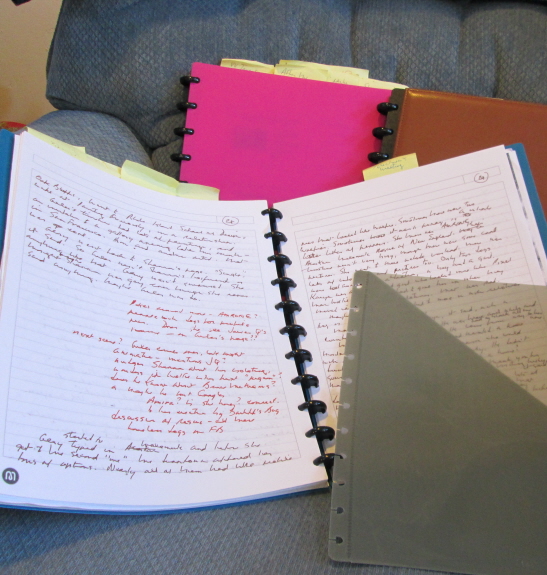
I was also looking for a way to organize my handwritten pages. Browsing at a office-supply chain store, I found these cool notebooks. They were looseleaf, sort of, but instead of two or three big metal rings, they had eleven little plastic ones. You could add pages, remove pages, or move pages around.

I bought one notebook and the filler paper to go with it. Wonder of wonders, I could write in fountain pen on both sides of the paper, and the words all stayed on their own side.

I was hooked. Now I’ve got three notebooks: a blue one for Wolfie, the novel in progress; a red one for Squatters’ Speakeasy, the novel on the back burner; and a brown one for everything else.

Wolfie has been eating up paper like nobody’s business. I scavenged paper from the red and the brown notebooks to put in the blue one. Then there was no more to scavenge. I was almost out of paper.

paperI hesitated. Blank paper is a challenge. Am I going to keep writing? Yeah, I thought. I am.

How much paper should I order? This was harder. Like I said, I’m cheap. I hate to spend money on stuff I don’t use. Sooner or later any blank paper left untouched on the shelf would be making faces at me and going “Nyah nyah, nyah nyah.”

I ordered five packets, 50 sheets to a packet — 500 sides of fountain-pen-friendly paper. And some section dividers to go with them.

Blank paper is faith in the future.

Ready to write

Notebooks with section dividers and sticky notes

Digested Research and Nonfiction Writing

For me this is true of fiction writing as well. I call it “composting.” When I moved to Martha’s Vineyard in 1985, I was working on a novel that was partly set on Martha’s Vineyard, which at that point I knew only as an occasional visitor. Before long I realized I didn’t know nearly enough to write fiction about the place. In my first years I wrote mostly poetry, and feature stories and reviews for the local paper. All of this sharpened my skills at observation and listening, while reflection was going on deep in the background. It was eight years before all this experience had composted enough for me to write the story that became the backstory for my first novel. Which wasn’t the novel I thought I was writing when I moved to the Vineyard.

Dinty W. Moore's avatarThe Brevity Blog

Holy_Trinity_B_Falls_3We’ve just run across Julija Šukys’ blog “Writing.Life.” in which she adroitly examines the craft of nonfiction writing, including a recent post that delves into what she defines as the “holy trinity of creative nonfiction” – SCENE + RESEARCH + REFLECTION.  In the snippet below, she discusses the hardest part for many new writers, digesting the research:

For example, I have a student who has recently returned from a life-changing trip to Iceland, and he’s now starting to write about it. His first level of research is complete, but more work lies ahead. The second level and stage of research might mean his going to the library and reading tons about sagas and Icelandic history until this writer has mastered his subject enough to distill and retell with energy and spontaneity. Once this learning starts to belong to him in some way (as family history does) — that is, once he’s achieved a kind of…

View original post 107 more words

In Praise of Readers

If a tree falls in a forest and no one hears it, did it make a sound?

I think it did. I also suspect that when we repeat the question, we’re not just talking about trees. Trees don’t care if they make a sound. They’re going to fall, and rustle, and crack, whether we hear them or not.

For me, writing is part of a conversation. I do want people to hear the rustling and cracking of my words, and more than that: I want to hear what they have to say in response. I’ve had three one-act plays produced, and I love giving readings. Nothing beats the thrill of seeing and hearing people respond to my words.

mud-cover-smIt’s a rare audience that will sit still for a book-length work, but I’m lucky: I’ve experienced what has to be the next-best thing. Last Wednesday and the Wednesday before, I got to sit down and talk with a group of women all of whom had read my novel, The Mud of the Place, and were interested in what I was writing about, the lives of year-round residents in a seasonal resort.

Minnesota Women's Press publishes a bimonthly newsletter that's all about books, writers, and readers.

Minnesota Women’s Press publishes a bimonthly newsletter that’s all about books, writers, and readers.

These women, who came from all around the U.S. and Canada too, were participants in Books Afoot, also known as Reading on the Road, a program of the Minnesota Women’s Press. As organizer Mollie Hoben described it in an email, “The basic idea is that reading and travel make a rewarding combination. We pick a destination, learn about women writers from that place (which always involves exciting discoveries), select books to read beforehand, then travel there with interested reader-travelers for exploration and book discussion. Participants come from all over the country.”

I first learned about Books Afoot a year and a half ago, when Mollie contacted me out of the blue. Three Books Afoot groups would be coming to Martha’s Vineyard in the fall, and my novel was one of the four “required reading” books. Would I be willing to meet with any or (ideally) all of the groups?

One of the 2013 Books Afoot groups, meeting in the outdoor café at a local bookstore

One of the 2013 Books Afoot groups, meeting in the outdoor café at a local bookstore

Would I?? This was a fantasy come true, and the reality surpassed my wildest expectations. (I blogged about it here.) I’d pretty much decided that writing a second novel was a waste of time. These women changed my mind.

This year we were joined by my writer friend Shirley Mayhew, whose wonderful Looking Back: My Long Life on Martha’s Vineyard came out early this summer — too late for the travelers to have read it before they got here, but plenty of them bought a copy to take home with them. Shirley moved here as a young bride in 1947; I arrived solo in 1985. Our books and our very different but overlapping experiences became gateways for the visitors to enter a place that many people know about but few actually know.

Last month I concluded a blog post, “Who Do You Write For?,” with this description of the kind of reader I’d like to be: “one who’s brave enough to venture into unfamiliar territory as long as she trusts her guide, and one who appreciates the effort that goes into the writing.”

When a book goes out into the world, does it make a sound? If it does, will I hear it through all the cacophonous competition? Having sat down and talked with dozens of such adventurous readers, I know you’re out there. I’m writing for you.

The 2014 Books Afoot women each picked a postcard from wherever they were from and wrote a favorite book recommendation or two on the back. Here are a few of them.

The 2014 Books Afoot women each picked a postcard from wherever they were from and wrote a favorite book recommendation or two on the back. Here are a few of them.

Plotting

I just discovered this in From the Seasonally Occupied Territories, my blog about living year-round on Martha’s Vineyard. When I blogged it, in June 2013, I wasn’t even thinking of starting a writing-and-editing blog. Or maybe I was. I’ve updated it a bit, but not much.

Plotting fiction is like making rock candy. Left to itself, boiled sugar water just sits there. Nothing happens. Well, yes, things happen, but they take so long that it’s a rare soul who’ll just sit there and watch.

For me "how-to-write" books are mostly a procrastination technique, but this is one I actually find useful.

For me “how-to-write” books are mostly a procrastination technique, but this is one I actually find useful.

Not the stuff of plot.

Day-to-day life on Martha’s Vineyard is like boiled sugar water. Things happen, but most of them unfold
s-l-o-w-l-y. Even when the results are noteworthy, the steps taken to get there are mundane, quotidian, dull. Follow the newspapers for a few months if you don’t believe me.

No surprise, then, that most novels written about Martha’s Vineyard are murder mysteries. Killing someone off is like dropping a string in the sugar water. Formless liquid crystallizes around the string. Murder shakes people out of their day-to-day routines. They say and do things they wouldn’t do otherwise.

Homicides are rare here. Fiction writers are all in the alternate-reality business, especially if we write about real places, but though I’m happy to read about alternate Martha’s Vineyards where murder happens several times a year, I don’t want to create one. As a plot device, murder makes me just a little bit queasy. My fictional alternate reality is a sort of psychic map of Martha’s Vineyard. I want it to mesh with the Vineyard (I think) I live on.

Dramatic events do happen, of course. Once in a while a quiet undercurrent will explode into a headline. A loose dog jumps a fence and chases down and kills a miniature horse. An on-leave police officer obstructs the firefighters who shows up to extinguish a fire at her home. Such incidents are like strings in the sugar water, good grist for plot, but they have their own challenges. Have you ever really listened to how we recount such incidents for someone who wasn’t there?

“So Jane parked in front of her sister’s house — you know her sister, right? You met her at Cynthia’s Groundhog Day party — no, that’s her older sister; this was the younger one, Margaret — no, you don’t want to call her Peggy, that’s their mother’s name and the two of them barely speak — Is that what happened? I hadn’t heard that — this sister lives in Edgartown, back behind the gas station — yeah, there’s been some trouble there, I’m getting to that — Jane just sat in the car because there was a young guy standing there with a wool cap on even though it’s August — isn’t this heat outrageous? Yeah, I know it’s how they dress, but Jane never saw him before and he had a skateboard under one arm — really, I almost hit one last year when he came shooting into Five Corners from the post office . . .”

Every little thing that happens has at least half a dozen stories feeding into it. Trying to prune and shape these into a plot that readers can follow is, to put it mildly, a challenge.

When I started Mud of the Place, my first and so far only novel, I couldn’t plot my way out of a paper bag. I learned by trial and error, and with the help of a couple of books: Plot, pictured above, and Beginnings, Middles & Ends, by sf writer Nancy Kress.

I didn’t kill anyone off in Mud, but the string I dropped into the sugar water involved a shooting that could have got someone killed. All sorts of interesting stuff crystallized around that shooting.

Wolfie, the canine protagonist of my novel in progress, comes close to killing some sheep. He’s suspected of killing several chickens. Several citizens of his town — which bears the same name as my town — wouldn’t mind taking a shot at him. Some plot has coalesced around that.

There’s also a human character in this novel that I wouldn’t mind taking a shot at, but I haven’t.

Yet.

Hyphenalia

Policy maker, policy-maker, or policymaker? Pre-eminent or preeminent? First grader or first-grader? E-mail or email?

Hyphens can be tricky, but that's no reason to tear your hair out.

Hyphens can be tricky, but that’s no reason to tear your hair out.

According to Sturgis’s Law #5: “Hyphens are responsible for at least 90 percent of all trips to the dictionary. Commas are responsible for at least 90 percent of all trips to the style guide.”

The tricky thing here is that the dictionary will only tell you what to do if your word is in there. Often it isn’t. If it is, you’re in luck — as long as you don’t notice that (1) dictionaries are wildly inconsistent when it comes to hyphenation, and (2) dictionaries often disagree with each other.

Merriam-Webster Unabridged doesn’t list “policy-maker” or “policymaker.” This may be taken to mean that MW considers it two words: “policy maker.” The American Heritage Dictionary, however, lists “policymaker” as one word, no hyphen. And while we’re at it, MW thinks “policyholder” is one word. “Slaveholder” is one word, but “slave owner” is two.

For several editions now, the Chicago Manual of Style has been trying to impose method on the hyphenation madness. In section 7.85 of the 16th edition you’ll find a handy-dandy several-page chart. It sorts compounds by category, parts of speech, and specific words; gives examples of each subcategory; and then summarizes the “rule.”

It’s useful, it really is. I refer to it often. But it too will lead you into inconsistency, not least when you notice that British English uses hyphens more liberally than American English and the sky hasn’t fallen in yet. Chicago “prefers a spare hyphenation style.” So do the Merriam-Webster dictionaries. The operative word here is “style.” In matters of style, there’s generally a big gray area where choices have to be made.

What editors and teachers and style guides tend to forget is that hyphens serve a purpose — beyond driving editors crazy, that is. Hyphens are joiners: they link words into temporary compounds and attach prefixes and suffixes to root words. Over time temporary compounds may become permanent if they’re used enough. A few years ago “e-mail” was generally hyphenated, but these days it’s often one word: “email.”

“Policy maker” and “policy making” are in transition. That’s why one dictionary makes them two words and another closes them into one, and you’ll sometimes see “policy-maker” and “policy-making.” I suspect that the words are closing up fastest among people who write about public policy. They and their readers think of “policymaker” as one word, not two.

If you read books that were published a century, or even a few decades, ago, you’ll probably find hyphens where they’re seldom found today. “Rail road” was once two words, then it was hyphenated, then it fused into one: “railroad.” Other compounds have split into two distinct words: “no-one” is still out there, but “no one” is now standard. The hyphen is no longer needed to tell readers that “no” and “one” are a unit.

What if the potential for confusion still exists? That’s part of the gray area. A readership of educators and parents of young children will probably realize at first glance that a “first grader” is a kid in first grade. A more general audience might need a little help. I generally hyphenate “first-grader” myself, but when I’m editing, I’ll nearly always go with the author’s choice.

How about “high school student”? Yes, it is possible to read that to mean a school student on drugs, but this generally involves some contortion on the reader’s part or (more likely) an affection for puns. If your readers are familiar with the term “high school,” you can safely omit the hyphen.

Once in a while, though, the little hyphen is crucial. Chickens live in a coop; people buy food at a co-op. Newspaper columns are op-eds (an abridgment of “opposite the editorial page”), not opeds.  Merriam-Webster’s hyphenates “co-ed” as both noun and adjective; American Heritage says it can go either way: “co-ed” or “coed.”

Which brings up another handy thing about hyphens: they can join, but they can also separate. In “co-op,” “op-ed,” and “co-ed,” the hyphen tells you to read or pronounce each word as two syllables, not one. This is why plenty of writers use a hyphen in words like “pre-eminent”: to signify that “pre-” is a prefix and that the first syllable of the word is not “preem.”

Merriam-Webster’s and Chicago don’t like such hyphens, so rule-following copyeditors routinely strike them out, whether they’re useful or not. I don’t know about you, but I can’t look at “reignite” without seeing “reign-ite” or “coworker” without seeing “cow-orker,”  so I’m inclined to deal with hyphens on a case-by-case basis. Be wary of “one size fits all” rules when it comes to hyphens, or anything else for that matter.

A hyphen between prefix or suffix and root word can also subtly call attention to the root. The authors I edit often hyphenate “pro-,” “anti-,” and “non-” words. Whether they’re doing it instinctively or by choice, I suspect this is why they do it — because I do it myself. To me “pro-choice” is stronger than “prochoice,” “anti-liberal” than “antiliberal,” and so on.

The author of a current copyediting job hyphenates “desert-like.” Chicago says “-like” compounds should be closed if they’re closed in Webster’s, and sure enough, “desertlike” is given in the entry for “desert.” Is that a good reason to close up “desert-like”? I don’t think so. “Desert-like” calls a little more attention to “desert,” and the passage it’s part of is a little more vivid as a result. So I entered “desert-like” on my style sheet, so the proofreader will realize it’s intentional, and moved on.

Hyphens are handy, versatile little buggers. Sure, they can be overused, but so can anything else.  Do learn whatever conventions prevail in your field or genre, but don’t worry about hyphens when you’re first-drafting. Even if the whole world will think you’re stupid because you put a hyphen in the wrong place, you don’t have to worry about it yet. Not until you’re ready for the whole world — or at least your writers’ group, or an editor — to have a look at your ms.

When you get to your second and subsequent drafts, that’s soon enough to think about whether this or that hyphen serves a purpose.