Who Do You Write For?

I’ve been struggling with this one. “Who do you write for?” keeps getting tangled up with “who’s your audience?” They’re related, but they’re not the same. Who are you writing for before you have an audience out there? Let’s leave the out there audience aside for now. We’ll come back to it soon, I promise.

Aside: Yes, I do know that purists will insist on “Whom do you write for?” or “For whom do you write?” At the moment I’m not writing primarily for purists. Be warned.

So the other morning, while procrastinating warming up, I went over to Brevity’s Nonfiction Blog and found “When Words Stop” by Beth Taylor. Beth Taylor was writing for me, whether she knew it or not, so I had to write back:

Been there . . . For me writing is a conversation. If no one’s listening and (maybe more important) if no one’s speaking back and otherwise responding, the words dry up. Any actor can tell you that monologues are hard to pull off. One-person shows are even harder. In a one-person show, the actor is rarely talking just to her- or himself. Sometimes she’s talking to the audience, or a particular person in the audience. Other times she’s addressing a character that only she can see at first, but in doing so she makes that character visible to the audience. Writers can do that — we’re often doing it without knowing it.

When I write, I write alone -- but there's always someone there.

When I write, I write alone — but there’s always someone there.

Aha. That’s who I’m writing for: someone that only I can see but that I’m in continual conversation with when I write. That someone has evolved over the years. She wasn’t always there.

At first I wrote to keep from cracking up. I also wrote to turn myself on — remember the desert fantasies? This was back in the day when writing on paper was the only option. Most of the paper I wrote on got burned in my parents’ fireplace or, later, ripped to shreds and put out with the trash. This was a big clue that I wasn’t writing for anyone else. I destroyed most of what I wrote because I was afraid someone else would find it and think I was crazy.

The time came — and it came pretty quickly — when writing for myself wasn’t enough. I wanted people to read at least some of what I wrote. I thought it was worth reading. In college I reviewed books and the occasional concert. I wrote regular op-ed columns, mostly political commentary. Most of my published writing since then has consisted of reviews and commentary, with significant forays into poetry, journalism, theater, and, most recently, fiction.

But that doesn’t explain why I sometimes hesitate over a phrase and think: No, that’s not right or That’s going too far. Or why I make choices that I know bloody well aren’t commercial: they limit my publication options, which weren’t all that great to start with. Who do I write for?

Turns out that the choices I make are clues to the identity of this mysterious entity, the reader who makes writing worthwhile.

I’m writing for the person who’s willing to read about and even identify with characters who aren’t like them in some ways.

I’m writing for the person who’s willing to be momentarily perplexed or even pissed off but doesn’t want to be hoodwinked for no reason.

I’m writing for the person who once in a while will be struck by a turn of phrase and think, That’s exactly right. Who might even toy with possible alternatives and finally conclude, Yeah, you made the right choice.

All of which, come to think of it, describes the sort of reader I’d like to be, and try to be: one who’s brave enough to venture into unfamiliar territory as long as she trusts her guide, and one who appreciates the effort that goes into the writing.

Let's see where the road goes, huh?

Let’s see where the road goes, huh?

Details, Details

“The devil’s in the details” — or is it God that’s in the details? God and the devil are always mixing themselves up, but that’s a post for another time, another blog. What matters is that details are important.

For writers, they’re crucial. Whether you write fiction or nonfiction, poetry or plays, details help bring your stories to life. (They can also weigh your story down. We can talk about that some other time.)

Where do details come from? They’re all around you. All you have to do is pay attention.

Four buses in waiting at the West Tisbury School

Four buses in waiting at the West Tisbury School

I was reminded of this yesterday when I posted “Little Changes” to my other blog, From the Seasonally Occupied Territories. On our walks, my dog and I often follow a trail that skirts the school bus parking lot at the nearby elementary school. Last year four buses parked there. They went away for the summer, but when school resumed earlier this month, there were again four buses in the parking lot.

124 signFrom a distance they looked like the same four buses — not only do school buses look alike, big, long, and bright yellow, but they look a lot like they did when I was a kid back in the Pleistocene. But they weren’t the same buses. Each bus has a number. Last year the regulars were 121, 123, 124, and 117H. This year 124 is back, but with different companions: 125, 126, and 116H.

Close-up of the 116H bus

Close-up of the 116H bus

Finally I got curious about the H. What made 116H and 117H different from their buddies? This wasn’t obvious from a distance either, so I looked more closely.

116H seats fewer kids than the non-H buses — because it leaves room for a wheelchair and has a wheelchair entrance at the back. The H, it seems, stands for “Handy Bus” (so it says on the side of the bus), and “Handy” is probably shorthand for “handicap access.”

Back in the Pleistocene, the school buses in my town weren’t accessible by wheelchair. By noticing the details, I learned something about school buses. Will this ever come up in my writing? (Other than this blog, I mean.) Probably not, but who knows? If I ever write a murder mystery, maybe a school bus will have been seen at the scene of the future crime. Maybe some alert soul will have noticed the number.

Too much detail can obscure the main point.

Too much detail can obscure the main point.

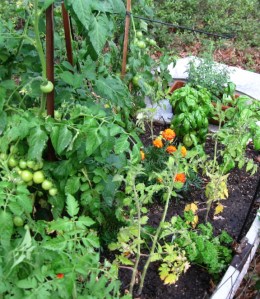
Details often sprout into images, similes, and metaphors. Images, similes, and metaphors aren’t scary when they grow organically from your own experience. If you mess around in a garden, for instance, your mind is almost certainly linking what your eyes see, your hands feel, and your nose smells to other things in your life. When I look at my little garden, sometimes I think about making pesto or eating cherry tomatoes, but other times I think, What a mess! I can’t see what’s going on here.

Which is what I sometimes think when I’m revising and come to a passage that’s drowning in detail. Pruning is good, both for prose and for shrubs.

I often think in generalities and abstractions, but when I describe my thoughts to someone else, I almost always reach for concrete images to illustrate them. No surprise there: most useful generalizations are firmly grounded in specifics. In the spring of 1970, I was a freshman at Georgetown University in Washington, D.C. Here’s a story from that time, as recounted several decades later:

Lauinger Library opened toward the end of my freshman year, about a month before the Kent State shootings shut the campus down. Within a very few weeks footpaths had appeared across the green lawn fronting the library, one leading from the main gate, the other from the corner of Healy Hall where foot traffic from several dorms and classroom buildings converged. Imagine a terrestrial ice cream cone, with the traffic circle standing in for one scoop of your favorite flavor and the tip at the library’s front door. While war raged in Southeast Asia and anti-war movements fought it across the United States and around the world, university officials battled the entire student body over the right way to walk to the library. The officials contended that we should follow the existing asphalt walkway around the perimeter of the lawn. Our footsteps, in their hundreds, then thousands and tens of thousands, countered that the shortest distance between two points was a straight line.

Our footsteps carried the day. Officialdom conceded, and the foot-beaten paths were enshrined in asphalt.

“The shortest distance between two points is a straight line”: Well, duh — everybody knows that. But the truism doesn’t stick in my mind the way that story has all these years. It taught me to pay attention to something that just about all of us tend to forget: footsteps matter.

Footsteps, come to think of it, are like details. Pay attention to them. They’re important.


Poets and Punctuation

A couple of posts ago I advised even non-poets to read lots of poetry. “Good poets make every word count,” I wrote.

Synchronicity rules: The wonderful Brain Pickings e-newsletter just featured a short digression by poet Mary Oliver on this very subject. She set out to “write a poem that uses no punctuation” so she could “see what I could do simply with the line break and the cadence of the line and so forth.”

The poem is “Seven White Butterflies.” The Brain Pickings story includes both the text of the poem and a video of the poet reading it. Check it out.

Of Dots and Dashes

Dashes and ellipses. Many editors don’t like them. Dashes and ellipses take up space. They call attention to themselves. And they’re often overused: writers may resort to dashes and ellipses when they can’t figure what else to do.

But dashes and ellipses are handy critters. Used with care, they’ll help you shape your writing to say what you want and sound the way you want it to.

First off, what are they?

An ellipse consists of three periods in a row. (In British English, periods are called full stops.) Like this: . . .

There’s a space between the dots, and one at each end. What your word-processing program calls an ellipsis looks like this: … No spaces between the dots. If you want to score brownie points with your editors and your more discerning readers, don’t use this shortcut. Type dot-space-dot-space-dot.

The ellipsis serves an important purpose in academic and other nonfiction: when you’re quoting from another source and you want to abridge the quote, the ellipsis is used to indicate where words have been left out. Say I wanted to quote the second sentence in the second paragraph of this post but not all of it: “Used with care, they’ll help you shape your writing to say what you want and sound the way you want it to.”

I’d render it thus: “Used with care, they’ll help you shape your writing to . . . sound the way you want it to.”

Important resources for learning more about ellipses, dashes, and other stuff

Important resources for learning more about ellipses, dashes, and other stuff

Aside: Leaving words and whole sentences out of quoted material can distort and misrepresent the original author’s intent. Use ellipses with care. For more about this use of the ellipsis, consult your favorite style and grammar handbook.

In fiction and non-scholarly nonfiction, the ellipsis indicates a trailing off. Words are being omitted not because they’re being dropped from a quotation but because they aren’t being said.

Here’s a snippet from my novel in progress. Giles and Shannon are friends. Wolfie and Pixel are dogs. Giles is meeting Wolfie for the first time.

Giles was pointing at Wolfie. “Who, or what, is that?”

“This is Wolfie,” said Shannon. “I told you about Wolfie.”

“You did,” Giles conceded, “but I wasn’t prepared . . .” He fluttered his fingers at Pixel, who was lying in the hallway paying close attention.

Giles doesn’t complete his sentence. He shifts his focus — and the reader’s — from Wolfie to Pixel. The reader doesn’t know what Giles was about to say or why he didn’t say it.

In dialogue the dash, in contrast to the ellipsis, indicates an interruption. Here’s an example from later in the same scene. Giles and Shannon are both artists. They’re looking at a wall mural in Shannon’s house.

With his coffee mug Giles indicated a long line across the middle distance. “What this wall needs,” he pronounced, “is some movement.”

“Thank you, Mr. Picasso,” Shannon said. “You could just stand there and direct traffic —” She stopped short. “Aha!” she said, setting her coffee down and joining Giles at the wall.

Shannon interrupts herself. Dashes can also be used when characters interrupt each other. An interrupted sentence sounds different from one that trails off. It’s like the difference between walking into a door because you didn’t see it and slowing down before you get there.

Dashes have other uses too. Like commas and parentheses, they often come in pairs. Note my sentence above:

He shifts his focus — and the reader’s — from Wolfie to Pixel.

The dashes could be replaced by either commas or parentheses:

He shifts his focus,  and the reader’s, from Wolfie to Pixel.

He shifts his focus (and the reader’s) from Wolfie to Pixel.

Or the punctuation could be dropped altogether:

He shifts his focus and the reader’s from Wolfie to Pixel.

I chose dashes on the fly because I heard “and the reader’s” as a very slight detour, a stepping-back from the sentence before following it to the end. If I revise the sentence (which I probably won’t — this is a blog after all!), I might consider the alternatives. Set off by commas, “and the reader’s” is more fully integrated into the sentence, but not as fully as it would be with no punctuation at all.

Set off by parentheses, it becomes an afterthought, as in “Why include it at all?” When I put something in parens, it’s often because I have a sneaking suspicion it doesn’t need to be there but I can’t bear to delete it. The parens are there till I muster the nerve to yank it out.

Now take another look at the paragraph just before the preceding one. There’s a sentence in there that includes a dash and an exclamation point and parentheses all bundled up together. Am I going to warn you “Don’t do this at home”? I am not. I’m going to say “Try it. See if it works. If it doesn’t, try something else.”

No Need to Shout!!

99% of all editors, writing instructors, and experienced writers will tell you: “Use emphasis sparingly.” Emphasis includes ALL CAPS, bold, underscore, and italics. And exclamation points!!!

(OK, 99% is an unverified statistic. I made it up — you know, to emphasize my point.)

This is why our gatekeeper friends will relegate a manuscript to the slush pile if the first couple of pages include too many italicized, bolded, underscored, or ALL CAPPED words and phrases. Fairly or not, they’re leaping to the conclusion that the writer who relies heavily on gimmicks is not ready for prime time.

How many is “too many”? If they’re the first thing a person notices when she pulls your ms. out of the envelope or opens the file, that’s too many. Aim for “none” and you’ll probably get it about right.

“But,” you wail, “how do I show what’s important?”

Good question!

When we speak, we can emphasize words and phrases by speaking them more loudly, or drawing them out, or exaggerating their each and every syllable. We can use our hands and our faces to express our feelings or underscore a point.

You can replicate some of these methods in writing. You can describe how a character said something and/or what she was doing while she said it. Too much description, though, can slow a passage down when you want it to move right along. Lucky for all of us, written English offers some powerful tools to call attention to whatever you want to call attention to. and without using ALL CAPS, bold, underscore, italics, and other gimmicks. Learning to use them is part of the writer’s craft.

So how does one go about this?

Here’s where I advise even non-poets to read lots of poetry. Good poets make every word count. They have to: poems use fewer words than stories, essays, and full-length books. They read their written words aloud and pay attention to how they sound. Poets who work in traditional forms, like the sonnet, use meter and rhyme to emphasize important words. Words at the ends of lines and lines at the ends of stanzas get particular emphasis. And so on.

Prose writers use sentences and paragraphs the way poets use lines and stanzas. Words at the beginning and, especially, at the end of a sentence are emphasized. Likewise sentences at the beginning or end of a paragraph, and paragraphs at the beginning or end of a scene.

Have you ever confronted a paragraph that sits on the page like a dark gray lump? One sentence follows another with no break, maybe for a whole page or more. If the eye gives in to the natural temptation to skim through to the end, the mind is almost certainly going to miss something important.

But there’s no need to bold or italicize the sentence you want to call the reader’s attention to. If that paragraph belongs to you, try breaking it so that your key sentences fall either at the end of one paragraph or the beginning of another. If you’re reading it in a book, identify a place or two where author or editor might have started a new paragraph. (You may not find any such places. It’s possible that the paragraph really needed to be that long.)

I like long loopy sentences, but I also know that long sentences tend to lose energy. So I pay close attention to the words, phrases, and clauses that make them up. When I’m editing, I’ll sometimes break a compound sentence in two in order to focus more attention on each of its parts.

Here’s where the oft-repeated advice to “omit needless words” comes in handy. “Needless words” are the ones that camouflage or otherwise distract attention from the important stuff. What’s tricky is that you have to identify the important stuff before you can decide what’s needless, and this often doesn’t happen till a second or third draft.

The best way to develop your skill at emphasizing key points without resorting to gimmicks!! is by experimenting on your own work, getting feedback from editors and other writers, and giving feedback to other writers on their in-process work. Anyone out there have an example to share with other readers of this blog? Keep it fairly short, say 100 words or so. You can use either the comments link at the top of this post or the contact form in the “You!” tab on the menu bar.


Murder, They Write — and Write, and Write

I’m probably going to get into big trouble here. Quite a few of my friends and acquaintances write murder mysteries. A vast number of my friends and acquaintances read murder mysteries.

Still, I’ve gotta say it: Something bugs me about murder mysteries.

The other day lonelyboy1977, a blogger I follow, blogged about “the one trope I love to hate.” The trope he loves to hate is the love triangle. It’s not the trope itself he hates. It’s the way writers who use it tend to fall into ruts. Rather than develop their characters and plots, they let the trope do the work.

In real life, murder is a crime. In fiction, it’s a trope. In murder mysteries, it’s a sine qua non. Without a murder, it’s not a murder mystery.

Aside: OK, now I’m curious. Are there any murder mysteries out there in which murder doesn’t happen? Recommendations welcome.

No, I don’t for a minute believe that writing and reading murder mysteries makes a person insensitive to murder. I get the distinction between fiction and real life. Even when it’s set in a real place, fiction creates an alternate reality. My friend Cynthia Riggs writes murder mysteries about Martha’s Vineyard, the place where we both live. They’re fun, they’re well-written, they’re true to the place in almost every detail . . .

body outlineExcept for the dead bodies that keep turning up. Homicide is very rare on Martha’s Vineyard. If murders happened on the Vineyard as often as they do in Cynthia’s books, the Vineyard would be a very different place. More of us would lock our doors. Fewer of us would go for long walks in the woods alone. Every time someone was murdered, we’d be surreptitiously studying our friends and neighbors for clues: Did you do it?

And perhaps wondering ourselves: Who out there is itching to kill me?

Why is the murder trope so popular with writers? Well, duh, writers write murder mysteries because there’s an apparently insatiable market out there for them. But how about from a strictly writing point of view?

fingerprintToss a murder into the meandering stream of daily life and plot happens. I’ve blogged before about how I’m plot-impaired. The number of online how-to-plot guides out there tells me I’m not alone. I’d probably be better at plotting if I were better at killing characters off.

The task I’ve set myself, though, pretty much precludes that option. In my fiction, I’m exploring Martha’s Vineyard. In creating my alternate-reality Vineyard, I’ve limited myself to the materials lying around in the actual place. At present I’ve got a loose dog, a child trapped in a bad family situation, and a protagonist who gets sucked into trying to rescue both of them. The dog almost gets shot and there’s one character I wouldn’t mind killing off, but so far no one’s died or committed murder.

What I’m curious about is how the murder trope influences the writer’s imagination. Murder is such a sure-fire way to get a plot going — does it push other possibilities out of the picture? The same goes for other tried-and-true tropes, like the love triangle. If something works once, we’ll usually do it again — and again and again and again.

Till it stops working.

Which isn’t likely to happen in our lifetimes.

Here I’m going to take a giant step backwards. As the late Grace Paley said, and I’m forever quoting, “If your feet aren’t in the mud of a place, you’d better watch where your mouth is.”

My feet aren’t in the mud of murder mysteries, and I’ve already said enough. But I’m curious. And I hope some of you murder mystery writers and avid readers out there will weigh in.

Murder weapons

Murder weapons in waiting

Islanders Write? Not Quite

In some ways this is specific to Martha’s Vineyard, where I live. In other ways — well, some people are forever trying to erect walls with a few writers inside and most of us out in the hinterlands somewhere. Keep the faith — and keep writing, no matter what.

Susanna J. Sturgis's avatarFrom the Seasonally Occupied Territories . . .

In the summer we denizens of the Seasonally Occupied Territories are regularly bombarded with events that have “Martha’s Vineyard” in their names. Their main connection to the year-round Vineyard is that they’re held on the same terra firma.

no trespassingSummer residents are often featured at these events. The year-round Vineyard, though, is usually not on the organizers’ psychic map. The underlying assumption seems to be that we year-rounders have much to learn from the summer folk but they have nothing to learn from us.

So earlier this summer, when I heard of an upcoming conference called Islanders Write, I dared hope that it might be something different. “Islanders Write”: Doesn’t that sound active to you? Islanders writing, talking about writing, talking about all the kinds of writing being done on Martha’s Vineyard, encouraging other islanders to write?

Aside: “Islanders” is what the academics call a contested term. Do you have to…

View original post 863 more words

Dear You

Got a question about editing? Is your work-in-progress snagged on some invisible rock? Are there some days when you just can’t sit still long enough to write?

Whatever you’re wrestling with, other writers are almost certainly wrestling with something similar — or we will be next week.

See the “You!” tab on the nav bar up above? It’s for you, You. It’s got a contact form in it. Send along your questions, your snags, and whatever else is on your writerly mind. This blog has almost 600 followers now (eeeeek!). I bet we can help you out.

All best,

Me


What’s a Style Sheet?

I knew nothing about style sheets when I started copyediting books for trade publishers and university presses. Before long I thought style sheets were the greatest thing since mocha chip ice cream — well, almost.

So what’s a style sheet? More important, if you’re a writer, not an editor, why should you care?

English is a richly diverse language. British English (BrE) and American English (AmE) often spell the same word differently: spelt/spelled, labour/labor, tyre/tire. In AmE, some words can be spelled in more than one way, like ax and axe, or façade and facade. Others have variations that are pronounced differently but mean the same thing: amid and amidst, toward and towards.

And hyphens! Don’t get me going about hyphens. One of these days I’ll devote a whole blog post to hyphens. Sometimes a hyphen is crucial: consider, for instance, the difference between coop and co-op. Often the hyphen is helpful but not crucial. When I look at reignite, the first thing I see is reign. If an author wants to hyphenate it, re-ignite, that’s fine with me. For most readers, the hyphen in living-room sofa isn’t essential, but if the author has written it that way, I’ll generally leave it alone — and insert a hyphen in dining-room table if the author has left it open.

A style sheet collects all such choices into one handy list: choices not only about how words are spelled but about how they’re styled. Hyphenation is often a matter of style rather than spelling. When do you spell out numbers and when do you use figures? Are abbreviations OK? When the dictionary notes that a word is “often capped” or “usually capped,” which does the writer prefer?

It’s a rare author who submits a style sheet with his or her manuscript. A recent job included Arabic and Urdu terms transliterated into English, and many personal and place names that are transliterated in myriad ways. The author did include a style sheet with his preferred spellings and stylings, and I was profoundly grateful. It saved me a lot of online research and second-guessing.

In fact-checking another recent job, a novel, I quickly discovered discrepancies between the names of some real-life places and the way my author was spelling them. Other names were faithful to the actual place. I’m still not sure whether these discrepancies were intentional or not. If the job had come with a style sheet, I would have known — and I wouldn’t have spent so much time trying (unsuccessfully) to verify the author’s versions.

Why should you, the writer, keep a style sheet?

Maintaining consistency in a novel or long nonfiction work is a challenge. Sure, if you’re working on the computer, you can use the search function to find earlier instances of a word or name — or you could just consult your style sheet. If you’re writing a series involving the same locations and characters, a style sheet will be even more useful.

Whether you self-publish or publish with a trade, academic, indy, or small press, your style sheet means your copyeditor doesn’t have to start from scratch. If she finds inconsistencies in the ms., she’ll be able to go with your preference instead of guessing what you want.

Several books that appear frequently in my "Primary References" section

Several books that appear frequently in my “Primary References” section

I find that keeping a style sheet makes me more conscious of my choices, whether I’m editing or writing. Plenty of choices are “six of one, half dozen the other.” Others are a matter of style: for instance, do you prefer diacritics in words like façade and résumé and naïve? And sometimes, especially with proper nouns, it’s a matter of right and wrong. In the very well written nonfiction book I just finished copyediting, Katherine Hepburn’s name was so spelled. I’ve seen it so often (mis)spelled that way, I didn’t have to look it up (but I did anyway): it’s Katharine, with an a. Before you enter a name on your style sheet, verify the spelling.

If you write fantasy or science fiction, with made-up names that can’t be verified online, a style sheet can be especially useful. Same goes if, in either fiction or nonfiction, you’re dealing with names from other languages, especially languages that don’t use the Roman alphabet. Transliteration systems differ. Accents and diacritics and other spelling conventions can be confusing to someone who doesn’t know the language.

You can organize your style sheet in any way that makes sense to you and whatever you’re working on. Here are the major categories and subcategories in the style sheet I made for a just-completed job, with a brief explanation of each. Most of mine follow a similar format.

Primary References

Here’s where I put whatever dictionaries, style guides, and other reference works I’m using. This keeps my word list (see below) under control: it means I only have to list spellings and stylings that differ from the dictionary’s or style guide’s recommendation.

General

This section is for style choices that apply to the whole book. Number 1 is nearly always “serial comma.” Number 2 usually specifies either “which/that distinction observed” or “which OK for restrictive clauses.” (Anyone want a crash course on the which/that distinction??)

This particular style sheet had subsections for Capitalization, Hyphens & Dashes, Quotes & Italics, and Slashes. Most also have a Numbers subsection, but not this one.

Words

Word lists can be short or long. They should include choices made where alternatives exist, e.g., axe rather than ax, or vice versa. They’ll probably include plenty of words where capitalization, hyphenation, the use of italics, or the styling of numbers is at issue. Their #1 purpose is to help me keep my choices and the author’s straight.

Among the words and phrases in my list were the following (with the reason I included each one):

Braille (can be lowercased)

carpe diem (like other foreign-language expressions listed in the dictionary, it’s usually not italicized)

coauthor (commonly hyphenated)

 decision-making (n.) (decision making and decisionmaking are also possible)

 not-yet-imagined, the (coinage by the author)

 rebbe (variant spelling of rabbi)

transparence (variant of transparency)

Trickster tales (Trickster capped as an archetype)

Western (cultural); western (n.; genre): compass directions are usually lowercased, except when they take on a more-than-geographical meaning. Eastern and Western may signify large cultural groupings. During the Cold War, they had political significance. (North and South are generally capped in reference to the sides in the U.S. Civil War.) And western the genre is sometimes capped and sometimes not. Could drive you crazy, no?

Names

Some copyeditors list the names of virtually every person mentioned in a book. As a proofreader, I don’t find such exhaustive lists useful. So I don’t list familiar names that are easily verified — unless they are frequently misspelled (like Katharine Hepburn) or the author is inconsistent. It can be hard to verify names with particles (von, van, de, etc.), partly because styling varies from family to family and because online references aren’t always as authoritative as they think they are. So it’s worth putting them on the style sheet.

serenity prayer

A good style sheet helps editors and proofreaders recognize what should be changed and what’s fine as it is.