Recognition Rocks

bloggerrecognitionaward

Ordinarily I don’t do awards, but hey, recognition is good, especially when it comes from a fellow writer, so thank you for nominating me, Gavin Zanker. I recently started following Gavin’s blog, but already I get the impression that he’s making it up and figuring it out as he goes along, which is pretty much what I do. More power to us.

I have two blogs, this one and From the Seasonally Occupied Territories, about being a year-round resident of Martha’s Vineyard. As both writer and editor I’m mostly self-taught, which is to say I’ve learned a tremendous amount from my peers, a couple of mentors, and reading master writers but I haven’t gone to school for any of it. Write Through It is part of my attempt to give something back and keep learning at the same time.

Advice to bloggers, especially bloggers who do other kinds of writing: Your writing will teach you what you need to know. Just keep doing it — and be prepared for unexpected detours and forks in the road.

Here are my nominees, in no particular order. All these blogs expand my world, albeit in different ways. Some of these bloggers don’t do awards, but check out their blogs anyway. They’re special.

The TomPostPile • Tom lives up the road from me. I already knew he was a musician and a master sign painter, but until he started his blog I knew nothing about Wishetwurra Farm. Here’s your intro. He also takes wonderful photos of both here and “away” — sometimes as close as Woods Hole but other times considerably more distant.

Charlotte Hoather • Charlotte Hoather is a gifted young soprano pursuing her music studies in Scotland. She also writes wonderfully.

Cochin Blogger • I “met” Cochin Blogger on an international editors’ list we both subscribe to. His words and wonderful photos have introduced me to daily life in Kerala, which is where he lives.

The Immortal Jukebox  • Thom Hickey’s “blog about music and popular culture.” Every post is a musical adventure, complete with embedded videos.

Evelyne Holingue • Evelyne is a novelist who grew up in France and now lives in the U.S. She’s witty, observant, and perceptive, and she blogs in both English and French. Earlier this year she worked her way through the alphabet, looking for the English equivalents of common French idioms. Her readers joined in. It was wonderful.

The Glass Bangle • Thoughtful, perceptive, funny — this is my window into the world of a writer, poet, and avid reader in India who’s raising two daughters.

MV Obsession • Joan has known the Vineyard for longer than I have, but she sees it from the perspective of someone who doesn’t live here year-round. When I start getting snarky about “summer people,” I think about Joan and all the others who have their feet in the mud of this place too.

What Matters • Janee Woods doesn’t post all that often, but everything she does post is essential reading for anyone trying to understand how privilege works and why dealing with it is important.

Self-Published Authors Helping Other Authors • Absolutely crucial for writers thinking of self-publishing, and for those who want to put their own experiences to good use.

Off the Beaten Path: Hikes, Backpacks, and Travels • Just what it sounds like. I’m a lifelong East Coast girl, and Cindy’s wonderful photos of wildlife, mountains, and places you can’t reach by car transport me to parts of the U.S. that I may never see in person.

Alex Palmer: Your Man in the Field • Sports is terra incognita to me, mostly by choice, but Alex writes so well that I might turn into a sports fan in spite of myself. He just launched this blog a few months ago, so check it out. P.S. Not only does Alex live on the Vineyard, he grew up in the same off-island town I did.
Crimson

Just found this gem by the author of The Glass Bangle, one of my favorite blogs. Eloquent, intensely visual poetry about writing, and about other things.

Divide and Conquer (Your Prose)

This focuses specifically on blogging, but the message applies to all kinds of writing, fiction and nonfiction. In my novel in progress, the sections are scenes. Each has a beginning, middle, and end. Each links what precedes to what follows. Check out the two examples cited. They’re good.

Titles

No, not job titles or aristocratic titles or even the title to my finally paid-off Forester that arrived in the mail a few weeks ago.

Titles of stories, novels, essays . . . especially the title of a piece I posted to my other blog, From the Seasonally Occupied Territories, yesterday morning. The post was ready to go except for the blank box at the top where the title was supposed to go.

That blank box was staring at me.

Some titles come easy. Not this one, but I was more than ready to go walking with my dog. I typed “Rootless” in the blank box, hit Publish, gave it one last read-through for typos, and logged off.

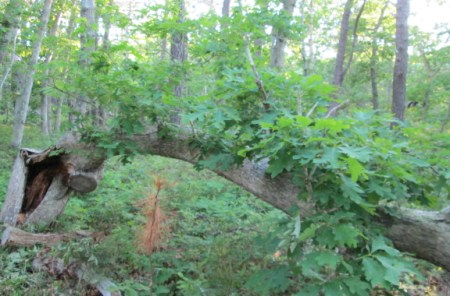
This oak was felled by Hurricane Irene in 2011. For three years it leafed out lying down.

This oak was felled by Hurricane Irene in 2011. For three years it leafed out lying down.

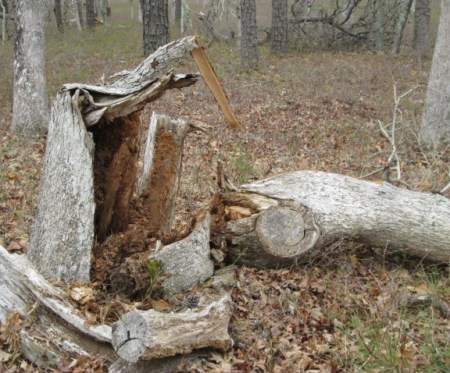
“Rootless” wasn’t a bad title. The blog post is about two different trees, a birch and an oak, that I pass often on my walks. Both trees were felled by storms, the oak by a 2011 hurricane, the birch by one of this past winter’s blizzards. Both remained partly attached to their trunks, and both continued to leaf out after they fell. Both have since been severed from their roots. One is dying, the other dead.

As I walked, another title came to me: “Two Downed Trees.” Bingo.

The winter of 2015 severed the oak's trunk. Its leafing days are over.

The winter of 2015 severed the oak’s trunk. Its leafing days are over.

It’s nice when that happens.

Some titles come easy. Others come hard. Some don’t come at all — you have to go looking for them.

When titles come early, they often help shape the story. The epigraph for my first novel, The Mud of the Place, gave the novel its title and kept me honest while I was writing it. It’s a remark by the late Grace Paley (1922–2007), a wonderful poet, fiction writer, and political activist.

“If your feet aren’t in the mud of a place,” she said in an interview, “you’d better watch where your mouth is.”

I added some literal mud to the novel so readers wouldn’t be disappointed.

Novel #2, in progress, needed a working title so I could stop referring to it as “my current project” or “the novel I’m working on.” I started calling it Wolfie, after one of the main characters, a dog. That may turn out to be the actual title. Who knows? It’s definitely the one to beat.

The novel on the back burner has been The Squatters’ Speakeasy almost since it first flickered into my mind. This is the project that stalled out because of its “surfeit of subplots,” one of which has to do with a bunch of musicians and artists who take over a trophy house and turn it into, well, a sort of speakeasy. I love the title. Trouble is, as the novel bubbles along on the back burner, the speakeasy subplot is fading into the background. I don’t know what the main plots and themes will turn out to be. Will they include a squatters’ speakeasy? Damned if I know — yet.

So where do your titles come from? Do they come easy, or do they come hard? How do you know when you’ve got a good one?

Leave your comments here. If you’re shy, feel free to use the handy-dandy form below. Seriously — you don’t have to be shy to use the form, and it doesn’t have to be about titles either.

Go back

Your message has been sent

Warning
Warning
Warning
Warning

Warning.


Sturgis’s Law #2

Earlier this month I started an occasional series devoted to Sturgis’s Laws. “Sturgis” is me. The “Laws” aren’t Rules That Must Be Obeyed. Gods forbid, we writers and editors have enough of those circling in our heads and ready to pounce at any moment. These laws are more like hypotheses based on my observations over the years. They’re mostly about writing and editing. None of them can be proven, but they do come in handy from time to time. Here’s #2:

Given enough time to fill, even the most intelligent commentator will wind up making stupid statements.

When I was growing up, we had the news at 6 and the news at 10 (or 11), and it didn’t last more than an hour. On Sunday we had talking-head shows like Meet the Press. They didn’t last more than an hour either.

With the advent of cable TV came channels that delivered news and commentary 24/7. The quantity increased, but not the quality. Blather is cheap. Investigation and analysis are hard. There’s good stuff out there for sure, but you have to wade through a flood of drivel to find it.

Print journalism, like print in general, imposes limits. The space available is finite and the words have to fit into it. In my newspaper days, ads would often come in or be cancelled at the last minute. I’d have to cut a story on the fly to make room or figure out how to fill the hole. I learned, among other things, that no matter how well-written and well-edited a story was, I could nearly always cut two or three or four column inches out of it without doing serious harm.

sufferedThe web doesn’t impose space limits. Bloggers and others writing for the web could theoretically go on forever — but we don’t. Paradoxically perhaps, when it comes to the web the standard advice is “keep it short.” We could go on forever, but most readers won’t stick with us that long. There are limits, but they aren’t spatial.
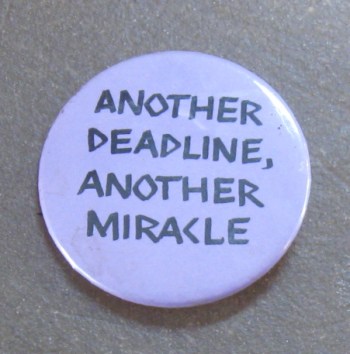
We writers like to kick against the restrictions imposed on us by circumstance and by (you’re way ahead of me) editors, but restrictions are often a good thing. Think about it.

Tasks with deadlines usually get done before tasks without.

Cutting a 3,000-word draft to fit a 1,000-word limit often sharpens the focus and tightens the prose.

Poets make every word count because they have to. Not only do poems usually have fewer words than stories and essays (even flash fiction and nonfiction), they’re also shaped by the limitations of rhyme, rhythm, and/or meter.

Early drafts can sprawl. Sprawling is good — it sure beats being blocked. But it’s revising and editing that make the piece, whether poetry or prose, by shaping and focusing — by imposing limits.

deadline miracle

Reviewing Isn’t Easy

Most of my writing time over last weekend went into an 1,800-word review of a nonfiction book. Monday was the deadline, and Monday I emailed it in to my editor. Editors love it when writers deliver their stuff on time. Trust me on this. They also love it when writers turn in copy that’s well organized and properly punctuated. Trust me on that too.

I’ve done plenty of reviewing over the years, mostly of books but also of local theater performances and the occasional concert or album. Reviewing is hands-down the hardest writing I ever do, which is why I don’t do much of it these days. My other writing has pushed it to the side. I regret this because I think reviewing is important and because I’m pretty good at it.

Reviewing is important. An author or performer puts the work out there, and the reviewer enters into conversation with it — a conversation that includes not only the work and its creator(s) but also the potential audience for that work.

Perhaps most important, reviews let prospective readers know that a book is out there and whether they might be interested in it.

So a review is like PR — free publicity for the book?

In some ways yes, but in other ways very much no. What reviewers write can persuade people to buy the book, but we aren’t part of the production team. Our job is not to persuade people to buy the book or put it on their to-read lists. Our job is to help them make up their minds.

What distinguishes reviews from back-cover blurbs and other promotional copy is that reviewers come to the work from outside. We haven’t been involved in the writing, editing, publishing, or promoting of the book we’re reviewing.

So what’s a review anyway?

Good question! “Review” covers the vast territory between a blurb and the kind of literary criticism that appears in academic journals. A review can be short, long, or somewhere in-between. It can be written down or delivered orally. Usually it describes what the book is about, provides some context — for instance, mentioning the author’s previous works, if any, or recent publications in the same field — and offers some clues as to whether the book is worth your while or not.

Beyond that, it depends — on the reviewer, the review medium (radio, blog, webzine, newspaper, Goodreads, Amazon, etc.), and the intended audience.

My writer friend wants me to review her book. Should I do it?

No. A thousand times no.

Personally I think your writer friend shouldn’t even have asked you. She’s putting you in a terrible position.

Since you’re in that terrible position, ask yourself these questions:

  • Can I tell prospective readers what they deserve to know about this book before they buy it?
  • If I give my honest opinion about my writer friend’s book, will we still be friends?

Of course, if you decline to review the book, the friendship may hit the skids anyway — see what I mean about terrible positions?

If you’re the writer with a forthcoming book, don’t do this to your friends. If your friends write well and want to help out, enlist them to write jacket copy, press releases, and brief synopses for your website. If they’re published authors themselves or have other useful credentials, they can write one of those signed blurbs that appear on the back cover of a print book or in the opening pages of an ebook. No one expects these things to be written by an impartial reviewer.

So what’s “impartial”? When is it OK to review someone’s book?

Good reviewers think about this a lot. We discuss it with other reviewers. In many fields and genres, authors, editors, publishers, and reviewers mingle on a regular basis, in person and/or online. Many of us wear more than one hat. We know each other by reputation even if we haven’t actually met.

Smart authors and publishers, including self-publishers, keep an eye out for reviewers who would be a good match for their books. Authors, especially self-publishing authors, may contact prospective reviewers directly. It’s up to the reviewer to say yes or no, and saying no to someone you know is not always easy, especially when they press you to come up with a reason. (Note to writers: Please don’t do this. It’s OK to take no for an answer. Last month I reblogged this excellent post: “Author Etiquette for Contacting Book Bloggers.” Read it and pass it on.)

How close is too close to write an impartial review? Here are some recommendations. You’re too close —

  • If you’ve seen any draft of the manuscript before it was published. If the author is in your writers’ group or workshop or writing class, you’re too close. If you were a second or third reader, you’re too close. If you critiqued or edited the ms., you’re too close. Possible exception: If you heard the author read from the novel in progress and had no prior relationship with the author, you might not be too close.
  • If you have any professional connection with the publisher, paid or unpaid, staff or freelance. This goes mainly for small presses, independents, and self-publishers. With huge trade-publishing conglomerates and even mid-sized university presses, it’s easy to be several arm’s-lengths away from any particular book.
  • If you’re more concerned with the author’s feelings than with telling prospective readers what they deserve to know.

What about when a book you’re asked to review really sucks?

Forgive my bluntness here, but this is the elephant in the booksellers’ marketplace so let’s not pretend it isn’t there. Some books really do suck, and some of those sucky books are written by people we know and like. You shouldn’t be reviewing books by your friends even if those books are stupendously good and in the running for major awards, but what if you get roped in to reviewing a book that’s really bad — as in, you really don’t think anyone should be wasting their time and money on it?

If you’re working on assignment from a book blog or other review medium, and whoever made the assignment has no personal connection to the author, this usually isn’t too hard. Explain that you don’t think the book is worth reviewing. Ask for another assignment.

If you do know the author, it’s a lot more difficult. You can try procrastinating. Some authors will catch on: Endless procrastination translates into “I really don’t want to do this.” Others won’t. In such cases, if you don’t say something, one of those elephants is going to take up residence in your relationship with the author. Saying something is hard. This is why those elephants aren’t on the endangered species list.

There is almost no good reason to review a really, really bad book, especially when that book is a first novel or a self-published book. If it doesn’t get reviewed, the book will probably sink with nary a trace. This is the best scenario for all concerned, though they probably won’t see it that way. The big exception is when the bad book is written and/or published by someone from whom we’ve got good reason to expect better things. In these cases, readers deserve to be warned off.

Slashing a bad book to ribbons can be fun, but it can — and should — leave a very unpleasant aftertaste. Don’t do it.


Author Etiquette for Contacting Book Bloggers

Having been at various times a reviewer, an anthology editor, a newspaper features editor, and a few other things, I think this is excellent advice for any writer who is trying to get another writer to do something for free. Online, offline, anywhere!

Tricia Drammeh's avatarAll I Have to Say

Hello, everyone! It’s me again with another author advice post. Warning: This post isn’t for everyone. If you’re an author who finds etiquette posts tiresome, this post isn’t for you. If you’re already an expert on book marketing, this post will probably seem pretty basic, but I hope you’ll read on and add your advice in the comment section. This post is for people like me – people who came into the writing world with limited social media knowledge. It’s for people who didn’t realize book bloggers existed until they were told to go out and promote their book. If you’re intimidated or overwhelmed by the idea of contacting reviewers and bloggers, or if you’ve sent requests to bloggers and only received a lukewarm response, this post is for you.

  1. DO read the blogger’s FAQs, Policies, or Submission Guidelines. Each blogger is different. Some bloggers want you to contact them by email. Others have…

View original post 1,456 more words

Write On, and On, and On

Happy New Year to all, and may your writing flourish and lead you along interesting paths.

If you look up at the menu bar, you’ll see it’s been streamlined. The five Ws — Who, What, When, Where, and Why — and their first cousin How are now all on the same page.

The “You!” page is now “Got a Question?” It includes a comment form to make it easy for you to ask questions, share your experience, offer suggestions, whatever.

If you’re on Facebook, Write Through It has its own page. If you “like” it (and maybe even if you don’t), you can make comments and ask questions there too.

Write Through It now has 1,060 followers, and it’s not even a year old yet. I’m amazed. Welcome aboard, and special thanks to all who’ve commented, liked various posts, and otherwise supported this blog. You’re keeping it, and me, going.

P.S. I just added four new ink colors to my collection: sepia brown, suede blue, copper burst, and velvet black. No, I didn’t need any more ink, but ink, like pens and blank paper, is faith in the future. It’s going to be a good writing year. Here’s the current collection.

The four new bottles are on the left. You can tell they're new because they're so clean. I don't know why I up-ended Travvy's bone behind the tableau, but I like it.

The four new bottles are on the left. You can tell they’re new because they’re so clean. I don’t know why I up-ended Travvy’s bone behind the tableau, but I like it.

What Makes a Real Writer?

Stacey, who follows Write Through It and blogs at Diary of a Ragamuffin, posed this question: “What makes one a real ‘writer’?”

She added:

My reason for asking:  After 15 years of teaching, I decided to change careers and have begun a job as a reporter for my small-town newspaper (that is owned by a not-so-small-town corporation).  They knew I had no journalism experience when they hired me.  After four  months, I’m beginning to wonder if just anyone could do the job I do.

I’m not sure if what I do each day is what I had hoped it would be.  Often there is not enough time to write reflectively, and when there is, there’s no one qualified to critique it (in my opinion).

The answer is that there’s no answer, but you know I’m not going to stop there, right?

First off, I worked eight years for a small-town newspaper, the Martha’s Vineyard Times, in a succession of overlapping capacities: proofreader, features editor, features writer, theater reviewer, copyeditor. Reporting wasn’t my forte, but I did a little of that, mostly covering stories when no “real” reporter was available.

So I’m here to assure Stacey: The job you do can’t be done by just anyone, or by just any writer either. The fact that you’re wondering probably means that you’re good at it. You’ve got the knack. You learn fast. You’re able to apply your experience in other jobs to your journalism job.

Been there, done that. I wasn’t a journalist either when I got drafted to fill in for an editorial typesetter who was going on sick leave. I was scared to death I’d screw up, but I needed the work. I could type, I could proofread, I could write, and I had several years’ editorial experience. Short version: I loved it, I was good at it, and pretty soon the paper hired me as a part-time proofreader.

The tricky thing about job description “writer” is that it covers so many different kinds of writing. Reporter. Novelist. Columnist. Essayist. Poet. Diarist. Blogger. Biographer. Academic. Copywriter. Technical writer. And so on and on. No writer does all of them. No writer I’ve ever met wants to do all of them.

I know some crackerjack journalists who won’t cop to being writers. In their minds, writers write books, or fiction, or literary criticism. What writers don’t do is write for newspapers. You see the paradox here? If real writers don’t write for newspapers, then the writing in newspapers isn’t real writing.

Of course it is. If it isn’t, what the hell is it?

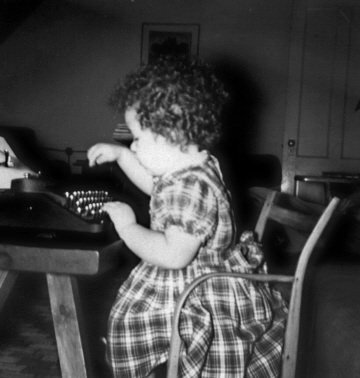
That's me, long before I knew what an editor was.

That’s me, long before I knew what an editor was.

In my teens and twenties, I assumed that a real writer had to know grammar and punctuation backwards and forwards and be a world-class speller besides. So I developed those skills. It wasn’t until I got a job as an editor in the publications office of a big nonprofit that I realized that in the real world these skills made me an editor. I hadn’t even known what an editor was. Some editorial skills belong in every writer’s toolkit, but you don’t have to be an editor to be a real writer.

Poets & Writers is a venerable organization that publishes a bimonthly magazine of the same name. Doesn’t the name imply that category “poets” isn’t included in category “writers”? It does to me. Plenty of poets either don’t call themselves writers or are semi-apologetic when they do: “I just write poetry. I’m not a real writer.”

Same deal as with journalists: If what poets write isn’t writing, what is it? And if the people who write it aren’t writers, what are they?

About her journalism job Stacey noted: “Often there is not enough time to write reflectively, and when there is, there’s no one qualified to critique it.”

This is true. Journalism means writing to deadlines, and deadlines don’t stand around waiting for the writer to get it perfect.

Deadlines don’t wait for editors either. Accuracy is more important than a perfectly crafted sentence. Spell a kid’s name wrong and her parents and grandparents will remember it forever.

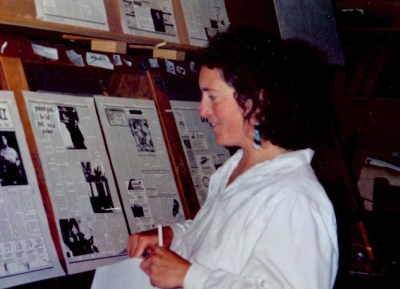
Me, checking the boards at the Martha's Vineyard Times. You can tell it was back in the Pleistocene because the paste-up was pre-digital. October 1993.

Me, checking the boards at the Martha’s Vineyard Times. You can tell it was back in the Pleistocene because the paste-up was pre-digital. October 1993.

Working for the newspaper made me a better writer and a better editor in more ways than I can count. I learned I could write and edit with phones ringing off the hook and people bringing me press releases 12 hours after deadline. I learned that endings don’t have to be perfect because the last two or three inches of a story would often be lopped off when a late ad came in. I learned that writers who can turn out prose like yard goods may write sloppy sentences but they sure come in handy when a scheduled story doesn’t show or an ad gets pulled. I learned that in the work of novice writers the lead paragraph is often buried a third of the way down. I learned that I can turn out a coherent theater review even when I haven’t a clue what the play was about. (It was Beckett’s Happy Days, in case you’re wondering.)

I learned that “good enough” often is good enough, and it’s actually pretty damn good, though for sure you could do better at a writers’ retreat. For a congenital perfectionist like me this was huge.

So what makes someone a “real writer”?

Marge Piercy nailed it in “For the Young Who Want To”:

The real writer is one
who really writes. Talent
is an invention like phlogiston
after the fact of fire.
Work is its own cure. You have to
like it better than being loved.


That’s the last verse. Read the whole thing. Read it often. You don’t have to be young.

Listen to Those Blocks

Creative blocks in rearrangement mode

Creative blocks in rearrangement mode

Ever notice how most of the stuff you learn about writing is stuff you already know?

I’m not talking primarily about grammar, punctuation, spelling, and all the nuts-and-bolts basics. I’m talking about the “how to keep going” part.

Last winter the novel I was working on, The Squatters’ Speakeasy, wasn’t coalescing or developing any momentum. I wouldn’t say I was blocked exactly, but the writing sure got sludgy. I procrastinated a lot before I sat down to write, and fidgeted a lot when I got there.

I also started this blog, and wrote an essay about a controversial statue that was in the news at the time. As I blogged back in April, in “Course Correction”:

 When I got up in the morning, I couldn’t wait to sit down in my chair and start writing. I finished the essay. I kept going with the blog. Whenever I thought about waking Squatters from its winter snooze, I was overcome by an irresistible urge to play endless games of Spider solitaire.

Procrastination was trying to tell me something. Finally I got the message. I put Squatters aside. About a year before I’d written a scene about a dog named Wolfie, a kid named Glory, and Shannon, a character from my first novel, The Mud of the Place. It didn’t fit in Squatters, so I put it aside. Now I pulled it back onto my lap and had another look. My imagination woke up.

Long story short: This blog now has more than a thousand followers. The novel, working title: Wolfie, passed the 50,000-word mark three days ago.

Here comes the bit about how writers keep learning what we already know.

Or, to put it in a slightly less flattering light: “Insanity is doing the same thing over and over again and expecting different results.” However, for some strange reason, it’s always easier to catch your friends doing the same thing over and over again than it is to realize that you’re up to your old tricks again.

Who, me?

Short version: My other blog, From the Seasonally Occupied Territories, was wilting. Running out of steam. I was thinking of wrapping it up, or at least putting it in the indefinite deep freeze. At the same time, there were so many things I wanted to write about that I was thinking of starting another blog.

Sheesh. When I type that, it looks so obvious. I really must have been nuts or in denial or just plain dense not to see that I could do the writing I wanted to do in From the Seasonally Occupied Territories.

If you’re curious about the longer version, you can read it here.

Writers talk about writer’s blocks and procrastination all the time. Most of us have at least a passing acquaintance with both. Many of us have had long-term relationships with one or the other. We dread them, we hate them, we do endless rituals to keep them at bay.

I’m here to remind you — because I know you know this already — that often the blocks and the procrastination are trying to tell you something. Sometimes the back-seat driver is right: Either you’ve missed a turn or you’ve taken one you didn’t want.

The road you want is the one that keeps your pen moving across the paper or your fingers on the keyboard.

Creative blocks, rearranged

Creative blocks, rearranged