When Chitchat Takes the Wheel

Dialogue is a challenge. It’s got to sound real, but it can’t be too real because in real life people often go on at great length without saying much of anything. If your characters go on at great length without moving the plot forward in some way, your readers will zone out. (For some tips about writing dialogue, see “4 Ways to Write Better Dialogue” and “Monologue About Dialogue.“)

I recently critiqued two first-novel manuscripts. Both were rich with promising material, and both bogged down in endless stretches of what I can only call chitchat: the protagonist talking with friends, relatives, and casual acquaintances about things that had nothing to do with plot or subplot.

What to do when you come upon long rambling dialogue while revising your own work or critiquing someone else’s? Here’s an idea: Ask what the writer is avoiding. (The writer, need I say, can be you.)

In one of the manuscripts I was working on, the chitchat was occasionally interrupted by passionate monologues by different characters (rarely the protagonist). These monologues had plenty to do with the plot, but they read like position papers, not fiction.

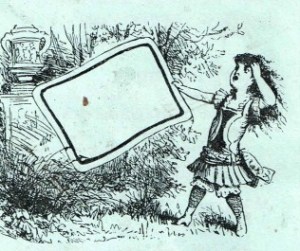
Travvy tries to persuade a tractor to move.

Travvy carries on a one-sided dialogue with an offstage tractor.

These monologues did serve an important purpose, however: they made it clear that the characters disagreed with each other strenuously and eloquently on issues that were not only important in themselves but closely related to major themes in the novel. I knew that this material could fuel riveting, even dramatic dialogue — if only the writer would let the characters engage with each other.

It wasn’t hard to see why this writer was reluctant to do this. Both she and her protagonist are dealing with explosive issues that people have a hard time talking about without blowing up.

Writing takes courage. Often when we set out on a journey we don’t know how much will be asked of us. If we did know, we might not take the first step. But as we travel, we become braver, more willing to open closed doors and break new trail. Revision works the same way: in revision, we develop not only the skill but the courage to grapple with the questions we’re asking of ourselves and our characters.

In the other manuscript I was critiquing, the same symptom — endless chitchat on topics peripheral to the novel — had a different cause. The protagonist remembered nothing of her traumatic childhood and early adolescence, and she was so ashamed of her later adolescence and young womanhood that she wouldn’t talk about it even to her husband and closest friends. This gave her little to talk about besides chitchat.

Worse, because her repressive upbringing was key to the plot, it made her a sitting duck for the villain, who wasn’t hampered by amnesia or reticence.

Survivors of violent and traumatic events often repress memories of those events, but though it’s possible that someone might have no memories of her first 15 years, it’s certainly not inevitable. Most important, it wasn’t an interesting choice for this particular character in this particular novel. Interesting choices open up possibilities. This particular choice closed them off.

I suggested that this writer give her protagonist increased access to her own past and the willingness to share some of the grim details with those she trusts. At the very least, it will give the protagonist something to talk about, and greatly cut down on the chitchat.

Dead Air

I seem to have taken up semi-permanent residence in Revisionland. Not only am I working on draft 3 of Wolfie, my own novel in progress, my recent jobs have included two critiques of first novels and a line edit whose structure needs a little tweaking. Editor that I am, with a fair amount of reviewing experience under my belt, I love revising and rewriting and recommending what other writers might do to improve their current drafts.

Most mornings I begin my writing session by lighting a candle or two, then picking The Writer’s Chapbook* from the table on my right, opening it at random, and reading the first quote that catches my eye. This morning the book opened to the “On Films” section, and my eye fell on a lengthy quote by novelist and screenwriter Thomas McGuane. After noting that in the novels of William Faulkner (“who frequently had his shit detector dialed down to zero”) “wonderful streaks” often alternate with “muddy bogs” that need to be slogged through, he continues:

Everyone agrees that Faulkner produced the greatest streaks in American literature from 1929 to 1935 but, depending on how you feel about this, you either admit that there’s a lot of dead air in his works or you don’t. After you’ve written screenplays for a while, you’re not as willing to leave these warm-ups in there, those pencil sharpenings and refillings of the whiskey glasses and those sorts of trivialities. You’re more conscious of dead time. Playwrights are even tougher on themselves in this regard. Twenty mediocre pages hardly hurt even a short novel but ten dead minutes will insure that a play won’t get out of New Haven.

Me (right) in rehearsal, spring 1994, Vineyard Playhouse.

Me (right) in rehearsal, spring 1994, Vineyard Playhouse.

From the mid-1980s till the end of the 1990s, I was very involved in community theater, mostly as a stage manager, actor, or reviewer. (No, I did not review plays I was involved in. However, I often reviewed plays directed or acted in by people I knew. This taught me tact. Whole other subject. I’ve written about reviewing before — see “Reviewing Isn’t Easy” — and surely will again.) No surprise, then, that when I’m writing fiction, I often feel like I’m blocking scenes or directing them and that my characters are doing improv up on stage.

Both of the first-novel manuscripts I critiqued recently hold plenty of promise, but both are currently weighed down with loaded with dead air. In both cases, much of the dead air is dialogue. To both authors I suggested: “Imagine you’re watching these scenes on a stage. Read them out loud. How long before you start to doze off, fidget, or throw tomatoes?”

A novel might survive “twenty mediocre pages,” as McGuane suggests, but five pages of dead air might well be fatal, especially if they come near the beginning, and especially if you’re a first-novelist trying to get past one of the gatekeepers: agent, publisher, reviewer, or even readers willing to give unknown writers a chance.

Put your talking, puttering-about characters up on stage or on a movie screen. How long would you sit still?

* * * * *

*The Writer’s Chapbook: A Compendium of Fact, Opinion, Wit, and Advice from the 20th Century’s Preeminent Writers, ed. George Plimpton (New York: Penguin, 1989). I’ve got the revised, expanded version of the first edition. A completely overhauled edition was published in 1999, including some of the original excerpts but also more quotes from more recent and more diverse writers. Both editions are out of print but used copies can be found. That’s how I got mine. Highly recommended.

Revisionist

You bet I’ve got revision on the brain. There are books and websites a-plenty that will tell you how to go about revising your novel, memoir, essay, or whatever, but here’s what I’m doing. I can’t tell you what to do, but maybe this will give you some ideas.

Scribbles on the printout

Scribbles on the printout

In my writing time each morning I’m reading through draft #2 of the novel in progress, making notes on the printout and also preparing a longhand synopsis. In the synopsis, I go chapter by chapter, describing what happens in each scene in black cherry ink (a rather disappointing color, by the way: I was hoping for something that was more cherry and less black), then in red I scribble whatever occurs to me about where something might lead, what it reminds me of, or whether it might be better off somewhere else.

After a couple of hours of this, Travvy — on whom Wolfie, the title character of this novel, is based — and I go for a long walk. While I walk, scenes and fragments are usually churning, swirling, composting in my head. Sometimes an idea or insight will swoop in out of nowhere — or maybe they’ve been there all along waiting for an opportunity to pounce.

Synopsis in progress, with commentary

Synopsis in progress, with commentary

Re-vision: To see again, to see with new eyes, to see new possibilities.

A few months ago I blogged “Simplify: A Key to Revision.” My later drafts are mostly about simplifying — pruning whatever doesn’t enhance the story in some way. I’ll be doing some of that in draft #3, but at this point “the story” is still expanding and deepening so it’s often not clear what’s essential and what’s extraneous. Some of the latter bits turn out to be hidden doorways or the glinting of sunlight off something that needs exploring.

At this point Wolfie is still evolving. It’s a will o’ the wisp, out of reach but still reachable. Revision brings me closer to it.

My response to anyone who asks what Wolfie is about has been “It’s about a girl and a dog who need rescuing and how they rescue each other.” The very first scene I wrote brings together Glory (the girl), Wolfie (the dog), and Shannon (the rescuer). That scene, currently chapter 3, has changed very little since I wrote it, and it’s not likely to change in draft #3.

In the course of draft #2, however, Glory, a smart, artistically gifted sixth-grader who loves dogs and hates her stepfather, has become more guarded, more calculating. Felicia, her mother, has evolved from a two-dimensional figure whom I didn’t much like into a more complex and much more interesting character who may hold the key to the whole book. Shannon, who as an advocate for women and children in crisis is an old hand at rescuing, is contacted by the one person she couldn’t rescue: her younger sister, long-estranged refugee from the same violent, alcoholic family, now sober and wanting to make contact.

Rereading the early chapters of draft #2, I’m surprised to see that much prep work and foreshadowing for these themes is already there. It just took me a while to figure out where it was going.

I still don’t know how the novel ends, by the way. Draft #1 didn’t tell me, and draft #2 hasn’t either. Each draft has come closer, though, so maybe by the time I get close to the end of draft #3 I’ll know.

How will I know? That’s the question. I’m always saying “Your writing will teach you what you need to know,” which can sound terribly glib when your writing is staring you in the face and not saying anything. Mine does that too. Sometimes you just need to walk away and ignore it for a while.

Other times — well, learning to listen to your writing is part of the process too. Since I’m an editor as well as a writer, it probably won’t surprise anybody that I like revising more than first-drafting. First-drafting is like breaking trail. Revising is working with something that’s already there — and that’s what I do for a living. I’ve come to expect each new manuscript, be it academic paper or memoir or novel, to tell me what it needs, and it nearly always does. Same goes for my own stuff.

Reviewing other people’s books can be useful too: It focuses your attention on the big picture and how the pieces fit together. Trouble is, really good books often seem inevitable, and you don’t see any of the drafts that got them to that point. With works in progress or less accomplished works, it’s easier to see the gaps and the missed opportunities. This is why I heartily recommend writers’ groups, if you can find or start one that works for you, and sharing work in progress informally with other writers. Reviewing, evaluating, and critiquing other writers’ work will make you better able to hear what your own writing is trying to tell you.

Sturgis’s Law #7

ink blot 2Last spring I started an occasional series devoted to Sturgis’s Laws. “Sturgis” is me. The “Laws” aren’t Rules That Must Be Obeyed. Gods forbid, we writers and editors have enough of those circling in our heads and ready to pounce at any moment. These laws are more like hypotheses based on my observations over the years. They’re mostly about writing and editing. None of them can be proven, but they do come in handy from time to time. Here’s #7:
It’s hard to see the whole when you’re up too close, and easy to see unity when you’re too far away.

Notice how some people will make sweeping generalizations about huge groups of people they know very little about, then call you on every generalization you make about their people?

That’s what Sturgis’s Law #7 is about. This is a presidential election year in the United States — lucky you if you haven’t noticed — and generalizations are running amok. Generalizations are often made about groups of people the generalizer doesn’t particularly like. Conservatives generalize about liberals, liberals about conservatives, Democrats about Trump supporters, Sanders supporters about Clinton supporters, gun control advocates about gun owners . . .

When anyone generalizes about “Americans,” all 320 million of us, I look around my town of fewer than 3,000 souls and realize I’d have a hard time making a generalization about us, other than “we all live in West Tisbury.”

Sturgis’s Law #7 has several applications for writers and editors. Here’s one: You’ve got a grand idea for a story or novel or essay. You map it out in your head. Then you sit down to write it — and you immediately realize how little you know about the details necessary to create images in the reader’s mind.

Here’s another: You’re so fascinated by the research you’re doing for your project that you lose sight of, and maybe interest in, the project itself.

And here’s yet another, this time from the editorial side: When I’m copyediting — reading line by line watching for typos, pronouns with unclear referents, sentences that swallow their own tails — I probably won’t notice that a compelling scene in chapter 4 really needs to come earlier. But if I’m critiquing, considering the work as a whole, I’ll probably skip over the typos or even miss them completely. In fact, if I’m too conscious of typos, it’s either because I’m not paying enough attention to the big picture or because the typos are so numerous they’re distracting me from my job.

Many editors specialize in either “big picture” structural editing or sentence-by-sentence language editing, but even those who do both won’t try to do both at the same time. Wise writers do likewise. When you start revising, don’t obsess about typos and subject-verb agreement. Deal with those when the work’s structure is solid. If you share your near-final drafts with volunteer readers, make it clear that you want them to read, not proofread — unless one of them is a crackerjack speller, in which case you may want to let him or her have at it.

In traditional publishing, a manuscript passed through several editors on its way to becoming a book. Once the structure was sound, the focus moved on to the paragraphs and sentences, then to the words, and finally the proofreader went hunting for the details that had eluded everyone else. The result probably wasn’t error-free, but it came pretty close.

Such attentiveness, however, is time-consuming and expensive, beyond the reach of most self-publishers and many small and not-so-small presses. Still, it’s possible to get excellent results by keeping Sturgis’s Law #7 in mind. Both distance vision and tight focus are important, but don’t expect yourself or your editor to catch everything on one pass through your manuscript.

***********

Serendipitously, I just came across this passage in The Writer’s Chapbook: A Compendium of Fact, Opinion, Wit, and Advice from the Twentieth Century’s Preeminent Writers, edited by George Plimpton (New York: Random House, 1999). It’s full of pithy comments by all sorts of writers on all sorts of writing-related subjects. It’s also out of print, alas. I got it on interlibrary loan. Anyway, this bit from novelist Michael Crichton illustrates what Sturgis’s Law #7 is about:

In my experience of writing, you generally start out with some overall idea that you can see fairly clearly, as if you were standing on a dock and looking at a ship on the ocean. At first you can see the entire ship, but then as you begin work you’re in the boiler room and you can’t see the ship anymore. All you can see are the pipes and the grease and the fittings of the boiler room, and you have to assume the ship’s exterior. What you really want in an editor is someone who’s still on the dock, who can say, Hi, I’m looking at your ship, and it’s missing a bow, the front mast is crooked, and it looks to me as if your propellers are going to have to be fixed.

The Charles W. Morgan, restored 19th century whaling ship, seen from the dock. Vineyard Haven, Mass., June 2014.

The Charles W. Morgan, restored 19th century whaling ship, seen from the dock. Vineyard Haven, Mass., June 2014.

Sturgis’s Law #4

This past spring I started an occasional series devoted to Sturgis’s Laws. “Sturgis” is me. The “Laws” aren’t Rules That Must Be Obeyed. Gods forbid, we writers and editors have enough of those circling in our heads and ready to pounce at any moment. These laws are more like hypotheses based on my observations over the years. They’re mostly about writing and editing. None of them can be proven, but they do come in handy from time to time. Here’s #4:

“The check’s in the mail,” “I gave at the office,” “All this manuscript needs is a light edit”: Caveat Editor.

If you’ve forgotten all the Latin you ever learned or never studied it in the first place, “Caveat” means, roughly, “Watch out!”

brochure cover cropWhen someone tells you “The check is in the mail” or “I gave at the office,” your most likely response is skepticism. You know this because you have used variations on the same excuses yourself, right? I sure have.

It is true that all some manuscripts need is a “light edit.” These manuscripts are generally prepared by fairly experienced writers who have already run them by a few astute colleagues for comments and corrections.

When I and most of the working editors I know roll our eyes at “All this manuscript needs is a light edit,” it’s because the manuscript in question usually needs considerably more.

So what does “light edit” mean?

Nothing associated with editing has one clear-cut, hard-and-fast, universally understood definition, but “light edit” generally means copyedit, as described in “Editing? What’s Editing?”:

Let’s say here that copyediting focuses on the mechanics: spelling, punctuation, grammar, formatting, and the like. With nonfiction, it includes ensuring that footnotes and endnotes, bibliographies and reference lists, are accurate, consistent with each other, and properly formatted.

Once one starts dealing with matters of style and structure — snarly sentences, internal inconsistency, abrupt paragraph transitions, missing information, and so on — one has moved beyond the realm of the light edit.

Most of us are not the best judges of our own work. Good writers know this. When we think a story or essay is done, the very best we can do, we set it aside for a week or a month. When we come back to it, we see it with fresh eyes. Problems we missed before are now glaringly obvious, from typos to dangling participles to plot holes that could swallow a truck.  Often the fixes are just as obvious, thank heavens.

Outside editors come to the work with even fresher eyes, along with considerable experience in identifying and fixing problems in all sorts of manuscripts. They haven’t seen the previous drafts. They don’t know what you meant to say. They see only what’s there on the page.

So when you approach a prospective editor, don’t lead off with “All this manuscript needs is a light edit.” Describe the work and let the editor know what you want to do with it: submit it to a literary magazine or academic journal? find an agent? self-publish?

With a book-length work, fiction or nonfiction, an evaluation or critique is often the best place to start. Editing a book-length work takes time. This means it isn’t cheap. A good critique will point out the strengths of your ms. as well as any weaknesses that may exist. It will identify problems that you can fix yourself. It will let you know if this particular editor is a good match for you and your manuscript.

And if you’re an editor, the next time a prospective client approaches you with “All this manuscript needs is a light edit,” don’t snigger, raise your eyebrows, or roll on the floor laughing.

Because this time the author may be right.

What Is Editing Worth?

Ask a bunch of editors what good editing is worth and they’ll probably reply that it’s invaluable, priceless, and indispensable.

Listen to us talk for a while and we’ll probably get around to the books we’ve read that were either abysmally edited or (probably) not edited at all. What’s the matter with those writers? we wonder. How can they put their names on something that’s so disorganized or riddled with typos and grammatical errors?

Being both a writer and an editor, I think about this a lot. “Value” is a shifty word in English. “Valuable” and “invaluable” mean more or less the same thing. Plenty of value can’t be measured in money, but when you have to pay for it, money has to be considered. Editing has monetary value to me as an editor because it pays the rent. For me as a writer, whatever I spend on editing is money I can’t spend on book design, cover illustration, and marketing. Besides, I can do it pretty well myself.

The inescapable fact is that editing can’t be automated. If some outfit promises to “edit” your 300-page manuscript for a dollar a page, you can be sure that they’re not doing much more than running a spellchecker and a grammar checker through it, and maybe cleaning up the formatting. In my book that’s not editing: it’s word-processing.

Depending on what level of editing is called for, editing involves going through your manuscript page by page, line by line, even word by word. This is not like reading for pleasure. It takes time. For a book-length work, it takes a lot of time. Hypothetical example: Take a 300-page,  75,000-word manuscript. (In publishing, a page is conventionally reckoned at 250 words.) If the ms. is well written and has no structural problems, a good copyeditor might be able to clock 10 pages per hour. That’s 30 hours’ worth of work. Say the copyeditor is charging $30 an hour. (Some charge more, some charge less, but you can get a good copyeditor for $30/hour.) That’s $900 right there.

A manuscript that, as we say in the trade, “has problems” will take longer to edit. At 5 pages/hour, that’s 60 hours. At $30/hour, that’s $1,800. If the problems are serious enough, you may have trouble finding an editor who’ll work for only $30/hour. There are few things more frustrating than being asked to copyedit a manuscript that has structural problems. It’s like frosting a cake that’s collapsed in the middle and didn’t taste all that good to start with.

I don’t know about you, but $1,800 would put a huge dent in my budget, even if I could pay it off over time. I’m never surprised when a writer has sticker shock at an estimate for editing. Editors can say that editing is “priceless” and “invaluable” because we’re not paying for it. When a service costs that much, “priceless” and “invaluable” go out the window. Writers who are paying out of pocket — and this includes me — are up against a harder question: “What is editing worth to me?”

It depends. It really is OK to say “not much” or “I’d love to hire an editor but I have to win the lottery first.” Here are some things to think about:

  • Do you want your work to be read by people who don’t have to read it? Do you want them to spend their hard-earned money on your book?

If the answer to these questions is no, you don’t need an editor, so editing may not be worth all that much to you. On the other hand, it might be. I spend my hard-earned money on things I don’t need. (Ask me about the two fountain pens I just scored off eBay. And don’t ask me how much money I’ve spent over the years on training and competing with my dog.)

If the answer is yes, or maybe, or “I’m not sure,” consider the following questions.

  • How good are you at spelling and punctuation?
  • How much experience have you got? How good are you, period? (Be honest now.)
  • Are you in a good writers’ group or otherwise sharing your work with competent and honest writers?
  • What are your plans for your work?
  • Is your work likely to bring in any money? Enough money to make editing worthwhile from a financial standpoint? (Be realistic here. If you’re writing fiction or poetry, the answer is probably no.)
  • What are your goals and priorities as a writer?

And here are some strongly held personal opinions on the subject:

If you aren’t a crackerjack speller and/or you aren’t confident with punctuation, you need help — especially if you plan to submit work to journals, agents, or publishers. These gatekeepers are swamped with far more submissions than they can use. They are looking for reasons to reject incoming manuscripts. Sloppy spelling and punctuation is painfully easy for a competent editor or agent to spot. You might be able to get the help you need from a talented amateur who won’t charge for her time. It depends on how talented and how generous your friends are.

An old printer’s adage: “Cost, speed, quality: Pick any two.” This means, for example, that if you spring for a low price and a fast turn-around time, the quality will probably be less than stellar. If you want a high-quality job done ASAP, expect to pay a premium price for it. This applies to writing too. If you the writer are willing to put in the time, in classes, writers’ groups, and/or self-study, you can get by with less editing. You will also be better able to choose the right editor for your work if you decide to hire one. Just sayin’ . . .

And here’s some free advice for anyone working solo on a book-length manuscript, fiction or nonfiction. Even if you’re cheap, even if your disposable income is barely in positive numbers — think seriously about hiring a pro to critique it. Critiquing costs a lot less than editing because the critiquer is reading your manuscript the way a reviewer might, not going through it line by line. The critiquer will identify both strengths and problems. She’ll probably have suggestions about fixing the problems — but it’s up to you to do the work.

I’ve read several novels in the last year or so that read like good first drafts. Lots of good raw material, but plot holes abounded. Characters did implausible things just because the author said so. Backstory was dumped here, there, and anywhere. Tantalizing leads were introduced — and then dropped. And so on. These are things that can be dealt with in revision, but these novels all went to press in various states of disarray. One of these novels, by the way, was published by a major trade publisher, probably on the strength of the author’s reputation in nonfiction.

Maybe that’s “good enough”? Maybe it is. But ask yourself: When you start reading a book and realize that the author has cut corners, do you keep reading? If you get through to the end, do you recommend the book to a friend? Do you write a glowing online review?

Good editing is expensive, but sometimes it really is worth the money. Your call.


Shibboleths and Other Pitfalls

For all too many people, the English language is a minefield. They’re afraid that if they take one wrong step, something will blow up in their face.

hidden cove NTIt gets worse when they learn you’re a writer, a teacher, or (gods forbid) an editor. Some people laugh nervously. Others clam up.

Many of those explosive devices we’re so afraid of are shibboleths. Like “Never end a sentence with a preposition” and “Don’t split infinitives.”

What’s a shibboleth? Here’s what the American Heritage Dictionary had to say:

  1. A word or pronunciation that distinguishes people of one group or class from those of another.
  2. a. A word or phrase identified with a particular group or cause; a catchword.
    b. A commonplace saying or idea.
  3. A custom or practice that betrays one as an outsider.

old courthouse rd 2Readers and writers, teachers and editors, are forever getting them mixed up with rules. How to tell a rule from a shibboleth? Rules usually further the cause of clarity: verbs should agree with their subjects in number; pronouns should agree with the nouns they refer to. Shibboleths often don’t. No surprise there: their main purpose isn’t to facilitate communication; it’s to separate those who know them from those who don’t.

To complicate matters even further, the language is continually evolving. New words are born. Meanings morph. Nouns get verbed and verbs get nouned. If you’re too far ahead of the pack in adopting a new usage, someone‘s not going to be happy about it.

If that’s not enough, we’ve also got such everyday confusables like ensure/insure/assure, affect/effect — and is it irrespective that’s OK and irregardless that’s verboten, or is it the other way round?

No wonder English starts to look like a minefield, even to native speakers who use it all the time.

Editors have been known to make it worse. Been there, done that. It’s an occupational hazard. An example:

As an apprentice editor, I was initiated into the mysteries of the which/that distinction. “That” was for restrictive (essential) clauses: “The sweater that I’m wearing was made by my mother.” (This implies that I have other sweaters and my mother probably didn’t make all of them.) “Which” was for non-restrictive clauses: “The house, which was built in 1850, has been in his family for decades.” (The building date is extra information. It doesn’t specify which house has been in his family for decades.)

security signHoo boy, did I go wild or what. Anyone who hadn’t mastered the which/that distinction was an ignoramus. I got to look down my snoot at them. I got to educate them.

Then I learned that British English (BrE) was managing to get along quite nicely without the which/that distinction. BrE writers liberally used which” for restrictive clauses.  Their editors weren’t changing every “which” to “that.”

Wonder of wonders, I had no trouble understanding which clauses were restrictive and which weren’t.

By that time I’d so internalized the which/that distinction that it came naturally to me. This was an asset when I started copyediting for U.S. publishers, many of whom require copyeditors to change every restrictive “which” to “that.” Fortunately most writers won’t fight about this. Many have internalized the which/that distinction just the way I did. When editing the work of a BrE writer, I’ll generally stet the restrictive “which” and note it in my style sheet so the proofreader will realize that this was a conscious decision on my part, not a (gods forbid) mistake.

Another shibboleth is the widespread notion among U.S. copyeditors that “toward” is American English and “towards” is British English. They mechanically knock the “s” off every “towards” they come to. A few years back, Jonathon Owen, linguist, writer, and editor, did his master’s thesis on this very subject. As reported in his excellent blog, Arrant Pedantry, his research suggested that U.S. editors are creating the perception that “toward” is AmE and “towards” is BrE. For writers, it’s six of one, half dozen of the other. In edited manuscripts, however, “toward” overwhelmed “towards,” 90% to 10%.

In a recent online discussion, an assortment of editors took on the difference between “such as” and “like.” (If you haven’t heard of it, worry not: I’d been editing for 10 years before I was initiated into this particular mystery. Till then I thought “such as” was simply a more formal synonym for “like.”) According to those who observe the distinction, if I refer to “movies such as Lawrence of Arabia,” I am including Lawrence in the group. If I write “movies like Lawrence of Arabia,” I’m not.

Most of the editors participating in the discussion thought the such as/like distinction was a made-up “rule” — a shibboleth. I rarely use “such as”; when I use “like,” I’m not excluding the item(s) that follow from the group. I’ll wager that most writers do likewise, and — even more important — so do most readers. What this means is that if it’s important to know whether the item(s) are included or not, you better not rely on the such as/like distinction alone to get the message across. (The discussion suggested that readers of scientific literature were alert to the distinction, so if that’s your audience you’d best observe it.)

A caveat: English is riddled with sound-alike and look-alike words that don’t mean the same thing. These aren’t shibboleths. They facilitate communication. If you write or read, they’re worth learning. As an editor, I’m always on the lookout for them. The very capable author of a recent editing job consistently confused “imply” and “infer.” (A speaker implies that something is true. Her listeners may infer the truth from what she said.) I made the necessary changes and explained the difference to the author. He said he had a hard time keeping those two words straight.

Why does any of this matter? Here I turn to “Rules That Eat Your Brain,” by Geoffrey Pullum, linguist and frequent writer on English grammar and usage. “Zombie rules” are shibboleths by another name.

Though dead, they shamble mindlessly on. The worst thing about zombie rules, I believe, is not the pomposity of those advocating them, or the time-wasting character of the associated gotcha games, but the way they actually make people’s writing worse. They promote insecurity, and nervous people worrying about their language write worse than relaxed people enjoying their language.

If the language really were a minefield, what fool would venture out into it? Be brave. Write on.


Writers’ Groups

Writers’ groups are like workshops, only less compressed and more ongoing. Writers’ groups are generally free. This is a big plus when you don’t have much in the way of disposable income. Unlike workshops and classes, they usually don’t have instructors. They may have a leader, official or unofficial, but that person’s job is generally to keep things on track, not to teach. In writers’ groups we learn from each other.

You may have had bad experiences in writers’ groups. If you hang out with other writers, you’ve almost certainly heard about a Writers’ Group from Hell. I know they’re out there.

Nevertheless, I’ve been in several writers’ groups over the years, formal and informal, and they’ve taught me a lot. If you aspire to write for an audience of more than one, i.e., yourself, a writers’ group can be beneficial in so many ways. Each meeting is a deadline for you to meet — very helpful if your writing is always taking a backseat to everything else going on in your life. The more work you share with other writers, the braver you’ll get about sharing your work. Other writers’ comments can help you see your own work from different angles — and your comments will help them likewise.

My first writers’ group included mostly poets and fiction writers, all women. Our numbers fluctuated, but there were about six regulars. At each meeting we’d talk about how our writerly lives were going and discuss the work of two or three members. Ideally we’d each get copies of our work to the others before the meeting, but this was long before email so this wasn’t always possible. Once we produced a potluck group reading in which more than 60 women crowded into a smallish community space to enjoy good food and good writing. This was the first public reading I’d ever done. It was wonderful.

A group I was in several years later usually met in the cozy kitchen of one of its members. The kitchen had a fireplace; except in the warmest weather, there’d usually be a fire going. We sat around the kitchen table, sipping coffee (and sometimes Black Bush whiskey), nibbling homemade chocolate chip cookies, and discussing our writing, which included short essays, one-act plays, memoir, and fiction.

At each meeting we’d do some freewriting, all with pen or pencil on paper. We took turns giving a starting word or phrase and setting a time limit — usually 10, 15, or 20 minutes. Then we’d read what we’d written aloud. We didn’t have to, but we nearly always did.

The group I’m in now meets weekly in the sitting room of its leader. She provides popcorn and beverages (usually wine, fruit juice, and water, with hot cider in season); members often contribute other goodies. At each meeting, we pass out copies of our work to everyone else and then read it aloud. As we listen, we mark our hardcopies — a check mark or “good!” for things that stand out, a question mark for things we find puzzling, perhaps an alternative word or wording if one pops into our heads. Then we discuss the work, and when everyone’s had their say, we pass the marked-up hardcopies back to the writer.

As you can see, writers’ groups vary a lot.  No one group is going to be everything to all its members. My current group doesn’t lend itself to in-depth critique: we’re all hearing each piece for the first time, and each piece gets about 20 minutes of our attention. Since most of us are writing book-length works — fiction, history, and memoir — we only see a small chunk of it each week. For comments on overall structure, we have to wait till we’ve finished a complete draft, then enlist volunteer readers or a professional editor to read the whole thing. But the weekly deadline has been invaluable, and so is reading my work aloud, and hearing others read theirs.

Yes, I have been in some groups that weren’t so helpful and that sooner or later fell apart. Keeping a group together is a group effort. I could go on, but instead I’ll quote from Marge Piercy’s poem “For the Young Who Want To”: “The real writer is one / who really writes.” If a group is monopolized by writers who talk incessantly about the writing they didn’t do, or were going to do, or mean to do before the next meeting, it will quickly become useless to the writers who are really writing.

So how to find a writers’ group? Libraries and bookstores are a good place to start looking. I know of groups that have spun off from adult ed classes: the course ended, but the writers decided to keep meeting on their own. If you can’t find one, or one that’s currently open to new members — it’s definitely possible for a group to get too big — try starting one. Start small, say with one or two or three writer friends.

And please share your experiences and tips in the comments!

Aside: “The Good, the Bad, and the Ugly, or How to Choose a Writers’ Group,” by the novelist and teacher Holly Lisle, is a wonderfully detailed guide, not just to choosing a group but for starting one.


Workshop

In the summer of 1984, having saved my pennies and summoned my courage, I headed off to Ithaca, New York, for the Feminist Women’s Writing Workshop. Was I ready? Was I good enough?

My poetry chapbook (1989). Cover design by Maggie MacCarty.

I’d never been to a workshop. I’d never taken a writing class. I didn’t know what to expect. Junior year of high school, though, I’d won the school’s writing prize. Since then I’d done lots and lots of self-teaching. The college newspapers had published my op-eds and reviews. More recently, my reviews and essays had appeared in feminist and gay publications. I’d written most of the poems that eventually appeared in my chapbook, Leaving the Island (1989). I was working on a novel.

Maybe most important of all, I was the book buyer for Lammas, Washington, D.C.’s feminist bookstore. For years I’d been immersed in a movement, a community, for which books and magazines and newspapers were crucial, life-sustaining stuff. I saw it every day at work: women discovering words that inspired them, strengthened them, and even changed their lives.

Words were my only instrument, writing and editing my only useful skills. It was time, I thought, to test my vocation.

Me standing on the boathouse deck during a break, ca. 1987

Me standing on the boathouse deck during a break, ca. 1987

The heart of the workshop was our morning critique sessions. At each two-hour session, an hour would be devoted to the work of one participant. In those days the workshop was held at Wells College in tiny Aurora, New York, about 30 miles from Ithaca. These meetings were held on the second floor of the boathouse, overlooking Cayuga Lake.

The day before, the scheduled writers would put copies of their work out for everyone to read. (“Copies” meant paper in those days. In 1984 we all still had typewriters.) We took our homework seriously. When we gathered in a big circle at 9 every morning, everyone was prepared. The scheduled writers were usually at least a little bit nervous.

The ground rules were simple. For the first part of the session, the writer was invisible. Critiquers were to discuss the work with each other, as if she weren’t there. Her job was to listen. She wasn’t to speak. The workshop director got the discussion going by asking a question about the work, then she’d keep the discussion on track by asking more questions, making comments, and when necessary reminding us of the ground rules. With 10 or 15 minutes to go in the hour, she’d close the discussion and give the floor to the writer. The writer could then answer whatever questions had been raised, ask some of her own, and generally respond to the comments made.

Talking writing on the Wells College lawn, ca. 1987

Talking writing on the Wells College lawn, ca. 1987

Taking part in these sessions morning after morning was a powerful experience. As the writer being critiqued, I listened to 18 of my peers focusing all their attention on my work. My work had to stand on its own, apart from me. Sometimes my peers would argue about a particular line. They’d disagree, sometimes heatedly, about what it meant and whether it worked. Gradually it dawned on me that I couldn’t take any single comment, supportive or critical, as the final word. I had to sort through all the feedback and decide how to use it.

As a critiquer, this meant my job was to tell the writer whatever I could about her work, even if I thought my idea was off-the-wall or too personal or even negative. “I don’t understand what’s going on here” is my take on the work, no more, no less. Maybe the writer will find it useful, maybe not. Either way it’s her call. Sometimes as a critique session began, I’d be on the verge of panic because a work had left me cold, or angry, or frustrated. Some works were more polished than others. I learned that I could nearly always come up with something the writer might find useful.

For better or worse, my vocation passed the test. I returned to the workshop for the next three years as one of two assistant directors. By 1988, however, I’d been sucked into the seasonal economy of Martha’s Vineyard, to which I’d moved in 1985, and could no longer escape for 10 days in the summer. The Feminist Women’s Writing Workshop no longer exists, but the critique process I learned there can be replicated anywhere — if the workshop leader (if there is one) and participants are willing to create a safe space for critiquing and being critiqued.