I was already thinking that L was for Literature or maybe Literary. My thought was to riff on the ways these words are used to exclude, marginalize, and intimidate. I’ve done this before. I could do it again.
Then I came across something I’d posted to this blog in 2014, after Ursula K. Le Guin was honored at the 65th National Book Awards for her distinguished contribution to American letters. Her acceptance speech is wonderful. As I wrote at the time: “In barely five minutes she proved that her distinguished contribution continues. Her speech seems to be going viral. Good. It’s a challenge to writers, publishers, and readers. Let’s live up to it.”
2014 is pretty much the Pleistoscene at this point. Did we even imagine that Donald Trump could become president, or what havoc he would unleash in the country? Le Guin, like other fantasy and science fiction adepts, knew what mayhem and destruction can be unleashed on the world by an arrogant and ignorant conjurer. Whatever went viral then is long since forgotten now. But this is worth remembering. Le Guin reminds us that “literature” is so much more than what the gatekeepers and the bean-counters want us to believe, and so much more important.
So here again is the video of her speech, and the text as transcribed by Parker Higgins and posted on his blog. He notes that the bits in parentheses were ad-libbed to the audience.
RIP Ursula (1929–2018). May your words never die.
Thank you, Neil [Gaiman, presenter], and to the givers of this beautiful reward, my thanks from the heart. My family, my agent, editors, know that my being here is their doing as well as mine, and that the beautiful reward is theirs as much as mine. And I rejoice at accepting it for, and sharing it with, all the writers who were excluded from literature for so long, my fellow authors of fantasy and science fiction—writers of the imagination, who for the last 50 years watched the beautiful rewards go to the so-called realists.
I think hard times are coming when we will be wanting the voices of writers who can see alternatives to how we live now and can see through our fear-stricken society and its obsessive technologies to other ways of being, and even imagine some real grounds for hope. We will need writers who can remember freedom. Poets, visionaries—the realists of a larger reality.
Right now, I think we need writers who know the difference between the production of a market commodity and the practice of an art. Developing written material to suit sales strategies in order to maximize corporate profit and advertising revenue is not quite the same thing as responsible book publishing or authorship. (Thank you, brave applauders.)
Yet I see sales departments given control over editorial; I see my own publishers in a silly panic of ignorance and greed, charging public libraries for an ebook six or seven times more than they charge customers. We just saw a profiteer try to punish a publisher for disobedience and writers threatened by corporate fatwa, and I see a lot of us, the producers who write the books, and make the books, accepting this. Letting commodity profiteers sell us like deodorant, and tell us what to publish and what to write. (Well, I love you too, darling.)
Books, you know, they’re not just commodities. The profit motive often is in conflict with the aims of art. We live in capitalism. Its power seems inescapable. So did the divine right of kings. Any human power can be resisted and changed by human beings. Resistance and change often begin in art, and very often in our art—the art of words.
I have had a long career and a good one. In good company. Now here, at the end of it, I really don’t want to watch American literature get sold down the river. We who live by writing and publishing want—and should demand—our fair share of the proceeds. But the name of our beautiful reward is not profit. Its name is freedom.
Thank you.
 In other words, value judgments lurk not far below the surface of both “literary” and “literature,” and it’s not hard to see how they stir up uneasiness and outright opposition. In some quarters “literary” suggests not only bookish and pedantic, but pretentious, snobbish, affected, esoteric, incomprehensible . . .
 Genres have been around long enough at this point that they’re embedded in readers’ heads. Audiences have developed for particular genres, subgenres, and sub-subgenres, and self-publishers who want to sell ignore this at their financial peril.
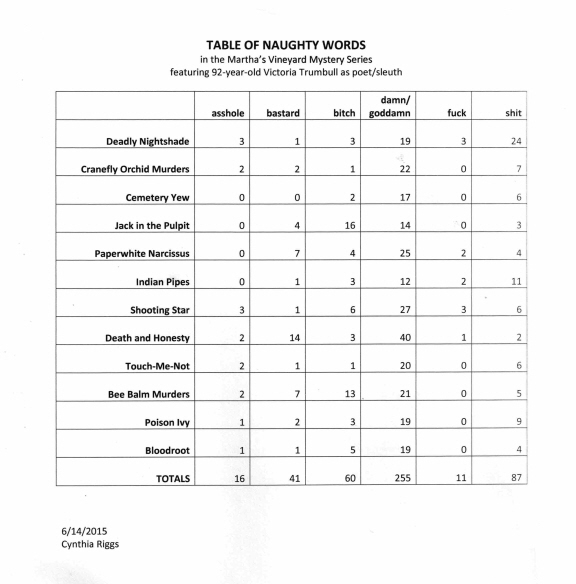

 Except for the dead bodies that keep turning up. Homicide is very rare on Martha’s Vineyard. If murders happened on the Vineyard as often as they do in Cynthia’s books, the Vineyard would be a very different place. More of us would lock our doors. Fewer of us would go for long walks in the woods alone. Every time someone was murdered, we’d be surreptitiously studying our friends and neighbors for clues: Did you do it?
 Toss a murder into the meandering stream of daily life and plot happens. I’ve blogged before about how I’m
 Write Through It