On Inspiration

Truth. Nothing is wasted, everything is compost, and exploring within is at least as important as having exotic experiences. Another good one from the Business in Rhyme blog.

Where is the inexhaustible source of inspiration for your writing?

Maja Todorovic's avatarBusiness in Rhyme

disraeli

I’m going to be quite bold in my next statement and say that it lies in you. You are your most valuable and inexhaustible well of inspiration for any story, poem, article or blog post you want to write. Sounds strange? Now, before you dismiss the rest of the article, let me elaborate a bit:

Often times, we look for external stimulants, information for guidance and ideas for our writing. But I believe that our own actual, raw and vivid experiences are our truest guides in which direction our writing should go. Every event, relationship, travel, struggle, joy, pain, suffering, reasons to be happy…are our best source of inspiration. When you share sincere bits of your personalities, these are the parts that people can relate to most.

You can write a beautiful poem about your ordinary everyday trip to a grocery store (like an ode to strawberries 🙂 ), you can…

View original post 381 more words

Every Damn Day

From the third week in March I’ve been swamped with work. April was already looking busy when I was offered a proofread about the Attica prison uprising of 1971. I’m going to turn that down? No way. So what if the text was almost 600 pages long, with another 100 pages of notes.

No matter how you look at it, editing and proofreading are time-intensive. You’ve got to put in the hours, and you can’t add more hours to the day. If you’re anything like me, you can’t devote all your waking hours to reading as closely as a copyeditor or proofreader has to read. Nowhere close. The brain gets tired. The eyes glaze over. The body needs to get up and move.

As March gave way to April, I wasn’t sure I could meet all these deadlines, some of which were firm, others of which were flexible, none of which were “whenever.” So I decided to give over my writing time to editing.

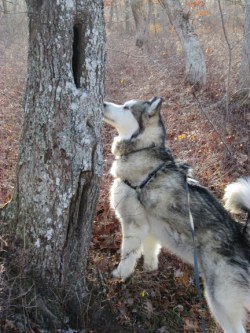
Travvy looks for a squirrel in a tree.

Travvy looks for a squirrel in a tree.

I’m a morning person. I write best in the morning, usually from 7 or 7:30 to 9 or 9:30. Then Travvy, my malamute roommate, and I go for an hour-long walk. I do a fair amount of writing-related mulling on these walks. Ideas, insights, and solutions to plot snags pop into my head the way they usually don’t when I’m sitting at the keyboard.

So Monday morning I gave over my writing time to proofreading. After Travvy and I got back from our walk, I checked email, played a little on Facebook, then got back to work. I did the same on Tuesday, and on Wednesday, and on Thursday. While out walking with Trav, I noticed that when it wasn’t just enjoying the sunshine or whining about the rain, my mind was occupied with one or another of my various editing projects. A plot snag was approaching in Wolfie, the novel in progress, but my mind was not interested in mulling about that.

By Wednesday afternoon I knew I was in trouble. The plot snag was looming larger and larger, so large and so daunting that I couldn’t even imagine the short transition scene that leads into the one where the snag had to be resolved. I couldn’t even imagine imagining that short transition scene.

In short order I regressed from I can’t figure this out to I’ll never figure this out to I’ve bitten off way more than I can chew here and who needs this stupid novel anyway?

This was drowning out the little voice in my head repeating two of my main mantras: “The way out is through” and “Your writing will teach you what you need to know.”

What I was having, in other words, was yet another crisis of faith.

By Thursday it had gotten so bad that I was sure I’d have nothing to take to writers’ group on Sunday. This reminded me that what I’d taken to writers’ group last Sunday was really good. It was also the culmination of an extended sequence that had taken several weeks to finish and worn me out in the process.

Aha, I thought. Maybe the well is just temporarily dry.

Right. It does happen, but you don’t know if the well’s been replenished unless you drop your bucket into it. For me this means picking up a pen and moving my hand across sheets of paper, but I wasn’t doing this because I was editing or proofreading during my best writing time.

So this morning I took pen in hand, fully ready to start with “I can’t write this scene because . . . ,” but instead there was my protagonist, sitting on her front step in the twilight, accompanied by her two dogs, thinking about the momentous conversation she’d just had with her estranged sister.

Writing every damn day really is the answer. My faith wobbles if I don’t.

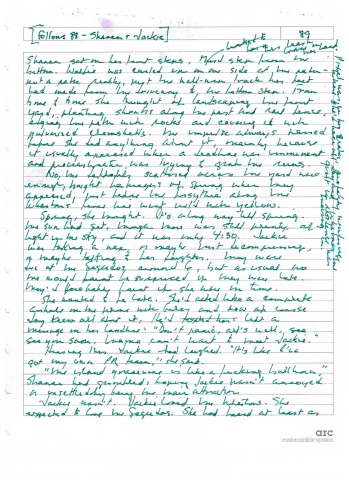
This is what came out of the pen this morning, and two and a half more just like it.

ms page 3

Pen Magic

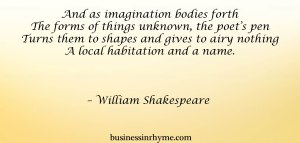
This so eloquently and elegantly describes what writing is about, and not just poetry either. Check out Businessinrhyme.com for daily nudges, prods, and general inspiration for writers.

Maja Todorovic's avatarBusiness in Rhyme

shakespeare1

Need some more poetic inspiration? Sign up for a free bimonthly newsletter.

View original post

Writing as Discovery

I’ve got a new morning ritual. After I light a candle or two — currently it’s a Yankee Candle, because fat candles in glass jars last a lot longer than tapers in candlesticks — I open The Writer’s Chapbook at random and read a couple of passages.

The Writer’s Chapbook is, says its subtitle, is “A Compendium of Fact, Opinion, Wit, and Advice from the 20th Century’s Preeminent Writers.” This is true. Organized into a couple dozen topics, the book consists of extracts from interviews conducted from The Paris Review from 1953 onward. Some extracts are aphoristic; others are full-blown anecdotes. It’s like listening in on an intense conversation among extremely accomplished and articulate writers, and because the writers in each chapter appear in alphabetical order, the likes of Anne Sexton, Georges Simenon, and James Thurber may show up on facing pages.

There are two editions out there. I borrowed the 1999 edition from the library and knew almost at once that I had to have it. Turns out it’s out of print and very hard to find: copies on BigBehemoth.com were going for $299 and up, and I dropped out of an auction on MegaMarketplace.com when the bidding sailed past $30 — that copy eventually went for $71. With a bit of persistence, I scored a used copy of the 1989 edition for less than $10, including shipping.

So this morning I opened to two pages in the “On Performance” chapter. On the verso (left-hand) page was this, from playwright Edward Albee:

Naturally, no writer who’s any good at all would sit down and put a sheet of paper in a typewriter and start typing a play unless he knew what he was writing about. But at the same time, writing has got to be an act of discovery. Finding out things about what one is writing about. To a certain extent I imagine a play is completely finished in my mind — in my case at any rate — without my knowing it, before I sit down to write. So in that sense, I suppose, writing a play is finding out what the play is.

And just opposite, on the recto (right-hand) page, novelist John Barth was saying this:

I have a pretty good sense of where the book is going to go. . . . But I have learned from experience that there are certain barriers that you cannot cross until you get to them; in a thing as long and complicated as a novel you may not even know the real shape of the obstacle until you heave in sight of it, much less how you’re going to get around it. I can see in my plans that there will be this enormous pothole to cross somewhere around the third chapter from the end; I’ll get out my little pocket calculator and estimate that the pothole will be reached about the second of July, 1986, let’s say, and then just trust to God and the muses that by the time I get there I’ll know how to get around it.

Travvy, on whom Wolfie is based but who has his own stories to tell

Travvy, on whom Wolfie is based but who has his own stories to tell

Wolfie, my novel in progress, is fast approaching its second birthday. All through the first draft and well into the second, I told anyone who asked “It’s about the rescue of a dog and the rescue of an eleven-year-old girl and how they rescue each other — oh yeah, and the dog is based on my Alaskan malamute, Travvy.”

Then one character told another the tale of how she’d failed to rescue her father, who had been devastated by the shooting death of his three-year-old grandchild. And my protagonist, who as a teenager fled a violently dysfunctional family, gets a phone call from the younger sister she couldn’t take with her. To make it more fun, no one is sure exactly what the girl needs to be rescued from, though it’s pretty clear to all that she needs rescuing.

So yes, Edward Albee: writing this novel is finding out what the novel is. And yes, John Barth, I suspected the obstacles were out there, but until I drew closer I couldn’t see what they were, never mind how I was going to get round them. If I’d thought too hard about it, I would never have started.

But I’m trusting the muses and my fountain pens, and the candle burning on the table to my right, to show me how it’s done.

Trust the pen, and the hand that holds it.

Trust the pen, and the hand that holds it.

Let Gratitude Empower Your Creativity

I’m not usually inspired by “inspirational” writing, but this post about gratitude was exactly what I needed to read before I got down to writing this morning. Instead of beating myself up about how long it takes to write a novel and how maybe it’s a stupid thing to be doing, I’m grateful for the characters who want me to tell their story and the words that come to me just when I need them.

Maja Todorovic's avatarBusiness in Rhyme

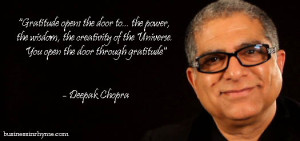
Deepak

In almost any religion and culture we have heard of the importance of being grateful: to search for positive aspects in life instead of dwelling on what is wrong and how world is a bad place to live in. Our modern and fast paced environment has so much to offer: yet we  get trapped in to trivial and petty things instead of concentrating our attention on more important experiences. Those negative feelings that arise can literally block our creative energy, potential for problem solving and seizing the opportunities.

Gratitude can help us combat fear and anxiety. That feeling of appreciation opens the door for receiving even better things to flow into your life – like creativity. Experience of positive emotions and nurturing the state of well-being helps us engage in the  activities that encourage discovery and growth. Your observation improves; your relationship with the environment improves and you tackle problems…

View original post 342 more words

The Importance of Place

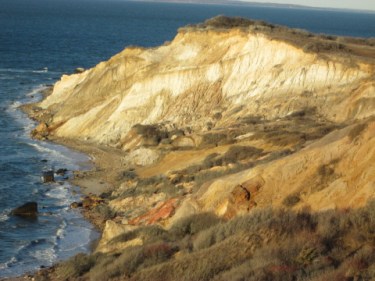
The Gay Head Cliffs, seen from the observation area.

The Gay Head Cliffs, seen from the observation area.

Two days before the late January snow fell, I drove all the way to Aquinnah to see the Gay Head Cliffs. My Alaskan malamute, Travvy, rode shotgun, his nose usually as far out the window as it could get.

In the Forester’s back seat were two of my characters, protagonist Shannon and her long-estranged sister Jackie. Shannon’s in her mid-fifties. Jackie’s three years younger. They survived their violently alcoholic family in different ways, Shannon by fleeing, Jackie by sticking it out. After almost four decades of minimal contact, it’s Thanksgiving weekend and Jackie has come for a visit.

I live on, and write about, Martha’s Vineyard, an island off the coast of Massachusetts. Martha’s Vineyard is famous, not least because the president and one of his recent predecessors vacation here. I write about the place and the people who are still here when the celebrities leave.
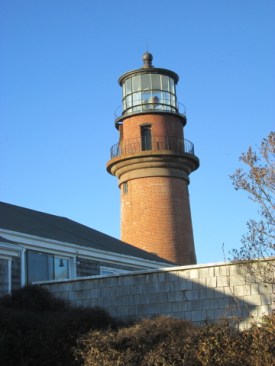
Gay Head light

The Gay Head lighthouse. In a major engineering feat last fall it was moved 129 feet back from the cliff that was eroding out from under it.

The Gay Head Cliffs are celebrities in their own right, celebrities who never leave. People who know nothing else about Martha’s Vineyard have seen them in photographs. Shannon, like me and many another year-round resident, is somewhat jaded about both celebrities and tourist attractions, but she’s showing her sister around and it’s late November: no chattering crowds, ample places to park.

At this point I realized that my mental image of the cliffs looked like a picture postcard. I hadn’t been there in years. I couldn’t remember the path down to the beach or what the beach looked like. Hence this mid-January expedition. I kept my eyes on the road, occasionally scratched Travvy’s back, and listened to Shannon and Jackie talking in the back seat.

After I parked the car — there was no shortage of available space — we walked past the silent summer shops and up to the observation area. Shannon and Jackie leaned on the post-and-rail fence. Shannon pointed out over the water. “That’s Devil’s Bridge,” she said. “Major hazard to navigation.”

Jackie shaded her eyes against the sun and squinted. “I can’t see anything,” she replied.

“Neither can the ships,” said Shannon.

Most Vineyard people know about the wreck of the City of Columbusa passenger steamship bound from Boston to Savannah. It ran aground on Devil’s Bridge, a submerged rocky shoal, in the dark early hours of January 18, 1884, and quickly sank. Despite heroic rescue efforts that morning by the Gay Headers and the crew of a passing vessel, 104 died; only 29 were rescued.

The anniversary had just passed when we drove to Aquinnah, so it was on my mind, but when Shannon said “Neither can the ships,” I froze. Rescue is a major theme in my novel in progress, starting with the rescue of Wolfie, the title character, who was inspired by (you guessed it) Travvy — rescue and the difficulty of recognizing threats before it’s too late. And there it was, arising naturally and unobtrusively from the place where my characters stood.

Every story, remembered or made-up, takes place somewhere. Where it takes place affects what takes place, deeply, profoundly, deeply, indelibly. Characters, both fictional and nonfictional, are deeply affected by where they are and where they’ve come from. Images, characters, and whole plots grow out of the soil they take root in.

Regional writing, writing deeply rooted in place, sometimes gets a bad rap. Regional writing is only about that region, so the thinking goes. It’s not universal. (If this reminds you of the equally popular notion that writing about women is only about women, and writing about people of color is only about people of color, while writing about white men is universal — it should.)

If William Blake could “see a World in a Grain of Sand,” writers can find a whole world in a particular place, and readers can learn more about their world from following a writer’s words into places they’ve never been.

For another take on where imagery comes from, check out my earlier blog post “Grow Your Images.”

Trav on path

The path to Moshup’s Beach is a lot longer and wider than I remembered. That’s my sidekick, Travvy, waiting for me to put the camera away and keep walking.

Moshup's Beach

Once I realized how rocky the beach was, it was easier to hear what Shannon and Jackie were saying as they picked their way over the rocks.

Backstory Happens

Standard advice for fiction writers usually includes “Start in the middle.” Good advice, for the most part, but how do you work in all the important stuff that’s happened before the story starts, the backstory?

Backstory often gets a bad rap. It’s associated with info dumps, superfluous prologues, and abrupt jumps back in time.

But backstory is crucial, not just the backstory for the situation but the backstory of each character. (Come to think of it, these overlap so heavily that they might almost be the same thing.) Lately I’ve become a huge fan of Sally Wainwright, the British screenwriter who’s largely responsible for such series as Last Tango in Halifax, Scott and Bailey, and Happy Valley. She’s created some of the most three-dimensional, complex, recognizable characters I’ve ever seen on small screen or large — or in novels, for that matter.

A big reason is that Wainwright’s characters have pasts. Where they’ve come from helps shape who they are, yes, but their histories also help drive the plot. Unexpected events in the present trigger memories of the past; those memories affect how they respond to the events. Their friends and co-workers see them in a different, perhaps surprising light.

Most of us have memories that we would rather keep in the closet, safe from prying eyes — including our own. When events force them into the open, we have plot.

In “Notes and More Notes” I wrote that for me “writing is a journey of discovery. If I know in advance what I’m going to discover, why make the trip? I’m just a sightseer gazing through the windows of a tour bus.”

In Wolfie, the novel in progress, much of what I’m discovering is about backstory. I already knew that protagonist Shannon fled her violently alcoholic family as a teenager. Now, in the late stages (I hope) of draft #2, I, along with Shannon, am learning what happened after she left, thanks to an unexpected phone call from Shannon’s estranged younger sister. As a result, draft #3 is going to have a plot thread that’s completely absent from the first three-quarters of draft #2.

This might drive a careful planner nuts. Planners often want to know a character’s history cold before they get down to writing. What happens when unruly backstory starts to erupt out of the carefully planned tale?  Maybe it doesn’t happen. Maybe serendipity doesn’t bother to knock where it knows it won’t be welcome.

If I were on deadline, if I had to deliver a final draft to a publisher by, say, the end of April, I probably wouldn’t hear the knocking. Or maybe I’d scream so loud at the intrusion that serendipity would cower in the shadows and hesitate to come back. This is part of why I’ve never aspired to write for a living, though I wouldn’t turn down fame, fortune, and/or more time if they came knocking.

But I’m not on deadline, and for the moment I’m grateful. I knew almost at once that this particular plot thread was meant to be in the novel. It fits. It’s been exerting a sort of gravitational pull on Shannon all her adult life, but for a long time Shannon wasn’t dealing with it so I didn’t have a clue. Other events flushed it out of hiding.

Backstory happens if you let it happen. Your characters will help you with this. They’ll say or do something that makes you wonder: Where did that come from? And in a few moments you have the kernel of an earlier incident that will become part of the character’s backstory.

These incidents may loom large in the character’s memory long after everyone else in the vicinity has forgotten them. When I was 13, I was told by another kid in my church choir that I always sang off-key. No one else ever told me that, and I didn’t even like this kid, but I was so afraid she was right that I stopped singing for almost 20 years. Most of us have had experiences like that. So have our characters. In our heads we’re often arguing with people who passed out of our lives years or even decades earlier. Listen.


In Marilyn’s Kitchen

Word came last Friday that an old friend had passed. Years ago Marilyn had left Martha’s Vineyard, where I live, to return to her native Canada. She was a phone person; I’m not. I’m an email person; she wasn’t. Communication between us was sporadic, but we did manage to touch base at least once a year.

Marilyn was a retired teacher, and if anyone ever had a richer, more adventurous retirement I can hardly imagine it. She was a master of the fiber arts, spinning and weaving. She loathed Canadian winters and would usually spend the winter months in a warmer place, often in Central or South America, or in Goa, on the west coast of India. She’d come back with fabric ideas and stories about the people she met.

Marilyn was multi-talented. Along with spinning and weaving, she wrote wonderfully, sang in the same chorus I did, and made the world’s best chocolate chip cookies. She also had a genius for bringing together people who wouldn’t have connected otherwise. I was lucky enough to be one of them. She roped me into a group of women who gathered, usually in Marilyn’s kitchen but occasionally elsewhere, to write and share our writing.

Puppy Rhodry tangled up in Marilyn's weaving, ca. February 1995. That's me standing by.

Puppy Rhodry tangled up in Marilyn’s weaving, ca. February 1995. That’s me standing by.

A fire might be burning in the fireplace. Coffee was ready on the counter, a plate of chocolate cookies on the table, and not infrequently we’d have a nip of Black Bush on the side. My half-malamute dog Rhodry sometimes came along. Once when he was a puppy I forgot to keep an eye on him while we were writing. A thump from the living room brought us all out of our seats: little Rhodry had managed to get himself tangled up in one of Marilyn’s looms. I almost panicked, but Marilyn didn’t: she methodically disentangled the puppy from the precious weaving. Nothing was damaged. Then she insisted on recreating the scene so we could get a picture.

I’m an editor by trade and a writer by avocation, but I was hooked on computers by then. I typed on a keyboard and my words appeared on a screen. In Marilyn’s kitchen we wrote in longhand, in pen or pencil on yellow pads of paper. One of us would choose a word or a key phrase, set the timer for 10 or 15 or 20 minutes, and say “Go.” And we’d write write write till the timer went off.

Then we’d read what we’d written aloud to each other. No one had to read what she’d written, but we nearly always did. And what we wrote was amazing, sometimes startling, often beautiful or wry or laugh-out-loud funny, and sometimes all of it at once.

No one was more amazed than I. I’d fallen into the common writerly trap of thinking that writing was synonymous with suffering and angst, and especially that it was inevitably solitary. In Marilyn’s kitchen I learned otherwise. I learned that if I let myself go, I could cover two pages with words in 15 minutes or less, and that there would always be images and insights and whole anecdotes that I could then build on.

While working on my first novel somewhat later, I discovered that the surefire cure for writer’s block was to take pen and paper in hand and leave the computer behind. Later still, with first novel mostly done and me sinking into the writer’s equivalent of postpartum depression, I did Julia Cameron’s Artist’s Way workbook from beginning to end. Morning pages reminded me of the power of writing in longhand, and I’ve been doing most of my first-drafting that way ever since.

But the revelation first came in Marilyn’s kitchen, and another one too: that writing doesn’t always have to be a solitary struggle. Writing together can be exhilarating, and a reminder of what richness can pour from the pens of those who don’t consider themselves writers.

Notes and More Notes

These days the how-to-write gurus like to divide writers into planners and pantsers. Planners, it’s said, outline everything in advance, then stick to the outline. Pantsers fly by the seat of their pants. They don’t know how the story is going to end until they get there. They make it up as they go along.

Either/or doesn’t work for me. Meticulous outlines make sense for some, but for me they suck the point out of writing. Writing is a journey of discovery. If I know in advance what I’m going to discover, why make the trip? I’m just a sightseer gazing through the windows of a tour bus.

Nevertheless, a story needs forward motion. To maintain forward motion, some sort of structure is required; otherwise you’ve got waves breaking on the shoreline, getting no higher than the high-water mark before they fall back, momentum spent. Last year I set a project aside because it had a surfeit of subplots, characters galore — and no forward motion whatsoever. I kept waiting for something to happen, but nothing did. What it lacked was structure.

Think of structure as the frame of a building or a road through previously untracked wilderness. Either way, your job is to build it. My first novel, The Mud of the Place, started with a character and a problem. I wrote it scene by scene. But though I never made an outline, I scribbled notes here there and everywhere. Years after I finished the final draft, I was still finding yellow pads with notes on them: notes about characters, notes about plot, notes about how I didn’t know what the hell I was doing.

I’m doing the same thing with Wolfie, the novel in progress. Ideas and insights and solutions to plot problems often come to me while I’m walking or kneading bread or falling asleep, but to really explore and develop them I have to keep my hand moving across the page. This time I’m keeping the notes in one place, and in chronological order. When I’m stuck or drifting or just need a jump start, I dip back into them. My old ideas keep giving me new ideas.

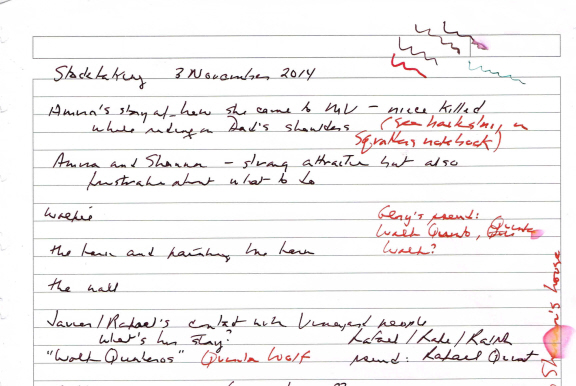
Here’s a sample of what they look like and what I use them for.

In early November I was trying to corral some emerging themes, subplots, and images. I was auditioning names for one character (Javier? Rafael? Rafe? Ralph?) and social media handles for another (for the moment she’s settled on Quinta Wolf). Note also the ink scribbles at the top and the liquid splotch (probably tea, maybe beer) at right. The red notes were added later.

20141107 notes

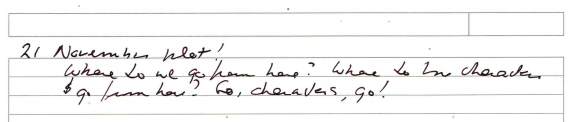
Here the author is trying to figure out what the hell happens next. She does this a lot.

20141121 notes 1

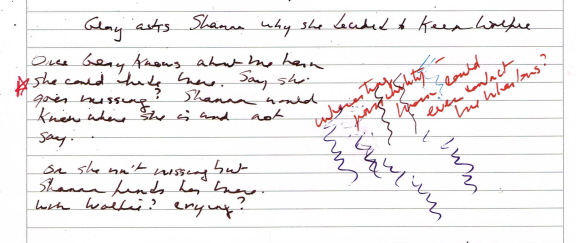
Toward the bottom of the same page, the pen offers an answer — and starts speculating about a possible plot development further down the road. I haven’t got there yet, so I don’t know how it’s going to play out. Note the scribbles. Note taking often involves scribbles.

20141121 notes 2

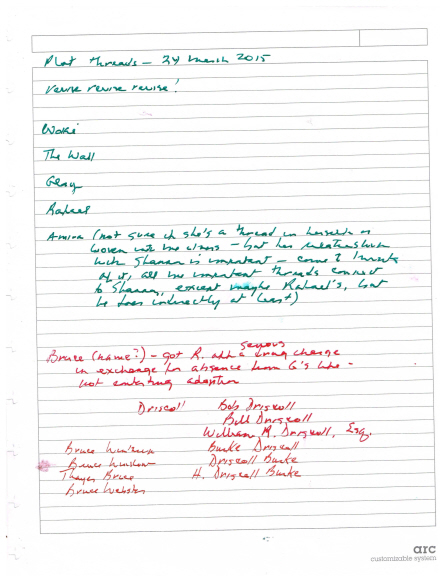
By late February, I had started draft 2, even though I hadn’t finished draft 1. My main plot threads were clear and becoming clearer. I had to build them a trellis to climb on. On March 24, I listed the characters driving each of the threads. “The Wall” is a mural that protagonist Shannon is painting on her living room wall. It has, as these supposedly inanimate objects sometimes do, taken on a life of its own. Amira wandered in from the set-aside novel, where she plays a major role. Her role in Wolfie isn’t settled yet, but it’s definitely important.

At the bottom of the page I’m brainstorming names for my villain. He started off as Bruce McManus, which didn’t feel right. “Bruce” has stuck, but “McManus” is gone. I didn’t want a name with obvious ethnic associations. I did want a name that suggested that what this guy does, though terrible, can be and often is done by ordinary, unexceptional men. His surname is now Smith.

20150324 notes

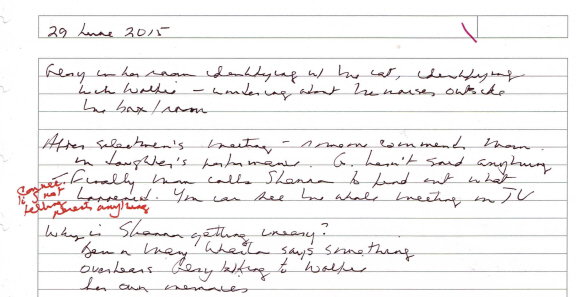
Here — not even three weeks ago! — I’m looking ahead to what follows a key scene (“selectmen’s meeting”). The scene itself is being lifted wholesale from draft 1, but when I first wrote it I hadn’t thought much about what its repercussions and aftershocks might look like. I’m also working out some character motivation: “Why is Shannon getting uneasy?” She is uneasy, and with good reason, but neither she nor I are quite sure why. The tricky thing is that it can’t be too obvious. One of the questions that’s driving this novel for me is “What do you do when you suspect something is very wrong, but you can’t be sure and the stakes are too high to allow for mistakes?” The jury’s still out on that one.

20150628 notes

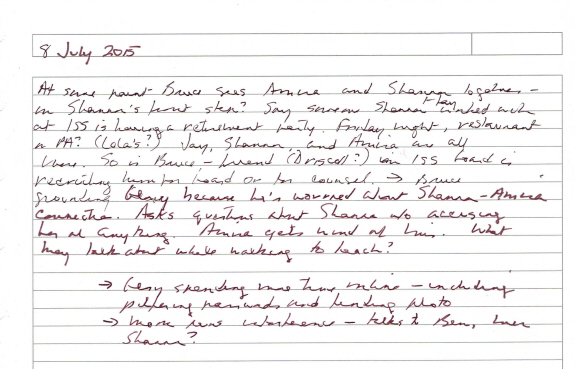
And finally, here’s the sketch for a plot break-through scene. Bruce, an outwardly rational lawyer who weighs the consequences of (almost) everything he contemplates doing, has to make a move that isn’t all that well thought out. He has to be, in other words, on the brink of panic. What would do it? Well, if he realized that Shannon, whom his 11-year-old stepdaughter, Glory, idolizes, knows Amira, who counseled Glory four years earlier when she was in trouble at school, that would do it. How to bring that about? I mulled that over on several walks, then a possibility popped into my head. On July 8, I sketched it out and decided, Yeah, that’ll work. Let’s try it.

20150708 notes

Beyond the Written Word

Words flow through my fingers and onto the paper, onto the keyboard. I take them for granted, even when they’re lumpy or reluctant or stuck. They flow out of my mouth as reliably as tap water (I’m lucky that way). Sometimes I sing them. I’m not a real singer, but I sing regularly, in a pick-up group — all comers welcome — that gets together monthly to sing and also in the Spirituals Choir. The choir is part of the U.S. Slave Song Project. We sing the folk songs sung by African slaves in America between 1619 and 1865.

For more than a decade, between the mid-1980s and the very late 1990s, I was very involved in local theater, first as a reviewer for one of the local papers, then mainly as a stage manager and actor. I even wrote several one-act plays.

Mostly these days, though, my creative life is words on paper and words on screen, writing them and editing them.

A couple of weeks ago, Roberta Kirn, the leader of the pick-up group I sing with and also a dancer, drummer, and teacher, sent round an email to all the singers, drummers, and musically inclined people on her list. An upcoming production at The Yard was looking for singers to form a sort of flash mob in the audience during the performance. Contact information was provided.

Of course I was tempted — but I’m not a real singer: was I a good enough singer to do this, whatever it was? And The Yard is a summer dance colony in the next town over. Of all the creative arts, dance is the one I have the least affinity for. Dance is a language I don’t speak. It’s spoken mostly by skinny people who can contort their bodies in impossible ways. I’m not skinny now, and for a couple of decades I was downright fat. My contortions are all mental. I do them with words.

Poster for "The Queue" at The Yard

Poster for “The Queue” at The Yard

Still, it sounded fun, and a little risky, and an excuse to get out of my head. I signed up. I had to miss the rehearsal; the director said come anyway. Our song was a three-part arrangement of the chorus of Pat Benatar’s “We Belong.” Before Friday night’s performance, we did a run-through with the cast of The Queuedeveloped and performed by the Lucky Plush dance theater company from Chicago. The company began the song onstage, then the half dozen or so of us singers joined in from our scattered seats in the audience. I managed to pick up my note, hold my part, and remember the song even with no one around me to lean on — always a worry of mine.

The big reward was getting to see The Queue twice through. It’s set in an airport. At the beginning, apart from a gay couple setting out on their honeymoon, the seven players don’t know each other. Gradually connections develop and emerge among them. The piece is theater as well as dance. I do speak theater, and I totally forgot that I don’t speak dance. In theater, how the actors use space and their own bodies can be at least as important as what they do with their voices and the words of the script. The Queue draws on slapstick, vaudeville, and the great choral production numbers of yesteryear, among other things, and since the players are trained dancers who can do astonishing things with their bodies, I forgot that dance, music, and theater are supposed to be separate arts involving separate skills.

Well, OK, I already knew that. Thanks to my theater experience, writing often feels like directing or stage-managing to me. My characters are my actors. I watch them, coach them, and sometimes become them. Singing probably makes me even more attentive to sounds, rhythm, and silences than I would be otherwise. But lately I’ve been so exclusively engaged with the written word it’s like I’ve had blinkers on. Or as if I’ve been riding on an escalator focused entirely on the straight-ahead, screening out all the distractions to left and right.

And dance. I was totally ignoring dance. It’s not just for skinny people, and it’s not just a foreign language spoken in places I’ll never visit. I was just part of a dance production, even if all I did was stand up and sing.

Writers are scavengers. We’re the ultimate recyclers and repurposers. Our minds may seem crammed to capacity, but they aren’t. There’s always room for more.