Free the Scene!

Here’s a revision tip for you. I’m currently working on the second draft of my second novel, and it just came in handy (again).

When reading your early drafts, keep an eye out for the potentially interesting scene that happens off-stage. Maybe you were in a hurry when you wrote that part. Maybe you didn’t see the possibilities. Maybe you did, but they were a little bit unsettling and you didn’t want to go there — yet.

Open the door. Let the scene out. Give it room to breathe. See what happens.

These things are little gifts from the Muses, or your subconscious, or wherever you think your writing comes from. They’re the treasures you find at the bottom of a heap at the thrift shop, or in your own closet.

Here’s one of mine. In draft #1, Shannon, one of the novel’s two viewpoint characters, gets a phone call. It goes like this:

Meanwhile, Shannon had had a call from some busybody on the conservation commission, whose members apparently cruised around looking for unsightly objects that detracted from what they called “the character of the town.” The busybody objected to the snow fencing Shannon and Ben [Shannon’s next-door neighbor] had put up to reinforce the post-and-rail fence in the back yard. Shannon explained about Wolfie [the dog she’s just rescued], and how the post-and-rail alone wouldn’t keep Wolfie in for a minute. The busybody was not impressed: the fence did not conform to the town’s fence bylaw and that was that.

This phone call had the makings of a fun scene, and I was ready for a little comic relief. What if the busybody showed up in person? What if she caught Shannon in the act of installing the fence?

snow fence 1Consulting the town’s zoning bylaws — the scene takes place in the town I live in — I discovered that the snow fencing didn’t violate any bylaws, but this wouldn’t stop some of the busybodies I’ve run into in my time. I also decided that she wasn’t actually on the conservation commission. She had appointed herself guardian of the character of a neighborhood she didn’t even live in.

This is what the phone call turned into this morning. Note that I’m still in early-draft mode. I strongly suspect that the scene will appear in the novel’s final draft, but I don’t know what it will look like. Will this woman appear again? No idea. It’s up to the Muses.

[Shannon] was halfway done when a white Honda Pilot passed on the road, heading toward the intersection with the Edgartown Road. She didn’t recognize it. Not that she knew every vehicle that lived between here and Sepiessa, but her mind half-consciously sorted them into familiar and unfamiliar and this one she’d never seen before.

Even more unusual, two minutes later it passed by again in the opposite direction. Shortly after that it rolled to a halt on the grassy shoulder opposite her driveway. Looking for directions?

The driver got out of the car, looked both ways, and crossed the road. She carried a cane but walked briskly, barely tapping it on the pavement. Her mostly gray hair was done up in a french twist and her garb said “country gentry”: heavy wool cardigan with leather elbow patches, an ample wool skirt that hung just below the knee, and sturdy walking shoes, all in autumnal browns and russets. She did not look lost. She caught Shannon’s eye briefly then rapped the top rail of the roadside fence with her cane.

Taking this as a summons, Shannon wiggled the stake she had just driven into the ground to make sure it was steady, laid mallet and zip ties on the ground, and walked up to greet the visitor.

The visitor wasted no time on introductions. “Do you have a permit for that fence?” she asked, in a clipped accent that sounded somewhat English but wasn’t.

Loaded for bear, thought Shannon, but with no bears in sight. “That fence has been there for over fifteen years,” she said pleasantly. “I don’t believe I need a permit.”

“That orange fence” — the woman pronounced the word with obvious distaste — “has not been there for fifteen years. You are just now putting it up.”

Caught red-handed, Shannon thought. “I don’t believe I need a permit for that either,” she said. “It’s temporary. I’m fostering a dog for a few days, and I don’t want him getting loose.” She resisted the temptation to tell the woman why she didn’t want Wolfie getting loose. Maybe the woman did know someone on the road. Maybe she kept chickens.

“It is unsightly,” said the woman. “It is not in keeping with the character of the neighborhood.” She rapped the railing with the head of her cane for emphasis.
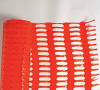
snow fence 2

In Shannon’s fourth grade Sister Mary Clement had habitually rapped her eighteen-inch ruler on the desktop while fixing the latest class miscreant with a glare that promised trouble. Shannon hadn’t thought of her in twenty years. Her visitor wasn’t a nun but she was cast from the same mold.

Shannon conceded that the blaze-orange snow fencing was not especially attractive but noted that it was only visible from the road if you slowed down to about five miles an hour and stared out the passenger-side window. She did not ask the woman if she’d ever been down this road before, and if not, how she knew so much about the character of the neighborhood. The character of this neighborhood was more disturbed by big gray dogs running loose than by blaze-orange snow fencing in someone’s back yard.

“The town bylaws are quite clear what sorts of fence are allowed,” the woman said, “and this is not one of them.”

Shannon had no idea what the town bylaws said about fences, but Ben had once served on the zoning board. If he thought snow fencing might be a problem, he wouldn’t have suggested it. Besides, it was past the middle of October. No one who came down this road at this time of year would be bothered by snow fencing. Those with more delicate sensibilities had mostly gone home. “I’ll see what I can do,” said Shannon, turning back toward her interrupted labor.

“I intend to communicate this to the conservation commission,” the woman called after her.

“You do that,” Shannon muttered, not quite audibly. She heard the staccato whack whack whack of the woman’s cane on the asphalt. The car door opened and slammed shut. A moment later the engine rumbled. Shannon zip-tied the snow fencing to the new post and set about pounding the next one into the ground.

Joan Didion’s Cure for Bankrupt Mornings

Serendipity rules: I read this while I was working on “Restarting.” These days I don’t keep a notebook, but opening the work in progress seems to fill a similar function. Whatever works!

My Characters, My Selves

The other day a writer-editor friend on Facebook posted a quote from Truman Capote: “You can’t blame a writer for what the characters say.”

An interesting discussion ensued. The first comment took issue with the word “blame.” So do I. But characters come out of a writer’s head somehow, even when they’re based on real people. I’m not my characters and my characters aren’t me, but whatever my characters do or say rises in my mind, travels down my arms, and is transmitted to paper or screen by my fingers.

“Homo sum, humani nihil a me alienum puto,” as the old guy said — I’m a human being; nothing human is alien to me.

I’m not my characters, my characters aren’t me, but I’ve imagined them. I’ve brought them to some kind of life.

Creating characters is probably the weirdest thing about writing fiction or plays. It’s totally juju. Joan of Arc’s voices don’t seem strange to me. I sometimes wonder if I might stumble off the edge and forget that my characters are characters. What if I ventured into my fictional world and couldn’t find my way back?

Can writers create believable characters if we don’t have the seeds of those characters in our heads? I suspect not. Whether we dare acknowledge and nurture those seeds into fully developed characters is a whole other question. A character in my novel in progress is a man who has sexually abused his stepdaughter and may do so again. He’s not a viewpoint character. I don’t want to get into his head, and I’m not sure I could.

Actually, now that I think of it, what I’m really afraid of is that I can get into his head. This fellow has appeared in a couple of scenes already. He acts like a trial lawyer at the family dinner table. His wife steps gingerly to avoid triggering his temper. Hmm. I recognize this. I grew up with something similar. I learned from my father how to intimidate people with words.

paperwhites

That’s me on the right, ca. 1993, in rehearsal. I was playing a rather timid nursing-home volunteer. Words came out of my mouth in an English accent that isn’t mine. I wasn’t her, but we definitely had a connection.

Characters often do things that their creators would never do, and say things that their creators don’t believe, or wouldn’t say in public if they did. Do authors really hide behind despicable characters to say the despicable things they believe but don’t dare say under their own names? I’m sure it happens, but I’m equally sure that if you want clues to what the author believes, you have to look at the whole work, not just the words or deeds of one or two characters.

Good actors can be so persuasive playing despicable characters. They have to connect with some despicable kernel in themselves to be that persuasive. When they’re really persuasive, viewers may feel an unsettling connection with that despicable character. Writers both create the characters and watch them in action. That can be pretty unsettling too.

When a really horrendous act is reported on the news, a common response is “how could anybody do something like that?” Me, I’m immediately working out a hypothetical trajectory in my head: how did this person get from birth to the point where he (it’s usually a he, but not always) could do this terrible thing? Into the cauldron of my mind go whatever sketchy details are available and everything I’ve read, heard, or experienced about, say, war, poverty, hopelessness, anger, addiction, fanaticism, denial, the way that humans tend to get swept away by what the other humans around them are doing . . .

Homo sum, humani nihil a me alienum puto. I’m a human being; nothing human is alien to me.

I’m still having a hard time with that abusive stepfather.


Some Blogs I Like

My m/other blog, my first blog, From the Seasonally Occupied Territories, is read mostly by non-bloggers. Soon after I launched this blog last winter, it started attracting followers who had blogs of their own. Before the end of its second month, Write Through It was Freshly Pressed — featured in WordPress’s ongoing “best of WordPress” feature.

Wow.

I tried to check out the blogs of every blogger who followed Write Through It and every blog that was Freshly Pressed. I was quickly overwhelmed. I cut back and cut back and cut back some more. I still subscribe to more blogs than I can keep up with. All I can say is — there’s an awful lot of good stuff out there.

Several bloggers have nominated Write Through It for various blogging awards or otherwise let me know that they like this blog. Thanks especially to creativewriter, Tempest Rose of Nonsense & Shenanigans, and Susan J. Kroupa.

Rather than nominate other bloggers for awards, I’m listing here a few blogs that I like, along with a few words about why I like them. Not only do I read them regularly, they help keep me going — which is one of the things Write Through It is about. This is nowhere close to an exhaustive list, and it won’t be my last list either. Be warned.

In no particular order:

Off the Beaten Path: Hikes, Backpacks, and Travels: Westerner54, aka Cindy, shares her hikes and travels in glorious photographs and commentary. She’s based in Montana and roams through areas where I’ve never been and probably never will go. (Maybe it’s because I live on Martha’s Vineyard, maximum elevation about 350 feet, but I’m awestruck by mountains.) She shares her knowledge of the places, the flora, and fauna, and her love of the places she visits is contagious.

Speaking of place, the blogger behind Cochin Blogger lives in Kerala, India. His photos, vignettes, and occasional book reviews offer an ongoing introduction to another place I’ll probably never get to.

In Across the Great Dividejournalist Charlie Quimby blogs (all too infrequently these days) about volunteering in a homeless shelter’s preschool. His wonderful first novel, Monument Road, was published late last year. Its vividly evoked characters shape and (more often) are shaped by the less-than-hospitable place they live in — western Colorado.

You may notice a theme emerging here. I’m drawn to blogs that pull me into places and lives I don’t live. This is also true of Charlotte Hoather’s blog. Charlotte is a young woman training to be a classical singer at the Royal Conservatoire of Scotland and aspiring to go on to opera school. She’s got a glorious voice, writes wonderfully, and takes great photos of the places she visits and performers. She recently released a recording of some favorite songs. Of course I bought and downloaded it. It’s excellent.

How to describe Nonsense & Shenanigans? Let’s see: Tempest Rose blogs about daily life, the universe, and being the bipolar (maybe) mother of a young son whose father is in prison. She’s observant, honest, witty, snarky, provocative, and fun. She’s also incredibly prolific. No way I can keep up with her, but I jump into her swift-flowing stream pretty often and always come out refreshed and inspired.

Evelyne Holingue is a French-American writer who blogs about writing, publishing, and traveling, among other things. She’s particularly attentive to the ways cultures and mores combine and collide, a topic that fascinates me too. This is a main theme of her brand-new YA novel, Chronicles from Château Moines, which I’ve just downloaded and started to read. It’s about a California middle-school student who moves to Normandy and has to make a life for himself in a new country and a language he isn’t quite fluent in. Evelyne blogs in both English and French. The French I read slowly and with dictionary at the ready, but it’s one of the attractions of this lively and wonderfully written blog.

And, finally, the Writer Site blog also focuses — surprise, surprise! — on writing, particularly memoir. Blogger Luanne reviews memoirs and is working on one of her own. She blogs about writing, publishing, and other aspects of a writer’s life — and very well too.


In Praise of Readers

If a tree falls in a forest and no one hears it, did it make a sound?

I think it did. I also suspect that when we repeat the question, we’re not just talking about trees. Trees don’t care if they make a sound. They’re going to fall, and rustle, and crack, whether we hear them or not.

For me, writing is part of a conversation. I do want people to hear the rustling and cracking of my words, and more than that: I want to hear what they have to say in response. I’ve had three one-act plays produced, and I love giving readings. Nothing beats the thrill of seeing and hearing people respond to my words.

mud-cover-smIt’s a rare audience that will sit still for a book-length work, but I’m lucky: I’ve experienced what has to be the next-best thing. Last Wednesday and the Wednesday before, I got to sit down and talk with a group of women all of whom had read my novel, The Mud of the Place, and were interested in what I was writing about, the lives of year-round residents in a seasonal resort.

Minnesota Women's Press publishes a bimonthly newsletter that's all about books, writers, and readers.

Minnesota Women’s Press publishes a bimonthly newsletter that’s all about books, writers, and readers.

These women, who came from all around the U.S. and Canada too, were participants in Books Afoot, also known as Reading on the Road, a program of the Minnesota Women’s Press. As organizer Mollie Hoben described it in an email, “The basic idea is that reading and travel make a rewarding combination. We pick a destination, learn about women writers from that place (which always involves exciting discoveries), select books to read beforehand, then travel there with interested reader-travelers for exploration and book discussion. Participants come from all over the country.”

I first learned about Books Afoot a year and a half ago, when Mollie contacted me out of the blue. Three Books Afoot groups would be coming to Martha’s Vineyard in the fall, and my novel was one of the four “required reading” books. Would I be willing to meet with any or (ideally) all of the groups?

One of the 2013 Books Afoot groups, meeting in the outdoor café at a local bookstore

One of the 2013 Books Afoot groups, meeting in the outdoor café at a local bookstore

Would I?? This was a fantasy come true, and the reality surpassed my wildest expectations. (I blogged about it here.) I’d pretty much decided that writing a second novel was a waste of time. These women changed my mind.

This year we were joined by my writer friend Shirley Mayhew, whose wonderful Looking Back: My Long Life on Martha’s Vineyard came out early this summer — too late for the travelers to have read it before they got here, but plenty of them bought a copy to take home with them. Shirley moved here as a young bride in 1947; I arrived solo in 1985. Our books and our very different but overlapping experiences became gateways for the visitors to enter a place that many people know about but few actually know.

Last month I concluded a blog post, “Who Do You Write For?,” with this description of the kind of reader I’d like to be: “one who’s brave enough to venture into unfamiliar territory as long as she trusts her guide, and one who appreciates the effort that goes into the writing.”

When a book goes out into the world, does it make a sound? If it does, will I hear it through all the cacophonous competition? Having sat down and talked with dozens of such adventurous readers, I know you’re out there. I’m writing for you.

The 2014 Books Afoot women each picked a postcard from wherever they were from and wrote a favorite book recommendation or two on the back. Here are a few of them.

The 2014 Books Afoot women each picked a postcard from wherever they were from and wrote a favorite book recommendation or two on the back. Here are a few of them.

Who Do You Write For?

I’ve been struggling with this one. “Who do you write for?” keeps getting tangled up with “who’s your audience?” They’re related, but they’re not the same. Who are you writing for before you have an audience out there? Let’s leave the out there audience aside for now. We’ll come back to it soon, I promise.

Aside: Yes, I do know that purists will insist on “Whom do you write for?” or “For whom do you write?” At the moment I’m not writing primarily for purists. Be warned.

So the other morning, while procrastinating warming up, I went over to Brevity’s Nonfiction Blog and found “When Words Stop” by Beth Taylor. Beth Taylor was writing for me, whether she knew it or not, so I had to write back:

Been there . . . For me writing is a conversation. If no one’s listening and (maybe more important) if no one’s speaking back and otherwise responding, the words dry up. Any actor can tell you that monologues are hard to pull off. One-person shows are even harder. In a one-person show, the actor is rarely talking just to her- or himself. Sometimes she’s talking to the audience, or a particular person in the audience. Other times she’s addressing a character that only she can see at first, but in doing so she makes that character visible to the audience. Writers can do that — we’re often doing it without knowing it.

When I write, I write alone -- but there's always someone there.

When I write, I write alone — but there’s always someone there.

Aha. That’s who I’m writing for: someone that only I can see but that I’m in continual conversation with when I write. That someone has evolved over the years. She wasn’t always there.

At first I wrote to keep from cracking up. I also wrote to turn myself on — remember the desert fantasies? This was back in the day when writing on paper was the only option. Most of the paper I wrote on got burned in my parents’ fireplace or, later, ripped to shreds and put out with the trash. This was a big clue that I wasn’t writing for anyone else. I destroyed most of what I wrote because I was afraid someone else would find it and think I was crazy.

The time came — and it came pretty quickly — when writing for myself wasn’t enough. I wanted people to read at least some of what I wrote. I thought it was worth reading. In college I reviewed books and the occasional concert. I wrote regular op-ed columns, mostly political commentary. Most of my published writing since then has consisted of reviews and commentary, with significant forays into poetry, journalism, theater, and, most recently, fiction.

But that doesn’t explain why I sometimes hesitate over a phrase and think: No, that’s not right or That’s going too far. Or why I make choices that I know bloody well aren’t commercial: they limit my publication options, which weren’t all that great to start with. Who do I write for?

Turns out that the choices I make are clues to the identity of this mysterious entity, the reader who makes writing worthwhile.

I’m writing for the person who’s willing to read about and even identify with characters who aren’t like them in some ways.

I’m writing for the person who’s willing to be momentarily perplexed or even pissed off but doesn’t want to be hoodwinked for no reason.

I’m writing for the person who once in a while will be struck by a turn of phrase and think, That’s exactly right. Who might even toy with possible alternatives and finally conclude, Yeah, you made the right choice.

All of which, come to think of it, describes the sort of reader I’d like to be, and try to be: one who’s brave enough to venture into unfamiliar territory as long as she trusts her guide, and one who appreciates the effort that goes into the writing.

Let's see where the road goes, huh?

Let’s see where the road goes, huh?

Grow Your Images

I loved high school English, but after all those in-depth discussions of Shakespeare, Hemingway, Austen, Fitzgerald, and the rest, I went out into the world with some wrong ideas about writing.

I thought images, symbols, and metaphors were like booby traps. Writers embedded them in their stories in order to razzle-dazzle sophisticated readers, and to trick high school students. Why was there a green light at the end of Jay Gatsby’s dock? Why, to drive us crazy, of course.

My English teacher senior year was aware of the problem. She’d ask what an author was trying to do in a particular passage and then, usually after a minute of nervous silence from the class, add, “This is not a trick question.” We didn’t believe her.

For many years, I wrote mostly nonfiction. Nonfiction, I mistakenly thought, was safe from images, symbols, and metaphors. When I started dabbling in poetry, I knew I was in trouble. Poetry is all about images, symbols, and metaphors, isn’t it?

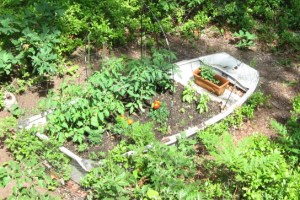
I am not a gardener, but I do have a little garden. It's in an old dinghy.

I am not a gardener, but I do have a little garden. It’s in an old dinghy.

Before long, though, I got it: Images, symbols, and metaphors grow out of the writing. They’re gifts, like sprouts in the spring garden. (Look, look! A simile!) The gardener can nourish them and help them grow, or she can decide the row is too crowded and yank some of the seedlings out. (Metaphor!)

A writer I once workshopped with relayed something she’d heard from a poet she knew: “To be a writer, you have to know one thing well.”

The thing you know well is the soil from which your images, symbols, and metaphors grow. Of course there can be more than one thing, and you can always learn more.

We humans have five senses: sight, hearing, smell, taste, and touch. Think how often we use them figuratively, as opposed to literally. A sighted person can be blind to her talents. A blind person can have vision. I was touched by his concern. That story smells funny.

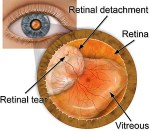
When my retina detached, I barely knew what a retina was.

When my retina detached, I barely knew what a retina was.

Almost 10 years ago, the retina in my right eye detached. In traveling back and forth to Boston, I saw firsthand the changes wrought in the wake of 9/11, which I’d managed to mostly ignore for three years because I don’t travel much and don’t have a TV. Over the following years I wrote an essay about the experience: “My Terrorist Eye.” My main images are right there in the title. They were there from the beginning.

You’ve probably heard the saying “Sometimes a cigar is just a cigar.” This is true. It’s aimed at Freudians who want to turn everything of a certain shape into a phallic symbol. At the same time, the cigar may have significance beyond the literal. If one of your characters recoils from the smell of cigar smoke — well, there may be a story behind it.

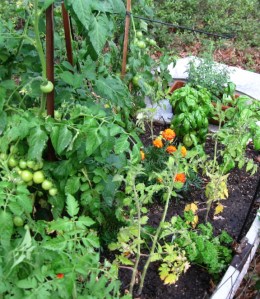
When the garden gets too crowded, it's hard to see what's going on.

When the garden gets too crowded, it’s hard to see what’s going on.

Any story or poem or essay is bound to have lots of images in it. This is fine. Gardens contain lots of plants, don’t they? All sorts of plants. At the same time, if you’ve got too many flowers growing in a limited space, your readers won’t know where to look. They may miss something that you want them to notice. Keep that in mind when you get down to revising your work.

One last thing to keep in mind: Many, many common expressions are metaphors that have long since come adrift from their literal meanings. This can get writers into trouble. Take the phrase “rein in,” as in “rein in one’s ambition.” I sometimes see “reign in” even in the work of pretty good writers. “Rein in” comes from horsemanship. If you keep horses, reins, and bridles in mind, you won’t write “reign” for “rein.” (Come to think of it, I don’t believe I’ve ever come across a reference to “unbridaled passion.” It has possibilities, doesn’t it.)

Metaphors and images can be effectively mixed and matched. They can complement each other or create dissonance. If you use them with care and know where they came from, you won’t inadvertently come up with doozies like “He’s a wolf in cheap clothing” — which also has possibilities, but seriously, you don’t want to do it by mistake, do you?

For a crash course in metaphors, see this post by Richard Nordquist, a retired English professor who is very good at explaining things.


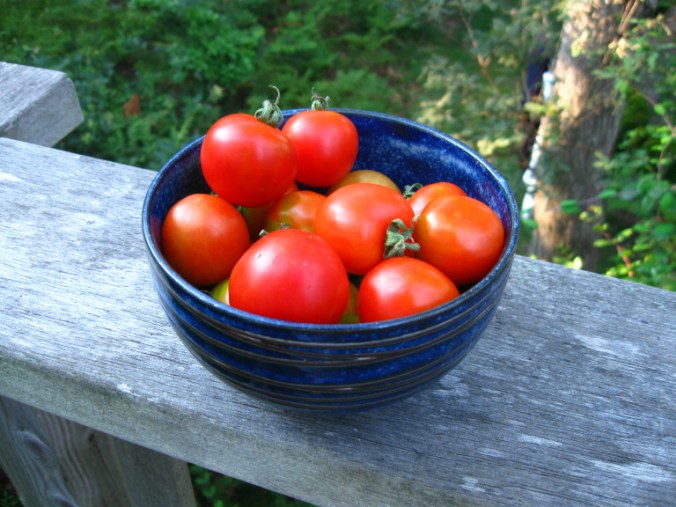
My writing may be a garden, but I'd rather eat tomatoes than words.

My writing may be a garden, but I’d rather eat tomatoes than words.

Creative Blocks

block pile

built blocks 1

built blocks 2

Another view. At upper left is a photo of the late Adrienne Rich, poet, lesbian feminist theorist, and one of my icons. At lower right is Travvy, Alaskan malamute. He is waiting patiently to take me for a walk. Photo was taken by JEB in the early 1980s.