Just found this gem by the author of The Glass Bangle, one of my favorite blogs. Eloquent, intensely visual poetry about writing, and about other things.
poetry
Stretching
The nice thing about poetry is that you’re always stretching the definitions of words. Lawyers and scientists and scholars of one sort or another try to restrict the definitions, hoping that they can prevent people from fooling each other. But that doesn’t stop people from lying.
Cezanne painted a red barn by painting it ten shades of color: purple to yellow. And he got a red barn. Similarly, a poet will describe things many different ways, circling around it, to get to the truth.
— Pete Seeger
I love this quote. Once upon a time poetry was one of my two word mediums. (Nonfiction was the other.) I loved working with traditional forms, especially sonnets, villanelles, and sestinas. They taught me to listen to the words, to say them out loud. Every word had to count, and I had to trust each word to do its job, all the while knowing that I couldn’t control exactly what it did once I let it go.
Gradually my lines got longer and longer. One multi-voice poem turned into a one-act play. From plays I slowly eased into fiction, though I’ve never ceased to think of myself as primarily a nonfiction writer.
It’s been a very long time since I tried to write a poem, but every day I draw on what writing poetry taught me: to listen to the words, to play with them, to let them play with each other.
Am I still “stretching the definitions of words”? Probably not. An essay can include many hundreds of words, a novel many thousands. Too much stretchiness causes ambiguity, which is fine in a work short enough to be read and reread several times but not so fine in a long work whose readers may accept the occasional detour but still expect forward motion.
Still, I do plenty of circling around in both fiction and nonfiction, less with the words themselves than with the images and scenes I create with them. They blend and they clash, they resonate and dissonate. (Two dictionaries think I made “dissonate” up — maybe I’m stretching words after all.) Sometimes they startle me.
Wrote Emily Dickinson, a master of the poet’s art:
Tell all the truth but tell it slant —
Success in Circuit lies
Perhaps the truth really is too blinding to be faced directly. I have no idea. I’ll let you know when I find it. For now, exquisite precision doesn’t seem to be getting me any closer, so I’m putting my faith in slant and indirection.
Sturgis’s Law #2
Earlier this month I started an occasional series devoted to Sturgis’s Laws. “Sturgis” is me. The “Laws” aren’t Rules That Must Be Obeyed. Gods forbid, we writers and editors have enough of those circling in our heads and ready to pounce at any moment. These laws are more like hypotheses based on my observations over the years. They’re mostly about writing and editing. None of them can be proven, but they do come in handy from time to time. Here’s #2:
Given enough time to fill, even the most intelligent commentator will wind up making stupid statements.
When I was growing up, we had the news at 6 and the news at 10 (or 11), and it didn’t last more than an hour. On Sunday we had talking-head shows like Meet the Press. They didn’t last more than an hour either.
With the advent of cable TV came channels that delivered news and commentary 24/7. The quantity increased, but not the quality. Blather is cheap. Investigation and analysis are hard. There’s good stuff out there for sure, but you have to wade through a flood of drivel to find it.
Print journalism, like print in general, imposes limits. The space available is finite and the words have to fit into it. In my newspaper days, ads would often come in or be cancelled at the last minute. I’d have to cut a story on the fly to make room or figure out how to fill the hole. I learned, among other things, that no matter how well-written and well-edited a story was, I could nearly always cut two or three or four column inches out of it without doing serious harm.
 The web doesn’t impose space limits. Bloggers and others writing for the web could theoretically go on forever — but we don’t. Paradoxically perhaps, when it comes to the web the standard advice is “keep it short.” We could go on forever, but most readers won’t stick with us that long. There are limits, but they aren’t spatial.
We writers like to kick against the restrictions imposed on us by circumstance and by (you’re way ahead of me) editors, but restrictions are often a good thing. Think about it.
Tasks with deadlines usually get done before tasks without.
Cutting a 3,000-word draft to fit a 1,000-word limit often sharpens the focus and tightens the prose.
Poets make every word count because they have to. Not only do poems usually have fewer words than stories and essays (even flash fiction and nonfiction), they’re also shaped by the limitations of rhyme, rhythm, and/or meter.
Early drafts can sprawl. Sprawling is good — it sure beats being blocked. But it’s revising and editing that make the piece, whether poetry or prose, by shaping and focusing — by imposing limits.
What Makes a Real Writer?
Stacey, who follows Write Through It and blogs at Diary of a Ragamuffin, posed this question: “What makes one a real ‘writer’?”
She added:
My reason for asking: After 15 years of teaching, I decided to change careers and have begun a job as a reporter for my small-town newspaper (that is owned by a not-so-small-town corporation). They knew I had no journalism experience when they hired me. After four months, I’m beginning to wonder if just anyone could do the job I do.
I’m not sure if what I do each day is what I had hoped it would be. Often there is not enough time to write reflectively, and when there is, there’s no one qualified to critique it (in my opinion).
The answer is that there’s no answer, but you know I’m not going to stop there, right?
First off, I worked eight years for a small-town newspaper, the Martha’s Vineyard Times, in a succession of overlapping capacities: proofreader, features editor, features writer, theater reviewer, copyeditor. Reporting wasn’t my forte, but I did a little of that, mostly covering stories when no “real” reporter was available.
So I’m here to assure Stacey: The job you do can’t be done by just anyone, or by just any writer either. The fact that you’re wondering probably means that you’re good at it. You’ve got the knack. You learn fast. You’re able to apply your experience in other jobs to your journalism job.
Been there, done that. I wasn’t a journalist either when I got drafted to fill in for an editorial typesetter who was going on sick leave. I was scared to death I’d screw up, but I needed the work. I could type, I could proofread, I could write, and I had several years’ editorial experience. Short version: I loved it, I was good at it, and pretty soon the paper hired me as a part-time proofreader.
The tricky thing about job description “writer” is that it covers so many different kinds of writing. Reporter. Novelist. Columnist. Essayist. Poet. Diarist. Blogger. Biographer. Academic. Copywriter. Technical writer. And so on and on. No writer does all of them. No writer I’ve ever met wants to do all of them.
I know some crackerjack journalists who won’t cop to being writers. In their minds, writers write books, or fiction, or literary criticism. What writers don’t do is write for newspapers. You see the paradox here? If real writers don’t write for newspapers, then the writing in newspapers isn’t real writing.
Of course it is. If it isn’t, what the hell is it?
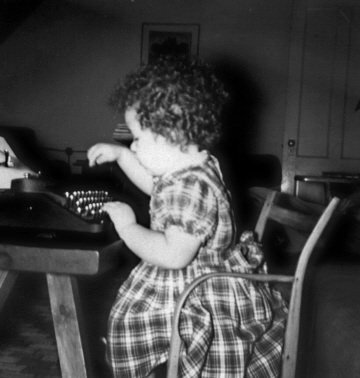
That’s me, long before I knew what an editor was.
In my teens and twenties, I assumed that a real writer had to know grammar and punctuation backwards and forwards and be a world-class speller besides. So I developed those skills. It wasn’t until I got a job as an editor in the publications office of a big nonprofit that I realized that in the real world these skills made me an editor. I hadn’t even known what an editor was. Some editorial skills belong in every writer’s toolkit, but you don’t have to be an editor to be a real writer.
Poets & Writers is a venerable organization that publishes a bimonthly magazine of the same name. Doesn’t the name imply that category “poets” isn’t included in category “writers”? It does to me. Plenty of poets either don’t call themselves writers or are semi-apologetic when they do: “I just write poetry. I’m not a real writer.”
Same deal as with journalists: If what poets write isn’t writing, what is it? And if the people who write it aren’t writers, what are they?
About her journalism job Stacey noted: “Often there is not enough time to write reflectively, and when there is, there’s no one qualified to critique it.”
This is true. Journalism means writing to deadlines, and deadlines don’t stand around waiting for the writer to get it perfect.
Deadlines don’t wait for editors either. Accuracy is more important than a perfectly crafted sentence. Spell a kid’s name wrong and her parents and grandparents will remember it forever.
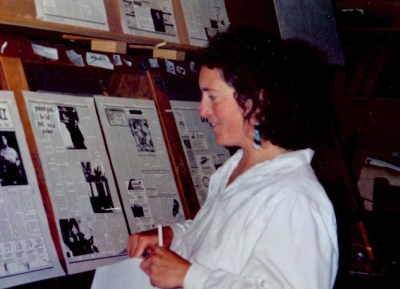
Me, checking the boards at the Martha’s Vineyard Times. You can tell it was back in the Pleistocene because the paste-up was pre-digital. October 1993.
Working for the newspaper made me a better writer and a better editor in more ways than I can count. I learned I could write and edit with phones ringing off the hook and people bringing me press releases 12 hours after deadline. I learned that endings don’t have to be perfect because the last two or three inches of a story would often be lopped off when a late ad came in. I learned that writers who can turn out prose like yard goods may write sloppy sentences but they sure come in handy when a scheduled story doesn’t show or an ad gets pulled. I learned that in the work of novice writers the lead paragraph is often buried a third of the way down. I learned that I can turn out a coherent theater review even when I haven’t a clue what the play was about. (It was Beckett’s Happy Days, in case you’re wondering.)
I learned that “good enough” often is good enough, and it’s actually pretty damn good, though for sure you could do better at a writers’ retreat. For a congenital perfectionist like me this was huge.
So what makes someone a “real writer”?
Marge Piercy nailed it in “For the Young Who Want To”:
The real writer is one
who really writes. Talent
is an invention like phlogiston
after the fact of fire.
Work is its own cure. You have to
like it better than being loved.
That’s the last verse. Read the whole thing. Read it often. You don’t have to be young.
Poets and Punctuation
A couple of posts ago I advised even non-poets to read lots of poetry. “Good poets make every word count,” I wrote.
Synchronicity rules: The wonderful Brain Pickings e-newsletter just featured a short digression by poet Mary Oliver on this very subject. She set out to “write a poem that uses no punctuation” so she could “see what I could do simply with the line break and the cadence of the line and so forth.”
The poem is “Seven White Butterflies.” The Brain Pickings story includes both the text of the poem and a video of the poet reading it. Check it out.
No Need to Shout!!
99% of all editors, writing instructors, and experienced writers will tell you: “Use emphasis sparingly.” Emphasis includes ALL CAPS, bold, underscore, and italics. And exclamation points!!!
(OK, 99% is an unverified statistic. I made it up — you know, to emphasize my point.)
This is why our gatekeeper friends will relegate a manuscript to the slush pile if the first couple of pages include too many italicized, bolded, underscored, or ALL CAPPED words and phrases. Fairly or not, they’re leaping to the conclusion that the writer who relies heavily on gimmicks is not ready for prime time.
How many is “too many”? If they’re the first thing a person notices when she pulls your ms. out of the envelope or opens the file, that’s too many. Aim for “none” and you’ll probably get it about right.
“But,” you wail, “how do I show what’s important?”
Good question!
When we speak, we can emphasize words and phrases by speaking them more loudly, or drawing them out, or exaggerating their each and every syllable. We can use our hands and our faces to express our feelings or underscore a point.
You can replicate some of these methods in writing. You can describe how a character said something and/or what she was doing while she said it. Too much description, though, can slow a passage down when you want it to move right along. Lucky for all of us, written English offers some powerful tools to call attention to whatever you want to call attention to. and without using ALL CAPS, bold, underscore, italics, and other gimmicks. Learning to use them is part of the writer’s craft.
So how does one go about this?
Here’s where I advise even non-poets to read lots of poetry. Good poets make every word count. They have to: poems use fewer words than stories, essays, and full-length books. They read their written words aloud and pay attention to how they sound. Poets who work in traditional forms, like the sonnet, use meter and rhyme to emphasize important words. Words at the ends of lines and lines at the ends of stanzas get particular emphasis. And so on.
Prose writers use sentences and paragraphs the way poets use lines and stanzas. Words at the beginning and, especially, at the end of a sentence are emphasized. Likewise sentences at the beginning or end of a paragraph, and paragraphs at the beginning or end of a scene.
Have you ever confronted a paragraph that sits on the page like a dark gray lump? One sentence follows another with no break, maybe for a whole page or more. If the eye gives in to the natural temptation to skim through to the end, the mind is almost certainly going to miss something important.
But there’s no need to bold or italicize the sentence you want to call the reader’s attention to. If that paragraph belongs to you, try breaking it so that your key sentences fall either at the end of one paragraph or the beginning of another. If you’re reading it in a book, identify a place or two where author or editor might have started a new paragraph. (You may not find any such places. It’s possible that the paragraph really needed to be that long.)
I like long loopy sentences, but I also know that long sentences tend to lose energy. So I pay close attention to the words, phrases, and clauses that make them up. When I’m editing, I’ll sometimes break a compound sentence in two in order to focus more attention on each of its parts.
Here’s where the oft-repeated advice to “omit needless words” comes in handy. “Needless words” are the ones that camouflage or otherwise distract attention from the important stuff. What’s tricky is that you have to identify the important stuff before you can decide what’s needless, and this often doesn’t happen till a second or third draft.
The best way to develop your skill at emphasizing key points without resorting to gimmicks!! is by experimenting on your own work, getting feedback from editors and other writers, and giving feedback to other writers on their in-process work. Anyone out there have an example to share with other readers of this blog? Keep it fairly short, say 100 words or so. You can use either the comments link at the top of this post or the contact form in the “You!” tab on the menu bar.
Words
Back in the days before online dictionaries — back, for that matter, before the World Wide Web was ready for prime-time — I was the features editor for a weekly newspaper. Editors and reporters worked together in the newsroom. The American Heritage Dictionary sat on top of a midsize bookshelf, within easy reach of everybody.

Some tools of the word trade. Clockwise from top: the Chicago Manual of Style, 16th ed.; Words into Type, my favorite usage and grammar guide; The Copyeditor’s Handbook (3rd ed.), by Amy Einsohn; and Merriam-Webster’s Collegiate Dictionary, 11th ed.
Most of my colleagues consulted it, at most, once or twice a day. I, on the other hand, was out of my seat and flipping through its pages so often that I finally brought my own AHD from home. When I was at my desk, it was almost always open on my lap.
My colleagues were nothing if not quick. If they wanted to know how to spell something, or whether a certain word was right for their sentence, they’d holler to me from their desks. I’d holler back. Usually I had the answer in my head. Sometimes I’d look it up to make sure I was right. Other times I’d look it up just because I was curious.
When I left that job, one reporter wrote on my farewell card: “You saved me a year’s wear and tear on my dictionary.”
Ask a writer what tools she uses and she might list her favorite dictionary, usage guide, computer, and so on. (I, of course, would include fountain pens and bottles of ink.) But really our absolutely most essential bottom-line sine qua non tool is words.
Recently I edited a very long nonfiction book whose author had done a commendable job of organizing complex material and marshalling a daunting number of references. On the word level, however, he was somewhat challenged. He regularly confused “affect” and “effect,” which are on just about everyone’s Frequently Confused Words list, but his troubles went well beyond that. An example, chosen at random and tweaked slightly to conceal the original:
These actions revealed the official’s willingness to adjust to complaints about public intoxication. They also underscored his constancy.
I’ve bolded the words that stopped me in my tracks. Uh, no, thought I. Close but not close enough. For “adjust to” I suggested “accommodate” and for “constancy” “consistency.”
A good copyeditor will catch less-than-felicitous word choices and suggest improvements, but why let the editor have all the fun? The English language is full of vivid, precise, flexible, wonderful words. While you’re writing your first million words, learn as many as you can, Play with them. Notice how words often take on different shadings depending on where you put them. Then go on to your second million and third million words.
While you’re doing it, read a gazillion words. Listen to people talk, even if you never intend to write dialogue — but especially if you do.
Read, and listen to, poetry. Listen to songs. Poets and songwriters are really, really good at making words count because poems and songs don’t have all that many words in them. Try your hand at poetry or songwriting. (No need to write a new tune: pick a traditional one.) I can just about guarantee that your prose will be the stronger for it.
 Write Through It