On Inspiration

Truth. Nothing is wasted, everything is compost, and exploring within is at least as important as having exotic experiences. Another good one from the Business in Rhyme blog.

Where is the inexhaustible source of inspiration for your writing?

Maja Todorovic's avatarBusiness in Rhyme

disraeli

I’m going to be quite bold in my next statement and say that it lies in you. You are your most valuable and inexhaustible well of inspiration for any story, poem, article or blog post you want to write. Sounds strange? Now, before you dismiss the rest of the article, let me elaborate a bit:

Often times, we look for external stimulants, information for guidance and ideas for our writing. But I believe that our own actual, raw and vivid experiences are our truest guides in which direction our writing should go. Every event, relationship, travel, struggle, joy, pain, suffering, reasons to be happy…are our best source of inspiration. When you share sincere bits of your personalities, these are the parts that people can relate to most.

You can write a beautiful poem about your ordinary everyday trip to a grocery store (like an ode to strawberries 🙂 ), you can…

View original post 381 more words

Let Gratitude Empower Your Creativity

I’m not usually inspired by “inspirational” writing, but this post about gratitude was exactly what I needed to read before I got down to writing this morning. Instead of beating myself up about how long it takes to write a novel and how maybe it’s a stupid thing to be doing, I’m grateful for the characters who want me to tell their story and the words that come to me just when I need them.

Maja Todorovic's avatarBusiness in Rhyme

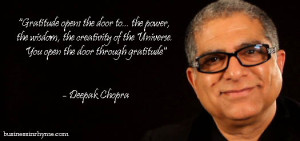
Deepak

In almost any religion and culture we have heard of the importance of being grateful: to search for positive aspects in life instead of dwelling on what is wrong and how world is a bad place to live in. Our modern and fast paced environment has so much to offer: yet we  get trapped in to trivial and petty things instead of concentrating our attention on more important experiences. Those negative feelings that arise can literally block our creative energy, potential for problem solving and seizing the opportunities.

Gratitude can help us combat fear and anxiety. That feeling of appreciation opens the door for receiving even better things to flow into your life – like creativity. Experience of positive emotions and nurturing the state of well-being helps us engage in the  activities that encourage discovery and growth. Your observation improves; your relationship with the environment improves and you tackle problems…

View original post 342 more words

Structured Revision: Keeping Your Novel on Track

I’ll almost certainly be starting draft 3 of Wolfie before I finish draft 2, so Alison McKenzie’s assurance that it really is OK to edit before you have a complete draft came at just the right time. Wrangling book-length works into shape is a challenge no matter what, but I’m intrigued by her “25K rule” and might try it with novel #3. If you’re working on a novel, novella, or book-length memoir, check it out.

Crimson

Just found this gem by the author of The Glass Bangle, one of my favorite blogs. Eloquent, intensely visual poetry about writing, and about other things.

Go Set a Watchman

Plenty of people have reviewed or written about Harper Lee’s Go Set a Watchman, but my friend and mystery writer Cynthia Riggs pinpoints what I think is the most important issue raised by the contrast between Watchman and the classic that grew from it, To Kill a Mockingbird: the importance of editing. Not just copy and line editing, but the kind of editing that sees the potential in a manuscript that isn’t “there” yet and then coaxes, browbeats, and otherwise persuades the writer to make it real.

It’s rare these days that a publisher will invest this kind of time and expertise in a book, especially a first novel. Writers have to do much of the work ourselves, with the help of workshops and writers’  groups and, if we’ve got the money and can find the right person, an editor. But it’s always possible to improve even the drafts that we’re sure are done.

Cynthia Riggs's avatarMartha's Vineyard Mysteries

To All Who Plan to Read or Have Read “Go Set a Watchman”:

Cynthia and Howie comparing copies of Cynthia and Howie compare “Go Set a Watchman” with “To Kill a Mockingbird”
photo by Lynn Christoffers

“Go Set a Watchman” was Harper Lee’s first book, and first books are usually unpublishable, as was “Watchman.”  While it has brilliant writing in patches, it has inconsistencies, improbable passages, repetitions, unnecessary divergences, too much back story, ramblings, boring passages, too much overwriting, and almost every error a new writer can make.

Tay Hohoff, an editor at Lippincott, saw promise in the work, saying the “spark of the true writer flashed in every line.”  She urged Harper Lee to scrap “Watchman” and start all over, write a new book with an entirely different story.  Hohoff saw Scout’s young voice, one of several back stories in “Watchman,” as the potential for a great book once it was rewritten, and, of course…

View original post 208 more words

Enough Notebooks

My regular writing time is from 7 to 9 a.m. I’m one of those insufferable people who’s wide awake and functional as soon as my eyes are fully open, and I don’t need coffee to do it. (I drink strong black tea with milk, no sugar, but only when I’m awake.) This morning I was a little late getting started because I’m reading an excellent book: Dorothy West’s The Wedding. I knocked off 20 minutes early because my longhand drafts and notes for Wolfie, the novel in progress, no longer fit in their notebook, and my other two notebooks are otherwise occupied.

Clearly a visit to the Staples website was in order.

Now the strict constructionists among you will not allow that the purchase of writing-related supplies constitutes “writing” for the purpose of “writing time,” and you may be right. However, being a writer, I can rationalize anything, and the pages spilling out of my notebook were messing up my head.

Dear readers, I ordered.

The Staples website is not as sensibly organized as it might be, so it took more than 20 minutes to find everything, even though I knew what I was looking for.

Some of the current pen collection

Some of the current pen collection

I do nearly all my first-drafting and most of my note-taking in longhand. On paper. Cut, Copy, and Paste don’t work on paper, but I still need to move things around, insert new pages between old ones, and (ideally) find some dimly remembered bit when it needs to be found. In my world folders do best in file cabinets, not lying around on desks and tables. I wanted notebooks. Three-ring binders might have worked, but I write with fountain pens and real ink-bottle ink and most punched or punchable paper can’t handle it.

Well, it can, but the ink often comes through to the other side, which means I can’t write on both sides of the paper. I am frugal, I am cheap. This wouldn’t do.

So a few years ago I spotted an ingenious notebook system in the Levenger catalogue. The Levenger catalogue is high-class porn for writer types, but it’s on the pricey side. Being frugal and cheap, I wasn’t willing to shell out for a system I didn’t know would work for me.

Open notebook with pocket divider

Open notebook with pocket divider. No, I could not live without Post-it notes.

Then I  encountered something very similar at Staples, the Home Depot of office supplies. The price was reasonable enough to take a chance on. I splurged. The system, which Staples calls “ARC,” quickly became indispensable.

At left you can see what the notebooks look like. The binding comprises 11 plastic rings. The rings don’t open; the paper is punched with 11 holes, each one open so it can fit over the ring. Pages can be moved, singly or in chunks, from one place to another.

A custom 11-hole punch is available, so you can punch holes in any paper you like, but the paper that comes with the system is, wonder of wonders, sturdy enough for my fountain pens to write on both sides. And sturdy enough to be moved here and there several times.

So this morning I ordered three more notebooks — one with a leather cover (like the brown one in the photo) and two with polyvinyl (like the rose one) — and more dividers, some with pockets, some without.

Blank paper,” I wrote last fall, “is faith in the future.” Enough notebooks, perhaps, is faith that what’s been written will be worth retrieving. Either way, I can’t wait for my order to get here.


Notes and More Notes

These days the how-to-write gurus like to divide writers into planners and pantsers. Planners, it’s said, outline everything in advance, then stick to the outline. Pantsers fly by the seat of their pants. They don’t know how the story is going to end until they get there. They make it up as they go along.

Either/or doesn’t work for me. Meticulous outlines make sense for some, but for me they suck the point out of writing. Writing is a journey of discovery. If I know in advance what I’m going to discover, why make the trip? I’m just a sightseer gazing through the windows of a tour bus.

Nevertheless, a story needs forward motion. To maintain forward motion, some sort of structure is required; otherwise you’ve got waves breaking on the shoreline, getting no higher than the high-water mark before they fall back, momentum spent. Last year I set a project aside because it had a surfeit of subplots, characters galore — and no forward motion whatsoever. I kept waiting for something to happen, but nothing did. What it lacked was structure.

Think of structure as the frame of a building or a road through previously untracked wilderness. Either way, your job is to build it. My first novel, The Mud of the Place, started with a character and a problem. I wrote it scene by scene. But though I never made an outline, I scribbled notes here there and everywhere. Years after I finished the final draft, I was still finding yellow pads with notes on them: notes about characters, notes about plot, notes about how I didn’t know what the hell I was doing.

I’m doing the same thing with Wolfie, the novel in progress. Ideas and insights and solutions to plot problems often come to me while I’m walking or kneading bread or falling asleep, but to really explore and develop them I have to keep my hand moving across the page. This time I’m keeping the notes in one place, and in chronological order. When I’m stuck or drifting or just need a jump start, I dip back into them. My old ideas keep giving me new ideas.

Here’s a sample of what they look like and what I use them for.

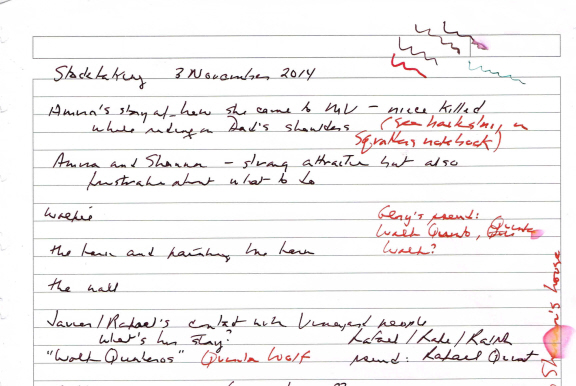
In early November I was trying to corral some emerging themes, subplots, and images. I was auditioning names for one character (Javier? Rafael? Rafe? Ralph?) and social media handles for another (for the moment she’s settled on Quinta Wolf). Note also the ink scribbles at the top and the liquid splotch (probably tea, maybe beer) at right. The red notes were added later.

20141107 notes

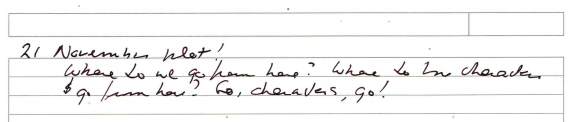
Here the author is trying to figure out what the hell happens next. She does this a lot.

20141121 notes 1

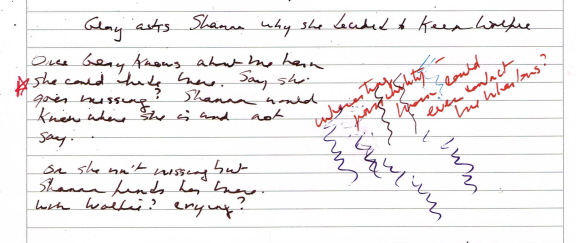
Toward the bottom of the same page, the pen offers an answer — and starts speculating about a possible plot development further down the road. I haven’t got there yet, so I don’t know how it’s going to play out. Note the scribbles. Note taking often involves scribbles.

20141121 notes 2

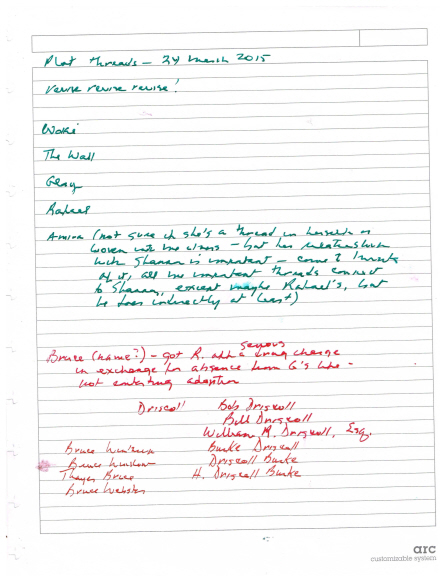
By late February, I had started draft 2, even though I hadn’t finished draft 1. My main plot threads were clear and becoming clearer. I had to build them a trellis to climb on. On March 24, I listed the characters driving each of the threads. “The Wall” is a mural that protagonist Shannon is painting on her living room wall. It has, as these supposedly inanimate objects sometimes do, taken on a life of its own. Amira wandered in from the set-aside novel, where she plays a major role. Her role in Wolfie isn’t settled yet, but it’s definitely important.

At the bottom of the page I’m brainstorming names for my villain. He started off as Bruce McManus, which didn’t feel right. “Bruce” has stuck, but “McManus” is gone. I didn’t want a name with obvious ethnic associations. I did want a name that suggested that what this guy does, though terrible, can be and often is done by ordinary, unexceptional men. His surname is now Smith.

20150324 notes

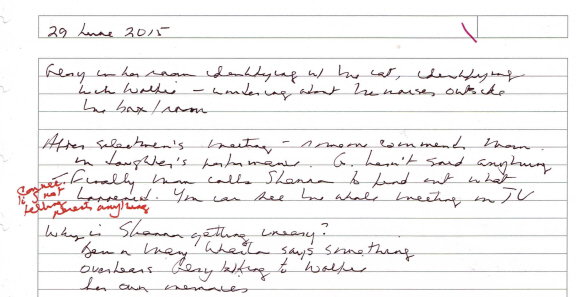
Here — not even three weeks ago! — I’m looking ahead to what follows a key scene (“selectmen’s meeting”). The scene itself is being lifted wholesale from draft 1, but when I first wrote it I hadn’t thought much about what its repercussions and aftershocks might look like. I’m also working out some character motivation: “Why is Shannon getting uneasy?” She is uneasy, and with good reason, but neither she nor I are quite sure why. The tricky thing is that it can’t be too obvious. One of the questions that’s driving this novel for me is “What do you do when you suspect something is very wrong, but you can’t be sure and the stakes are too high to allow for mistakes?” The jury’s still out on that one.

20150628 notes

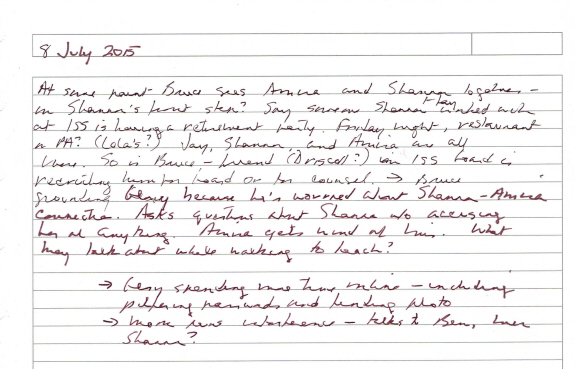
And finally, here’s the sketch for a plot break-through scene. Bruce, an outwardly rational lawyer who weighs the consequences of (almost) everything he contemplates doing, has to make a move that isn’t all that well thought out. He has to be, in other words, on the brink of panic. What would do it? Well, if he realized that Shannon, whom his 11-year-old stepdaughter, Glory, idolizes, knows Amira, who counseled Glory four years earlier when she was in trouble at school, that would do it. How to bring that about? I mulled that over on several walks, then a possibility popped into my head. On July 8, I sketched it out and decided, Yeah, that’ll work. Let’s try it.

20150708 notes

Letting Go, Take 2


An editor colleague just asked what to do about a client who’s written a very good novel but wants to keep revising and revising and won’t start querying agents or publishers.

There’s not much you can do, I said.

Aside: “Letting Go,” take 1, was prompted by a similar query. It took off in a somewhat different direction. I suspect that writers and editors never stop dealing with this stuff.

The word “perfectionism” came up.

As a recovering perfectionist — often a recovering-by-the-skin-of-my-teeth perfectionist who wonders if she’s recovering at all — I know a few things about this. Perfectionism can mean that everything you do has to be perfect before you’ll let it out of your sight, but it can and often does mean more than that. Perfectionism is a way of maintaining control. If I do everything right, I won’t get fired, my lover won’t leave, my kids will turn out perfect, and my novel will get made into a top-grossing movie and the world will swoon at my feet.

It often doesn’t work out that way. Deep down we perfectionists suspect this. Deep down we know that once something leaves our hands, the outcome is out of our control. So we don’t let it go.

Which is what I suspect is going on with the novelist who can’t stop revising, mainly because I’ve known many writers over the years who can’t let go of their work. They tell themselves the work isn’t done — they need to do more research, or do one more draft — and nothing anyone tells them can persuade them otherwise. The problem isn’t that the work isn’t done, it’s that the word “done” isn’t in the writer’s vocabulary because “done” means s/he has to let go.

For writers, here is where it gets tricky. Letting go means you’re putting the outcome in the hands of person(s) unknown. Persons who don’t know you and don’t have any particular reason to wish you well — unless, of course, you’ve produced the sort of work that might make lots of money. The overwhelming majority of us have not done this. Competent agents agree to represent only a small fraction of the manuscripts they see. Many of the ones they reject are very good or better.

In other words, if “failure” to you means rejection by an agent, or by a dozen or a hundred agents, your fear of failure is completely justified.

So is your fear of success. Fear of success is the flip side of fear of failure. They both have deep roots in the fear of letting go. Say you do get an agent, the agent sells your book, and there’s actually a book on the market that has your name on the cover. To you it’s a huge deal, as it should be, but most of the world — including your friends, relatives, and casual acquaintances — is going to say, at best, “That’s nice,” and move on.

Am I telling you to give up? Of course not. Read on.

Here’s a little parable: A kid finds a new butterfly struggling to get out of its chrysalis. The kid pulls the chrysalis apart and helps the butterfly get out. But the butterfly’s wings aren’t fully developed. It cannot fly. Moral of story: It’s the struggle to get out of the chrysalis that strengthens the butterfly’s wings so it can fly.

I like this little parable even though some people turn it into a rationale for never helping anybody out. I like it because it applies so well to writing and other creative endeavors. In the struggle to create, we not only become good writers, we also figure out what we want to do with our writing. We create a path forward for ourselves and develop the courage to follow it.

For many of us, this involves seeking out and sharing experiences with other writers. We become better writers, yes, but we also develop two crucial skills: the ability to dissociate ourselves from our creations, and the ability to sort through other people’s comments, edits, and critiques and decide what works for us. In the process, we learn about the many options for getting our work out into the world.

To complete a book-length work without doing this — well, it’s like finding that the road you’ve been on for years ends in a precipitous drop. Or maybe like opening the door from your dark room and being blinded by the light outside.

The very first line of this blog, back in “The Basics,” was “Your writing will teach you what you need to know.”

I believe it.

In that same post, I quoted two of the truest things I’ve ever heard about writing. I believe them too. Here they are again.

”I think writing really helps you heal yourself. I think if you write long enough, you will be a healthy person. That is, if you write what you need to write, as opposed to what will make money, or what will make fame.”
Alice Walker

The real writer is one
who really writes. Talent
is an invention like phlogiston
after the fact of fire.
Marge Piercy

Sturgis’s Law #1

I’m taking a hint from one of my favorite bloggers, Evelyne Holingue. She’s a native French speaker who now lives in the U.S. During the month of April she went through the alphabet A to Z. For each letter, she chose a French idiom then gave its literal meaning, its idiomatic meaning, and its nearest English equivalent. It was great fun — playing with language always is! — and (dare I say it) educational.

I loved the idea of doing some kind of series. Not about idioms but about — what?

Over the years I’ve been compiling observations about writing and editing. I call them Sturgis’s Laws. Not “rules.” No way. We’ve got enough rules already. There are 17 so far, plus one unnumbered law that isn’t really a law at all — I’ll save that one for last.

So here begins an occasional series with, of course, Sturgis’s Law #1:

If you stare at any sentence long enough, it will look wrong.

Sturgis’s Law #1 has an obvious corollary. Call it Law #1a:

If you stare at any word long enough, it will look wrong.

In the editors’ forums I frequent, editors often post sentences we’re having problems with. Is this construction OK? we ask. Would you use this word in American English (AmE) or is it mostly British? Is a comma enough here, or should it be a dash? What the hell does this sentence mean?

And so on. Usually the question is answered pretty quickly, but the editorial tribe rarely stops there. We rip the sentence apart, rearrange the words, change the punctuation, and come up with clever ways of misreading a phrase that was perfectly clear at first glance.

20130227 birthday bone

If only more sentences were this tasty . . .

We’re a pack of vultures or a dog with a bone — take your pick. I’m partial to the dog-and-bone metaphor myself.

The editor who posted the query, if s/he is wise, has long since moved on, leaving the rest of us to our gnawing.

There’s much to be learned from these gnaw-fests, but at some point Sturgis’s Law #1 comes into play. If you stare at any sentence long enough, it will look wrong — and the longer you stare at it, the more things you’ll find to fiddle with.

Hesitate too long at one sentence or one word and you’ll never finish the job.

How many sentences in the typical short story, academic paper, or full-length book? How many words? How long does the typical reader linger over a typical sentence, a typical word?

Moral of story: Don’t linger too long over this sentence or that word. As the poet said, “the Moving Finger writes; and, having writ / Moves on.”

It’s good advice.

typo

Joan Didion’s Cure for Bankrupt Mornings

Serendipity rules: I read this while I was working on “Restarting.” These days I don’t keep a notebook, but opening the work in progress seems to fill a similar function. Whatever works!