Do You NEED an Editor?

So there’s this meme circulating among some editors I know. The gist is that all writers need an editor.

Sure, every writer, and every piece of writing that aspires to be read, could use or would benefit from an editor — from a good editor, or from good editing — but need?

A brochure I created many years ago, before I realized that in my area it was one thing to need editing and quite another to be willing to pay for it.

A brochure I created many years ago, before I realized that in my area it was one thing to need editing and quite another to be willing to pay for it.

That depends. Those who insist that every writer needs an editor are mostly editors. They get paid for editing. They need paying customers at least as much as writers need editors.

All needs are not created equal.

When a water pipe breaks and water starts spraying all over the basement, you need a plumber. If the toilet bowl overflows and a plunger doesn’t fix it, you need a plumber. When a faucet starts leaking into the sink and your do-it-yourself tricks haven’t worked, you need a plumber, especially if you pay for your water. The need isn’t as pressing as when the water in your basement is two inches deep and rising, but it’s there.

You will pay the plumber to come fix your plumbing. You will probably pay extra to have him/her come ASAP, especially if it’s a weekend or a holiday (as it always seems to be when pipes break and toilets overflow). Unless money is flowing into your bank account like the water flowing into your basement, you will probably put off other, less pressing expenses in order to pay the plumber.

Last fall my dentist told me that I needed a tooth crowned. Crowns are expensive — $1,500 was the estimate. Dentistry isn’t covered by my insurance. (Don’t get me started.) It didn’t need to be done tomorrow, said my dentist, but it should be done soon. Then my car needed new rear shocks, to the tune of almost $700. The car got repaired; the dentistry got put off.

My teeth were working fine; my car wasn’t. “Soon” was not “right now.” I ranked my needs, budgeted accordingly, and carried on.

So we come round to editing. Editors are not plumbers, or car mechanics, or dentists. Your basement won’t flood, your car won’t break down, and your teeth won’t fall out if you don’t hire an editor, or if the one you do hire turns out to be inadequate.

Good editing does pay for itself, but rarely in hard currency. Nevertheless, it has to be paid for in real money. Even if you get your book, essay, or story published, the financial returns probably won’t cover what you shelled out.

But that goes double for what you put into your writing, right? More than double: we’re talking exponential here. Add up what you’ve spent on classes, workshops, and how-to books. Don’t forget the time you’ve spent writing your “million words” — the ones conventional wisdom says you have to write to develop your craft. If you were looking primarily for a tangible return on your investment, you probably would have gone into plumbing, or dentistry, or car mechanics, right?

However, if you’re a relative novice whose overriding goal is to get into print as soon as possible, you do need an editor, an excellent editor who can do all the things that good writers learn to do for ourselves. (See “Editing? What’s Editing?” for a brief breakdown of what’s involved in “editing.”) One-on-one editing is time-intensive, so expect to pay well for it.

My strong hunch is that if you’re following this blog, you’re more the do-it-yourself sort. Like me.

My two drums

My two drums

My other strong hunch is that, like me, you sometimes pay for things you don’t need. I’ve spent plenty of money competing with my dog in Rally Obedience — nothing necessary about it, but it was challenging and fun and worth the expense (until I needed a new work chair and my car needed new tires).

I joined a drumming class, loved it, and, after borrowing a drum for several months, have managed to acquire not one but two congas. These things don’t pay me back in money, but they do pay me back.

If you’re serious about your writing, and especially if you self-publish, the time will probably come when the value of good editing will be worth the money you spend on it. Worth it to you.

Meanwhile, there’s plenty you can do to develop your skill as a writer and improve whatever you’re currently working on. Some of these things don’t cost at all, and they all cost a lot less than editing. Join a writers’ group or workshop. Attend a writers’ conference. Find a couple of fellow writers to share work with. Read critically; pay close attention to how the writers you respect do what they do. (Keep in mind that they’ve probably had editorial assistance along the way.) And by all means keep writing.
 

Flashbacks Happen

A flashback is a trip back in time. The story leaves the main narrative line to tell a tale that happened before the narrative began. Flashbacks come in handy in both fiction and nonfiction, but they can be confusing to the reader. An excess of them may mean that the author couldn’t figure out more graceful ways to incorporate bits of backstory into the narrative.

This is an area where editors and guinea pigs (also known as second readers) can be helpful, but I digress: This post isn’t about flashbacks in a finished work. This is about the kind of flashback that happens when you’re in the throes of first-drafting.

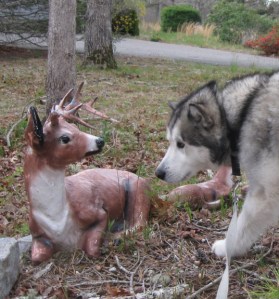
The fictional Wolfie is based on the very real Travvy. He wooed at the deer, but the deer wouldn't move.

The fictional Wolfie is based on the very real Travvy. He wooed at the deer, but the deer wouldn’t move.

The other day I was cruising along in Wolfie, the novel in progress, when my mind started to wander. The scene up ahead looked boring. I didn’t want to write it. In it my protagonist, Shannon, and her sixth-grade protégée, Glory, run a temperament test on Wolfie, the Alaskan malamute they’ve rescued from getting shot. One option was to describe the test step by step. I yawned just thinking about it. I’m writing a novel, not a dog-training manual.

Much as I love to write scenes in order, I’ve learned that it’s OK to skip over or skirt the scenes that just aren’t happening. So I sent Glory home to look after her little brother, Matt, while their parents are otherwise occupied.

So the next morning my trusty Pelikan was laying down line after line of brown ink on the page. It wasn’t terribly interesting — sibling interactions that probably won’t survive the first draft — but I had this idea that Glory might try to temperament-test her brother and that sounded like fun. They were out in the driveway. Glory had set up some plastic cones. Matt was pedaling his racing car  around them. Then Matt decides he wants to play on the swing set. He leaves his pedal car in the middle of the driveway. Glory reminds him — with more than a dash of big-sister exasperation — that it has to be put away. Matt scowls —

— and Glory is thrown back a couple of hours, to Shannon’s living room, where she and Shannon are temperament-testing Wolfie.

Oh my. The brown ink flowing out of my Pelikan created A Scene. It did everything I want a scene to do: show my characters in (inter)action, move the plot forward, and turn the heat up — raise the stakes, if you will, for the characters, for future readers, and of course for me. It didn’t sound a bit like a dog-training manual.

I write my first drafts in longhand because my handwriting is barely legible and my zealous Internal Editor can’t fuss at what she can’t read. My writers’ group meets every Sunday night, and since my fellow writers can’t read my handwriting either, I’m typing this first draft into Word as I go along. I edit lightly while I type, but I don’t second-guess myself about the big stuff; I do make notes about things to consider when I launch into serious rewrite. This typescript isn’t really a second draft. I think of it as version 1.5.

In Wolfie 1.5, however, that serendipitous scene will appear in Shannon’s living room, not in Glory’s driveway. Wolfie will be there. Little brother won’t.

Why didn’t that scene show up in its chronological order? Damned if I know. Writing is full of mysteries, and like the songwriter Iris DeMent, I’m content to “let the mystery be.” (Great song, by the way. Take a break and Google it.) Some scenes don’t show up in order. They show up when they’re ready. All you have to do is keep your hand moving across the page, or your fingers on the keyboard.


Monologue

Writing stalls for myriad reasons. Sometimes the glass is empty, and when you peer down into the well there’s nothing there either. Maybe the secret of avoiding writer’s block is to catch yourself in a stall before it gets worse?

Last week I stalled. The well wasn’t dry — the words were flowing, but they were breaking around the scene I wanted to write. The scene I wanted to write sat on a little island in the middle of a stream. I kept floating on by, over and over. It was opaque. I couldn’t see inside. The outside told me nothing.

In the scene, an 11-year-old girl bikes home after helping a neighbor save a loose dog from being shot. Her long hair is flying, the helmet she’s supposed to be wearing is swinging from her handlebars. I’m getting to know this kid pretty well. She calls herself Glory. Her mother calls her Gloria. Already I don’t like her mother.

But the scene froze as soon as she turned in to her driveway. I could see her house. I couldn’t see inside it.

Time to do some research. Sometimes, in fiction as well as nonfiction, this means looking things up, or going somewhere in person, or interviewing someone who’s got the information you need. In this case the information was in my imagination. Freewriting is my most reliable tool for tapping into my imagination.

Too reliable. That‘s why I was stalling. I’ve glimpsed enough of where my story is going to not want to know what’s going on in that house.

Time to start getting acquainted with Glory’s mother.

I sat down in my chair with lined paper, an old-fashioned notebook, and a fountain pen loaded with the Tropical Blue ink I hadn’t used for a while.

I met Bruce at a fundraiser for a conservation group — they were raising money for rainforests in Brazil or mustangs in the Wild West, I can’t remember. I’m not into all that — life is overwhelming enough in the here and now, don’t you think?

Pen, blotter, and the first page of Glory's mother's monologue

Pen, blotter, and the first page of Glory’s mother’s monologue

Hot damn. I hadn’t even known her husband’s name. Then Glory’s mother confirmed what I’d begun to suspect: that this Bruce fellow is her second husband, and not Glory’s biological father. Glory looks so unlike her parents that her best friend asked if she was adopted. I’d been wondering the same thing.

Javier and I were talking about separating, so it’s OK that I went out for a nightcap with Bruce afterward, don’t you think?

Glory’s mother kept talking. We were at a party — or maybe I was her new therapist? She didn’t tell me her name. I didn’t ask, because I thought I was supposed to know it already. Bruce may not be Bruce either, or or Javier, Javier. That doesn’t matter. Some characters come with names firmly attached — Glory did, that’s for sure — but other names take time to settle in.

What matters is that now I knew enough about Glory’s family to see inside the house. The film started rolling again. Glory walked her bike into the garage and leaned it against the wall, noting that her mom’s car was there but her dad’s car wasn’t. She wasn’t surprised: her dad works off-island (my novel is set where I live, on Martha’s Vineyard) and often isn’t home during the week.

None of Glory’s mother’s monologue is likely to end up in the novel. If I were counting words, would these six handwritten pages count toward my quota? No idea. What counts is that I had to write them before I could write Glory’s next scene.


By the Numbers?

I can tell you I wrote well yesterday morning, that my characters pushed the scene forward with little help from me.

I can tell you that the switch I blogged about a couple of weeks ago in “Course Correction” — setting aside the novel I was working on in favor of one on the back burner — is working out really well.

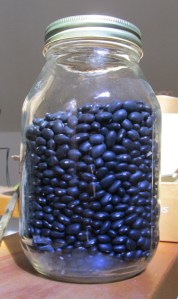
Beans

Beans

I can tell you that when I knocked off at 8:50 p.m. I was drifty to the point of disoriented. This is a sure-fire good sign: when I’m absorbed in what I’m writing, it takes a few minutes to come back to earth.

What I can’t tell you is how many words I wrote. This is partly because I was writing in longhand. Reading my scrawly handwriting is hard enough; no way am I going to count the words.

Actually I may have that backwards: I write in longhand so the internal editor can’t second-guess what I’m writing, and so the internal bean-counter can’t count the words. The internal bean-counter wishes I’d stick to Word, which oh-so-helpfully counts the words as I type them. Then the internal bean-counter could rest assured that I was really writing.

When someone crows that she wrote 893 words this morning, or 1,125, or 1,499, my internal bean-counter gets worried. Maybe I haven’t done enough? Maybe I’m not doing it right?

Dear Internal Bean-Counter:

Take a break. Seriously. It doesn’t matter how many words I wrote this morning, or yesterday morning, or in the middle of tomorrow night. If I wrote 893 words yesterday, I may jettison 878 of them today. So how many words did I really write yesterday?

Yours truly,

The Writer

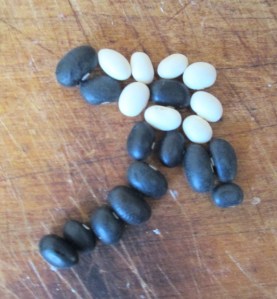
Spilled beans

Spilled beans

Our society loves to quantify. It loves to count and then compare the numbers. I get it: numbers are precise and, well, quantifiable. Real life is messy and hard to pin down. Numbers can be useful. Right now WordPress is telling me I’ve got 313 words on the screen — 320, 321, 322 . . . This is good to know. When the word-counter hits 800, I know it’s time to wrap it up. (Don’t worry: we’re not going there today.)

But numbers are deceptive. They don’t tell us as much as we like to think they do. Polls don’t tell us what people think. The number on the scale doesn’t tell you how you feel. Your word count for yesterday doesn’t mention the breakthrough you had in that floundering scene, or how many words it took to get there.

Creative beans

Creative beans

Don’t worry about the numbers. Get your hand moving across the page, or your fingers moving on the keyboard. See what happens. Your writing will teach you what you need to know. Numbers are dumb in comparison.

(Word count: 443.)


Course Correction

Earlier this week I officially set aside novel #2, working title The Squatters’ Speakeasy, to work on novel #3, which doesn’t really have a working title yet. I’ve been calling it “Wolfie” for reasons that will shortly become apparent.

Travvy inspired Wolfie, but Wolfie gets into a lot more trouble.

Trav inspired Wolfie, but Wolfie gets into a lot more trouble.

Over a year ago, Shannon — a protagonist in my Mud of the Place (aka novel #1) and also a major player in Squatters — spotted a dog running through the woods. She followed it, first in her car, then on foot. She caught it as it tried to wriggle through a fence to get to the sheep on the other side, just in time to save it from the owner of the sheep, who was headed in their direction with a rifle in his hand.

I liked the story, not least because the dog, called Wolfie because that’s what he looked like, was clearly based on my Travvy. But despite my best efforts I couldn’t graft it onto Squatters’ Speakeasy. I made a new folder for it, promised to come back, and returned to Squatters.

Squatters was alive, no doubt about that. It sprawled and kept sprawling, tossing up possibilities like — well, like a dog that offers one behavior after another because it doesn’t know what its person wants. I didn’t know what I wanted either.

In early February, I took a break from Squatters to work on an essay about a controversial statue. (See “Get Me Rewrite” for details.) I also started this blog. When I got up in the morning, I couldn’t wait to sit down in my chair and start writing. I finished the essay. I kept going with the blog. Whenever I thought about waking Squatters from its winter snooze, I was overcome by an irresistible urge to play endless games of Spider solitaire.

I’ve been here before. You probably have too. Is this procrastination, pure and simple? I wondered. What’s really going on here?

As I set out on the path that led to The Mud of the Place, looming up ahead was the 40-Page Barrier. It was high. It was wide. It was solid. I’d written essays, reviews, poems, stories, and one-act plays, some of them pretty good and many of them published, but at 40 pages I choked. I was the cartoon character that runs off a cliff and keeps running — till she looks down, realizes the ground has disappeared, and plummets.

Build it scene by scene, I was advised. Brilliant! Scenes were shorter, often lots shorter, than the essays and such that I’d managed to finish. I could write scenes. Scene by scene I left the 40-Page Barrier in the distance. 100 pages, 200 . . .

As I closed in on 300 pages, a supporting character said something I hadn’t suspected. It changed everything. Prospects had been looking grim for Jay, one of my protagonists. With one character’s revelation they improved immensely. OK, I thought. I’ll finish this first draft, I’ll beat the 40-Page Barrier once and for all, then I’ll go back and rewrite.

But I couldn’t. After happily running on air for nearly 300 pages, I looked down and saw how far down the ground was. I didn’t plummet, but I couldn’t keep going either.

I went back and started rewriting. Thanks to my outspoken character, I noticed things and sensed possibilities I’d missed before. The first 300 pages went much faster this time. I charged forward. I completed a draft that needed plenty of work, sure, but it was still pretty good.

Nevertheless, the standard advice of more experienced writers is Keep going, no matter what! With Procrastination fighting for control of my time, I tried to follow it. But Procrastination was gaining the upper hand.

Then a Facebook friend linked to an article that said procrastination wasn’t all bad. An email from a novelist whose list I’d just joined assured me that writing could and should be fun. And a member of my writers’ group mentioned a paper he’d co-authored about working with survivors of incest and other abuse. I had no idea he’d done this. He had no idea this was a emerging theme in the “Wolfie” manuscript.

These had to be omens. Reassured, I’m running with “Wolfie.” But I’m still nervous. The end is a long way off, and the ground is a long way down. Wish me luck.


Like Driving

As a kid I’d ride in the passenger’s seat and watch my mother’s hands on the steering wheel. They were always moving. How did she know when to move her hands? Driving, I thought, must be very difficult.

After I’d been behind the wheel myself a few times, I began to get it: You don’t move your hands on the wheel. The wheel moves your hands. Your hands respond to the road, the car, and what your eyes and other senses tell them.

True, your hands turn the wheel when you want to go left or right, but if you hold your hands still when you’re going down the road, you’ll probably start drifting to one side or the other.

In the last two months I’ve copyedited two demanding nonfiction manuscripts. One was 900 pages long, the other about 550. Yesterday morning I sent the second of the two off to its publisher.

I probably made thousands of editorial decisions for each of those books. Many were easy: insert a comma, remove a comma, correct the spelling of a misspelled word. If you stopped me in the middle of such insertions and deletions, I could explain without hesitation what I was doing and why I was doing it.

With many others, the explanation would take a moment or two. Here I changed “in a small number of instances” to “in a few instances.” Why? Because “instances” was more important than “number,” and we had no idea what that “small number” was. There I deleted “kind of” from “This kind of semi-prosperity.” My author was overly fond of “a number of,” “this kind of,” and “a sort of.” Sometimes they served a purpose. Sometimes they didn’t.

As I work, I make such decisions so quickly it feels as though the manuscript is telling me what to do. I just know. But an awful lot of experience goes into that knowing. That’s why, in retrospect, I can usually explain what I’ve done.

stetIt’s also why sometimes I’ll slam on the brakes a page or two after I’ve made one of those apparently instinctive changes, then go back and stet the author’s version. (“Stet” means “let it stand.” If a writer doesn’t agree with an editor’s change, she can stet the original.) While I’m editing along, evidently I’m also evaluating my editing. How do I do it? Damned if I know.

When I learned to drive, I was conscious of all the steps that went into making a smooth stop just a foot or two behind the car in front. Until I learned to judge distances, and to trust my judgment, I’d leave several feet between my bumper and the other car’s. It also took a while to learn to coordinate clutch and accelerator, especially on inclines. (I learned on a standard and that’s what I still drive.)

On the back roads, trees, curves, and bumps enforce the speed limit.

On the back roads, trees, curves, and bumps enforce the speed limit.

Of course I also learned the rules of the road, not just the written-down ones likely to be on the test but also the informal ones, like it’s usually safe to go five or so miles an hour over the speed limit and if an oncoming car flashes its headlights at you there’s a speed trap up ahead. If the vehicle ahead of you is poking along at ten mph under the speed limit, it may be looking for a crossroad, so be prepared for a sudden and unsignaled turn.

Editing works the same way. So does writing. So does every other skill I can think of. You learn the rules and conventions, they become second nature, then you start to improvise. If you leave the paved road, you don’t have to obey the traffic laws, but you better know know what your vehicle can handle and how to read the terrain. Otherwise you might wind up in a ditch, or worse.

Walking

The deadline-frazzled writer is often depicted staring at a blank screen or a blank sheet of paper. From the look in the writer’s eyes and the beads of sweat on the writer’s face, you know he or she is on the verge of panic.

Common advice to blocked or procrastinating writers: Chain yourself to your desk until it’s done.

Ummm — maybe. Writing every day is a really good idea. Chaining yourself to your desk — maybe not.  Staring too long at the computer screen can cause brain freeze. When my brain freezes, so do the characters in my story. So do the thoughts I’m trying to spin into an essay.

How to unfreeze the brain? What works best for me is physical activity. Something that doesn’t involve sitting in a chair. Something that doesn’t involve a computer.

Travvy, my #1 walking buddy, and I take a break on the trail.

Travvy, my #1 walking buddy, and I take a break on the trail.

Walking is high on my list. I walk a lot. Lately I’ve been walking even more than usual.

My last several weeks have been busy. I’ve got two huge, demanding editing jobs in progress, and I’ve also been looking after an assortment of critters while their owners are away. Usually these gigs only last a few days. In one case it’s three weeks. Weekend before last, the beginning of school vacation, I was looking after two cats, five hens, one rabbit, and four dogs, one of them mine.

My best writing time is first thing in the morning. The good news is that every single day for the last almost-three weeks I’ve managed to get up and write for at least an hour before I’m off to feed the dogs, let the hens out, and check on the cats. On my busiest weekend, three of the dogs could be walked in combination. My Travvy does better solo, and besides, a brisk hour-long walk is part of our routine. The upshot is that he and I don’t get home till a little after 10.

My writerly brain is not idle while I walk. While I’m talking to a dog and noticing changes in the air and landscape, my brain is testing ideas for my essay in progress — this is the one I referred to in “Get Me Rewrite,” about a statue that’s caused controversy at Wellesley College. It’s also playing with the structural challenges of Squatters’ Speakeasy, the novel in progress. When I get home, I scribble down notes that I hope will come in handy next time I sit down at the computer.

Try it. Walk. Knead bread (another favorite activity of mine). Knit. Chop vegetables. Do barn chores. Anything that doesn’t involve staring at the computer screen. We humans have bodies as well as brains. The two are connected. Movement of the body can unfreeze the brain.

Talk to your characters. Listen to them talk to each other, or to themselves. Play with the ideas you’re trying to shape into an essay. They’re talking to you too, the way characters do. Listen to them.


Make Room

Place matters.

Places help shape the things that happen there.

A classroom doesn’t look like an office doesn’t look like a church. All classrooms (etc.) don’t look alike either. They aim to shape different things. Some work better than others.

Some people can write anywhere, anytime. When you’re stalled or stuck or feeling balky, though, having place on your side can be very helpful. Classrooms, offices, and churches help people focus on whatever they’ve come to do: learn, teach, work, worship, whatever. Your writing place can do likewise.

It doesn’t have to be a separate room with a door that closes, though if you live with other people this might help.

When my workspace is messy, it means things are happening there. That's Travvy, one of my muses, on the left.

When my workspace is messy, it means things are happening there. That’s Travvy, one of my muses, on the left.

It doesn’t have to be a place you use only for writing either. Plenty of good writing happens at kitchen tables. I write in the chair where I also sit to edit or read. When I sit down to write, I light a candle or two. If a candle is burning, it’s writing time.

Particular objects and rituals can help turn ordinary time into writing time, an ordinary place into a writing place. Experiment. Pay attention to all your senses. Candles, incense, music, a favorite glass or cup or mug, a special photo — any or all can help create the place where writing happens.

Actually writing in that place makes the place more conducive to writing. That might be the most important factor of all. So don’t obsess too much about making the place perfect. (Perfectionista is always lurking in the background, waiting for a way to get into your head.) If writing doesn’t happen immediately in your writing place — just write. Write anything. Write the same sentence over and over again. Do it for 10 minutes. Then do it again tomorrow.


Lower Your Standards!

The shrieking you hear is Perfectionista in the background. “Lower my standards? Never! You want me to write dreck?”

Etc., etc., etc.

No, dear. I want you to write, period.

Expectations are good. Goals are good. When they’re unrealistic, however, they’re not so good. When I’m stuck or stalled, unrealistic expectations are usually the source of my troubles.

Consider: You’ve resolved to write for two hours a day, but day after day you don’t do it because you can’t find two hours to write in.

Revise your goal. You’ll write for one hour a day. If you can’t find one hour a day to write in, make it 30 minutes. Or 15. Or 5. When you’re meeting your goal, start revising it upward. Be sneaky if you have to.

After I’d completed a draft of The Mud of the Place, I freaked out. OMG, thought I. I might actually finish this thing.

This raised all sorts of scary questions, like “What if it sucks?” and “What next?” I dillied, I dallied, I stalled.

I made a resolution: I will write every day until it’s done. At that point I knew myself well enough not to specify a length of time or a number of words. Just I will write every day until it’s done.

And I did. Sometimes I didn’t start till 11:30 at night. A few times I didn’t open the file till five minutes to midnight. But I wrote every day till it was done. In the process I learned that when I’m working on a long or scary project, writing every day is important. Hell, just looking at the thing every day is important. If I don’t, I quickly convince myself that whatever I’m working on is unsalvageable crap. Then I don’t dare look at it. What if I look at it and discover I’m right?

Thanks to Travvy, my Alaskan malamute, I got into dog training. He needed it. So, as it turned out, did I. One of the basic principles of the training I do is Make it easy for your dog to succeed. If your dog isn’t learning what you’re trying to teach, try breaking the task down into smaller parts. When the dog gets one part, move on to the next.

Works for writing too. Try it.


A Million Words

Received wisdom says that you have to write a million words before you can call yourself a writer. If you’re the literal type who’s using Word’s word counter to calculate your output, please forget I ever said that.

If you’re not all that literal — well, there’s something to it. If your writing will teach you all you need to know, it follows that the more you write, the more you’ll know. A million words, give or take a hundred thousand or so — why not?

I have no idea how many words I wrote before I started calling myself a writer. I can tell you that the words were in —

  • high school assignments, and poems and stories for the high school literary magazine
  • college term papers, and reviews and columns for college newspapers
  • the journals I kept whenever I was afraid I was going to kill myself if I couldn’t figure out what was going on in my head
  • the three notebooks I filled while hitchhiking around Britain and Ireland in 1975
  • press releases, lots of press releases
  • book reviews, lots of book reviews
  • essays for feminist and/or lesbian publications
  • etc.

Some of the words wound up in print. Many of them didn’t. Among the ones that didn’t were what I call my “desert fantasies.”

Oh dear. I get the shivers just thinking about them.

I was writing slash before I ever heard of slash. Before slash existed, if you date slash to the X-rated fan fiction inspired by Captain Kirk and Mr. Spock of the original Star Trek TV show. My first stories were inspired by Wagon Train, a TV western of the late 1950s and early ’60s. I had a terrible crush on Robert Horton as Flint McCullough, the wagon train’s scout, so I subjected him to terrible tortures then to homoerotic relief.

Before long, my proto-fanfic was hijacked by Lawrence of Arabia, which I first saw during its first U.S. run in early 1963. From then on it was, as Auda Abu Tayi told Lawrence in the movie, “there was only the desert” for me.  I kept the desert fantasies going till the early 1990s.

As a teenager and young adult, I was pretty sure that if anyone, like my parents, discovered my desert fantasies, they’d send me to a shrink or commit me to a loony bin PDQ. So periodically I’d burn them in the fireplace.

Years passed. I became a lesbian feminist and immersed myself in the lesbian community and the feminist Women in Print movement. I was sure I’d be drummed out of the sisterhood if anyone knew what I was writing on the sly, so I’d shred my stories and bury them in the trash.

In early 1985, not long before I left Washington, D.C., to return to my native New England, I attended a weekend workshop in Baltimore led by Maureen Brady. We did a lot of writing exercises. One of them began “I could never tell anybody that . . .” What came flowing out of my cheap ballpoint pen was the story of my desert fantasies. Maureen read some of our “I could never tell” stories, with no names attached. One of the ones she read was mine.

Well! Before half an hour had passed, I was claiming the desert fantasies as mine. The next year Lesbian Contradiction published my essay “‘What’s a P.C. Feminist like You Doing in a Fantasy like This?’ A Few Answers and a Few Questions.” The essay needed heavier editing than it got — it goes off in several different directions and never quite pulls itself together — but it’s not bad. You can read it here.

I swear, those desert fantasies taught me how to write dialogue.

Get going on those million words. If you’ve done a million already, start on the second million. Anything goes, and it’s all good.