Some very wise counsel here, not about which path to choose but about how to make the choice(s). Pay particular attention to the last paragraph.
publishing
Chicago Style
My library’s annual monster book sale was last weekend. Of course I went. Of course I came home with a stack of books, and all for $10.
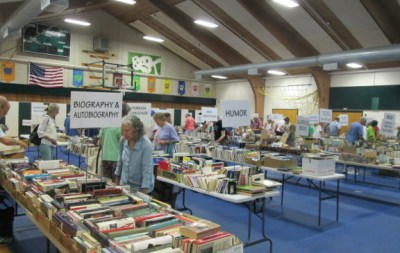
The book sale takes place in the elementary school gym. All the sorting and shelving is done by volunteers.
The book sale is a browser’s heaven: tables and tables of books sorted, and occasionally mis-sorted, into general categories, and many with more books in the boxes underneath. I rarely go with a particular book in mind. I always find books I didn’t know I was looking for.
Or they find me.
Browsers cheerfully recommend books to total strangers, and sometimes get into spirited conversations about books they liked or books they thought were overrated. I was poring over one of the history-related tables, head cocked sideways so I could read the spines, when the fellow to my right handed a book to the fellow on my left. The book passing in front of me was The Chicago Manual of Style.
“Are you interested in this?” asked the fellow on the right, who I guessed (correctly) was the father of the fellow on the left.

My constant editorial companions. Clockwise from top: The Chicago Manual of Style, Words into Type, Amy Einsohn’s Copyeditor’s Handbook, and Merriam-Webster’s Collegiate Dictionary.
I’ve been on first-name terms with Chicago since 1979, when it was still called A Manual of Style. Could I remain silent while my old buddy and sometime nemesis changed hands right before my eyes? I could not. “That’s the current edition,” I said. “I’ve got it at home. I’m an editor by trade.”
Dad let on that Son was an aspiring writer. Son seemed a little uneasy with the description. “If you have any interest in mainstream publishing,” I said, “that’s a very good book to have.”
I don’t know whether they bought it or not, or what they paid for it. It was half-price day at the book sale, so probably not more than a buck or two. But if you have any interest in mainstream publishing, especially in the U.S., it is a very good book to have. Or you can subscribe to the online edition for $35 a year.
In U.S. trade and academic publishing, The Chicago Manual of Style is something of a bible. It contains almost everything writers and editors need to know about book publishing, along with extensive recommendations for further reading in various areas. It includes chapters on grammar, usage, and punctuation. At least half of its 1,026 pages are devoted — as its title might suggest — to style.
What is “style”? Think of all the myriad choices you make when you’re writing and especially when you’re editing your own work, about capitalization and hyphenation, about the use of quotation marks, boldface, and italics. How to treat titles of movies or titles of songs, and words from other languages, and the English translations of those words. And on and on and on. Style comprises all the decisions made about how to handle these things. “Chicago style” is a collection of particular recommendations. If you italicize book titles and put song titles in quotes, you’re following Chicago style, maybe without knowing it.
Much of the nit-pickery that goes into copyediting is about style. Confronted with the plethora of details that go into Chicago style, or Associated Press (AP) style (widely used by newspapers and periodicals), or American Psychological Association (APA) style (widely used in academic writing, especially the social sciences), the novice writer or editor may find it hard to believe that applying a particular style makes things easier — but it does. Every time I embark on editing a long bibliography, I am profoundly grateful to Chicago for its documentation style and to the authors who apply it consistently. I would hate to have to learn or invent a new documentation style for every bibliography I work on.
That goes for other aspects of style too. Following a style guide in effect automates the minute details and frees your mind to deal with the more interesting stuff like word choice and sentence structure and transitions between paragraphs.
The Chicago Manual of Style came into existence early in the 20th century as the style guide for the University of Chicago Press. Then as now, the press specialized in scholarly works, and the early editions of its style guide reflected that. Now it’s widely used by trade publishers, independent publishers, and self-publishers as well as academic presses.
What this means in practice is that not all of its recommendations are well suited to every type of book, and the further one gets from scholarly nonfiction — say, into the realms of fiction and memoir — the more cause one is likely to have for ignoring some recommendations and improvising on others. This is fine with Chicago‘s compilers but not so fine with some copyeditors, who treat the book’s style recommendations as Rules That Must Be Obeyed.
I think of them as Conventions That Should Be Respected, and Generally Followed in the Absence of a Sensible Alternative. I also advise serious writers to introduce themselves to Chicago style and even get to know it. Automate the petty details and you can focus your attention on the big stuff. You’re also more likely to win an argument with a stubborn copyeditor.
Readers’ Challenge
Charles French nominated me for a “readers’ challenge” award. The whole award thing in the blogosphere is a little weird. As far as I can tell, it’s circle-jerkery, with people nominating each other for awards and some people crowing about every award they get nominated for. I am intimidated by how many blogs some of these people follow. Don’t they have lives? Don’t they have jobs? When do the writers among them do their writing?
To hell with that. I like Charles French’s blog on reading, writing, and teaching, and just as important, the questions in this challenge/survey interest me, mainly because I don’t think they were directed at people like me who are in the word trades and don’t read all that much on the side. So here goes.
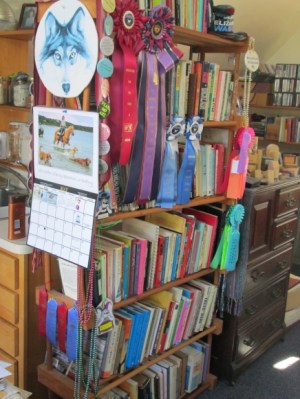
One of my two big bookshelves, freshly culled, dusted, and reorganized, and garnished with a few of my dog’s Rally Obedience title ribbons.
You have 20,000 books on your TBR. How in the world do you decide what to read next?
No way in a million years I would ever have 20,000 books on my to-be-read list. I do have a dozen or so hardcopy books on the shelves at the head of my bed and several more on my Nook. How do I decide? Partly it’s what grabs my attention at the moment. If someone I respect recommends a book, it goes to the top of the list. I’m usually reading two or three books at once, but since I do most of my reading in the 20 or so minutes before I fall asleep, I don’t get through them very fast.
You’re halfway through a book and you’re just not loving it. Do you quit or commit?
Quit. Life is too short to waste one’s time reading crappy books. At the moment I’m about halfway through a nonfiction book that I expected great things of. I semi-promised to review it in my Martha’s Vineyard blog, From the Seasonally Occupied Territories. I’m probably going to skim through the rest and bail. No idea how I’m going to review it, because it’s very relevant to that particular blog and because the whys and wherefores of its failures are worth discussing.
I’m an editor by trade. When I start editing while I’m reading, it usually means that something has gone off the rails. This is the case with the nonfiction book I’m reading now. Where was the editor? I wonder. There probably wasn’t one, even though the publisher is legit and shows up fairly often in the bibliographies of books I copyedit. It’s two or three drafts short of done, and the factual errors are glaring and could have been prevented.
The end of the year is coming and you’re so close yet so far away on your GoodReads challenge. Do you quit or commit?
I dabble on GoodReads, but I don’t commit to anything.
The covers of a series you love DO. NOT. MATCH. How do you cope?
Well, I rarely read more than one book in a series, so I doubt I’d notice. If the series is good enough that I read more than one, I probably would have forgotten the cover of the first by the time I started the second. Here’s an interesting question: If books in a series were routinely marketed with non-matching covers and nothing to indicate that they’re part of a series, would anyone pick them up and read them?
Everyone and their mother loves a book you really don’t like. Who do you bond with over shared feelings?
I’m rarely reading what everyone else is reading at the same time they’re reading it. If I read it, it’s five years after they’ve forgotten it. So this doesn’t come up often. Sometimes, though, I’ll hear someone say that a book I didn’t like was overrated. I’ll jump in with a “Same here!” and if it leads to further discussion, so much the better. Ditto when someone says she loved a book that I think was widely overlooked. Bonding is good.
You’re reading a book and you’re about to start crying in public. How do you deal?
Doesn’t bother me at all. The big problem is that I rarely have a hanky handy, so I have to use my sleeve.
A sequel of a book you loved just came out, but you’ve forgotten a lot from the prior novel. Will you re-read the book? Skip the sequel? Try to find a summary on GoodReads? Cry in frustration?
If I really like a book, I’ll probably avoid any sequels unless I’m assured through the grapevine that the sequel is worthy of the original. If I’ve already forgotten a lot from the original, it probably wasn’t all that great. A good book stands on its own even if it’s a sequel or part of a series. In other words, I won’t worry about it.
You don’t want ANYONE borrowing your books. How do you politely tell people “nope” when they ask?
I no longer lend out books that have particular meaning to me, especially when they’ve been inscribed by the author, but I’m more than willing to lend anything else to anyone who asks. I live in a studio apartment. I frequently cull my shelves and donate the good stuff to my town library’s annual book sale. Good books are happier circulating than gathering dust on a bookshelf. All right, so the books aren’t happier — I am. Good books have their work to do in the world, and they aren’t doing it cooped up in my apartment.
You’ve picked up and put down five different books in the past month. How do you get over the reading slump?
How is that a “slump”? When the right book comes along, I’ll stick with it. Till then I’ll find other things to do with my time.
There are so many new books coming out that you are dying to read! How many do you actually buy?
There are wonderful new books coming out all the time. I don’t know about most of them. This is a good thing. If the subject is of interest, if I’ve admired the author’s previous work, or if someone I respect recommends it, it’ll go on my mental “to-read” shelf. Maybe I’ll even put it on my GoodReads “to be read” shelf. I rarely buy a book until/unless I know I’m going to (a) read it, and (b) want to keep it around. Scott Anderson’s Lawrence in Arabia was one such. I’m also more likely to buy books from independent presses that I want to support. I bought Shade Mountain Press‘s first two books, Lynn Kanter’s novel Her Own Vietnam and Robin Parks’s story collection Egg Heaven. They’re both wonderful. (I reviewed them both on GoodReads.) I’m looking forward to their fall 2015 titles.
After you’ve bought a new book you want to get to, how long do they sit on your shelf until you actually read them?
I rarely buy new books, and when I do (see above) it’s because I want to read them now. And I do, though it usually takes me a few weeks to finish them. A couple of years ago I bought Margaret Atwood’s Cat’s Eye, which was first published in 1988. For years I was more than a little afraid of that book, partly because Atwood is a demanding writer and partly because the subject, so I’d heard, was girls’ nastiness to other girls. Then in late 2012 I copyedited an academic essay about the book that revived my interest in Cat’s Eye and assured me that it wasn’t just about girls’ nastiness to other girls. I bought and downloaded it right then. It was more than two years before I got around to reading it, but I’m very glad I did. It is demanding, but in all the best ways.
After you’ve bought a new book you want to get to, how long do they sit on your shelf until you actually read them?
See above: I rarely buy new books, period. When I got my Nook, my first e-reader, I did buy a novel on a friend’s recommendation, mainly so I’d have something to read on the road. That was three and a half years ago and I still haven’t read it — but I will, I will! I buy more books electronically than I do in print, mainly because the two bookstores within driving distance rarely have what I’m looking for. The downside is that my ebooks tend to sit around longer because I can’t see them, take them down off the shelf, flip through the pages, and decide “Yeah, it’s time to read this one.”
Nomination time
If you blog and these questions intrigue you, please adopt them and take them home with you.
Letting Go, Take 2
An editor colleague just asked what to do about a client who’s written a very good novel but wants to keep revising and revising and won’t start querying agents or publishers.
There’s not much you can do, I said.
Aside: “Letting Go,” take 1, was prompted by a similar query. It took off in a somewhat different direction. I suspect that writers and editors never stop dealing with this stuff.
The word “perfectionism” came up.
As a recovering perfectionist — often a recovering-by-the-skin-of-my-teeth perfectionist who wonders if she’s recovering at all — I know a few things about this. Perfectionism can mean that everything you do has to be perfect before you’ll let it out of your sight, but it can and often does mean more than that. Perfectionism is a way of maintaining control. If I do everything right, I won’t get fired, my lover won’t leave, my kids will turn out perfect, and my novel will get made into a top-grossing movie and the world will swoon at my feet.
It often doesn’t work out that way. Deep down we perfectionists suspect this. Deep down we know that once something leaves our hands, the outcome is out of our control. So we don’t let it go.
Which is what I suspect is going on with the novelist who can’t stop revising, mainly because I’ve known many writers over the years who can’t let go of their work. They tell themselves the work isn’t done — they need to do more research, or do one more draft — and nothing anyone tells them can persuade them otherwise. The problem isn’t that the work isn’t done, it’s that the word “done” isn’t in the writer’s vocabulary because “done” means s/he has to let go.
For writers, here is where it gets tricky. Letting go means you’re putting the outcome in the hands of person(s) unknown. Persons who don’t know you and don’t have any particular reason to wish you well — unless, of course, you’ve produced the sort of work that might make lots of money. The overwhelming majority of us have not done this. Competent agents agree to represent only a small fraction of the manuscripts they see. Many of the ones they reject are very good or better.
In other words, if “failure” to you means rejection by an agent, or by a dozen or a hundred agents, your fear of failure is completely justified.
So is your fear of success. Fear of success is the flip side of fear of failure. They both have deep roots in the fear of letting go. Say you do get an agent, the agent sells your book, and there’s actually a book on the market that has your name on the cover. To you it’s a huge deal, as it should be, but most of the world — including your friends, relatives, and casual acquaintances — is going to say, at best, “That’s nice,” and move on.
Am I telling you to give up? Of course not. Read on.
Here’s a little parable: A kid finds a new butterfly struggling to get out of its chrysalis. The kid pulls the chrysalis apart and helps the butterfly get out. But the butterfly’s wings aren’t fully developed. It cannot fly. Moral of story: It’s the struggle to get out of the chrysalis that strengthens the butterfly’s wings so it can fly.
I like this little parable even though some people turn it into a rationale for never helping anybody out. I like it because it applies so well to writing and other creative endeavors. In the struggle to create, we not only become good writers, we also figure out what we want to do with our writing. We create a path forward for ourselves and develop the courage to follow it.
For many of us, this involves seeking out and sharing experiences with other writers. We become better writers, yes, but we also develop two crucial skills: the ability to dissociate ourselves from our creations, and the ability to sort through other people’s comments, edits, and critiques and decide what works for us. In the process, we learn about the many options for getting our work out into the world.
To complete a book-length work without doing this — well, it’s like finding that the road you’ve been on for years ends in a precipitous drop. Or maybe like opening the door from your dark room and being blinded by the light outside.
The very first line of this blog, back in “The Basics,” was “Your writing will teach you what you need to know.”
I believe it.
In that same post, I quoted two of the truest things I’ve ever heard about writing. I believe them too. Here they are again.
”I think writing really helps you heal yourself. I think if you write long enough, you will be a healthy person. That is, if you write what you need to write, as opposed to what will make money, or what will make fame.”
— Alice Walker
The real writer is one
who really writes. Talent
is an invention like phlogiston
after the fact of fire.
— Marge Piercy
What’s The Most Important Lesson You’ve Learned: Words of Wisdom From Our Readers
An array of excellent advice here from readers of the Self-Published Authors Helping Other Authors blog.

About two weeks ago, Ruth and I asked you to send in your best advice on writing, editing, publishing, and marketing fiction. I am very pleased to say that nearly every day since my inbox has had wonderful messages from our many readers who were glad to send along their knowledge. Below you can see their comments, as well as wonderful pictures of them and their books. On behalf of the folks here at Self-Published Authors Helping Other Authors, we would like to thank you for your awesome contributions.
Here’s what our readers had to say:
Write the story you want to write. Be passionate, follow your heart, and ignore what others are writing. Just be you.
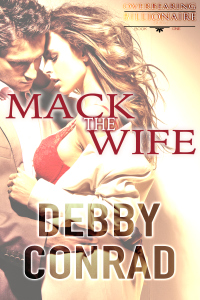
Debbie Conrad

Spell check. Spell check, spell check, spell check. After every draft, spell check. After every writing session, spell check. There are going to be things you missed, even if you think you haven’t…
View original post 1,112 more words
Reviewing Isn’t Easy
Most of my writing time over last weekend went into an 1,800-word review of a nonfiction book. Monday was the deadline, and Monday I emailed it in to my editor. Editors love it when writers deliver their stuff on time. Trust me on this. They also love it when writers turn in copy that’s well organized and properly punctuated. Trust me on that too.
I’ve done plenty of reviewing over the years, mostly of books but also of local theater performances and the occasional concert or album. Reviewing is hands-down the hardest writing I ever do, which is why I don’t do much of it these days. My other writing has pushed it to the side. I regret this because I think reviewing is important and because I’m pretty good at it.
Reviewing is important. An author or performer puts the work out there, and the reviewer enters into conversation with it — a conversation that includes not only the work and its creator(s) but also the potential audience for that work.
Perhaps most important, reviews let prospective readers know that a book is out there and whether they might be interested in it.
So a review is like PR — free publicity for the book?
In some ways yes, but in other ways very much no. What reviewers write can persuade people to buy the book, but we aren’t part of the production team. Our job is not to persuade people to buy the book or put it on their to-read lists. Our job is to help them make up their minds.
What distinguishes reviews from back-cover blurbs and other promotional copy is that reviewers come to the work from outside. We haven’t been involved in the writing, editing, publishing, or promoting of the book we’re reviewing.
So what’s a review anyway?
Good question! “Review” covers the vast territory between a blurb and the kind of literary criticism that appears in academic journals. A review can be short, long, or somewhere in-between. It can be written down or delivered orally. Usually it describes what the book is about, provides some context — for instance, mentioning the author’s previous works, if any, or recent publications in the same field — and offers some clues as to whether the book is worth your while or not.
Beyond that, it depends — on the reviewer, the review medium (radio, blog, webzine, newspaper, Goodreads, Amazon, etc.), and the intended audience.
My writer friend wants me to review her book. Should I do it?
No. A thousand times no.
Personally I think your writer friend shouldn’t even have asked you. She’s putting you in a terrible position.
Since you’re in that terrible position, ask yourself these questions:
- Can I tell prospective readers what they deserve to know about this book before they buy it?
- If I give my honest opinion about my writer friend’s book, will we still be friends?
Of course, if you decline to review the book, the friendship may hit the skids anyway — see what I mean about terrible positions?
If you’re the writer with a forthcoming book, don’t do this to your friends. If your friends write well and want to help out, enlist them to write jacket copy, press releases, and brief synopses for your website. If they’re published authors themselves or have other useful credentials, they can write one of those signed blurbs that appear on the back cover of a print book or in the opening pages of an ebook. No one expects these things to be written by an impartial reviewer.
So what’s “impartial”? When is it OK to review someone’s book?
Good reviewers think about this a lot. We discuss it with other reviewers. In many fields and genres, authors, editors, publishers, and reviewers mingle on a regular basis, in person and/or online. Many of us wear more than one hat. We know each other by reputation even if we haven’t actually met.
Smart authors and publishers, including self-publishers, keep an eye out for reviewers who would be a good match for their books. Authors, especially self-publishing authors, may contact prospective reviewers directly. It’s up to the reviewer to say yes or no, and saying no to someone you know is not always easy, especially when they press you to come up with a reason. (Note to writers: Please don’t do this. It’s OK to take no for an answer. Last month I reblogged this excellent post: “Author Etiquette for Contacting Book Bloggers.” Read it and pass it on.)
How close is too close to write an impartial review? Here are some recommendations. You’re too close —
- If you’ve seen any draft of the manuscript before it was published. If the author is in your writers’ group or workshop or writing class, you’re too close. If you were a second or third reader, you’re too close. If you critiqued or edited the ms., you’re too close. Possible exception: If you heard the author read from the novel in progress and had no prior relationship with the author, you might not be too close.
- If you have any professional connection with the publisher, paid or unpaid, staff or freelance. This goes mainly for small presses, independents, and self-publishers. With huge trade-publishing conglomerates and even mid-sized university presses, it’s easy to be several arm’s-lengths away from any particular book.
- If you’re more concerned with the author’s feelings than with telling prospective readers what they deserve to know.
What about when a book you’re asked to review really sucks?
Forgive my bluntness here, but this is the elephant in the booksellers’ marketplace so let’s not pretend it isn’t there. Some books really do suck, and some of those sucky books are written by people we know and like. You shouldn’t be reviewing books by your friends even if those books are stupendously good and in the running for major awards, but what if you get roped in to reviewing a book that’s really bad — as in, you really don’t think anyone should be wasting their time and money on it?
If you’re working on assignment from a book blog or other review medium, and whoever made the assignment has no personal connection to the author, this usually isn’t too hard. Explain that you don’t think the book is worth reviewing. Ask for another assignment.
If you do know the author, it’s a lot more difficult. You can try procrastinating. Some authors will catch on: Endless procrastination translates into “I really don’t want to do this.” Others won’t. In such cases, if you don’t say something, one of those elephants is going to take up residence in your relationship with the author. Saying something is hard. This is why those elephants aren’t on the endangered species list.
There is almost no good reason to review a really, really bad book, especially when that book is a first novel or a self-published book. If it doesn’t get reviewed, the book will probably sink with nary a trace. This is the best scenario for all concerned, though they probably won’t see it that way. The big exception is when the bad book is written and/or published by someone from whom we’ve got good reason to expect better things. In these cases, readers deserve to be warned off.
Slashing a bad book to ribbons can be fun, but it can — and should — leave a very unpleasant aftertaste. Don’t do it.
Write for a Living?
I just finished a long and demanding editing job, right on deadline. For the last 10 days or so, it’s been taking up seven or eight hours of every waking day. I’ve learned over the years that my daily capacity for demanding word work is about seven or eight hours. Beyond that my brain goes on auto-pilot.
 Writing and editing aren’t the same, but they both qualify as “demanding word work.” Over the last year or so, I’ve managed to maintain a pretty good balance: edit for five or six hours a day, write for up to two. The writer grabs the first two hours after waking, my absolute best creative time. (I’m an early riser, but my internal editor tends to sleep late. I’m also easily distracted by the events of the day once they start unfolding.)
So for 10 days or so, I’ve neither blogged nor worked on the novel. My writing has consisted of a few emails and the occasional post to Facebook. This is scary. The further I get from the practice of daily writing, the more certain I am that I’ll never get back to it. My writing, I fear, is like a fire in the woodstove. If it goes long untended, it will go out.
If only I didn’t have to work! I think. If only I could write for a living!
The same thought has probably crossed your mind. Maybe more than once. Maybe whenever life — specifically your paid job — gets in the way of the writing that you’d much rather be doing. Sound familiar?
When time-pressed writers imagine writing for a living, or at least writing as part of their job, they often aren’t thinking about going into journalism or academia. They aren’t thinking about writing lengthy reports for think tanks or government agencies, or how-to manuals for computer software and hardware. They definitely aren’t thinking of writing ad copy and jingles, although this may pay better than most of the other possibilities.
The fantasy is usually about making a living writing what we want to write. The big attraction is getting paid to do what we want to do.
I get it. Most of my life I’ve been able to make my living doing work that I enjoy, that I’m good at, and that seems useful to other people and sometimes even the world at large. It has nearly often involved the written word — but it’s rarely involved writing. During my several years working for a weekly newspaper, I got to write pretty much what I wanted to write — stories about interesting people and events — but my job description was “editor.” Editing has been my bread and butter, and occasionally my beer and chocolate, since the late 1970s.
If you’re determined to write for a living, or even for a substantial chunk of your living, I know I can’t talk you out of it. I’m not going to try. For sure some writers manage to do it. If you look closely, though, you’ll often see that other factors are helping them stay afloat economically: maybe a partner with a well-paying job, maybe a trust fund, maybe gigs teaching writing in one way or another. Take a hard look at your own resources before you even think of quitting your day job.
Think about this too: For me to make my living as a freelance editor, someone has to be willing and able to pay money for what I’m selling. The same goes for writing. The money coming into your checking account has to come from somewhere. It may come from a publisher. It may come direct from readers who are dying to read your books. It may come from newspapers, magazines, or online media that want to buy your feature articles and maybe send you off on assignment to write more.
These things are not going to fall into your lap. You’re going to have to hustle — to do all the research and self-promotion necessary to reach those willing and able to pay for what you’re selling, then to persuade them to part with their money. While you’re hustling, you probably aren’t writing what you what you write. You’re writing proposals, synopses, query letters, and press releases. Is it starting to sound like a day job yet?
Here’s another question: How often do you spend your hard-earned money on other writers’ writing? How often do you take a chance on a novel by someone you’ve never heard of? Will you do it for $9.99? for $2.99? for free? What would make people who’ve never heard of you take a chance on your book? This applies to attracting agents, editors, and publishers as well as to engaging individual readers in the emerging online marketplace. Perhaps even more so: If an agent, editor, or publisher takes you on, s/he will wind up investing far, far more than $9.99 in you and your work.
The real bottom line here is that if you want to make a living writing, you have to write what people are willing to pay money for, and you have to keep doing it. You’ll have deadlines that can’t be blown off. Your fallow periods and blocks will become even scarier than they are now because they’ll threaten your livelihood as well as your sanity and your sense of self-worth.
Writing, in short, will become your job.
And it may well get in the way of your writing.
Author Etiquette for Contacting Book Bloggers
Having been at various times a reviewer, an anthology editor, a newspaper features editor, and a few other things, I think this is excellent advice for any writer who is trying to get another writer to do something for free. Online, offline, anywhere!

Hello, everyone! It’s me again with another author advice post. Warning: This post isn’t for everyone. If you’re an author who finds etiquette posts tiresome, this post isn’t for you. If you’re already an expert on book marketing, this post will probably seem pretty basic, but I hope you’ll read on and add your advice in the comment section. This post is for people like me – people who came into the writing world with limited social media knowledge. It’s for people who didn’t realize book bloggers existed until they were told to go out and promote their book. If you’re intimidated or overwhelmed by the idea of contacting reviewers and bloggers, or if you’ve sent requests to bloggers and only received a lukewarm response, this post is for you.
- DO read the blogger’s FAQs, Policies, or Submission Guidelines. Each blogger is different. Some bloggers want you to contact them by email. Others have…
View original post 1,456 more words
Selling Books at the Artisans’ Fair
Sorry for long silence — I’ve had deadline-itis in a bad way.
This past Thursday’s deadline wasn’t a surprise. It wasn’t a rush — not until I turned it into one by spending 10 a.m. to 4 p.m. last Friday and Saturday at the Thanksgiving Artisans’ Fair. Along with three other local writers, I was part of “Writers’ Row.” (I blogged about the fair in From the Seasonally Occupied Territories: “A Saner Way to Shop.”)
So I was selling my novel, The Mud of the Place, and my colleagues were selling their books, and it dawned on me that, hey, not only had I written my book, I’d edited at least one of each of theirs.
This made me happy. These books were all good before I got hold of them, but I was proud to have had a hand in making each one a little bit better than it would have been otherwise. Editors are even more invisible than writers. Usually we finish a job, wave bye-bye, and never see the book or paper or story again. It was downright satisfying to see the finished books on display and hear people talk about them.
Not to mention — I know those books inside and out, love them all, and have no qualms about encouraging people to buy them.
 Lynn Christoffers is a wonderful photographer. Cats are her favorite subject, so Cats of Martha’s Vineyard was a natural. But she did more than photograph a hundred cats. She interviewed their people and turned those interviews into a book. I’m a chronic dog person, but I still think it’s cool.
 Shirley Mayhew moved to Martha’s Vineyard as a young bride in 1947 and has been here ever since. Her personal essays, collected in Looking Back, not only chronicle a quietly remarkable life; they provide a window into the last six-going-on-seven decades in this particular place — a place that’s often seen from the outside but rarely from within.
Cynthia Riggs took up mystery writing at age 70, after a career that included writing for the National Geographic Society and the Smithsonian, running a ferryboat company on the Chesapeake Bay, rigging boats on Martha’s Vineyard, and raising five children. The 11th book in her Martha’s Vineyard Mystery Series is due out from St. Martin’s Press in the spring. The previous ten were all for sale on Writers’ Row, but pride of place went to Murder on C-Dock, which is hot off the press (official pub date isn’t till next month) and which I copyedited. It begins a new series, drawing on the author’s 12 years living on a houseboat on the Washington, D.C., waterfront. It’s got such a stupendous cover that I’m determined to hire the artist, Elizabeth R. Whelan, to do the cover of my novel in progress.
Cynthia, by the way, contributed “On Being Edited” to this blog back in October. Her account of an Edit from Hell has been viewed more times and received more comments than any other Write Through It post. Good! I’m here to report that to my mind Cynthia is an ideal client: she writes well, takes her writing seriously, and appreciates careful editing. She also hosts the writers’ group that both Shirley and I belong to.
Writers usually work in isolation, so face-to-face contact with readers and prospective readers is exhilarating. It can also be exhausting: The Artisans’ Fair was busy from the time the doors opened at 10 till they closed at 4, which meant we were “on” for six consecutive hours. This is why I didn’t come straight home, go for a walk with the dog, then buckle down to editing. My brain needed a break.
At odd moments I wondered if we writers really belonged among the weavers, jewelers, leatherworkers, printmakers, and other crafters who work wonders with media more tangible than words. For sure no one objected to our presence, and all of us had a great time. My life is pretty much devoted to words: writing them, editing them, reading them, reviewing what others have written. It’s a little disorienting to be reminded that words aren’t everything, that creativity comes in myriad forms, and that there are plenty of things that words just can’t do.
UKL’s Challenge
We interrupt this blog to bring you an important message. Ursula K. Le Guin has been high in my literary pantheon for a very long time. The other night at the 65th National Book Awards, Le Guin was honored for her distinguished contribution to American letters. In barely five minutes she proved that her distinguished contribution continues. Her speech seems to be going viral. Good. It’s a challenge to writers, publishers, and readers. Let’s live up to it.
And here is The Speech, as transcribed by Parker Higgins and posted on his blog. He notes that the bits in parentheses were ad-libbed to the audience. Thanks!
Thank you, Neil, and to the givers of this beautiful reward, my thanks from the heart. My family, my agent, editors, know that my being here is their doing as well as mine, and that the beautiful reward is theirs as much as mine. And I rejoice at accepting it for, and sharing it with, all the writers who were excluded from literature for so long, my fellow authors of fantasy and science fiction—writers of the imagination, who for the last 50 years watched the beautiful rewards go to the so-called realists.
I think hard times are coming when we will be wanting the voices of writers who can see alternatives to how we live now and can see through our fear-stricken society and its obsessive technologies to other ways of being, and even imagine some real grounds for hope. We will need writers who can remember freedom. Poets, visionaries—the realists of a larger reality.
Right now, I think we need writers who know the difference between the production of a market commodity and the practice of an art. Developing written material to suit sales strategies in order to maximize corporate profit and advertising revenue is not quite the same thing as responsible book publishing or authorship. (Thank you, brave applauders.)
Yet I see sales departments given control over editorial; I see my own publishers in a silly panic of ignorance and greed, charging public libraries for an ebook six or seven times more than they charge customers. We just saw a profiteer try to punish a publisher for disobedience and writers threatened by corporate fatwa, and I see a lot of us, the producers who write the books, and make the books, accepting this. Letting commodity profiteers sell us like deodorant, and tell us what to publish and what to write. (Well, I love you too, darling.)
Books, you know, they’re not just commodities. The profit motive often is in conflict with the aims of art. We live in capitalism. Its power seems inescapable. So did the divine right of kings. Any human power can be resisted and changed by human beings. Resistance and change often begin in art, and very often in our art—the art of words.
I have had a long career and a good one. In good company. Now here, at the end of it, I really don’t want to watch American literature get sold down the river. We who live by writing and publishing want—and should demand—our fair share of the proceeds. But the name of our beautiful reward is not profit. Its name is freedom.
Thank you.
 Write Through It