Write for a Living?

I just finished a long and demanding editing job, right on deadline. For the last 10 days or so, it’s been taking up seven or eight hours of every waking day. I’ve learned over the years that my daily capacity for demanding word work is about seven or eight hours. Beyond that my brain goes on auto-pilot.
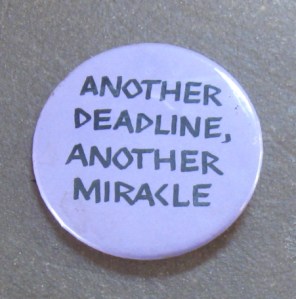
deadline miracleWriting and editing aren’t the same, but they both qualify as “demanding word work.” Over the last year or so, I’ve managed to maintain a pretty good balance: edit for five or six hours a day, write for up to two. The writer grabs the first two hours after waking, my absolute best creative time. (I’m an early riser, but my internal editor tends to sleep late. I’m also easily distracted by the events of the day once they start unfolding.)

So for 10 days or so, I’ve neither blogged nor worked on the novel. My writing has consisted of a few emails and the occasional post to Facebook. This is scary. The further I get from the practice of daily writing, the more certain I am that I’ll never get back to it. My writing, I fear, is like a fire in the woodstove. If it goes long untended, it will go out.

If only I didn’t have to work! I think. If only I could write for a living!

The same thought has probably crossed your mind. Maybe more than once. Maybe whenever life — specifically your paid job — gets in the way of the writing that you’d much rather be doing. Sound familiar?

When time-pressed writers imagine writing for a living, or at least writing as part of their job, they often aren’t thinking about going into journalism or academia. They aren’t thinking about writing lengthy reports for think tanks or government agencies, or how-to manuals for computer software and hardware. They definitely aren’t thinking of writing ad copy and jingles, although this may pay better than most of the other possibilities.

The fantasy is usually about making a living writing what we want to write. The big attraction is getting paid to do what we want to do.

I get it. Most of my life I’ve been able to make my living doing work that I enjoy, that I’m good at, and that seems useful to other people and sometimes even the world at large. It has nearly often involved the written word — but it’s rarely involved writing. During my several years working for a weekly newspaper, I got to write pretty much what I wanted to write — stories about interesting people and events — but my job description was “editor.” Editing has been my bread and butter, and occasionally my beer and chocolate, since the late 1970s.

If you’re determined to write for a living, or even for a substantial chunk of your living, I know I can’t talk you out of it. I’m not going to try. For sure some writers manage to do it. If you look closely, though, you’ll often see that other factors are helping them stay afloat economically: maybe a partner with a well-paying job, maybe a trust fund, maybe gigs teaching writing in one way or another. Take a hard look at your own resources before you even think of quitting your day job.

Think about this too: For me to make my living as a freelance editor, someone has to be willing and able to pay money for what I’m selling. The same goes for writing. The money coming into your checking account has to come from somewhere. It may come from a publisher. It may come direct from readers who are dying to read your books. It may come from newspapers, magazines, or online media that want to buy your feature articles and maybe send you off on assignment to write more.

These things are not going to fall into your lap. You’re going to have to hustle — to do all the research and self-promotion necessary to reach those willing and able to pay for what you’re selling, then to persuade them to part with their money. While you’re hustling, you probably aren’t writing what you what you write. You’re writing proposals, synopses, query letters, and press releases. Is it starting to sound like a day job yet?

Here’s another question: How often do you spend your hard-earned money on other writers’ writing? How often do you take a chance on a novel by someone you’ve never heard of? Will you do it for $9.99? for $2.99? for free? What would make people who’ve never heard of you take a chance on your book? This applies to attracting agents, editors, and publishers as well as to engaging individual readers in the emerging online marketplace. Perhaps even more so: If an agent, editor, or publisher takes you on, s/he will wind up investing far, far more than $9.99 in you and your work.

The real bottom line here is that if you want to make a living writing, you have to write what people are willing to pay money for, and you have to keep doing it. You’ll have deadlines that can’t be blown off. Your fallow periods and blocks will become even scarier than they are now because they’ll threaten your livelihood as well as your sanity and your sense of self-worth.

Writing, in short, will become your job.

And it may well get in the way of your writing.

In Praise of Readers

If a tree falls in a forest and no one hears it, did it make a sound?

I think it did. I also suspect that when we repeat the question, we’re not just talking about trees. Trees don’t care if they make a sound. They’re going to fall, and rustle, and crack, whether we hear them or not.

For me, writing is part of a conversation. I do want people to hear the rustling and cracking of my words, and more than that: I want to hear what they have to say in response. I’ve had three one-act plays produced, and I love giving readings. Nothing beats the thrill of seeing and hearing people respond to my words.

mud-cover-smIt’s a rare audience that will sit still for a book-length work, but I’m lucky: I’ve experienced what has to be the next-best thing. Last Wednesday and the Wednesday before, I got to sit down and talk with a group of women all of whom had read my novel, The Mud of the Place, and were interested in what I was writing about, the lives of year-round residents in a seasonal resort.

Minnesota Women's Press publishes a bimonthly newsletter that's all about books, writers, and readers.

Minnesota Women’s Press publishes a bimonthly newsletter that’s all about books, writers, and readers.

These women, who came from all around the U.S. and Canada too, were participants in Books Afoot, also known as Reading on the Road, a program of the Minnesota Women’s Press. As organizer Mollie Hoben described it in an email, “The basic idea is that reading and travel make a rewarding combination. We pick a destination, learn about women writers from that place (which always involves exciting discoveries), select books to read beforehand, then travel there with interested reader-travelers for exploration and book discussion. Participants come from all over the country.”

I first learned about Books Afoot a year and a half ago, when Mollie contacted me out of the blue. Three Books Afoot groups would be coming to Martha’s Vineyard in the fall, and my novel was one of the four “required reading” books. Would I be willing to meet with any or (ideally) all of the groups?

One of the 2013 Books Afoot groups, meeting in the outdoor café at a local bookstore

One of the 2013 Books Afoot groups, meeting in the outdoor café at a local bookstore

Would I?? This was a fantasy come true, and the reality surpassed my wildest expectations. (I blogged about it here.) I’d pretty much decided that writing a second novel was a waste of time. These women changed my mind.

This year we were joined by my writer friend Shirley Mayhew, whose wonderful Looking Back: My Long Life on Martha’s Vineyard came out early this summer — too late for the travelers to have read it before they got here, but plenty of them bought a copy to take home with them. Shirley moved here as a young bride in 1947; I arrived solo in 1985. Our books and our very different but overlapping experiences became gateways for the visitors to enter a place that many people know about but few actually know.

Last month I concluded a blog post, “Who Do You Write For?,” with this description of the kind of reader I’d like to be: “one who’s brave enough to venture into unfamiliar territory as long as she trusts her guide, and one who appreciates the effort that goes into the writing.”

When a book goes out into the world, does it make a sound? If it does, will I hear it through all the cacophonous competition? Having sat down and talked with dozens of such adventurous readers, I know you’re out there. I’m writing for you.

The 2014 Books Afoot women each picked a postcard from wherever they were from and wrote a favorite book recommendation or two on the back. Here are a few of them.

The 2014 Books Afoot women each picked a postcard from wherever they were from and wrote a favorite book recommendation or two on the back. Here are a few of them.

Author’s Voice

I get nervous when editors talk about “preserving the author’s voice.” There’s often a condescending tinge to it, as if “preserving the author’s voice” means putting up with sloppy writing. It doesn’t. It does, however, require a certain flexibility on the editor’s part. It may mean bending “rules” that aren’t rules at all, like “never split an infinitive” or putting a comma where the Chicago Manual of Style says you don’t need one. This makes some editors, especially copyeditors, uncomfortable. (For a rough breakdown of the “levels” of editing, see “Editing? What’s Editing?”)

Travvy, my Alaskan malamute, had no trouble finding his voice. He's very articulate, but he doesn't know beans about punctuation.

Travvy, my Alaskan malamute, had no trouble finding his voice. He’s very articulate, but he doesn’t know beans about punctuation.

I don’t think “author’s voice” had been invented when I started writing, so I never worried about finding mine.

I hope you won’t either.

If you write a lot, you will develop your own style. All the choices you make — about words, sentence structure, punctuation, and paragraphs, and especially about how to put them together — become your style. If you keep writing, it’ll evolve, depending on what you’re writing about.

Reading is crucial here. Read good writers. Pay attention to how they solve problems. If they’re really good, you might not realize that they ever had a problem. Trust me, they did. They do. They deal with awkward transitions, flaccid sentences, unconvincing characters, and all the other stuff that makes you want to tear your hair out and give up.

Even if you don’t have any problems (for the moment), you can pick up new tricks to try. The more tools you’ve got in your toolkit, the better. Go ahead and try writing in the style of an author you like. Or, maybe even better, an author you don’t like.

If you keep writing, you will develop your own style. You’ll find your voice. Trust me on this. It will happen.

Different kinds of writing do impose different requirements. Sometimes the author’s individual voice takes a back seat to the demands of the job. Think reporting. Think technical writing. If you work in such a field, you’ll develop a style that’s suited to it. Your editors will edit your work with the demands of the field in mind. This doesn’t mean you can’t do other kinds of writing as well. The ability to marshal facts and write clearly can come in handy anywhere.

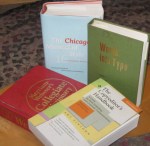
Some useful tools of the writer's trade. They're here to help you, not drive you huts.

Some useful tools of the writer’s trade. They’re here to help you, not drive you huts.

Yes, you should learn the rules and conventions of whatever language(s) you’re writing in. Contrary to popular belief, these rules were not invented to drive students crazy. They’ve developed over time to facilitate communication between writers and readers. They’re tools. Tools are as important to writers as they are to carpenters and car mechanics. When a writer isn’t comfortable with a particular tool, awkwardness can result.

At the moment I’m copyediting a nonfiction book whose author seems uncomfortable with pronouns. Instead of writing “he” or “him,” “she” or “her,” he repeats the subject’s name — and to avoid repetitiousness he’ll use the first name here, the last name there, and sometimes a nickname if the subject has one. It took me a while to sort out which names belonged to the same person.

If used consciously, this technique can convey nuance and tone. You can refer to a person (including, need I say, a fictional character) by his or her last name in formal situations, then use the first name when s/he’s hanging out with friends. Switching from one to the other will then suggest to your alert readers what mode the person is operating in, what figurative hat s/he has on.

Don’t worry about finding your voice. You’ve already got one. Think of all the ways you use your speaking voice. You can SHOUT. You can whisper. You can sing. You can runwordstogether or you can pause. between. each. one. Addressing a group, you speak more carefully than you do when you’re talking with friends. Your author’s voice can be just as flexible and at the same time just as much you. Keep writing!


Confessions of a Less-Than-Avid Reader

As a kid my nose was always in a book. I made a tent with the bedspread of my lower-bunk bed and read under it with a flashlight. When I went into the woods, it was usually to find a tree that I could climb and read in without being bothered.

I’m a writer.

I’ve reviewed books. I’ve sold books. I’ve written a novel.

I make my living as an editor.

I rarely read for pleasure any more. It’s not that I don’t have the time but that I’ve got more interesting things to do with the time I’ve got: write, go walking with Travvy, sing, drum, read e-mail, post responses to the e-lists I’m on, mess around on Facebook . . .

When The Mud of the Place was approaching completion, I circulated the manuscript to pretty much everyone I knew who was willing to slog through 400+ pages of typescript. Close to three dozen people in all. Their ages ranged from early 20s to late 70s. Nearly all of them liked it. Many waxed seriously enthusiastic, and many gave me useful comments about it.

Several of those people told me that they hardly ever read. They probably didn’t believe me when I said I didn’t either.

Educators and people in the book trades are forever bemoaning the decline in reading. The decline is well documented and ongoing. And I, writer and editor though I am, am part of it.

What to say about this?

I spent years working in a community — the women’s community of Washington, D.C., and the larger feminist movement — where words saved lives, words saved sanity. As a bookseller, I saw it happen over and over again. It happened to me. We knew books were important. Not a luxury. Not a duty. Important.

In theory I know there are books like that out there today, but I wouldn’t walk very far out of my way on the off chance that I might find one of them.

On the other hand — since I got my first e-reader in December 2011, I’ve been reading more books. Nowhere near as voraciously as I did growing up, or in my bookselling and reviewing days, but considerably more, and more enthusiastically, than in the previous 15 years or so. Most of these books have been recommended either in the (few) blogs I follow or by friends, often on social media.

I think not enough people have had their lives changed by a book, and if they have, they don’t know where to find another one like that. Neither do I. I have an especially hard time with general fiction. (With fantasy and science fiction, I know how to find the books and writers worth reading.) My life has never been changed by the technically flawless prose of a writer who wouldn’t know a moral conundrum if s/he met one on the road.

I’m looking for books that show me the world from new angles. I’m looking for books that can disturb my dreams without putting me to sleep.