The Act of Revision

I recently began the second draft of my second novel so this post is especially timely. Revising does involve re-vision — seeing your work in new ways, from different angles. And there’s no one way to go about it. Whatever works!

frenchc1955's avatarcharles french words reading and writing

heminwaywriting

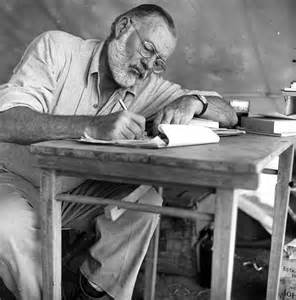
Interviewer: How much rewriting do you do?
Hemingway: It depends. I rewrote the ending of Farewell to Arms, the last page of it, 39 times before I was satisfied.
Interviewer: Was there some technical problem there? What was it that had stumped you?
Hemingway: Getting the words right.
(Ernest Hemingway, “The Art of Fiction,” The Paris Review Interview, 1956) 1

Writing-revision

The act of revision is an absolutely necessary part of writing, no matter what kind. Essays, stories, novels, books all require that the author not be satisfied with initial drafts. “Re-vision” means to re-see, or to look at the work from another perspective. This idea is something I try to teach my students in College First Year Writing classes, and it is crucial that I apply the ideas myself to my own work.

When I look back over my writing of the last few years, I can see that…

View original post 201 more words

On to Draft 2!

This past weekend I took a very deep breath and started draft 2 of Wolfie, my novel in progress.

The time had come.

I like to take a break between drafts. The longer the work, the longer the break, which means that with a novel or a long essay it can be a few weeks. This time I didn’t exactly take the break: the break took me. In late January I suspended work on the novel to focus my attention on a long, challenging editing job with an impending deadline. That deadline met, I turned to a review assignment whose deadine was also impending. I’d read the book and been thinking about it for weeks, but now I had to write the review. (For some thoughts about reviewing see “Reviewing Isn’t Easy.”)

Wolfie was never far from my mind. To push on with the first draft or to start the second? That was the question.

Draft 1 wasn’t complete. The Word file stood at 227 pages, almost 55,000 words, with a dozen or so handwritten pages yet to be transcribed. I had a pretty good idea of where things were headed. I probably could have forged on through climax to conclusion and then started the second draft . . .

The trouble was, a couple of significant plot threads have only come clear during the writing. One is hinted at in draft 1 but only sketchily developed. The other comes as a backstory dump in the handwritten pages I haven’t transcribed yet. It needs to start much earlier and be woven into the story.

Over the last year I’ve been taking Wolfie installments to my Sunday night writers’ group. This is a first for me. Usually I don’t let anything out in public until it’s in second or third draft — when I’ve gone as far as I can on my own and need some outside eyes. With Wolfie, though, the weekly deadline and my group’s encouragement have kept me going.

So — should I push on and bring the final chapters one by one to the group, explaining that the backstory to this or that wasn’t set up yet and they’d have to wait for the second draft to understand what was going on? I didn’t like that idea at all. I want the writing to stand on its own.

Maybe more important, I don’t really know how those last chapters are going to unfold. It’s going to depend in part on what my characters do and say in the parts I haven’t written yet, and I won’t know that until I’ve written them.

So I opened draft1.doc and saved it as draft2.doc.

old chap 1

Then I deleted Chapter One. It was an experiment that didn’t work out. The tall man is still in the story, but he doesn’t live in that house anymore. He’s no longer a viewpoint character either.

So far, so good. For me revision is usually about 80 percent cutting and rearranging what’s already there. Chapter Two from draft 1 is now Chapter One in draft 2.

new chap 1

My recollection was that this chapter didn’t need much work. It does a pretty good job of introducing one of the two viewpoint characters: Glory, a sixth-grade girl. What I’d forgotten was that somewhere along the way I’d shifted Glory’s sections from past tense to present, but her introduction is still in past tense.

And I’m still not 100 percent sure that present tense is the way to go. Rather than rewrite it now, I made a note in the margin. The muses haven’t given me a clear answer on that one yet.

For the new Chapter Two, I’ve gone back to writing in longhand. The story itself isn’t going to change much, but I need a new way into it — a way that hints at some of the things I didn’t know when I wrote it the first time. What this means is that with Wolfie second-drafting is going to look more like first-drafting than it usually does. It’s going to involve plenty of exploring, digging, and otherwise adding new stuff — writing, in other words.

Travvy

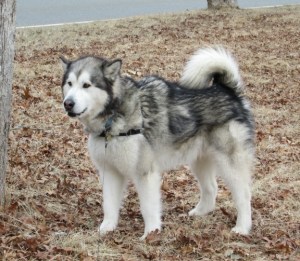
Travvy, on whom Wolfie’s title character is based, takes a break from digging in the snow.

For me, editing is relatively easy. The writing tells me what has to be done, and I do it.

Writing is more like breaking trail through two feet of snow. My dog and I have done a lot of that lately. It’s exhausting, and it takes longer to get anywhere than it does when we’re walking on good old dirt.

But second-drafting already seems less daunting than starting from scratch. This time around my characters are helping — some of them more than others, of course — and so is the story. If I listen carefully, I can hear what’s not being said. I can visualize the scenes that need to be there that aren’t there yet.

My writing will teach me what I need to know if only I keep writing.

What Is Editing Worth?

Ask a bunch of editors what good editing is worth and they’ll probably reply that it’s invaluable, priceless, and indispensable.

Listen to us talk for a while and we’ll probably get around to the books we’ve read that were either abysmally edited or (probably) not edited at all. What’s the matter with those writers? we wonder. How can they put their names on something that’s so disorganized or riddled with typos and grammatical errors?

Being both a writer and an editor, I think about this a lot. “Value” is a shifty word in English. “Valuable” and “invaluable” mean more or less the same thing. Plenty of value can’t be measured in money, but when you have to pay for it, money has to be considered. Editing has monetary value to me as an editor because it pays the rent. For me as a writer, whatever I spend on editing is money I can’t spend on book design, cover illustration, and marketing. Besides, I can do it pretty well myself.

The inescapable fact is that editing can’t be automated. If some outfit promises to “edit” your 300-page manuscript for a dollar a page, you can be sure that they’re not doing much more than running a spellchecker and a grammar checker through it, and maybe cleaning up the formatting. In my book that’s not editing: it’s word-processing.

Depending on what level of editing is called for, editing involves going through your manuscript page by page, line by line, even word by word. This is not like reading for pleasure. It takes time. For a book-length work, it takes a lot of time. Hypothetical example: Take a 300-page,  75,000-word manuscript. (In publishing, a page is conventionally reckoned at 250 words.) If the ms. is well written and has no structural problems, a good copyeditor might be able to clock 10 pages per hour. That’s 30 hours’ worth of work. Say the copyeditor is charging $30 an hour. (Some charge more, some charge less, but you can get a good copyeditor for $30/hour.) That’s $900 right there.

A manuscript that, as we say in the trade, “has problems” will take longer to edit. At 5 pages/hour, that’s 60 hours. At $30/hour, that’s $1,800. If the problems are serious enough, you may have trouble finding an editor who’ll work for only $30/hour. There are few things more frustrating than being asked to copyedit a manuscript that has structural problems. It’s like frosting a cake that’s collapsed in the middle and didn’t taste all that good to start with.

I don’t know about you, but $1,800 would put a huge dent in my budget, even if I could pay it off over time. I’m never surprised when a writer has sticker shock at an estimate for editing. Editors can say that editing is “priceless” and “invaluable” because we’re not paying for it. When a service costs that much, “priceless” and “invaluable” go out the window. Writers who are paying out of pocket — and this includes me — are up against a harder question: “What is editing worth to me?”

It depends. It really is OK to say “not much” or “I’d love to hire an editor but I have to win the lottery first.” Here are some things to think about:

  • Do you want your work to be read by people who don’t have to read it? Do you want them to spend their hard-earned money on your book?

If the answer to these questions is no, you don’t need an editor, so editing may not be worth all that much to you. On the other hand, it might be. I spend my hard-earned money on things I don’t need. (Ask me about the two fountain pens I just scored off eBay. And don’t ask me how much money I’ve spent over the years on training and competing with my dog.)

If the answer is yes, or maybe, or “I’m not sure,” consider the following questions.

  • How good are you at spelling and punctuation?
  • How much experience have you got? How good are you, period? (Be honest now.)
  • Are you in a good writers’ group or otherwise sharing your work with competent and honest writers?
  • What are your plans for your work?
  • Is your work likely to bring in any money? Enough money to make editing worthwhile from a financial standpoint? (Be realistic here. If you’re writing fiction or poetry, the answer is probably no.)
  • What are your goals and priorities as a writer?

And here are some strongly held personal opinions on the subject:

If you aren’t a crackerjack speller and/or you aren’t confident with punctuation, you need help — especially if you plan to submit work to journals, agents, or publishers. These gatekeepers are swamped with far more submissions than they can use. They are looking for reasons to reject incoming manuscripts. Sloppy spelling and punctuation is painfully easy for a competent editor or agent to spot. You might be able to get the help you need from a talented amateur who won’t charge for her time. It depends on how talented and how generous your friends are.

An old printer’s adage: “Cost, speed, quality: Pick any two.” This means, for example, that if you spring for a low price and a fast turn-around time, the quality will probably be less than stellar. If you want a high-quality job done ASAP, expect to pay a premium price for it. This applies to writing too. If you the writer are willing to put in the time, in classes, writers’ groups, and/or self-study, you can get by with less editing. You will also be better able to choose the right editor for your work if you decide to hire one. Just sayin’ . . .

And here’s some free advice for anyone working solo on a book-length manuscript, fiction or nonfiction. Even if you’re cheap, even if your disposable income is barely in positive numbers — think seriously about hiring a pro to critique it. Critiquing costs a lot less than editing because the critiquer is reading your manuscript the way a reviewer might, not going through it line by line. The critiquer will identify both strengths and problems. She’ll probably have suggestions about fixing the problems — but it’s up to you to do the work.

I’ve read several novels in the last year or so that read like good first drafts. Lots of good raw material, but plot holes abounded. Characters did implausible things just because the author said so. Backstory was dumped here, there, and anywhere. Tantalizing leads were introduced — and then dropped. And so on. These are things that can be dealt with in revision, but these novels all went to press in various states of disarray. One of these novels, by the way, was published by a major trade publisher, probably on the strength of the author’s reputation in nonfiction.

Maybe that’s “good enough”? Maybe it is. But ask yourself: When you start reading a book and realize that the author has cut corners, do you keep reading? If you get through to the end, do you recommend the book to a friend? Do you write a glowing online review?

Good editing is expensive, but sometimes it really is worth the money. Your call.


Details, Details

“The devil’s in the details” — or is it God that’s in the details? God and the devil are always mixing themselves up, but that’s a post for another time, another blog. What matters is that details are important.

For writers, they’re crucial. Whether you write fiction or nonfiction, poetry or plays, details help bring your stories to life. (They can also weigh your story down. We can talk about that some other time.)

Where do details come from? They’re all around you. All you have to do is pay attention.

Four buses in waiting at the West Tisbury School

Four buses in waiting at the West Tisbury School

I was reminded of this yesterday when I posted “Little Changes” to my other blog, From the Seasonally Occupied Territories. On our walks, my dog and I often follow a trail that skirts the school bus parking lot at the nearby elementary school. Last year four buses parked there. They went away for the summer, but when school resumed earlier this month, there were again four buses in the parking lot.

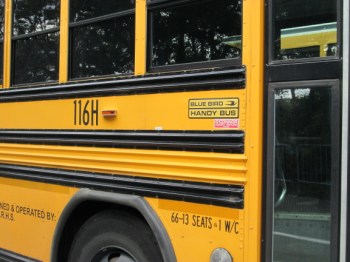
124 signFrom a distance they looked like the same four buses — not only do school buses look alike, big, long, and bright yellow, but they look a lot like they did when I was a kid back in the Pleistocene. But they weren’t the same buses. Each bus has a number. Last year the regulars were 121, 123, 124, and 117H. This year 124 is back, but with different companions: 125, 126, and 116H.

Close-up of the 116H bus

Close-up of the 116H bus

Finally I got curious about the H. What made 116H and 117H different from their buddies? This wasn’t obvious from a distance either, so I looked more closely.

116H seats fewer kids than the non-H buses — because it leaves room for a wheelchair and has a wheelchair entrance at the back. The H, it seems, stands for “Handy Bus” (so it says on the side of the bus), and “Handy” is probably shorthand for “handicap access.”

Back in the Pleistocene, the school buses in my town weren’t accessible by wheelchair. By noticing the details, I learned something about school buses. Will this ever come up in my writing? (Other than this blog, I mean.) Probably not, but who knows? If I ever write a murder mystery, maybe a school bus will have been seen at the scene of the future crime. Maybe some alert soul will have noticed the number.

Too much detail can obscure the main point.

Too much detail can obscure the main point.

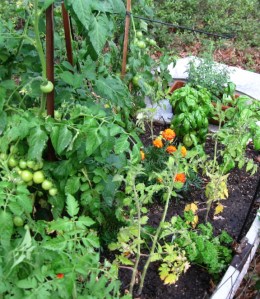
Details often sprout into images, similes, and metaphors. Images, similes, and metaphors aren’t scary when they grow organically from your own experience. If you mess around in a garden, for instance, your mind is almost certainly linking what your eyes see, your hands feel, and your nose smells to other things in your life. When I look at my little garden, sometimes I think about making pesto or eating cherry tomatoes, but other times I think, What a mess! I can’t see what’s going on here.

Which is what I sometimes think when I’m revising and come to a passage that’s drowning in detail. Pruning is good, both for prose and for shrubs.

I often think in generalities and abstractions, but when I describe my thoughts to someone else, I almost always reach for concrete images to illustrate them. No surprise there: most useful generalizations are firmly grounded in specifics. In the spring of 1970, I was a freshman at Georgetown University in Washington, D.C. Here’s a story from that time, as recounted several decades later:

Lauinger Library opened toward the end of my freshman year, about a month before the Kent State shootings shut the campus down. Within a very few weeks footpaths had appeared across the green lawn fronting the library, one leading from the main gate, the other from the corner of Healy Hall where foot traffic from several dorms and classroom buildings converged. Imagine a terrestrial ice cream cone, with the traffic circle standing in for one scoop of your favorite flavor and the tip at the library’s front door. While war raged in Southeast Asia and anti-war movements fought it across the United States and around the world, university officials battled the entire student body over the right way to walk to the library. The officials contended that we should follow the existing asphalt walkway around the perimeter of the lawn. Our footsteps, in their hundreds, then thousands and tens of thousands, countered that the shortest distance between two points was a straight line.

Our footsteps carried the day. Officialdom conceded, and the foot-beaten paths were enshrined in asphalt.

“The shortest distance between two points is a straight line”: Well, duh — everybody knows that. But the truism doesn’t stick in my mind the way that story has all these years. It taught me to pay attention to something that just about all of us tend to forget: footsteps matter.

Footsteps, come to think of it, are like details. Pay attention to them. They’re important.


Of Dots and Dashes

Dashes and ellipses. Many editors don’t like them. Dashes and ellipses take up space. They call attention to themselves. And they’re often overused: writers may resort to dashes and ellipses when they can’t figure what else to do.

But dashes and ellipses are handy critters. Used with care, they’ll help you shape your writing to say what you want and sound the way you want it to.

First off, what are they?

An ellipse consists of three periods in a row. (In British English, periods are called full stops.) Like this: . . .

There’s a space between the dots, and one at each end. What your word-processing program calls an ellipsis looks like this: … No spaces between the dots. If you want to score brownie points with your editors and your more discerning readers, don’t use this shortcut. Type dot-space-dot-space-dot.

The ellipsis serves an important purpose in academic and other nonfiction: when you’re quoting from another source and you want to abridge the quote, the ellipsis is used to indicate where words have been left out. Say I wanted to quote the second sentence in the second paragraph of this post but not all of it: “Used with care, they’ll help you shape your writing to say what you want and sound the way you want it to.”

I’d render it thus: “Used with care, they’ll help you shape your writing to . . . sound the way you want it to.”

Important resources for learning more about ellipses, dashes, and other stuff

Important resources for learning more about ellipses, dashes, and other stuff

Aside: Leaving words and whole sentences out of quoted material can distort and misrepresent the original author’s intent. Use ellipses with care. For more about this use of the ellipsis, consult your favorite style and grammar handbook.

In fiction and non-scholarly nonfiction, the ellipsis indicates a trailing off. Words are being omitted not because they’re being dropped from a quotation but because they aren’t being said.

Here’s a snippet from my novel in progress. Giles and Shannon are friends. Wolfie and Pixel are dogs. Giles is meeting Wolfie for the first time.

Giles was pointing at Wolfie. “Who, or what, is that?”

“This is Wolfie,” said Shannon. “I told you about Wolfie.”

“You did,” Giles conceded, “but I wasn’t prepared . . .” He fluttered his fingers at Pixel, who was lying in the hallway paying close attention.

Giles doesn’t complete his sentence. He shifts his focus — and the reader’s — from Wolfie to Pixel. The reader doesn’t know what Giles was about to say or why he didn’t say it.

In dialogue the dash, in contrast to the ellipsis, indicates an interruption. Here’s an example from later in the same scene. Giles and Shannon are both artists. They’re looking at a wall mural in Shannon’s house.

With his coffee mug Giles indicated a long line across the middle distance. “What this wall needs,” he pronounced, “is some movement.”

“Thank you, Mr. Picasso,” Shannon said. “You could just stand there and direct traffic —” She stopped short. “Aha!” she said, setting her coffee down and joining Giles at the wall.

Shannon interrupts herself. Dashes can also be used when characters interrupt each other. An interrupted sentence sounds different from one that trails off. It’s like the difference between walking into a door because you didn’t see it and slowing down before you get there.

Dashes have other uses too. Like commas and parentheses, they often come in pairs. Note my sentence above:

He shifts his focus — and the reader’s — from Wolfie to Pixel.

The dashes could be replaced by either commas or parentheses:

He shifts his focus,  and the reader’s, from Wolfie to Pixel.

He shifts his focus (and the reader’s) from Wolfie to Pixel.

Or the punctuation could be dropped altogether:

He shifts his focus and the reader’s from Wolfie to Pixel.

I chose dashes on the fly because I heard “and the reader’s” as a very slight detour, a stepping-back from the sentence before following it to the end. If I revise the sentence (which I probably won’t — this is a blog after all!), I might consider the alternatives. Set off by commas, “and the reader’s” is more fully integrated into the sentence, but not as fully as it would be with no punctuation at all.

Set off by parentheses, it becomes an afterthought, as in “Why include it at all?” When I put something in parens, it’s often because I have a sneaking suspicion it doesn’t need to be there but I can’t bear to delete it. The parens are there till I muster the nerve to yank it out.

Now take another look at the paragraph just before the preceding one. There’s a sentence in there that includes a dash and an exclamation point and parentheses all bundled up together. Am I going to warn you “Don’t do this at home”? I am not. I’m going to say “Try it. See if it works. If it doesn’t, try something else.”

It’s Your Call

In creative writing classes, students often study exemplary essays, stories, poems, and novels. Learn from the masters — makes sense, doesn’t it?

It does indeed. Nevertheless, much can be learned from flawed works as well.

Does that sound paradoxical?

Think about it. A top-notch work seems inevitable. There’s no trace of the earlier drafts, the ones where sentences and whole paragraphs have been deleted or moved around. There’s no hint of all the back-and-forth second-guessing the author did before settling on that word that strikes you as exactly right. A major character may have dwindled draft by draft and finally disappeared entirely. A bit player in the first draft may have wound up the star of the show.

We editors are lucky: we’re continually immersed in works that aren’t done yet. Copyeditors focus primarily on words and sentences. Substantive editors focus on structure. We develop a knack for identifying, diagnosing, and recommending fixes for whatever problems arise. (For a quickie rundown on the various levels of editing, see “Editing? What’s Editing?”) Sometimes the problem is simply an error that needs to be corrected. Other times it’s that something just doesn’t work.

On a recent job, a novel, I was supposed to be focusing on words and sentences, but before long I was acutely aware that the manuscript needed big-picture help. The novel’s title character — let’s call her Renée — has interesting adventures. She’s a spy behind enemy lines in wartime. But the author has chosen to use a first-person narrator for the entire novel — and this narrator has no contact with Renée while she’s having her interesting adventures. As a result, neither does the reader. The most interesting stuff happens off-stage.

Interesting choices open up possibilities. Not-so-interesting choices choke them off.

Travvy, whom these days I frequently call Wolfie.

Travvy, whom these days I frequently call Wolfie.

Recently, after forging bravely ahead in Wolfie, my novel in progress, I reached a crossroads — a point where choices have to be made. Wolfie, the title character, is an Alaskan malamute who’s been saved from probable death by Shannon, who already has one dog and does not want another. (See this excerpt in the Writers and Other Animals blog.)

What was Shannon most afraid of?

That Wolfie would get loose again. Wolfie’s life and Shannon’s credibility are on the line.

Well, that made it a no-brainer: Wolfie was going to get loose again. The big question was, What then?

Out walking one morning with Travvy, Wolfie’s inspiration and alter ego, I played with possible choices:

  • Wolfie is shot and killed by a farmer.
  • Wolfie is shot and disappears into the woods.

I don’t want to kill Wolfie off. He’s my title character, my wild card, and the first draft of the novel isn’t half done yet. He’s not going to die. Shannon’s going to find him first. The question is how. Shannon can’t run nearly as fast as Wolfie, so these were the obvious options:

  • The leash he’s trailing snags on a tree and he can’t get loose.
  • Wolfie finds Shannon before she finds him.

The second choice startled me: Wolfie comes back of his own accord? I ran with it. It startles Shannon too. It opens up possibilities — the sure sign of a good choice.

The rougher road often makes the more interesting choice.

The rougher road often makes the more interesting choice.

Often it’s not till the second or third draft that you recognize that more interesting choices are possible. What if the author of my recent job had thought, “Aha! If I made Renée a point-of-view character, or even a narrator, her wartime experiences would be so much more immediate and vivid”?

It would have been a much more interesting novel.

When you’re first-drafting and you reach a crossroads, ask yourself: What’s the most interesting choice I could make? What do I want to learn about my characters?

Your readers probably want to learn it too.

When you’re revising and a scene falls flat, ask yourself: What am I missing here? Where’s the conflict? Who’s the wild card? How do I make things happen?

You’re in the driver’s seat. It’s your call.


Do You NEED an Editor?

So there’s this meme circulating among some editors I know. The gist is that all writers need an editor.

Sure, every writer, and every piece of writing that aspires to be read, could use or would benefit from an editor — from a good editor, or from good editing — but need?

A brochure I created many years ago, before I realized that in my area it was one thing to need editing and quite another to be willing to pay for it.

A brochure I created many years ago, before I realized that in my area it was one thing to need editing and quite another to be willing to pay for it.

That depends. Those who insist that every writer needs an editor are mostly editors. They get paid for editing. They need paying customers at least as much as writers need editors.

All needs are not created equal.

When a water pipe breaks and water starts spraying all over the basement, you need a plumber. If the toilet bowl overflows and a plunger doesn’t fix it, you need a plumber. When a faucet starts leaking into the sink and your do-it-yourself tricks haven’t worked, you need a plumber, especially if you pay for your water. The need isn’t as pressing as when the water in your basement is two inches deep and rising, but it’s there.

You will pay the plumber to come fix your plumbing. You will probably pay extra to have him/her come ASAP, especially if it’s a weekend or a holiday (as it always seems to be when pipes break and toilets overflow). Unless money is flowing into your bank account like the water flowing into your basement, you will probably put off other, less pressing expenses in order to pay the plumber.

Last fall my dentist told me that I needed a tooth crowned. Crowns are expensive — $1,500 was the estimate. Dentistry isn’t covered by my insurance. (Don’t get me started.) It didn’t need to be done tomorrow, said my dentist, but it should be done soon. Then my car needed new rear shocks, to the tune of almost $700. The car got repaired; the dentistry got put off.

My teeth were working fine; my car wasn’t. “Soon” was not “right now.” I ranked my needs, budgeted accordingly, and carried on.

So we come round to editing. Editors are not plumbers, or car mechanics, or dentists. Your basement won’t flood, your car won’t break down, and your teeth won’t fall out if you don’t hire an editor, or if the one you do hire turns out to be inadequate.

Good editing does pay for itself, but rarely in hard currency. Nevertheless, it has to be paid for in real money. Even if you get your book, essay, or story published, the financial returns probably won’t cover what you shelled out.

But that goes double for what you put into your writing, right? More than double: we’re talking exponential here. Add up what you’ve spent on classes, workshops, and how-to books. Don’t forget the time you’ve spent writing your “million words” — the ones conventional wisdom says you have to write to develop your craft. If you were looking primarily for a tangible return on your investment, you probably would have gone into plumbing, or dentistry, or car mechanics, right?

However, if you’re a relative novice whose overriding goal is to get into print as soon as possible, you do need an editor, an excellent editor who can do all the things that good writers learn to do for ourselves. (See “Editing? What’s Editing?” for a brief breakdown of what’s involved in “editing.”) One-on-one editing is time-intensive, so expect to pay well for it.

My strong hunch is that if you’re following this blog, you’re more the do-it-yourself sort. Like me.

My two drums

My two drums

My other strong hunch is that, like me, you sometimes pay for things you don’t need. I’ve spent plenty of money competing with my dog in Rally Obedience — nothing necessary about it, but it was challenging and fun and worth the expense (until I needed a new work chair and my car needed new tires).

I joined a drumming class, loved it, and, after borrowing a drum for several months, have managed to acquire not one but two congas. These things don’t pay me back in money, but they do pay me back.

If you’re serious about your writing, and especially if you self-publish, the time will probably come when the value of good editing will be worth the money you spend on it. Worth it to you.

Meanwhile, there’s plenty you can do to develop your skill as a writer and improve whatever you’re currently working on. Some of these things don’t cost at all, and they all cost a lot less than editing. Join a writers’ group or workshop. Attend a writers’ conference. Find a couple of fellow writers to share work with. Read critically; pay close attention to how the writers you respect do what they do. (Keep in mind that they’ve probably had editorial assistance along the way.) And by all means keep writing.


Flashbacks Happen

A flashback is a trip back in time. The story leaves the main narrative line to tell a tale that happened before the narrative began. Flashbacks come in handy in both fiction and nonfiction, but they can be confusing to the reader. An excess of them may mean that the author couldn’t figure out more graceful ways to incorporate bits of backstory into the narrative.

This is an area where editors and guinea pigs (also known as second readers) can be helpful, but I digress: This post isn’t about flashbacks in a finished work. This is about the kind of flashback that happens when you’re in the throes of first-drafting.

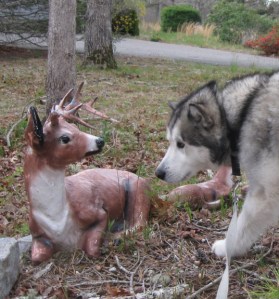
The fictional Wolfie is based on the very real Travvy. He wooed at the deer, but the deer wouldn't move.

The fictional Wolfie is based on the very real Travvy. He wooed at the deer, but the deer wouldn’t move.

The other day I was cruising along in Wolfie, the novel in progress, when my mind started to wander. The scene up ahead looked boring. I didn’t want to write it. In it my protagonist, Shannon, and her sixth-grade protégée, Glory, run a temperament test on Wolfie, the Alaskan malamute they’ve rescued from getting shot. One option was to describe the test step by step. I yawned just thinking about it. I’m writing a novel, not a dog-training manual.

Much as I love to write scenes in order, I’ve learned that it’s OK to skip over or skirt the scenes that just aren’t happening. So I sent Glory home to look after her little brother, Matt, while their parents are otherwise occupied.

So the next morning my trusty Pelikan was laying down line after line of brown ink on the page. It wasn’t terribly interesting — sibling interactions that probably won’t survive the first draft — but I had this idea that Glory might try to temperament-test her brother and that sounded like fun. They were out in the driveway. Glory had set up some plastic cones. Matt was pedaling his racing car  around them. Then Matt decides he wants to play on the swing set. He leaves his pedal car in the middle of the driveway. Glory reminds him — with more than a dash of big-sister exasperation — that it has to be put away. Matt scowls —

— and Glory is thrown back a couple of hours, to Shannon’s living room, where she and Shannon are temperament-testing Wolfie.

Oh my. The brown ink flowing out of my Pelikan created A Scene. It did everything I want a scene to do: show my characters in (inter)action, move the plot forward, and turn the heat up — raise the stakes, if you will, for the characters, for future readers, and of course for me. It didn’t sound a bit like a dog-training manual.

I write my first drafts in longhand because my handwriting is barely legible and my zealous Internal Editor can’t fuss at what she can’t read. My writers’ group meets every Sunday night, and since my fellow writers can’t read my handwriting either, I’m typing this first draft into Word as I go along. I edit lightly while I type, but I don’t second-guess myself about the big stuff; I do make notes about things to consider when I launch into serious rewrite. This typescript isn’t really a second draft. I think of it as version 1.5.

In Wolfie 1.5, however, that serendipitous scene will appear in Shannon’s living room, not in Glory’s driveway. Wolfie will be there. Little brother won’t.

Why didn’t that scene show up in its chronological order? Damned if I know. Writing is full of mysteries, and like the songwriter Iris DeMent, I’m content to “let the mystery be.” (Great song, by the way. Take a break and Google it.) Some scenes don’t show up in order. They show up when they’re ready. All you have to do is keep your hand moving across the page, or your fingers on the keyboard.


Needless Words?

“Omit needless words.” You’ve heard it, right? Maybe you’ve had it drummed into your head. It comes from Strunk and White’s famous, or infamous, Elements of Style. (More about that below.)

It’s actually pretty good advice. The tricky part is “needless.” What’s necessary and what isn’t depends on the kind of writing, the intended audience, and what the author had in mind, among other things. Consider, for example, “she shrugged her shoulders.” Taken literally, “her shoulders” is redundant — what else would she shrug? And sometimes “she shrugged” is fine. Other times, the mention of “her shoulders” emphasizes the physical aspect of the gesture, or influences the pacing of the sentence. “She shrugged” and “she shrugged her shoulders” read differently. Ditto “he blinked” and “he blinked his eyes.”

Unless you’re writing technical manuals (do people ever shrug or blink in technical manuals?), you don’t want an editor who lops off “eyes” and “shoulders” just because they’re literally redundant.

However, I do a lot of lopping off when I reread anything I’ve written. Words that served a purpose in the writing may turn out to be needless in later drafts — like the ladder you climbed in order to repaint a windowsill, they can be removed when the job is done. Nearly every draft I write is shorter than its predecessor.

Here’s an example from my novel in progress. Pixel has already been introduced as an elderly dog. Shannon is her owner, Ben their next-door neighbor.

Pixel descended the stairs with a confidence that Shannon hadn’t seen in weeks and thought might be gone for good, then trotted sprily over to Ben. Shannon followed, smiling. “Every summer I think she’s gone over the hill for good,” she said, “and with the first whiff of fall she always seems to drop a couple of years.”

Rereading, my eye balked at “and thought might be gone for good.” Wasn’t that covered by Shannon’s remark “I think she’s gone over the hill for good”? Sure it was. I struck out the needless words:

Pixel descended the stairs with a confidence that Shannon hadn’t seen in weeks and thought might be gone for good, then trotted sprily over to Ben. Shannon followed, smiling. “Every summer I think she’s gone over the hill for good,” she said, “and with the first whiff of fall she always seems to drop a couple of years.”

When I read it over, I didn’t miss those words at all, so the paragraph now looks like this:

Pixel descended the stairs with a confidence that Shannon hadn’t seen in weeks, then trotted sprily over to Ben. Shannon followed, smiling. “Every summer I think she’s gone over the hill for good,” she said, “and with the first whiff of fall she always seems to drop a couple of years.”

When I’m editing, either my own work or someone else’s, I’m always looking for what a workshop leader once called “soft ice” — words that don’t bear weight. What’s soft and what isn’t, and how soft is it, is a judgment call. I may go back and forth several times in five minutes about how soft — how needless — a word or phrase or whole sentence is.

In a current job, a memoir by a very good writer, I came upon this sentence:

As we came around the last curve, we were greeted by a scene of absolute devastation.

No problem, I thought. A couple of sentences later, I slammed on the brakes and backed up. How about this?

As we came around the last curve, we were greeted by a scene of absolute devastation.

I liked it. What the narrator saw was devastation, not a scene; “devastation” is a stronger word. But it’s the author’s call. She can stet “a scene of” if she prefers it that way.

*  *  *  *  *

While writing the above, I went looking for my copy of The Elements of Style. To my surprise, I had not one, not two, but three copies. The little paperback I probably bought myself. The illustrated version, published in 2005, was a gift. So was the decommissioned library edition. The name of the library was effectively redacted, but concealed within the book’s pages were cards from two former colleagues. One of them had given it to me as a parting gift when I left my newspaper job in 1999.
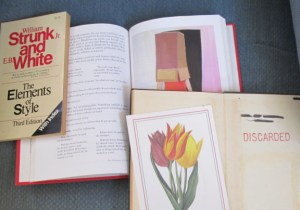
Strunk & White times three

Strunk & White times three

If you Google “strunk and white,” you’ll find that many love The Elements of Style and many, including some heavy-hitting grammarians, hate it. As I flipped through it for the first time in umpteen years, I was surprised by how much useful stuff it has in it. Yes, the tone is often prescriptive: Do it my way or else. No, it doesn’t apply equally to all kinds of writing. But it’s useful.

Strunk and White’s biggest drawback lies not within its pages but within its users. They turn guidelines into godlines, thou shalts and thou shalt nots that must not be disobeyed. This happens to The Chicago Manual of Style and Merriam-Webster’s Collegiate Dictionary too, among other reference books, so I know for sure it’s not entirely the book’s fault. When the godliners are teachers or editors, the damage they do can have a half-life of decades.

But this is no reason to jettison the books themselves. Read them. Experiment with their advice. Argue with it. Above all, take what you like and leave the rest.

And run like hell from anyone who insists you swallow them whole.

Editing? What’s Editing?

Good question. If you ask half a dozen editors, you’ll get two dozen answers. What’s a writer to do?

grammar policeEditing and writing are closely related, but they aren’t the same. Writing creates something new. Editing rearranges, refines, and otherwise messes with something that’s already been created.

Notice that I’m sticking with the verbs here, rather than trying to define what writers do and what editors do. It’s more complicated than “writers write and editors edit.” Plenty of editors are also writers. Most writers do at least some editing: that’s what second, third, and tenth drafts are about.

I encourage writers to learn as much as they can about editing. It makes us better writers. It gives us more control of our work. It saves us money, because the more we can do ourselves, the less we have to pay others to do. And when the time comes to hire an editor, we’re better able to find one who will do justice to our work.

So what’s editing, beyond messing with something that’s already been written? Here’s where it can get confusing. “Editing” can involve anything from correcting typos and grammar gaffes to rearranging paragraphs and even helping a writer build a book from scratch. So we talk about “levels of editing.” Here’s a rough guide to the levels, starting with “big picture” editing and moving down to what I call the “picky bitch stage”: catching spelling and grammar errors.

Ghostwriting. Ghostwriting is writing, not editing. I include it because I’m not the only editor who’s heard this question: “I’ve got a great idea. Can you help me turn it into a book and we can share the royalties?” The answer is no. Ghostwriting is time-intensive and therefore costly. The chances that the resulting product will earn any royalties are close to nil. My standard answer is “Sell your proposal first and then we can talk.” None of the querents has ever come back.

Developmental editing. Like ghostwriting, this involves building the manuscript from the ground up. For big projects, like textbooks, it can involve multiple authors, researchers, designers, and more. For the individual writer, it’s all the work that goes into creating a coherent complete draft. Most of us do our own developmental editing, often with assistance from writers’ groups and those generous people who volunteer to read our work and give us feedback.

Rewriting. Most of us do our own rewriting too. From the individual writer’s point of view, it’s close kin to developmental editing.

Structural editing. The structure of a work is its skeleton. When the wrist bones are connected to the thigh bones, the body doesn’t work too well. All written works have structure. Structure is what guides readers through the story or the essay. When you decide that a scene in the middle of the book has to come near the beginning or a certain character’s motivation won’t make sense, you’re messing with the work’s structure.

typoStylistic editing. This is called all sorts of things, including content editing, line editing, and copyediting. Here you go through the work line by line, asking whether each sentence, phrase, and word says what you want it to say, and in the best way possible. English is a wonderfully flexible language. Choosing the right word and putting it in the right place can make a big difference. Writers’ groups and volunteer readers (aka “guinea pigs”) can be invaluable here. You know what you meant to say, but until you get feedback from readers it’s hard to know how well it’s coming across.

prooffreadingCopyediting. I hire out as a “copyeditor,” but my work includes plenty of stylistic editing so I have a hard time distinguishing one from the other. Let’s say here that copyediting focuses on the mechanics: spelling, punctuation, grammar, formatting, and the like. With nonfiction, it includes ensuring that footnotes and endnotes, bibliographies and reference lists, are accurate, consistent with each other, and properly formatted.

Proofreading. This level is the most mechanical of all. It means catching the errors that have slipped through despite all the writer’s and editor’s best efforts. (No matter how expert the writer and editor are, there will be errors. Trust me on this. I just caught one in this sentence. No, I won’t tell.)

The Editors’ Association of Canada has a handy page on its website: “Definitions of Editorial Skills.” Other organizations, publishers, and individual editors break the skills down differently, but this list gives a good idea of all the skills that are subsumed under “editing.” Not to worry: Unless you work on big, complex projects, you’re unlikely to need more than a few of them. If you do work on big, complex projects, your team probably has all the skills required, or knows where to find them.