My Voice! Where’s My Voice?

There’s a lot of gobbledygook out there about “the writer’s voice,” also known as “the author’s voice.” Writers worry about finding their voice, and about not finding it, and about not knowing whether they’ve found it or not.

Copyeditors worry about interfering with the author’s voice, often without being too clear on what an author’s voice is, what a particular author’s voice sounds like, and when it’s OK to mess with it.

Agents and acquisitions editors often claim that it’s the writer’s voice that lifts a manuscript from the slush pile and into the elite ranks of the Traditionally Published. What exactly do they mean by that?

When I hear writers talk about finding their voices, this is the image that comes to mind: "His Master's Voice."

When I hear writers talk about finding their voices, this is the image that comes to mind: “His Master’s Voice,” the voice coming out of the record player. Where the hell did my voice go? Who’s talking?

Time to cut through the obfuscation and mystification. Your writer’s voice isn’t something you find, like the prize at the end of a treasure hunt or the pot of gold at the end of the rainbow. It’s something you develop on the journey.

If you’re writing in English, you start with pretty much the same rules and conventions as everybody else. The way you use, abuse, ignore, and stretch those rules and conventions will be influenced by the things you choose to write about, the audience(s) you’re writing for, your traveling companions, the places you pass through and sojourn in, and so on and on.

Think about it: Our speaking voices are flexible. We can whisper or we can shout. The foul-mouthed among us can clean up our language when we’re in polite company or interviewing for a job. Our writing voices can be likewise.

In some kinds of writing, the writer’s individual voice takes a back seat. News reporting, technical writing, scientific writing, the writing in textbooks and legal documents: these don’t generally show much personality. They’re not supposed to. They’re supposed to communicate clearly and, often, concisely. The writers write and the editors edit with this in mind. It takes tremendous skill to do this well.

Note, however, that some lawyers and academics write novels, journalists write memoirs, business people write poetry, and scientists write essays for the popular press. The novels don’t sound like legal briefs, the memoirs don’t sound like front-page news stories, the poems don’t sound like annual reports, and the newspaper op-eds don’t sound like scientific papers, even though they’re written by the same person.

Even though the writers are almost certainly applying the skills they’ve developed in one milieu to the writing they’re doing in another.
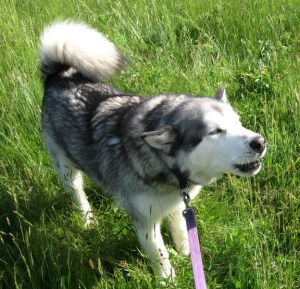
Travvy

My malamute, Travvy, has a flexible voice. Here he is trying to persuade a tractor to move.

These writers have flexible voices that can be adapted to different kinds of writing. I know a bit about this because over the years I’ve written reviews, essays, poems, news stories, op-eds, newspaper features, short stories, one-act plays, and a novel, not to mention something like 500 blog posts. Some forms I’m more comfortable with than others, some I’m better at than others, but they’re all coming out of the same well of words, opinions, and experiences that is contained in my brain.

Flexibility is especially important for fiction writers and writers of “creative nonfiction” — which seems to mean by definition nonfiction that encourages a distinctive authorial voice. Characters speak in different voices, and all those voices come out of the writer’s head.

The writers of memoir and travelogue often have occasion to quote actual people. This requires first the ability to listen attentively and then the ability to translate the other person’s voice onto the printed page. Sometimes this means putting words in the other person’s mouth that the other person never said. If the other person is dead or fictitious, he or she won’t sue for libel — but astute readers often know when a character steps out of character. When the lapse is obvious enough, the reader may lose confidence in the character, the story, and the author.

My editorial diet is similarly varied. Most of it is nonfiction, but it ranges from scholarly books and dissertations to memoirs, essay collections to book-length works by journalists. Most of the novels I edit are stand-alones: they aren’t part of a series, and they don’t belong to a recognizable genre. Each genre and kind of writing has its own conventions and its own objectives, and in most cases some flexibility is allowed — even encouraged.

In the early pages and chapters — I work primarily on book-length works — I listen for the author’s voice. Sometimes it’s distinctive; often it’s fairly subtle. I notice the words and constructions that the author is particularly fond of. These are perfectly OK in themselves, but used to excess they can become cloying. Some authors (like me) like long sentences and write them well, but that doesn’t mean that the occasional long sentence doesn’t get tangled enough to trip even a careful reader up.

I do this pretty much without thinking. If you asked me at the end of a job to describe the author’s voice, I’d have a hard time doing it — until I went back with a more analytical eye and identified the various components that make up the author’s style. As a result, I can be a little suspicious when agents, acquisitions editors, and writing teachers go on and on about the importance of that mystical, mystifying entity, “the writer’s voice.”

A few weeks back, though, I was reminded of just how important a writer’s voice can be. A writer I didn’t know asked me to critique his just-completed novel. Like many another editor upon receiving a similar request, I was wary. Most such manuscripts turn out to need serious work before they become publishable, or even readable. “Serious work” translates into serious time, which means serious money. The writer doesn’t have it, or doesn’t want to spend it, and I can’t afford to work for nothing.

So I asked to see a chapter or two. I was already bracing myself for frustration.

Then I started reading. Sure, the punctuation needed work and some of the word choices were a little off, but it was clear almost immediately that the author was one hell of a storyteller and that he had one hell of a story to tell.

Send me the whole thing, I said.

Since then that storyteller’s voice has conjured scenes I couldn’t imagine, taken me places I didn’t want to go, and made me laugh at the same time. This voice isn’t my voice, but it’s so strong and distinctive that I’ve had no trouble slipping inside it and hearing it while I meddle with the punctuation, rearrange the occasional sentence, and ask questions about things that aren’t clear.

Editing doesn’t get much better than this.

When this novel makes it into print, you will hear about it. I promise.
 

Editing Workshop, 2

Cherie O’Boyle asked: “When I am using a proper company name in my fiction, for example, when my character buys all her clothes mail order from Lands’ End, or spends Sunday morning reading the New York Times, should those names be italicized?”

Names of companies, like Lands’ End (note the placement of the apostrophe: they goofed when they registered the name, and it’s been their tradename ever since), aren’t italicized. They’re treated like the names of places and people. Names of newspapers are italicized. The Chicago Manual of Style recommends lowercasing the “the” before a newspaper’s name and setting it in roman (not italic), even when it’s part of the name. The Associated Press (AP) style manual wants the title styled exactly the way the newspaper does it. For most fiction and nonfiction, Chicago‘s style is fine: it saves you having to verify each newspaper’s “real” name.

Italics or roman? Quotes or no quotes? These questions come up often, but they don't have to drive you nuts.

Italics or roman? Quotes or no quotes? These questions come up often, but they don’t have to drive you nuts.

How to style these names? Italics or roman type? Quotation marks or no quotation marks? Like other copyeditors, I’ve got a truly terrifying number of such details stuffed into my brain. Ask the right question and out they come, almost as fast as the hits in a Google search.

But you don’t have to memorize a pesky plethora of picky details. (Sorry about that: I’m feeling alliterative this morning.) Learn the general principles for your kind of writing and you’ll get it right at least 95 percent of the time. Here are some common conventions for styling proper nouns and the titles of works in general fiction and nonfiction.

Names

The names of places, pets, brand-name products, businesses, organizations, government agencies, and the like are styled like the names of people: roman type, initial caps on each major word. My name is Susanna J. Sturgis, my dog’s name is Masasyu’s Fellow Traveller (his friends call him Trav or Travvy), I shop at Reliable Market, I buy clothes from Duluth Trading (and other places), etc.

When you’re using the name of a real place, person, or company, spell it right. Look it up even if you’re 100 percent sure you already know how to spell it. Some names of products and companies style their names in unconventional ways. WordPress is one word with a cap in the middle. (That’s popularly called a “camel cap.”) The other day I bought a fountain pen on eBay. I don’t have an iPad or an iPod but some of my friends do. I and most editors avoid putting such names at the beginning of a sentence, because both “EBay is an auction site” and “eBay is an auction site” look weird.

Companies often create distinctive logos from their names. You do not have to style a name in ALL CAPS just because the company’s logo is in ALL CAPS. You don’t need to use a backwards “R” in Toys R Us. You don’t need to use the ™ (trademark) or © (copyright) symbol just because the company does — unless you’re working for the company, in which case you follow company policy.

The names of ships, however, are generally italicized. Go figure.

Titles of Works

Style guides devote lots of space to the styling of names and titles. If you do a lot of your own editing, they'll teach you what styles are common for your kind of writing.

Style guides devote lots of space to the styling of names and titles. If you do a lot of your own editing, they’ll teach you what styles are common for your kind of writing.

As noted above, the names of newspapers, magazines, academic journals, and newsletters are italicized. So are the names of comparable online publications, like blogs. This blog is Write Through It. Writers and editors are still feeling our way toward a consistent way of styling online entities. At present, websites are often treated like places: initial caps, roman type. But blogs are treated like publications: initial caps, italics.

In general, books, full-length plays and musical works, record albums, and the like are italicized. Shorter works, like poems, songs, one-act plays, essays, and short stories, are styled in roman type and enclosed in double quotation marks (if you’re writing American English, that is; British English would use single quotes here). So are particular blog posts, like “Editing Workshop, 2.”

There’s plenty of gray area here. For instance, when a novella (which can be thought of as either a long short story or a short novel) is published by itself, its title is often italicized. Ebooks can be any length, from a few pages to several hundred. Classical music has its own naming conventions. If you write about classical music, they’re worth getting to know — and the chances are good that you’ve already picked them up from your reading.

That’s the key: Get to know the conventions in whatever field or genre or discipline you’re working in. And look stuff up even when you already know it.


No Need to Shout!!

99% of all editors, writing instructors, and experienced writers will tell you: “Use emphasis sparingly.” Emphasis includes ALL CAPS, bold, underscore, and italics. And exclamation points!!!

(OK, 99% is an unverified statistic. I made it up — you know, to emphasize my point.)

This is why our gatekeeper friends will relegate a manuscript to the slush pile if the first couple of pages include too many italicized, bolded, underscored, or ALL CAPPED words and phrases. Fairly or not, they’re leaping to the conclusion that the writer who relies heavily on gimmicks is not ready for prime time.

How many is “too many”? If they’re the first thing a person notices when she pulls your ms. out of the envelope or opens the file, that’s too many. Aim for “none” and you’ll probably get it about right.

“But,” you wail, “how do I show what’s important?”

Good question!

When we speak, we can emphasize words and phrases by speaking them more loudly, or drawing them out, or exaggerating their each and every syllable. We can use our hands and our faces to express our feelings or underscore a point.

You can replicate some of these methods in writing. You can describe how a character said something and/or what she was doing while she said it. Too much description, though, can slow a passage down when you want it to move right along. Lucky for all of us, written English offers some powerful tools to call attention to whatever you want to call attention to. and without using ALL CAPS, bold, underscore, italics, and other gimmicks. Learning to use them is part of the writer’s craft.

So how does one go about this?

Here’s where I advise even non-poets to read lots of poetry. Good poets make every word count. They have to: poems use fewer words than stories, essays, and full-length books. They read their written words aloud and pay attention to how they sound. Poets who work in traditional forms, like the sonnet, use meter and rhyme to emphasize important words. Words at the ends of lines and lines at the ends of stanzas get particular emphasis. And so on.

Prose writers use sentences and paragraphs the way poets use lines and stanzas. Words at the beginning and, especially, at the end of a sentence are emphasized. Likewise sentences at the beginning or end of a paragraph, and paragraphs at the beginning or end of a scene.

Have you ever confronted a paragraph that sits on the page like a dark gray lump? One sentence follows another with no break, maybe for a whole page or more. If the eye gives in to the natural temptation to skim through to the end, the mind is almost certainly going to miss something important.

But there’s no need to bold or italicize the sentence you want to call the reader’s attention to. If that paragraph belongs to you, try breaking it so that your key sentences fall either at the end of one paragraph or the beginning of another. If you’re reading it in a book, identify a place or two where author or editor might have started a new paragraph. (You may not find any such places. It’s possible that the paragraph really needed to be that long.)

I like long loopy sentences, but I also know that long sentences tend to lose energy. So I pay close attention to the words, phrases, and clauses that make them up. When I’m editing, I’ll sometimes break a compound sentence in two in order to focus more attention on each of its parts.

Here’s where the oft-repeated advice to “omit needless words” comes in handy. “Needless words” are the ones that camouflage or otherwise distract attention from the important stuff. What’s tricky is that you have to identify the important stuff before you can decide what’s needless, and this often doesn’t happen till a second or third draft.

The best way to develop your skill at emphasizing key points without resorting to gimmicks!! is by experimenting on your own work, getting feedback from editors and other writers, and giving feedback to other writers on their in-process work. Anyone out there have an example to share with other readers of this blog? Keep it fairly short, say 100 words or so. You can use either the comments link at the top of this post or the contact form in the “You!” tab on the menu bar.


What’s a Style Sheet?

I knew nothing about style sheets when I started copyediting books for trade publishers and university presses. Before long I thought style sheets were the greatest thing since mocha chip ice cream — well, almost.

So what’s a style sheet? More important, if you’re a writer, not an editor, why should you care?

English is a richly diverse language. British English (BrE) and American English (AmE) often spell the same word differently: spelt/spelled, labour/labor, tyre/tire. In AmE, some words can be spelled in more than one way, like ax and axe, or façade and facade. Others have variations that are pronounced differently but mean the same thing: amid and amidst, toward and towards.

And hyphens! Don’t get me going about hyphens. One of these days I’ll devote a whole blog post to hyphens. Sometimes a hyphen is crucial: consider, for instance, the difference between coop and co-op. Often the hyphen is helpful but not crucial. When I look at reignite, the first thing I see is reign. If an author wants to hyphenate it, re-ignite, that’s fine with me. For most readers, the hyphen in living-room sofa isn’t essential, but if the author has written it that way, I’ll generally leave it alone — and insert a hyphen in dining-room table if the author has left it open.

A style sheet collects all such choices into one handy list: choices not only about how words are spelled but about how they’re styled. Hyphenation is often a matter of style rather than spelling. When do you spell out numbers and when do you use figures? Are abbreviations OK? When the dictionary notes that a word is “often capped” or “usually capped,” which does the writer prefer?

It’s a rare author who submits a style sheet with his or her manuscript. A recent job included Arabic and Urdu terms transliterated into English, and many personal and place names that are transliterated in myriad ways. The author did include a style sheet with his preferred spellings and stylings, and I was profoundly grateful. It saved me a lot of online research and second-guessing.

In fact-checking another recent job, a novel, I quickly discovered discrepancies between the names of some real-life places and the way my author was spelling them. Other names were faithful to the actual place. I’m still not sure whether these discrepancies were intentional or not. If the job had come with a style sheet, I would have known — and I wouldn’t have spent so much time trying (unsuccessfully) to verify the author’s versions.

Why should you, the writer, keep a style sheet?

Maintaining consistency in a novel or long nonfiction work is a challenge. Sure, if you’re working on the computer, you can use the search function to find earlier instances of a word or name — or you could just consult your style sheet. If you’re writing a series involving the same locations and characters, a style sheet will be even more useful.

Whether you self-publish or publish with a trade, academic, indy, or small press, your style sheet means your copyeditor doesn’t have to start from scratch. If she finds inconsistencies in the ms., she’ll be able to go with your preference instead of guessing what you want.

Several books that appear frequently in my "Primary References" section

Several books that appear frequently in my “Primary References” section

I find that keeping a style sheet makes me more conscious of my choices, whether I’m editing or writing. Plenty of choices are “six of one, half dozen the other.” Others are a matter of style: for instance, do you prefer diacritics in words like façade and résumé and naïve? And sometimes, especially with proper nouns, it’s a matter of right and wrong. In the very well written nonfiction book I just finished copyediting, Katherine Hepburn’s name was so spelled. I’ve seen it so often (mis)spelled that way, I didn’t have to look it up (but I did anyway): it’s Katharine, with an a. Before you enter a name on your style sheet, verify the spelling.

If you write fantasy or science fiction, with made-up names that can’t be verified online, a style sheet can be especially useful. Same goes if, in either fiction or nonfiction, you’re dealing with names from other languages, especially languages that don’t use the Roman alphabet. Transliteration systems differ. Accents and diacritics and other spelling conventions can be confusing to someone who doesn’t know the language.

You can organize your style sheet in any way that makes sense to you and whatever you’re working on. Here are the major categories and subcategories in the style sheet I made for a just-completed job, with a brief explanation of each. Most of mine follow a similar format.

Primary References

Here’s where I put whatever dictionaries, style guides, and other reference works I’m using. This keeps my word list (see below) under control: it means I only have to list spellings and stylings that differ from the dictionary’s or style guide’s recommendation.

General

This section is for style choices that apply to the whole book. Number 1 is nearly always “serial comma.” Number 2 usually specifies either “which/that distinction observed” or “which OK for restrictive clauses.” (Anyone want a crash course on the which/that distinction??)

This particular style sheet had subsections for Capitalization, Hyphens & Dashes, Quotes & Italics, and Slashes. Most also have a Numbers subsection, but not this one.

Words

Word lists can be short or long. They should include choices made where alternatives exist, e.g., axe rather than ax, or vice versa. They’ll probably include plenty of words where capitalization, hyphenation, the use of italics, or the styling of numbers is at issue. Their #1 purpose is to help me keep my choices and the author’s straight.

Among the words and phrases in my list were the following (with the reason I included each one):

Braille (can be lowercased)

carpe diem (like other foreign-language expressions listed in the dictionary, it’s usually not italicized)

coauthor (commonly hyphenated)

 decision-making (n.) (decision making and decisionmaking are also possible)

 not-yet-imagined, the (coinage by the author)

 rebbe (variant spelling of rabbi)

transparence (variant of transparency)

Trickster tales (Trickster capped as an archetype)

Western (cultural); western (n.; genre): compass directions are usually lowercased, except when they take on a more-than-geographical meaning. Eastern and Western may signify large cultural groupings. During the Cold War, they had political significance. (North and South are generally capped in reference to the sides in the U.S. Civil War.) And western the genre is sometimes capped and sometimes not. Could drive you crazy, no?

Names

Some copyeditors list the names of virtually every person mentioned in a book. As a proofreader, I don’t find such exhaustive lists useful. So I don’t list familiar names that are easily verified — unless they are frequently misspelled (like Katharine Hepburn) or the author is inconsistent. It can be hard to verify names with particles (von, van, de, etc.), partly because styling varies from family to family and because online references aren’t always as authoritative as they think they are. So it’s worth putting them on the style sheet.

serenity prayer

A good style sheet helps editors and proofreaders recognize what should be changed and what’s fine as it is.

Needless Words?

“Omit needless words.” You’ve heard it, right? Maybe you’ve had it drummed into your head. It comes from Strunk and White’s famous, or infamous, Elements of Style. (More about that below.)

It’s actually pretty good advice. The tricky part is “needless.” What’s necessary and what isn’t depends on the kind of writing, the intended audience, and what the author had in mind, among other things. Consider, for example, “she shrugged her shoulders.” Taken literally, “her shoulders” is redundant — what else would she shrug? And sometimes “she shrugged” is fine. Other times, the mention of “her shoulders” emphasizes the physical aspect of the gesture, or influences the pacing of the sentence. “She shrugged” and “she shrugged her shoulders” read differently. Ditto “he blinked” and “he blinked his eyes.”

Unless you’re writing technical manuals (do people ever shrug or blink in technical manuals?), you don’t want an editor who lops off “eyes” and “shoulders” just because they’re literally redundant.

However, I do a lot of lopping off when I reread anything I’ve written. Words that served a purpose in the writing may turn out to be needless in later drafts — like the ladder you climbed in order to repaint a windowsill, they can be removed when the job is done. Nearly every draft I write is shorter than its predecessor.

Here’s an example from my novel in progress. Pixel has already been introduced as an elderly dog. Shannon is her owner, Ben their next-door neighbor.

Pixel descended the stairs with a confidence that Shannon hadn’t seen in weeks and thought might be gone for good, then trotted sprily over to Ben. Shannon followed, smiling. “Every summer I think she’s gone over the hill for good,” she said, “and with the first whiff of fall she always seems to drop a couple of years.”

Rereading, my eye balked at “and thought might be gone for good.” Wasn’t that covered by Shannon’s remark “I think she’s gone over the hill for good”? Sure it was. I struck out the needless words:

Pixel descended the stairs with a confidence that Shannon hadn’t seen in weeks and thought might be gone for good, then trotted sprily over to Ben. Shannon followed, smiling. “Every summer I think she’s gone over the hill for good,” she said, “and with the first whiff of fall she always seems to drop a couple of years.”

When I read it over, I didn’t miss those words at all, so the paragraph now looks like this:

Pixel descended the stairs with a confidence that Shannon hadn’t seen in weeks, then trotted sprily over to Ben. Shannon followed, smiling. “Every summer I think she’s gone over the hill for good,” she said, “and with the first whiff of fall she always seems to drop a couple of years.”

When I’m editing, either my own work or someone else’s, I’m always looking for what a workshop leader once called “soft ice” — words that don’t bear weight. What’s soft and what isn’t, and how soft is it, is a judgment call. I may go back and forth several times in five minutes about how soft — how needless — a word or phrase or whole sentence is.

In a current job, a memoir by a very good writer, I came upon this sentence:

As we came around the last curve, we were greeted by a scene of absolute devastation.

No problem, I thought. A couple of sentences later, I slammed on the brakes and backed up. How about this?

As we came around the last curve, we were greeted by a scene of absolute devastation.

I liked it. What the narrator saw was devastation, not a scene; “devastation” is a stronger word. But it’s the author’s call. She can stet “a scene of” if she prefers it that way.

*  *  *  *  *

While writing the above, I went looking for my copy of The Elements of Style. To my surprise, I had not one, not two, but three copies. The little paperback I probably bought myself. The illustrated version, published in 2005, was a gift. So was the decommissioned library edition. The name of the library was effectively redacted, but concealed within the book’s pages were cards from two former colleagues. One of them had given it to me as a parting gift when I left my newspaper job in 1999.

Strunk & White times three

Strunk & White times three

If you Google “strunk and white,” you’ll find that many love The Elements of Style and many, including some heavy-hitting grammarians, hate it. As I flipped through it for the first time in umpteen years, I was surprised by how much useful stuff it has in it. Yes, the tone is often prescriptive: Do it my way or else. No, it doesn’t apply equally to all kinds of writing. But it’s useful.

Strunk and White’s biggest drawback lies not within its pages but within its users. They turn guidelines into godlines, thou shalts and thou shalt nots that must not be disobeyed. This happens to The Chicago Manual of Style and Merriam-Webster’s Collegiate Dictionary too, among other reference books, so I know for sure it’s not entirely the book’s fault. When the godliners are teachers or editors, the damage they do can have a half-life of decades.

But this is no reason to jettison the books themselves. Read them. Experiment with their advice. Argue with it. Above all, take what you like and leave the rest.

And run like hell from anyone who insists you swallow them whole.

Author’s Voice

I get nervous when editors talk about “preserving the author’s voice.” There’s often a condescending tinge to it, as if “preserving the author’s voice” means putting up with sloppy writing. It doesn’t. It does, however, require a certain flexibility on the editor’s part. It may mean bending “rules” that aren’t rules at all, like “never split an infinitive” or putting a comma where the Chicago Manual of Style says you don’t need one. This makes some editors, especially copyeditors, uncomfortable. (For a rough breakdown of the “levels” of editing, see “Editing? What’s Editing?”)

Travvy, my Alaskan malamute, had no trouble finding his voice. He's very articulate, but he doesn't know beans about punctuation.

Travvy, my Alaskan malamute, had no trouble finding his voice. He’s very articulate, but he doesn’t know beans about punctuation.

I don’t think “author’s voice” had been invented when I started writing, so I never worried about finding mine.

I hope you won’t either.

If you write a lot, you will develop your own style. All the choices you make — about words, sentence structure, punctuation, and paragraphs, and especially about how to put them together — become your style. If you keep writing, it’ll evolve, depending on what you’re writing about.

Reading is crucial here. Read good writers. Pay attention to how they solve problems. If they’re really good, you might not realize that they ever had a problem. Trust me, they did. They do. They deal with awkward transitions, flaccid sentences, unconvincing characters, and all the other stuff that makes you want to tear your hair out and give up.

Even if you don’t have any problems (for the moment), you can pick up new tricks to try. The more tools you’ve got in your toolkit, the better. Go ahead and try writing in the style of an author you like. Or, maybe even better, an author you don’t like.

If you keep writing, you will develop your own style. You’ll find your voice. Trust me on this. It will happen.

Different kinds of writing do impose different requirements. Sometimes the author’s individual voice takes a back seat to the demands of the job. Think reporting. Think technical writing. If you work in such a field, you’ll develop a style that’s suited to it. Your editors will edit your work with the demands of the field in mind. This doesn’t mean you can’t do other kinds of writing as well. The ability to marshal facts and write clearly can come in handy anywhere.

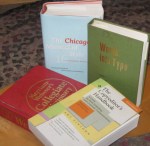
Some useful tools of the writer's trade. They're here to help you, not drive you huts.

Some useful tools of the writer’s trade. They’re here to help you, not drive you huts.

Yes, you should learn the rules and conventions of whatever language(s) you’re writing in. Contrary to popular belief, these rules were not invented to drive students crazy. They’ve developed over time to facilitate communication between writers and readers. They’re tools. Tools are as important to writers as they are to carpenters and car mechanics. When a writer isn’t comfortable with a particular tool, awkwardness can result.

At the moment I’m copyediting a nonfiction book whose author seems uncomfortable with pronouns. Instead of writing “he” or “him,” “she” or “her,” he repeats the subject’s name — and to avoid repetitiousness he’ll use the first name here, the last name there, and sometimes a nickname if the subject has one. It took me a while to sort out which names belonged to the same person.

If used consciously, this technique can convey nuance and tone. You can refer to a person (including, need I say, a fictional character) by his or her last name in formal situations, then use the first name when s/he’s hanging out with friends. Switching from one to the other will then suggest to your alert readers what mode the person is operating in, what figurative hat s/he has on.

Don’t worry about finding your voice. You’ve already got one. Think of all the ways you use your speaking voice. You can SHOUT. You can whisper. You can sing. You can runwordstogether or you can pause. between. each. one. Addressing a group, you speak more carefully than you do when you’re talking with friends. Your author’s voice can be just as flexible and at the same time just as much you. Keep writing!


Editing? What’s Editing?

Good question. If you ask half a dozen editors, you’ll get two dozen answers. What’s a writer to do?

grammar policeEditing and writing are closely related, but they aren’t the same. Writing creates something new. Editing rearranges, refines, and otherwise messes with something that’s already been created.

Notice that I’m sticking with the verbs here, rather than trying to define what writers do and what editors do. It’s more complicated than “writers write and editors edit.” Plenty of editors are also writers. Most writers do at least some editing: that’s what second, third, and tenth drafts are about.

I encourage writers to learn as much as they can about editing. It makes us better writers. It gives us more control of our work. It saves us money, because the more we can do ourselves, the less we have to pay others to do. And when the time comes to hire an editor, we’re better able to find one who will do justice to our work.

So what’s editing, beyond messing with something that’s already been written? Here’s where it can get confusing. “Editing” can involve anything from correcting typos and grammar gaffes to rearranging paragraphs and even helping a writer build a book from scratch. So we talk about “levels of editing.” Here’s a rough guide to the levels, starting with “big picture” editing and moving down to what I call the “picky bitch stage”: catching spelling and grammar errors.

Ghostwriting. Ghostwriting is writing, not editing. I include it because I’m not the only editor who’s heard this question: “I’ve got a great idea. Can you help me turn it into a book and we can share the royalties?” The answer is no. Ghostwriting is time-intensive and therefore costly. The chances that the resulting product will earn any royalties are close to nil. My standard answer is “Sell your proposal first and then we can talk.” None of the querents has ever come back.

Developmental editing. Like ghostwriting, this involves building the manuscript from the ground up. For big projects, like textbooks, it can involve multiple authors, researchers, designers, and more. For the individual writer, it’s all the work that goes into creating a coherent complete draft. Most of us do our own developmental editing, often with assistance from writers’ groups and those generous people who volunteer to read our work and give us feedback.

Rewriting. Most of us do our own rewriting too. From the individual writer’s point of view, it’s close kin to developmental editing.

Structural editing. The structure of a work is its skeleton. When the wrist bones are connected to the thigh bones, the body doesn’t work too well. All written works have structure. Structure is what guides readers through the story or the essay. When you decide that a scene in the middle of the book has to come near the beginning or a certain character’s motivation won’t make sense, you’re messing with the work’s structure.

typoStylistic editing. This is called all sorts of things, including content editing, line editing, and copyediting. Here you go through the work line by line, asking whether each sentence, phrase, and word says what you want it to say, and in the best way possible. English is a wonderfully flexible language. Choosing the right word and putting it in the right place can make a big difference. Writers’ groups and volunteer readers (aka “guinea pigs”) can be invaluable here. You know what you meant to say, but until you get feedback from readers it’s hard to know how well it’s coming across.

prooffreadingCopyediting. I hire out as a “copyeditor,” but my work includes plenty of stylistic editing so I have a hard time distinguishing one from the other. Let’s say here that copyediting focuses on the mechanics: spelling, punctuation, grammar, formatting, and the like. With nonfiction, it includes ensuring that footnotes and endnotes, bibliographies and reference lists, are accurate, consistent with each other, and properly formatted.

Proofreading. This level is the most mechanical of all. It means catching the errors that have slipped through despite all the writer’s and editor’s best efforts. (No matter how expert the writer and editor are, there will be errors. Trust me on this. I just caught one in this sentence. No, I won’t tell.)

The Editors’ Association of Canada has a handy page on its website: “Definitions of Editorial Skills.” Other organizations, publishers, and individual editors break the skills down differently, but this list gives a good idea of all the skills that are subsumed under “editing.” Not to worry: Unless you work on big, complex projects, you’re unlikely to need more than a few of them. If you do work on big, complex projects, your team probably has all the skills required, or knows where to find them.