Serialissima

If you hang out with editors and armchair grammarians, you soon learn that the serial comma is a contested issue.

You will hear some defend to the death their right not to use it, while others insist that every time it’s omitted the English language teeters closer to the brink of collapse.

If you hang out with editors and armchair grammarians or count them among your Facebook friends, it’s best to keep Sturgis’s Law #16 in mind. In the annotation of Sturgis’s Laws I haven’t got there yet , but here’s a sneak preview:

The amount of discussion devoted to an issue is inversely proportional to the issue’s importance and to the preparation required to say anything meaningful about it.

So what exactly is this little mite that inspires such passion?
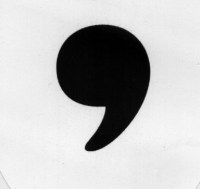
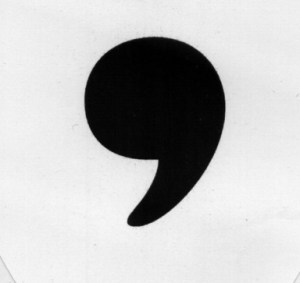
comma

Commas in isolation are hard to distinguish from apostrophes.

The serial comma is also called the Oxford comma, but I prefer “serial,” and not just because I live on the left side of the Atlantic. The serial comma, after all, is about how one punctuates series of three or more items, specifically about whether one should use a comma before the conjunction that precedes the last element.

This sentence is widely circulated by serial-comma fans to prove their point: “I’d like to thank my parents, Ayn Rand and God.” You’ve probably seen it, or one very like it.

Without the serial comma, “Ayn Rand and God” could be an appositive phrase. Is the writer really saying that Ayn Rand and God are his/her parents? Ha ha ha.

As an argument for the serial comma, however, this example is less than persuasive. Take any sentence out of context and myriad misreadings become possible. The Associated Press style guide, widely used by newspapers and businesses across the U.S., generally doesn’t recommend the serial comma unless confusion might result from its absence. The sky hasn’t fallen in yet, and besides, if one fears confusion might result from “my parents, Ayn Rand and God,” one is free to insert a comma after “Rand.”

That said, I’m a serial-comma fan. This has as much to do with habit as anything else. I don’t recall anyone making a big deal about serial commas when I was in school, but when I was an apprentice editor in the very late 1970s, “Chicago style” — currently codified in The Chicago Manual of Style, 16th edition — was drummed into my head. Chicago recommends the serial comma, as do most U.S. publishers.

As a result, I’m used to it. I notice when it’s not there. Here’s a sentence chosen at random from my novel in progress. The speaker is referring to Moshup, the giant of Wampanoag legend.

“He caught whales one-handed, cooked them up here, and shared the meat with the resident Wampanoags.”

To my eye and ear, the comma after “here” makes clear that there are three elements here, not two. If that comma isn’t there, my eye slides to the end of the sentence without registering the slight break that separates the third element from the second. A reader who doesn’t expect a comma there probably isn’t going to miss it.

Sometimes, however, I want my eye to slide to the end of a phrase. The U.S. flag is often called “the Red, White and Blue.” We say it almost as if it’s one word: “the RedWhiteandBlue.” With a comma after “White” I visualize three distinct colors, not a single flag. If I wrote “The flag is red, white, and blue,” would I use the serial comma? Yes, I would. (I just did.)

The serial comma is rarely used, by the way, when the conjunction “and” is represented by an ampersand: “The flag is red, white & blue.” Ampersands are rarely used in formal or even informal writing, so this comes up more often in display type, like advertisements, posters, and headlines. Why is this? Damned if I know, but the big ampersand dwarfs the tiny comma so I don’t blame the comma for wanting outta there.

But it’s more than habit and long experience that makes me a serial-comma fan. Because I generally use it, I can use its omission to shape the meaning of a phrase. Here’s a simple example:

Gathered in the foyer were colleagues, writers, and editors she’d known for years.

“Colleagues, writers, and editors” are three distinct groups, right? Now remove the commas after “writers”:

Gathered in the foyer were colleagues, writers and editors she’d known for years.

“Writers and editors” is now in apposition to “colleagues.” In other words, the writers and editors are her colleagues.

To a non-serial-comma user the second sentence could go either way: two groups or three? The astute non-serial-comma user might insert a serial comma here if three groups were meant, realizing that this is an instance where the serial comma serves a purpose. With any luck the non-serial-comma-using copyeditor would realize as much and not delete it.

So I use the serial comma regularly because if I do, its omission becomes a tool in my toolkit. Even if I only use it a few times a month, I like knowing it’s there.

How Clear Is Clear Enough?

20151007 blot 2The English language is a mother lode for punsters. So many words and phrases have multiple meanings. Viewed from a different angle, an innocuous phrase becomes hilarious. I love puns.

The very same quality makes English rich with possibilities for ambiguity and confusion. Here’s an example from the scene I took to my writers’ group last night. Shannon and Jackie are doing some sightseeing. Shannon is driving.

“As they drove by the old Keith farm on Middle Road, Shannon pointed out Jackie’s window.”

One group member stalled on “pointed out.” After a moment she understood what I meant, but, she pointed out, “point out” can mean “call attention to” as well as “point to something outside.” (See what I mean?)

At this point, I have a choice: leave it as is or reword it. On one hand, this is not a gaffe that will provoke the reader to gales of laughter. On the other, this is not a sentence that I want anyone to stumble over. Most important, it’s easy to fix. This morning, while reviewing the feedback from my writers’ group, I made a little change:

“As they drove by the old Keith farm on Middle Road, Shannon pointed a forefinger toward Jackie’s window.”

Part of an editor’s job is to misread everything that can be misread. The writer thinks something is perfectly clear; the editor says, “I’m not sure what you mean here.” This is one reason that writers sometimes think editors are a pain in the butt. (Being both writer and editor, I often think I’m a pain in the butt, so don’t feel bad.)

This is also why it’s an excellent idea to have others read your work before you send it out into the world: peers or colleagues, a writers’ group, maybe even a professional editor. At the very least, let it sit for a week or two or three, then read it as if you’ve never read it before. Be warned, though: This takes practice, and it’s never as reliable as having others read it.

Often a reader’s “Huh?” will prompt a rewording that works better than the original. Sometimes you’ll decide to stick with the original, perhaps because it’ll be readily understood by your target audience(s), or perhaps because all the fixes you come up with make it worse. It’s the writer’s call, but writers are usually better off for having some idea of how our writing is coming across to readers.

Sturgis’s Law #7

ink blot 2Last spring I started an occasional series devoted to Sturgis’s Laws. “Sturgis” is me. The “Laws” aren’t Rules That Must Be Obeyed. Gods forbid, we writers and editors have enough of those circling in our heads and ready to pounce at any moment. These laws are more like hypotheses based on my observations over the years. They’re mostly about writing and editing. None of them can be proven, but they do come in handy from time to time. Here’s #7:
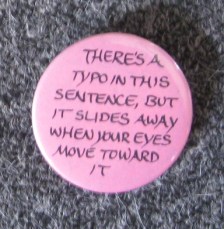
It’s hard to see the whole when you’re up too close, and easy to see unity when you’re too far away.

Notice how some people will make sweeping generalizations about huge groups of people they know very little about, then call you on every generalization you make about their people?

That’s what Sturgis’s Law #7 is about. This is a presidential election year in the United States — lucky you if you haven’t noticed — and generalizations are running amok. Generalizations are often made about groups of people the generalizer doesn’t particularly like. Conservatives generalize about liberals, liberals about conservatives, Democrats about Trump supporters, Sanders supporters about Clinton supporters, gun control advocates about gun owners . . .

When anyone generalizes about “Americans,” all 320 million of us, I look around my town of fewer than 3,000 souls and realize I’d have a hard time making a generalization about us, other than “we all live in West Tisbury.”

Sturgis’s Law #7 has several applications for writers and editors. Here’s one: You’ve got a grand idea for a story or novel or essay. You map it out in your head. Then you sit down to write it — and you immediately realize how little you know about the details necessary to create images in the reader’s mind.

Here’s another: You’re so fascinated by the research you’re doing for your project that you lose sight of, and maybe interest in, the project itself.

And here’s yet another, this time from the editorial side: When I’m copyediting — reading line by line watching for typos, pronouns with unclear referents, sentences that swallow their own tails — I probably won’t notice that a compelling scene in chapter 4 really needs to come earlier. But if I’m critiquing, considering the work as a whole, I’ll probably skip over the typos or even miss them completely. In fact, if I’m too conscious of typos, it’s either because I’m not paying enough attention to the big picture or because the typos are so numerous they’re distracting me from my job.

Many editors specialize in either “big picture” structural editing or sentence-by-sentence language editing, but even those who do both won’t try to do both at the same time. Wise writers do likewise. When you start revising, don’t obsess about typos and subject-verb agreement. Deal with those when the work’s structure is solid. If you share your near-final drafts with volunteer readers, make it clear that you want them to read, not proofread — unless one of them is a crackerjack speller, in which case you may want to let him or her have at it.

In traditional publishing, a manuscript passed through several editors on its way to becoming a book. Once the structure was sound, the focus moved on to the paragraphs and sentences, then to the words, and finally the proofreader went hunting for the details that had eluded everyone else. The result probably wasn’t error-free, but it came pretty close.

Such attentiveness, however, is time-consuming and expensive, beyond the reach of most self-publishers and many small and not-so-small presses. Still, it’s possible to get excellent results by keeping Sturgis’s Law #7 in mind. Both distance vision and tight focus are important, but don’t expect yourself or your editor to catch everything on one pass through your manuscript.

***********

Serendipitously, I just came across this passage in The Writer’s Chapbook: A Compendium of Fact, Opinion, Wit, and Advice from the Twentieth Century’s Preeminent Writers, edited by George Plimpton (New York: Random House, 1999). It’s full of pithy comments by all sorts of writers on all sorts of writing-related subjects. It’s also out of print, alas. I got it on interlibrary loan. Anyway, this bit from novelist Michael Crichton illustrates what Sturgis’s Law #7 is about:

In my experience of writing, you generally start out with some overall idea that you can see fairly clearly, as if you were standing on a dock and looking at a ship on the ocean. At first you can see the entire ship, but then as you begin work you’re in the boiler room and you can’t see the ship anymore. All you can see are the pipes and the grease and the fittings of the boiler room, and you have to assume the ship’s exterior. What you really want in an editor is someone who’s still on the dock, who can say, Hi, I’m looking at your ship, and it’s missing a bow, the front mast is crooked, and it looks to me as if your propellers are going to have to be fixed.

The Charles W. Morgan, restored 19th century whaling ship, seen from the dock. Vineyard Haven, Mass., June 2014.

The Charles W. Morgan, restored 19th century whaling ship, seen from the dock. Vineyard Haven, Mass., June 2014.

Master Proofread

I just finished a master proofread, and boy, was it a doozy.

The master proofreader reads proof against copy, line for line, word for word, character for character. It requires intense focus. This is exhausting.

Don't drive yourself crazy looking for the typo, OK?

Don’t drive yourself crazy looking for the typo, OK?

In a master proofread, errors fall into two categories: printer’s errors and editor’s alterations. Both are flagged and corrected in the margin with conventional proofreader’s marks. If the compositor didn’t follow the manuscript precisely, the proofreader marks the correction “pe” (printer’s error). When the proofreader catches something that the author, editor, and copyeditor missed, she marks the correction “ea” (editor’s alteration) or something similar.

When authors make changes in proof, they’re called, big surprise, author’s alterations and marked “aa.”

The distinction is made between printer’s errors and editor’s or author’s alterations because print shops correct their own errors for free. When authors or editors make changes at the proof stage, they generally get charged for them. Some writers have an irresistible desire to fiddle with their prose at the proof stage. Often the desire is somewhat easier to resist if they know it’s going to cost them money.

Fortunately the only person who has to translate this into type is me.

Fortunately the only person who has to translate this into type is me.

Before the digital age, typewritten manuscripts had to be completely rekeyed by the compositor. Good compositors are uncannily accurate, but when an entire 300-page ms. has to be retyped, errors are inevitable.  (Good compositors often correct obvious typos on the fly, but their only compensation for this is the gratitude of proofreader, editor, and author.)

These days, most mss. are submitted and edited electronically. Each version is “cleaner” — more free of errors — than its predecessor. The manuscript never has to be completely rekeyed, so at least in theory the proofs never have to be read against the edited ms. The proof still has to be read, however, ideally by a fresh set of eyes that have never seen the copy before. This is called “cold” or “blind” reading.

Most of the proofreading I do is cold reading.  (I’ve blogged elsewhere about why I like proofreading.) I never see the edited manuscript, so I don’t know what shape it was in when the copyeditor got it or how the author responded to the copyeditor’s changes. I’m the safety net. I’m supposed to catch whatever wasn’t caught earlier.

I’m also looking for formatting glitches, like weird end-of-line hyphenation (you don’t want “therapist” to break as “the-rapist,” or one-syllable words to break at all), “stacks” (when three or more consecutive lines end with a hyphen), and widows and orphans (these are variously defined, but basically they’re instances where a word or even a whole line winds up on a different page from the rest of its paragraph).

I do very few master proofreads these days. The last one was less than arduous: reading second-pass proofs against first-pass to make sure that all the corrections had been correctly entered and that the changes hadn’t messed up any line or page breaks.

So earlier this winter a publisher’s production editor (PE) asked if I’d be able to take on what clearly wasn’t your typical master proofread. Not only was the copyedit on paper (not common these days), but the author had done extensive rewriting after the copyedit. As the PE described it, it sounded like a compositor’s nightmare: “huge number of inserts in a hard-copy ms., no single file, author’s bordering-on-illegible handwriting.”

The 176 inserts — some of which were several pages long — hadn’t been copyedited, though the very capable PE had read them through and done some markup, along with making sure they were keyed to the manuscript so the compositor could replace old copy with new and keep everything in order. Where the author’s handwritten revisions on the original ms. were almost unintelligible, she’d written out the words so the compositor (and I) could read them.

To make it even more fun, both the PE and the book’s editor had written queries to the author on the ms., so part of my job was to copy these queries onto the proofs so the author can see them. These are marked “CQ,” which as I learned it stands for “carry query.” (Wikipedia notes that it actually stands for cadit quaestioliterally “the question falls,” which in legal writing and in some editorial venues means that the question has been settled. In my editing experience it means the exact opposite: the question hasn’t been answered.)

The first thing I did was lock Perfectionista in a closet where I couldn’t hear her carping. Perfectionista is my inner anti-muse who thinks perfection is a reasonable expectation and if I can’t achieve it I’m worthless. I was going to be simultaneously proofreading, copyediting, and looking out for continuity problems introduced by all the new text. No way was I going to catch everything. Once the proofs were corrected, there would be a second proofreading pass, both a master proofread and a cold read.  On jobs this messy, the safety net needs a safety net.

Blessing the PE for her meticulous work and the copyeditor for her comprehensive style sheet, which made it relatively easy to make all those inserts consistent with the copyedited pages that surrounded them, I made it through. Will the author have to pay for all those changes? I don’t know. The cost of implementing them — time spent by editor, production editor, compositor, and proofreaders — must be running well into the thousands of dollars.

The real moral of the story, dear writers, is this: Do your rewriting before your book goes into production, not after the manuscript has been copyedited.

Here’s what a fairly typical page of the copyedited, rewritten, and worked-over manuscript looked like:

ms page 2

A Rule Worth Giving Up On | Arrant Pedantry

Jonathon Owen doesn’t post all that often, but his blog, Arrant Pedantry, is always worth reading. He brings clarity and good sense to style, usage, and grammar questions that hang a lot of editors and writers up. Here he takes on that hoary bugaboo “Never end a sentence with a preposition.” Click on the link to read the whole thing.

— sjs

A Rule Worth Giving Up On

A few weeks ago, the official Twitter account for the forthcoming movie Deadpool tweeted, “A love for which is worth killing.” Name developer Nancy Friedman commented, “There are …

Source: A Rule Worth Giving Up On | Arrant Pedantry

Squeaky Clean

Sturgis’s Law #4 warns editors to be skeptical when anyone comes to them swearing that “all this manuscript needs is a light edit.”

The skepticism is warranted, but in all fairness — light edits do happen. I’m working on one now. In my post about Sturgis’s Law #4 I wrote that light edits “are generally prepared by fairly experienced writers who have already run them by a few astute colleagues for comments and corrections.” This particular manuscript was prepared by extremely experienced writers, and it’s being published by a reputable trade house. I copyedit regularly for this house, but this ms. is clean even by their standards.

Cleaning bucket

Cleaning bucket

To editors and others engaged in the publishing process, “clean” means, more or less, in very good shape. Whether edited on paper or on screen, the ms. doesn’t have a lot of markup showing. If an editor who’s reviewed your ms. tells you it’s very clean, that’s high praise. It doesn’t mean that the ms. won’t benefit from editing, but it does mean that the editing will mostly involve fine-tuning and polishing, not a remedial overhaul.

“Squeaky clean” to me goes a step further. A squeaky clean ms. could probably go straight to press without embarrassing anybody. No, it’s not perfect. Yes, I’ve caught a few typos and formatting glitches, a missing endnote, and one instance where a character is 17 years old on one page and 16 a few pages later. But this is not stuff that most readers notice. In gravity or quantity, these are not errors that would prompt even the perfectionists among us to toss the book aside as sloppily edited. The writing is just too good.

Squeaky clean mss., like well-edited proofs, can be a little scary. That perfectionist in the back of my head is sure I’m missing something. Maybe my eyesight has deteriorated overnight?

They also lead us into temptation — the temptation to fiddle where fiddling is not called for. The impulse to make our mark runs strong in most of us, and the manuscript where minimal marking is needed can be profoundly frustrating.  Doesn’t it mean that all the knowledge of grammar, punctuation, usage, and sentence structure crammed into our heads is going to waste?

No, it doesn’t. I adapted the familiar Serenity Prayer for editorial use. It goes like this: “Grant me the serenity to recognize the prose I should not change, the ability to improve the prose I can, and the wisdom to know the difference.”

That wisdom, and the self-restraint that comes with it, is an essential editorial skill. Most of us take a while to develop it. Novices are notorious for fiddling with what doesn’t need fiddling with, usually because we’re afraid we’re not doing our job if we aren’t making marks on page or screen. (When this persists and spins out of control, I call it “piss-on-fire-hydrant syndrome.” One of these days I should blog about that.)

Over the years I’ve come to realize that these squeaky clean manuscripts are a gift. When the prose is already clear and graceful, attentive to sound, pacing, and nuance, I get to focus on the finest of the fine points: Does this particular word, though definitely OK, perhaps have connotations that get in the way? How about a comma here, to slow somewhat the headlong rush to the end of the sentence?

With a ms. this clean, the competent editor quickly comes to trust the writer’s judgment, and even to sense why the writer has phrased something this way and not that. At the same time — well, this particular ms. is almost 500 pages long and contains more than 180,000 words. Even the most experienced and careful stylists can’t devote equal attention to every one of those words. So I suggest the occasional change, suspecting that the writer will appreciate the suggestion even if s/he decides not to act on it.

serenity prayer

How Many Is Too Many?

An editor was asking how to explain to a client that he was overusing a particular word.

Writers, even experienced writers, have our pet constructions, our favorite words. Often we don’t realize we’re overusing them. When I’m in revision mode, I’ll pause on a word and realize I’ve seen it pretty recently. I hit CTRL+F (that’s the Windows version — it’s COMMAND + F for you Mac folks), put the word in the search bar, and search upward. Recently I discovered I’d used “stage-whispered” twice in three pages. One of them wasn’t necessary. I got rid of it.

The editor’s query wasn’t unusual, but then the editor wanted to know if there was a “rule of thumb” for how many repetitions of a word was too many.

I replied that I went by the “rule of gut”: as an experienced editor and writer, I know that when something stops me in my tracks, it’s worth a second look.

Other editors pointed out that it depended on the word. Unusual words call attention to themselves. “Stage-whispered” isn’t exactly exotic, but as a dialogue tag it’s not all that common either. Twice in three pages struck me as once too often. Other words are so distinctive that if you encounter one on page 251, you may remember that you saw it a hundred pages earlier.

Aside: In my many years of editing on paper, without CTRL+F to fall back on, I developed a sixth sense for this. I also noted unusual words, variant spellings, and personal and place names on my style sheet, along with the applicable page number. When the Katherine on page 73 became Katharine on page 228, I usually noticed. CTRL+F has spoiled me rotten. I’m not as good at this as I used to be, but I’m still not bad.

The inquiring editor took all this in and finally asked how, if there was no rule, she could explain to the client that he was overusing a word. Had anyone done any studies on how often is too often? she wondered.

Then someone suggested telling the client that his readers would notice and not like it. Back in September I blogged about editors and other gatekeepers who hide behind “readers won’t like it if . . .” Editors who hide behind an “authority” that can’t be contradicted or even verified are treading on unsteady ground.

“Good editors don’t need to hide,” I wrote. “We’ll say things like ‘I stumbled over this bit’ or ‘Given the conventions of [insert genre here], you might consider picking up the pace in chapter one.'”

I’ve learned over the years that anything that trips a reader up is worth a second look. Especially if the reader is someone whose opinion I respect and whose honesty I want to encourage. Perceptive readers who’ll give you their honest opinion about your work in progress aren’t all that easy to find. Encourage them by paying attention to what they tell you.

You don’t have to act on all of it: of course not. Perhaps the most valuable lesson I learned at the first writing workshop I ever attended is that readers are a diverse lot. One might love a turn of phrase that another finds trite or confusing. Two might interpret a character’s actions in one scene in two different ways — and have equally valid reasons for doing so. Readers bring their own unique experiences and expectations to your work. They aren’t going to read it the same way no matter what you do. Listen to what they tell you, then make up your own mind.

So back to the original question: “How many is too many?” Well, if someone notes that a particular word or phrase or construction comes up a lot in your story or essay, take a critical look at it. Use CTRL+F or COMMAND+F to find out just how often you’re using a word or phrase. Even better, read the passage aloud. The word “audience” comes from the Latin verb audīre, to hear. For many of us, repetitiousness is easier to hear than to see.

Learn what your own literary tics are. You don’t have to avoid them completely: just come up with some alternatives.

And keep in mind that repetition can be an effective device. Sometimes it’s 100% intentional. Here’s an example from my novel in progress:

Shannon knew what the message said. It had been playing when she walked through the door twenty minutes ago. She’d dropped onto the sofa and been sitting there ever since, as the room grew darker and both dogs gave up on being fed early. If she got up, she’d have to decide: play the message back or deep-six it, like she’d deep-sixed the last one and the ones before it.

The last deep-six had been on impulse and she’d been regretting it ever since. . . .

“Deep-six” occurs three times in two adjacent sentences, and in the third instance the verb has turned into a noun. Horrors! Is this too many? Should one of those deep-sixes be deep-sixed?

For the moment, no. I like the way the passage reads. The repetition suggests that Shannon is obsessing about what she’s done and wondering what to do next. Will it survive into the next draft? That I can’t tell you. What seems just right now may seem like too many tomorrow — or vice versa. That’s writing for you, and it’s why I trust my rules of gut more than other people’s rules of thumb.


Dot Comma

This is part 2 of “Sturgis’s Law #5.” I got carried away with hyphens and didn’t get around to commas till the word count was edging toward the stratosphere. Here’s Sturgis’s Law #5 redux.

Hyphens are responsible for at least 90 percent of all trips to the dictionary. Commas are responsible for at least 90 percent of all trips to the style guide.

Commas drive people crazy. They’re small but they’re powerful. They can be used for so many things. Teachers, editors, and the authors of style guides often try to wrangle them into some sort of order, which is fine, but when the guidelines harden into rules, writers and other editors may get feisty.

I suspect that it’s not the poor commas that drive people crazy; it’s the notion that there are a gazillion iron-clad rules about the right and wrong way to use them and if you get any of them wrong someone will think you’re stupid.

Context matters. Is this a comma or an apostrophe? Actually it's the bottom half of a semicolon, but it's impersonating a comma.

Context matters. Is this a comma or an apostrophe? Actually it’s the bottom half of a semicolon, but it’s impersonating a comma.

Take my sentence above: “They’re small but they’re powerful.” To comma or not to comma? It’s actually OK either way: convention sensibly advises a comma before the conjunction that separates two independent clauses, but an equally sensible corollary notes that the comma may be dropped when the clauses are short.

So I went back and forth a half-dozen times between “They’re small, but they’re powerful” and “They’re small but they’re powerful.” To avoid settling on one or the other, I actually contemplated “They’re small but powerful” and “They’re small — but they’re powerful.” All four options are well within the pale of acceptable usage, but each reads a little differently.

Sentences like this can send us running to the style guide, and when the oracle responds with “It depends,” that’s when we start to lose it.

This, however, is no reason to throw the comma conventions out. Writing that consists of long comma-less sentences is devilish hard to read, and besides, we usually talk in phrases, emphasizing some words and not others. Commas, and punctuation generally, help shape your sentences so they’ll be read, understood, and heard the way you want them to be. Learn the basics so well that they become your default settings. At that point you’re ready to change the defaults when it best serves your writing.

Here’s a short paragraph plucked at random from my novel in progress. Shannon is explaining to the selectmen in her town* why Wolfie, a dog who’s been running amok and maybe killing livestock, should be allowed to remain in her house. No surprise, the paragraph has a lot of commas in it, doing common comma duties.

Shannon smiled. “You might say so,” she said. “When Wolfie’s confined to a crate, he tries to get out, and when he can’t get out, he howls. We’re making progress on that, but, well, I don’t think he would do well at the kennel.”

The first comma is standard in punctuating dialogue in American English (AmE). Use a comma before or after a dialogue tag, depending on its placement in the sentence. If you want, you can turn that sentence around:

She said, “You might say so.”

The second comma follows a dependent clause at the beginning of a sentence. Commas are also used to set off introductory phrases, especially when they’re fairly long. How long? I remember learning that any introductory phrase or clause of at least seven words should be followed by a comma, but please, don’t be making your decisions on word count alone. The main purpose of that comma is to keep the introductory phrase or clause from bleeding into the main sentence.

The third comma, the one before and, separates two independent clauses. The fourth, like the second, sets off an introductory clause. This sentence is both compound (it comprises two independent clauses) and complex (it includes dependent clauses). In such sentences, commas help the reader figure out what goes with what.

Next comes another before-the-conjunction comma, and then we’ve got an interjection: well. When interjections — well, oh, good heavens, and the like — come at the beginning of a sentence they are almost always followed by a comma. When they come in the middle, you usually want commas fore and aft. Say the sentence out loud. You pause before and/or after the interjection, right?

Good writers often use commas to help pace our sentences, perhaps to signal a slight pause. I hear a subtle difference between She shut the door then opened it again and She shut the door, then opened it again. In the former, the opening follows hard on the shutting. In the latter she hesitates; maybe she’s had second thoughts. Some people don’t hear any difference at all between the two. When an editor who doesn’t hear the difference meets up with a writer who does, things can get ugly.

When they approach commas that can’t be neatly explained by one of “the rules,” some editors ask “Is it necessary?” When I’m editing, my own work or someone else’s, I ask instead “Is it useful?” and “What purpose is it serving?” If it’s serving a purpose, I generally leave it alone.

This is not to say that I pause to ponder every comma I come to. In most book-length copyediting jobs I put a bunch in and take a bunch out on the fly. If asked, though, I can nearly always explain what I did and why: this is a knack that comes with experience, lots of experience.

Commas ready for recycling

Commas ready for recycling

Some writing, even good writing, is peppered with commas. I remove the excess and save them in a pepper shaker, so I’ll have them on hand when I come to a work with too many long, breathless sentences.

When a sentence or whole passage is overpunctuated — it contains so many commas and other punctuation marks that you barely notice the words — this is often a sign that the sentence itself needs work. The writer is trying to tame the sentence with commas when the real problem lies with the words, phrases, and/or clauses and the arrangement thereof.

OK? Commas may be small and powerful, but they don’t have to be scary. Play around with them. See what works and what doesn’t. And if you’ve got a comma question or observation, post it in the comments or use the “Got a Question?” form at the top of this page.


* This town, like most small to middling towns in New England, runs by the town meeting system. Town meeting, in which all the town’s registered voters can participate, functions like a legislature. In addition to the big annual town meeting, usually in the spring, there are usually two or three special town meetings during the year. The board of selectmen takes care of business in between.

Sturgis’s Law #5

This past spring I started an occasional series devoted to Sturgis’s Laws. “Sturgis” is me. The “Laws” aren’t Rules That Must Be Obeyed. Gods forbid, we writers and editors have enough of those circling in our heads and ready to pounce at any moment. These laws are more like hypotheses based on my observations over the years. They’re mostly about writing and editing. None of them can be proven, but they do come in handy from time to time. Here’s #5:

Hyphens are responsible for at least 90 percent of all trips to the dictionary. Commas are responsible for at least 90 percent of all trips to the style guide.

Policy making, policy-making, or policymaking? If “policy making” is the noun version, do you hyphenate “policy-making process”? How about “policymaker”? One word, two words, or hyphenated word? “Prodemocracy forces” or “pro-democracy forces”? “Back-seat driver” or “backseat driver”?

So you trot off to the dictionary. This is where the real fun starts. Dictionaries can be internally inconsistent: “policyholder” is one word, but “policy maker” is nowhere to be found, which generally means it’s two. The American Heritage Dictionary offers “policymaking or policy-making” but recommends “policymaker” for the person who makes the policy.

For even more fun, consult a second dictionary. Merriam-Webster’s Collegiate, aka MW, makes “backseat” one word, both as noun and adjective: “The dog sat in the backseat” and “He’s a terrible backseat driver.” American Heritage doesn’t list “backseat,” so it’s safe to assume that it considers it two words: “The dog sat in the back seat” and (probably) “He’s a terrible back-seat driver.”

My dog sits in the front seat.

My dog sits in the front seat. He is not a backseat driver.

Note that MW doesn’t list “frontseat” anywhere, so presumably it considers it two words. So what if you’ve got “front seat” and “back seat” in the same story, the same paragraph, even the same sentence? Do you follow the dictionary into an inconsistency that makes no sense? Not me.  In my own writing, it’s “The dog sat in the back seat” and “He’s a terrible backseat [or back-seat] driver.” (My dog sits in the front seat, by the way. It’s all I can do to keep him out of the driver’s seat.)

When you’ve sorted out “backseat” and “front seat,” you can move on to “backyard” and “front yard.” What’s sauce for the seat is sauce for the yard — or maybe not.

The Chicago Manual of Style has a handy-dandy several-page hyphenation chart. It’s extremely useful, it really is: you really don’t need to be deciding all this stuff from scratch. But if you use it a lot, as I do, pretty soon you’ll notice that it and your dictionary of choice don’t always agree. You’ll notice that different genres and different disciplines often have their own conventions, and these conventions are perfectly OK even if they don’t agree with Chicago or Merriam-Webster’s.

Here’s an example: Chicago often recommends hyphenating compound adjectives when they appear before a noun but leaving them open when they follow the verb. “A well-known proverb” but “The proverb is well known.” The catch here is that “well-known” appears in most English-language dictionaries. This makes it a word, and English words don’t generally change form according to their position in a sentence. So it depends on whether you think of “well-known” as a word or as a temporary compound — two or more words yoked together to serve a common purpose and that may be unyoked after that purpose is satisfied.

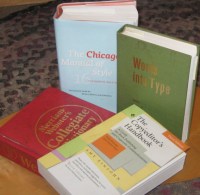
Arbiters of style.

Arbiters of style.

Here’s another one: Both Chicago and Merriam-Webster’s generally recommend dropping the hyphen after prefixes and before suffixes: multitask, flowerlike, and so on. (Yes, there are exceptions. No one recommends dropping the hyphen in “bell-like,” which would give you three l‘s in a row.) However, I’ve also noticed, both in my own writing and in what I edit, that the hyphen can call attention to the root word in a way that makes sense and may even aid understanding.

One of my current jobs refers several times to “pro-democracy activists.” Consider “prodemocracy” and “pro-democracy,” or “antichoice” and “anti-choice.” To me,  whether I’m reading or writing, the hyphenated version gives a little more weight to the root. This can be especially useful when the prefix is something like pro- or anti-, non-, or counter- and the compound is a temporary one, not an established word like “antifreeze.” Consciously or not, plenty of good writers seem to feel likewise. When I’m editing, I’m loath to delete hyphens where they’re consistently used and serve a purpose, even when Chicago and Merriam-Webster’s recommend against them.

American Heritage is more hyphen-friendly than Merriam-Webster’s, and British English is more hyphen-friendly than its American cousin. This is why I usually have American Heritage, MW, and Oxford open in my browser when I’m working. I’ve set my Oxford default to “British and World English,” which seems to be why I keep getting billed in pounds. No, I don’t live in the UK, but I do like the reality check when it comes to hyphens.

The short version: Hyphens are responsible for [insert large number of your choice] percent of our trips to the dictionary because we think there’s a right and a wrong way to do it and the dictionary has the answer. When it comes to hyphens, there may be more than one right answer, and different dictionaries may give different advice. Learn the guidelines, pay attention to what hyphens can do, and don’t get too hung up on it.

So I’m closing in on 1,000 words and have said almost nothing about commas. The comm part of Sturgis’s Law #5 can be found here.

Those Pesky Details

Once upon a time I copyedited a novel set in 19th-century New England that had cranberries being shipped to market in May.

Uh — no.

cranberries

Cranberries

I grew up in Massachusetts and have lived here most of my life. When fresh cranberries reach the market in early to mid fall, I stock my freezer with them because they aren’t available earlier in the year. That’s true in the 21st century, it was true in the late 20th (which was when I copyedited this novel), and it was surely true in the 19th, when transportation, storage, and other technologies were a good deal less sophisticated than they are today.

That’s known in the trade as a “good catch”: I caught something that the author, the book’s editor, and everyone who had already read the manuscript missed. Copyeditors are always catching things that everyone else missed, but this was an especially good one. That’s why I remember it more than 15 years later. (Tellingly, I can’t for the life of me remember the title of the novel or the name of its author.)

We copyeditors quite justifiably pat ourselves on the back for these catches and crow about the best ones to our colleagues.

Readers crow about them too when they find what they consider a glaring error in a published book. “Where was the copyeditor?” they cry. “Where was the proofreader?” This is often followed by a lament about how publishing, the English language, and/or western civilization is going to hell in a handbasket.

Well, if there are several glaring errors in a book, coupled with infelicities of spelling, usage, and style, it may be that it wasn’t properly copyedited or proofread at all. But errors do crop up in even the most conscientiously written, edited, and proofread works. The overwhelming majority of them, thank heavens, are minor.

Think of how many factual details go into any book-length work, fiction or nonfiction. Pity the poor author, who must focus on the whole forest while remaining acutely aware of each tree in the forest, each branch on each tree, each twig on each branch, each bud on each twig. Say you’re an expert in a particular sort of bud. Chances are good that you’ll eventually catch the author out — “No, no, no! Those buds never appear before May in the Upper Midwest!” — but chances are even better that most readers won’t notice. It won’t, and shouldn’t, undermine the credibility of the work.

Unless, of course, the work is about trees in the Upper Midwest. Then you may have a case.

swans on the Mill Pond

There’s a lot more to Martha’s Vineyard than swans on the Mill Pond, but we’ve got that too.

I live on Martha’s Vineyard, a place that is so often misrepresented in both fiction and nonfiction that much of my own writing is devoted to countering those misrepresentations. At the same time, I know that some errors are more significant than others. I don’t care (too much) if someone has a ferry sailing from Vineyard Haven at 5:15 instead of 5:00. Recently, though, I reviewed a book that got some of the geography wrong and misspelled several names that could have been verified without much trouble. Editor fail, I thought.

I do get really, really angry when someone assumes that what they’ve seen on the news is the whole truth and nothing but; that everyone here is wealthy when our median income is one of the state’s lowest.

“Write what you know” is a truism quoted ad nauseam, but I don’t mind it when it’s accompanied by its obvious corollary: “And if you don’t know it now, do your research.

This is why I was so impressed when I was contacted a couple of months ago by a writer whose novel in progress was partly set on the Vineyard. Could he ask me a few questions? Ask away, said I.

His questions were the sort that would only be asked by someone who had at least a passing acquaintance with the place. The larger world wouldn’t notice if he got these things wrong, but many Vineyarders would. I was thrilled to be asked and impressed that he cared enough to get it right. I answered as thoughtfully as I could. (Note to anyone who’s writing about Martha’s Vineyard: Contact me. I’m not kidding. If I can’t answer your questions, I can probably put you in touch with someone who can.)

This has inspired me. If I didn’t mind answering this writer’s questions — hell, no! I’m glad to be asked! — other people won’t mind answering mine. I’m not going to get all the details right, and even if I do, some people are going to disagree with me. But if I get out there and ask the questions, I’m probably going to meet some cool people and get into interesting conversations.

It’s all good.