Z Is for Zipped

Some book-length jobs arrive in a single file. Others have a file for each chapter, plus frontmatter, backmatter, author’s bio, and maybe captions and other stuff. Multiple files can be attached to a single email, so the client zips them into a single compressed file and sends it that way.

When I receive it, I save the file in the appropriate folder and unzip it. Voilà, all the individual files are there in their own folder, waiting to be opened and worked on.

Z also stands for zed, which is in fact how the last letter of the alphabet is pronounced in lots of places. And here are, on the last day of April, at the end of the alphabet.

Wow. I did it!

A couple of days ago I panicked. In the A–Z Challenge you were supposed to get Sundays off, but  Saturday was “Y Is for You” so Z was going to have to come on either Sunday or the first of May. Had I missed a day, or a letter? I grabbed my chairside calendar and counted. Three times I counted, and every time Z fell on Sunday, April 30.

Whew.

The lesson for me here is that I can come up with stuff to say almost every day of the month. I don’t have time and I have nothing to say and I’m too tired and I’m not inspired today and That’s too obvious and I said that already are just excuses. Start writing and the words will come.

I knew that already, right? So do you. That’s what this blog is about. But it’s something we have to keep learning and relearning. The alphabet may come to an end, but the writing doesn’t.

Write on!

X Is for X-Acto Knife

I was going to feature an image of my two X-Acto knives, a #1 and a #2, in their plastic case, but case and knives have vanished from the drawer where I keep miscellaneous office supplies. Could they be hiding somewhere else in this not-very-large studio apartment? Could I have lent or given them to someone? No idea.

Here’s what a #2 X-Acto looks like.

What I wanted to blog about was how we produced documents in the days before the digital age made it all a helluva lot easier. My X-Actos may have vanished, but I still have a few relics from back then, so here goes.

In my antiwar movement and student government days, late 1960s and early ’70s, photocopiers were generally inaccessible to us scruffy activist types, so to make multiple copies of anything we had to prepare a stencil and run it on (usually) a mimeograph or (sometimes) a Gestetner machine. What I recall most vividly about the Gestetner is its penchant for unexpectedly spewing ink in all directions.

Typos were a bear to correct on a mimeograph stencil, so accuracy at the keyboard was a plus. I didn’t learn how to type till several years later, after I learned that female liberal arts graduates were pretty much unemployable without clerical skills. Nevertheless, in college I did make some money typing papers for my fellow students, who realized that though I might type with my two forefingers, I would also correct their grammatical and spelling errors as I went. I didn’t know what an editor was at that point, but clearly I was on the way to becoming one.

In those days the guys did the writing and public speaking; the girls did the typing and ran the various duplicating machines. Supposedly the guys were innately adept at things mechanical, but when the mimeograph or the Gestetner jammed or otherwise screwed up, the guys were nowhere to be found so of course the girls figured out how to do it ourselves. This was a contributing factor to the rise of the women’s liberation movement and the decline of the (male) New Left. Feminism meant, among other things, that though we still ran the machines, we also got to write the stuff we printed on them.

Not only did we publish broadsides and pamphlets, we established print shops, like the Women’s Press Collective in Oakland and the Iowa City Women’s Press (guess where that was), whose technological capacity went way beyond mimeographs. They published magazines and books that included graphics and photographs and, eventually, four-color covers.

In the mid-1970s, now a competent typist, I got my first proofreading job, working on contract jobs for the company that published my hometown’s weekly newspaper. The production process was a complicated hybrid of technologies. I worked nights, usually alone in the office with the typesetter. Early in the evening Dave the production manager was still around. A generation older than I and my college colleagues, he was adept at fixing cranky machines.

The process went something like this, to the best of my recollection (which I confess is a little fuzzy in places). I sat at what looked like a contemporary desktop computer only clunkier, and it came with a couple of gizmos on the side that I don’t remember very well because I haven’t seen anything like them since. The typesetter’s  machine was a glorified IBM Selectric typewriter, or so I recall it, though I’m sure it had a monitor attached. It used a special ball that produced manuscript pages with what looked like a running barcode under the letters.

I would feed these pages into one of my gizmos, whereupon the copy would magically appear on my monitor, usually with a fair number of @@@@@@, which meant that the gizmo hadn’t read the barcode correctly. I’d correct these and other spelling and punctuation errors on my screen, then when it all looked good, I’d hit the equivalent of Send or Print or Enter and out of another gizmo would come a long punched tape. Here’s one of the relics from my drawer, showing the hole pattern for each letter and command. It looked a little like Braille, only with holes instead of raised dots.

I would then take the tape over to the humongous phototypesetting machine, which I think was a CompuGraphic, thread it properly (sort of like threading film in a pre-digital movie projector, or a chain through a bicycle’s rear derailleur); and press a button.

This step produced film in a sealed container, which then had to be fed through a developer. At long last, down the sloping front of the developer would come the galley proofs.

This process was laborious and time-consuming enough that we were not about to repeat it for every little correction — and yes, I did catch on the proofs typos I’d missed on the screen. This is where I became adept with X-Acto knife, straight edge, and Scotch tape. If two letters or two words had to be transposed, I’d carefully cut them out of the galley with knife and straight edge, apply tape to the back of the galley with the sticky side showing through, then use the tip of the knife to replace letters or words in the correct order.

line gauge

A line gauge, aka pica stick, makes an excellent straight edge, and you can measure with it too.

Presstype

My steady hand and reasonably accurate eye served me well in the years that followed, when I was active in various feminist groups in Washington, D.C.  We produced flyers and short documents using a combination of typewriting and presstype — rub-on transfer lettering that came in a wide variety of fonts and sizes, including dingbats, ornaments and symbols that could be used to make a page of unrelenting type more visually appealing.

me checking newspaper pages

Me, checking the boards at the Martha’s Vineyard Times, October 1993. Paste-up was still being done manually. Those “boards” were what went to the printer to be turned into a newspaper.

Also available was Formaline rub-on tape, which came in various widths and was used to put borders around text or graphics, or to separate stories from each other. It was still in use in my early newspaper days, late 1980s and early ’90s, before manual paste-up gave way to digital layout.

By this time photocopiers were widely available in offices, though prohibitively expensive for shoestring organizations and businesses. Those of us with office jobs used the office copier for movement work whenever we could, and “liberated” essential supplies from the supply room as needed. Especially coveted were carbon sets and Wite-Out correction fluid.

Proportion scale

Jobs that required serious graphic quality and more than a few copies went to the local women-run print shop. Preparing clean camera-ready copy required all of the above skills, plus an eye for layout. Photographs and other illustrations often had to be sized to suit the design.

With this handy-dandy proportion wheel you could choose the desired height or width of your graphic element, then figure out what the other dimension would be and how much space to allow for it.

Word-processing and layout apps have superseded most of the tools I used in my younger days. I can make multiple copies of pages to take to my writers’ group and they’re all as clean as the original — there is no original except the Word file on my computer. Fixing errors is easy, but catching them is still hard.

W Is for Write

There’s a verb for you.

By writing the writer spins a thread of written words from some mysterious place in her brain.

Your writing will teach you what you need to know.

Maybe what you most need to know is whether you’re a writer or not, a real writer. Writers wonder about this a lot, especially writers who don’t make a living writing or aspire to make a living or even part of a living from writing. Also writers who can’t point to books — ideally several books — that have their name on the cover, or a sheaf of clippings with their byline at the top.

Writers are ingenious at coming up with reasons they’re not real writers. Do nurses and carpenters and cooks and teachers keep coming up with reasons that they’re not real nurses and carpenters, cooks and teachers?

I blogged about this a while back, in “What Makes a Real Writer?” I don’t have a whole lot to add to that, and once again I’d refer all worried writers everywhere to Marge Piercy’s classic poem “For the Young Who Want To.”

For me the key is, was, and always will be “The real writer is one / who really writes.” But read the whole thing anyway.

These days I’m not all that worried about whether I’m a writer or not. Whatever else I am, I’m someone who can write well, who has writing in her toolkit, well honed and ready for action. I see myriad ways out there that this particular skill can be useful, from telling stories to reporting or analyzing news to blogging to trying to keep political discussions on social media reasonably focused and civil.

Writing is important, whether you call yourself a writer or not.

It’s a rare writer who can do all the things that writers collectively can do, but it’s an equally rare writer who can do only one thing.

Another Piercy classic is “To Be of Use.” You can probably infer the gist from the title alone, but again — read the whole thing. Here’s the stanza that grabbed me by both hands this time through:

I want to be with people who submerge
in the task, who go into the fields to harvest
and work in a row and pass the bags along,
who are not parlor generals and field deserters
but move in a common rhythm
when the food must come in or the fire be put out.


In the world these days we’ve got fires to put out and fires to keep going and fires to rekindle from scratch. Writing can do all these things.

Write.

Write.

Write.

Orthographic Musing

In the novel-in-progress excerpt I took to my writers’ group last night, one character (Glory’s mother, Felicia, for anyone who’s keeping track) spoke of a onetime band member who had ODed.

That’s the way I spelled it: ODed.

Several of my fellow writers thought it should be OD’d. That made sense too.

At my writers’ group meetings, we bring enough copies for everybody — at the moment we’re seven, with the eighth on sick leave — then the writer reads aloud while everyone else marks up the hardcopy. My Monday morning tasks include opening the active file (draft2.doc), going through the marked-up copies, and making revisions, corrections, or notes as needed or desired.

So I came to “ODed”, remembered what the others had said, and changed it to “OD’d”.

Being terminally curious, I then had to look it up. Being an editor, I had to look it up in three dictionaries, not one.

Merriam-Webster’s Collegiate (online) gave both “OD’d” and “ODed”.

American Heritage said “OD’ed” — with both the -ed and the apostrophe.

Oxford, both the UK/World and the US editions, had “OD’d”.

This drives some writers and editors crazy. Not me. I love it. The variation reminds me that when it comes to orthography, there’s often a right way and a wrong way to spell a word, but other times it depends. It’s “sceptic” in British English (BrE), “skeptic” in American English (AmE), but neither one is wrong. Newspapers and magazines usually have a house style that, in the interest of consistency, specifies a preference in cases where several choices exist.

Publishers do too, but the better ones generally allow more variation than magazines and newspapers. Books don’t have to be consistent with each other. They should, however, be internally consistent. If “OD’d” comes up more than once, spell it the same way each time. Make your choice, enter it on your style sheet, then stick to it. (Style sheets are a copyeditor’s best friend and secret weapon. Wise writers use them too. For more about style sheets, check out my blog post “What’s a Style Sheet?”)

While writing the above, I took a break to look up “orthography”. Here’s Merriam-Webster’s first definition: “the art of writing words with the proper letters according to standard usage”. I see two loopholes I could drive my car through: “proper” and “standard usage”. And that’s OK (okay?). MW calls it an “art”, after all, and in art the right answer is often “it depends”.

So what am I going to do about ODed / OD’ed / OD’d? For now I’m going with “OD’d”, but that may change.

Dot Comma

This is part 2 of “Sturgis’s Law #5.” I got carried away with hyphens and didn’t get around to commas till the word count was edging toward the stratosphere. Here’s Sturgis’s Law #5 redux.

Hyphens are responsible for at least 90 percent of all trips to the dictionary. Commas are responsible for at least 90 percent of all trips to the style guide.

Commas drive people crazy. They’re small but they’re powerful. They can be used for so many things. Teachers, editors, and the authors of style guides often try to wrangle them into some sort of order, which is fine, but when the guidelines harden into rules, writers and other editors may get feisty.

I suspect that it’s not the poor commas that drive people crazy; it’s the notion that there are a gazillion iron-clad rules about the right and wrong way to use them and if you get any of them wrong someone will think you’re stupid.
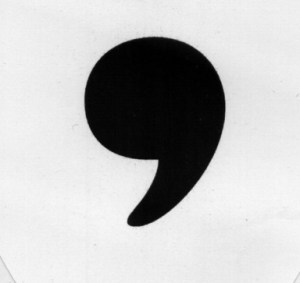
Context matters. Is this a comma or an apostrophe? Actually it's the bottom half of a semicolon, but it's impersonating a comma.

Context matters. Is this a comma or an apostrophe? Actually it’s the bottom half of a semicolon, but it’s impersonating a comma.

Take my sentence above: “They’re small but they’re powerful.” To comma or not to comma? It’s actually OK either way: convention sensibly advises a comma before the conjunction that separates two independent clauses, but an equally sensible corollary notes that the comma may be dropped when the clauses are short.

So I went back and forth a half-dozen times between “They’re small, but they’re powerful” and “They’re small but they’re powerful.” To avoid settling on one or the other, I actually contemplated “They’re small but powerful” and “They’re small — but they’re powerful.” All four options are well within the pale of acceptable usage, but each reads a little differently.

Sentences like this can send us running to the style guide, and when the oracle responds with “It depends,” that’s when we start to lose it.

This, however, is no reason to throw the comma conventions out. Writing that consists of long comma-less sentences is devilish hard to read, and besides, we usually talk in phrases, emphasizing some words and not others. Commas, and punctuation generally, help shape your sentences so they’ll be read, understood, and heard the way you want them to be. Learn the basics so well that they become your default settings. At that point you’re ready to change the defaults when it best serves your writing.

Here’s a short paragraph plucked at random from my novel in progress. Shannon is explaining to the selectmen in her town* why Wolfie, a dog who’s been running amok and maybe killing livestock, should be allowed to remain in her house. No surprise, the paragraph has a lot of commas in it, doing common comma duties.

Shannon smiled. “You might say so,” she said. “When Wolfie’s confined to a crate, he tries to get out, and when he can’t get out, he howls. We’re making progress on that, but, well, I don’t think he would do well at the kennel.”

The first comma is standard in punctuating dialogue in American English (AmE). Use a comma before or after a dialogue tag, depending on its placement in the sentence. If you want, you can turn that sentence around:

She said, “You might say so.”

The second comma follows a dependent clause at the beginning of a sentence. Commas are also used to set off introductory phrases, especially when they’re fairly long. How long? I remember learning that any introductory phrase or clause of at least seven words should be followed by a comma, but please, don’t be making your decisions on word count alone. The main purpose of that comma is to keep the introductory phrase or clause from bleeding into the main sentence.

The third comma, the one before and, separates two independent clauses. The fourth, like the second, sets off an introductory clause. This sentence is both compound (it comprises two independent clauses) and complex (it includes dependent clauses). In such sentences, commas help the reader figure out what goes with what.

Next comes another before-the-conjunction comma, and then we’ve got an interjection: well. When interjections — well, oh, good heavens, and the like — come at the beginning of a sentence they are almost always followed by a comma. When they come in the middle, you usually want commas fore and aft. Say the sentence out loud. You pause before and/or after the interjection, right?

Good writers often use commas to help pace our sentences, perhaps to signal a slight pause. I hear a subtle difference between She shut the door then opened it again and She shut the door, then opened it again. In the former, the opening follows hard on the shutting. In the latter she hesitates; maybe she’s had second thoughts. Some people don’t hear any difference at all between the two. When an editor who doesn’t hear the difference meets up with a writer who does, things can get ugly.

When they approach commas that can’t be neatly explained by one of “the rules,” some editors ask “Is it necessary?” When I’m editing, my own work or someone else’s, I ask instead “Is it useful?” and “What purpose is it serving?” If it’s serving a purpose, I generally leave it alone.

This is not to say that I pause to ponder every comma I come to. In most book-length copyediting jobs I put a bunch in and take a bunch out on the fly. If asked, though, I can nearly always explain what I did and why: this is a knack that comes with experience, lots of experience.
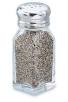
Commas ready for recycling

Commas ready for recycling

Some writing, even good writing, is peppered with commas. I remove the excess and save them in a pepper shaker, so I’ll have them on hand when I come to a work with too many long, breathless sentences.

When a sentence or whole passage is overpunctuated — it contains so many commas and other punctuation marks that you barely notice the words — this is often a sign that the sentence itself needs work. The writer is trying to tame the sentence with commas when the real problem lies with the words, phrases, and/or clauses and the arrangement thereof.

OK? Commas may be small and powerful, but they don’t have to be scary. Play around with them. See what works and what doesn’t. And if you’ve got a comma question or observation, post it in the comments or use the “Got a Question?” form at the top of this page.


* This town, like most small to middling towns in New England, runs by the town meeting system. Town meeting, in which all the town’s registered voters can participate, functions like a legislature. In addition to the big annual town meeting, usually in the spring, there are usually two or three special town meetings during the year. The board of selectmen takes care of business in between.

Sturgis’s Law #5

This past spring I started an occasional series devoted to Sturgis’s Laws. “Sturgis” is me. The “Laws” aren’t Rules That Must Be Obeyed. Gods forbid, we writers and editors have enough of those circling in our heads and ready to pounce at any moment. These laws are more like hypotheses based on my observations over the years. They’re mostly about writing and editing. None of them can be proven, but they do come in handy from time to time. Here’s #5:

Hyphens are responsible for at least 90 percent of all trips to the dictionary. Commas are responsible for at least 90 percent of all trips to the style guide.

Policy making, policy-making, or policymaking? If “policy making” is the noun version, do you hyphenate “policy-making process”? How about “policymaker”? One word, two words, or hyphenated word? “Prodemocracy forces” or “pro-democracy forces”? “Back-seat driver” or “backseat driver”?

So you trot off to the dictionary. This is where the real fun starts. Dictionaries can be internally inconsistent: “policyholder” is one word, but “policy maker” is nowhere to be found, which generally means it’s two. The American Heritage Dictionary offers “policymaking or policy-making” but recommends “policymaker” for the person who makes the policy.

For even more fun, consult a second dictionary. Merriam-Webster’s Collegiate, aka MW, makes “backseat” one word, both as noun and adjective: “The dog sat in the backseat” and “He’s a terrible backseat driver.” American Heritage doesn’t list “backseat,” so it’s safe to assume that it considers it two words: “The dog sat in the back seat” and (probably) “He’s a terrible back-seat driver.”

My dog sits in the front seat.

My dog sits in the front seat. He is not a backseat driver.

Note that MW doesn’t list “frontseat” anywhere, so presumably it considers it two words. So what if you’ve got “front seat” and “back seat” in the same story, the same paragraph, even the same sentence? Do you follow the dictionary into an inconsistency that makes no sense? Not me.  In my own writing, it’s “The dog sat in the back seat” and “He’s a terrible backseat [or back-seat] driver.” (My dog sits in the front seat, by the way. It’s all I can do to keep him out of the driver’s seat.)

When you’ve sorted out “backseat” and “front seat,” you can move on to “backyard” and “front yard.” What’s sauce for the seat is sauce for the yard — or maybe not.

The Chicago Manual of Style has a handy-dandy several-page hyphenation chart. It’s extremely useful, it really is: you really don’t need to be deciding all this stuff from scratch. But if you use it a lot, as I do, pretty soon you’ll notice that it and your dictionary of choice don’t always agree. You’ll notice that different genres and different disciplines often have their own conventions, and these conventions are perfectly OK even if they don’t agree with Chicago or Merriam-Webster’s.

Here’s an example: Chicago often recommends hyphenating compound adjectives when they appear before a noun but leaving them open when they follow the verb. “A well-known proverb” but “The proverb is well known.” The catch here is that “well-known” appears in most English-language dictionaries. This makes it a word, and English words don’t generally change form according to their position in a sentence. So it depends on whether you think of “well-known” as a word or as a temporary compound — two or more words yoked together to serve a common purpose and that may be unyoked after that purpose is satisfied.

Arbiters of style.

Arbiters of style.

Here’s another one: Both Chicago and Merriam-Webster’s generally recommend dropping the hyphen after prefixes and before suffixes: multitask, flowerlike, and so on. (Yes, there are exceptions. No one recommends dropping the hyphen in “bell-like,” which would give you three l‘s in a row.) However, I’ve also noticed, both in my own writing and in what I edit, that the hyphen can call attention to the root word in a way that makes sense and may even aid understanding.

One of my current jobs refers several times to “pro-democracy activists.” Consider “prodemocracy” and “pro-democracy,” or “antichoice” and “anti-choice.” To me,  whether I’m reading or writing, the hyphenated version gives a little more weight to the root. This can be especially useful when the prefix is something like pro- or anti-, non-, or counter- and the compound is a temporary one, not an established word like “antifreeze.” Consciously or not, plenty of good writers seem to feel likewise. When I’m editing, I’m loath to delete hyphens where they’re consistently used and serve a purpose, even when Chicago and Merriam-Webster’s recommend against them.

American Heritage is more hyphen-friendly than Merriam-Webster’s, and British English is more hyphen-friendly than its American cousin. This is why I usually have American Heritage, MW, and Oxford open in my browser when I’m working. I’ve set my Oxford default to “British and World English,” which seems to be why I keep getting billed in pounds. No, I don’t live in the UK, but I do like the reality check when it comes to hyphens.

The short version: Hyphens are responsible for [insert large number of your choice] percent of our trips to the dictionary because we think there’s a right and a wrong way to do it and the dictionary has the answer. When it comes to hyphens, there may be more than one right answer, and different dictionaries may give different advice. Learn the guidelines, pay attention to what hyphens can do, and don’t get too hung up on it.

So I’m closing in on 1,000 words and have said almost nothing about commas. The comm part of Sturgis’s Law #5 can be found here.

Chicago Style

My library’s annual monster book sale was last weekend. Of course I went. Of course I came home with a stack of books, and all for $10.

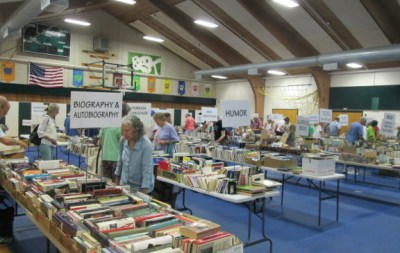
The book sale takes place in the elementary school gym. All the sorting and shelving is done by volunteers.

The book sale takes place in the elementary school gym. All the sorting and shelving is done by volunteers.

The book sale is a browser’s heaven: tables and tables of books sorted, and occasionally mis-sorted, into general categories, and many with more books in the boxes underneath. I rarely go with a particular book in mind. I always find books I didn’t know I was looking for.

Or they find me.

Browsers cheerfully recommend books to total strangers, and sometimes get into spirited conversations about books they liked or books they thought were overrated. I was poring over one of the history-related tables, head cocked sideways so I could read the spines, when the fellow to my right handed a book to the fellow on my left. The book passing in front of me was The Chicago Manual of Style.

“Are you interested in this?” asked the fellow on the right, who I guessed (correctly) was the father of the fellow on the left.

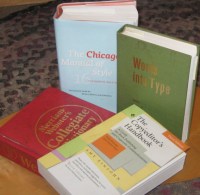
My constant editorial companions. Clockwise from top: The Chicago Manual of Style, Words into Type, Amy Einsohn's Copyeditor's Handbook, and Merriam-Webster's Collegiate Dictionary.

My constant editorial companions. Clockwise from top: The Chicago Manual of Style, Words into Type, Amy Einsohn’s Copyeditor’s Handbook, and Merriam-Webster’s Collegiate Dictionary.

I’ve been on first-name terms with Chicago since 1979, when it was still called A Manual of Style. Could I remain silent while my old buddy and sometime nemesis changed hands right before my eyes? I could not. “That’s the current edition,” I said. “I’ve got it at home. I’m an editor by trade.”

Dad let on that Son was an aspiring writer. Son seemed a little uneasy with the description. “If you have any interest in mainstream publishing,” I said, “that’s a very  good book to have.”

I don’t know whether they bought it or not, or what they paid for it. It was half-price day at the book sale, so probably not more than a buck or two. But if you have any interest in mainstream publishing, especially in the U.S., it is a very good book to have. Or you can subscribe to the online edition for $35 a year.

In U.S. trade and academic publishing, The Chicago Manual of Style is something of a bible. It contains almost everything writers and editors need to know about book publishing, along with extensive recommendations for further reading in various areas. It includes chapters on grammar, usage, and punctuation. At least half of its 1,026 pages are devoted — as its title might suggest — to style. 

What is “style”? Think of all the myriad choices you make when you’re writing and especially when you’re editing your own work, about capitalization and hyphenation, about the use of quotation marks, boldface, and italics. How to treat titles of movies or titles of songs, and words from other languages, and the English translations of those words. And on and on and on. Style comprises all the decisions made about how to handle these things. “Chicago style” is a collection of particular recommendations. If you italicize book titles and put song titles in quotes, you’re following Chicago style, maybe without knowing it.

Much of the nit-pickery that goes into copyediting is about style. Confronted with the plethora of details that go into Chicago style, or Associated Press (AP) style (widely used by newspapers and periodicals), or American Psychological Association (APA) style (widely used in academic writing, especially the social sciences), the novice writer or editor may find it hard to believe that applying a particular style makes things easier — but it does. Every time I embark on editing a long bibliography, I am profoundly grateful to Chicago for its documentation style and to the authors who apply it consistently. I would hate to have to learn or invent a new documentation style for every bibliography I work on.

That goes for other aspects of style too. Following a style guide in effect automates the minute details and frees your mind to deal with the more interesting stuff like word choice and sentence structure and transitions between paragraphs.

The Chicago Manual of Style came into existence early in the 20th century as the style guide for the University of Chicago Press. Then as now, the press specialized in scholarly works, and the early editions of its style guide reflected that. Now it’s widely used by trade publishers, independent publishers, and self-publishers as well as academic presses.

What this means in practice is that not all of its recommendations are well suited to every type of book, and the further one gets from scholarly nonfiction — say, into the realms of fiction and memoir — the more cause one is likely to have for ignoring some recommendations and improvising on others. This is fine with Chicago‘s compilers but not so fine with some copyeditors, who treat the book’s style recommendations as Rules That Must Be Obeyed.

I think of them as Conventions That Should Be Respected, and Generally Followed in the Absence of a Sensible Alternative. I also advise serious writers to introduce themselves to Chicago style and even get to know it. Automate the petty details and you can focus your attention on the big stuff. You’re also more likely to win an argument with a stubborn copyeditor.

Enough Notebooks

My regular writing time is from 7 to 9 a.m. I’m one of those insufferable people who’s wide awake and functional as soon as my eyes are fully open, and I don’t need coffee to do it. (I drink strong black tea with milk, no sugar, but only when I’m awake.) This morning I was a little late getting started because I’m reading an excellent book: Dorothy West’s The Wedding. I knocked off 20 minutes early because my longhand drafts and notes for Wolfie, the novel in progress, no longer fit in their notebook, and my other two notebooks are otherwise occupied.

Clearly a visit to the Staples website was in order.

Now the strict constructionists among you will not allow that the purchase of writing-related supplies constitutes “writing” for the purpose of “writing time,” and you may be right. However, being a writer, I can rationalize anything, and the pages spilling out of my notebook were messing up my head.

Dear readers, I ordered.

The Staples website is not as sensibly organized as it might be, so it took more than 20 minutes to find everything, even though I knew what I was looking for.

Some of the current pen collection

Some of the current pen collection

I do nearly all my first-drafting and most of my note-taking in longhand. On paper. Cut, Copy, and Paste don’t work on paper, but I still need to move things around, insert new pages between old ones, and (ideally) find some dimly remembered bit when it needs to be found. In my world folders do best in file cabinets, not lying around on desks and tables. I wanted notebooks. Three-ring binders might have worked, but I write with fountain pens and real ink-bottle ink and most punched or punchable paper can’t handle it.

Well, it can, but the ink often comes through to the other side, which means I can’t write on both sides of the paper. I am frugal, I am cheap. This wouldn’t do.

So a few years ago I spotted an ingenious notebook system in the Levenger catalogue. The Levenger catalogue is high-class porn for writer types, but it’s on the pricey side. Being frugal and cheap, I wasn’t willing to shell out for a system I didn’t know would work for me.

Open notebook with pocket divider

Open notebook with pocket divider. No, I could not live without Post-it notes.

Then I  encountered something very similar at Staples, the Home Depot of office supplies. The price was reasonable enough to take a chance on. I splurged. The system, which Staples calls “ARC,” quickly became indispensable.

At left you can see what the notebooks look like. The binding comprises 11 plastic rings. The rings don’t open; the paper is punched with 11 holes, each one open so it can fit over the ring. Pages can be moved, singly or in chunks, from one place to another.

A custom 11-hole punch is available, so you can punch holes in any paper you like, but the paper that comes with the system is, wonder of wonders, sturdy enough for my fountain pens to write on both sides. And sturdy enough to be moved here and there several times.

So this morning I ordered three more notebooks — one with a leather cover (like the brown one in the photo) and two with polyvinyl (like the rose one) — and more dividers, some with pockets, some without.

Blank paper,” I wrote last fall, “is faith in the future.” Enough notebooks, perhaps, is faith that what’s been written will be worth retrieving. Either way, I can’t wait for my order to get here.


Joan Didion’s Cure for Bankrupt Mornings

Serendipity rules: I read this while I was working on “Restarting.” These days I don’t keep a notebook, but opening the work in progress seems to fill a similar function. Whatever works!

Write On, and On, and On

Happy New Year to all, and may your writing flourish and lead you along interesting paths.

If you look up at the menu bar, you’ll see it’s been streamlined. The five Ws — Who, What, When, Where, and Why — and their first cousin How are now all on the same page.

The “You!” page is now “Got a Question?” It includes a comment form to make it easy for you to ask questions, share your experience, offer suggestions, whatever.

If you’re on Facebook, Write Through It has its own page. If you “like” it (and maybe even if you don’t), you can make comments and ask questions there too.

Write Through It now has 1,060 followers, and it’s not even a year old yet. I’m amazed. Welcome aboard, and special thanks to all who’ve commented, liked various posts, and otherwise supported this blog. You’re keeping it, and me, going.

P.S. I just added four new ink colors to my collection: sepia brown, suede blue, copper burst, and velvet black. No, I didn’t need any more ink, but ink, like pens and blank paper, is faith in the future. It’s going to be a good writing year. Here’s the current collection.

The four new bottles are on the left. You can tell they're new because they're so clean. I don't know why I up-ended Travvy's bone behind the tableau, but I like it.

The four new bottles are on the left. You can tell they’re new because they’re so clean. I don’t know why I up-ended Travvy’s bone behind the tableau, but I like it.