E Is for Ellipsis

An ellipsis is three dots.

An ellipsis comprises three dots. (See, I have to show that I know how to use “comprise” in what used to be considered the correct manner.)

An ellipsis consists of three dots with spaces between them.

. . .

not

I don’t get feisty about the things some editors get feisty about. I mean, I’m behind the serial comma, but I don’t believe those who don’t use it are trying to destroy the English language, western civilization, or some other cosmic entity. Ellipses, on the other hand . . .

Aside: That wasn’t an ellipsis. Those were suspension points. Read on for clarification.

I get feisty about ellipses. In my mind, for instance, there is no such thing as a “four-dot ellipsis.” An ellipsis comprises three dots. The fourth dot is a period — “full stop” if you’re working in British English (BrE).

Let me back up a bit. When you’re quoting from someone else’s work and you decide to skip some of the original writer’s words, you use an ellipsis to indicate the omission. Say I wanted to quote from the previous paragraph, but I wanted to drop “for instance.” I might write this: “In my mind . . . there is no such thing as a ‘four-dot ellipsis.'”

When would you use a four-dot ellipsisperiod followed by an ellipsis? When what you decide to drop follows a complete sentence. The complete sentence ends with a period, you add the ellipsis, then you carry on with your quotation.

Here I part company with the Chicago Manual of Style (CMS), so if you’re a dedicated follower of Chicago you better clap your hands over your ears. I want my readers to figure out as much as possible about the source of my abridged quote, so I don’t insert a period where there wasn’t one in the original, even if the remnant is a complete sentence. A capital letter signifies where the next complete sentence begins, and that’s enough.

So — suspension points. What are they? Suspension points indicate a trailing off, a suspension. Whatever was going to be said is suspended — it hangs in the air. I like the common convention in American English (AmE) that three dots indicate a trailing off, but a dash indicates an interruption. A while back I wrote about this in “Of Dots and Dashes.” Do note that at that time I either didn’t know or didn’t care about the distinction between ellipses and suspension points. 🙂

D Is for Deadline

I was thinking “D is for Dictionary,” but I’m in deadline hell at the moment so Deadline won.

Most editors and writers have mixed feelings about deadlines. We love them when we’ve met them, not least because if this is a paid gig  the check will shortly be in the mail or payment will land in our bank account.

Until then, however, deadlines are swords of Damocles hanging over our heads and dominating our thoughts even when we’re not supposed to be thinking about work.

I’m never more focused than when I’m on deadline. Deadlines make it easier to set priorities: “No, I can’t drop everything and go to lunch. This has to be done by tomorrow.”

Deadlines also make it easier to get out of stuff you don’t want to do anyway. It’s so much easier to say “Sorry, I can’t — deadlines!” than “No, I really don’t want to sit through another three-hour meeting where nothing gets done.” (I hope I didn’t blow my, or your, cover with that one.)

My years working for a weekly newspaper taught me a lot about deadlines. Web-based publications may have rolling deadlines, but print is less flexible. During much of my time at the paper it was not flexible at all: “the boards” from which the paper was printed had to be on a certain boat or a certain plane to make their rendezvous with the printer’s representative on the other side of Vineyard Sound. (Living on an island does complicate things somewhat.) The adrenaline surge on Wednesday afternoon was exhilarating, especially if a story broke late: the reporter might be typing furiously at 3 p.m. while Production rearranged pages to make room for new copy.

Don’t be like this. Please.

As an editor, I learned just how annoying it can be when writers blow off deadlines without advance warning, or turn in copy that’s longer, shorter, or sloppier than expected.

Being a fairly slow writer, I learned to appreciate my colleague whose copy might be sloppy but who could crank out anything if it was needed to fill a gap, maybe because an ad was cancelled or a story pulled or another writer didn’t make his or her deadline.  I could clean up sloppy copy much faster than I could turn out something that didn’t need editing.

Sometimes an impending newspaper deadline made me buckle down and write something that I would cheerfully have given up on under any other circumstances. Once I had to review a local production of Samuel Beckett’s play Happy Days.  The acting was fine, but I had no idea what the play was about — and this was before the digital age, when an hour or so online would have given me enough background to BS semi-intelligently about Beckett.

So in desperation I transcribed and embellished the notes I’d taken during the play, which were sort of a stream-of-consciousness attempt to make sense of what I was seeing. Then I knocked them into paragraphs and called it a review. After the review appeared in print, the actress who’d played Winnie told me that she thought I really “got” what the play was about. Go figure. Maybe the desperation born of deadlines can make you smarter than you think you are.

For me the biggest challenge is having no deadline at all. Projects without deadlines tend to get pushed down the priority list again and again. How to keep going when your own enthusiasm flags or you hit a roadblock that you can’t see around?

No one’s waiting for my novel in progress, but two mini-deadlines keep me going. One is to write “every damn day.” (That blog post is about what happened when I let work deadlines take too much precedence over my own writing. It wasn’t pretty, but I know what to do when I get into that kind of trouble.) The other is my writers’ group, the Sunday Writers, which meets (you guessed it) every Sunday evening. All of us bring pages to nearly every meeting, and many’s the time that deadline has made me keep writing or revising till I had something coherent enough to bring to group.

C Is for Comma

As noted in “A Is for Audience,” I started this A-to-Z challenge a little late. C should have been posted on the 4th, but it’s currently the 6th. I’m backdating this post to the 4th to make myself look good. I will catch up, I promise.

According to Sturgis’s Law #5, “Hyphens are responsible for at least 90 percent of all trips to the dictionary. Commas are responsible for at least 90 percent of all trips to the style guide.”

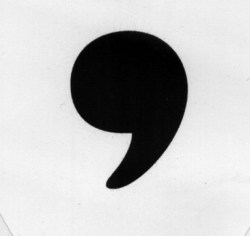
Is it a comma, or is it an apostrophe? Without more context, like maybe a baseline, it’s hard to tell.

Commas drive many writers and editors crazy, mostly because they are convinced that there are places where commas must always be used and places where commas must never be used, and the rules that specify which places are which are both inscrutable and shifty, which is to say they swap places in the night just to mess with people’s heads.

Commas are useful little buggers. Writing that consists of long comma-less sentences is devilish hard to read, and besides, we usually talk in phrases, emphasizing some words and not others. Commas, and punctuation generally, help shape your sentences so they’ll be read, understood, and heard the way you want them to be.

Yes, it’s usually a good idea to put a comma before the conjunction that separates two independent clauses:

She dashed down the stairs and into the street, but the car was already disappearing around the corner.

But when the clauses are short, a comma might feel like overkill:

Michaela went into the garden and Joan left the party.

But a comma wouldn’t be wrong in the sentence just above, nor would it be wrong to omit it in “She dashed down the stairs . . .” Much depends on how the writer hears the sentence, and how she wants readers to hear it. A comma does suggest, or at least permit, a pause.

Not all writers hear the words we write, but some of us definitely do. When I’m editing and come to a comma in an unconventional place, or an absence where convention thinks a comma should be, I read the sentence aloud with and without the comma. Do the two versions feel different? If so, which works better in context?

Commas are small but powerful. Don’t be afraid of them. Put them to work.

For more of my thoughts on commas, check out “Dot Comma.” And if you have any questions or advice about commas, let me know.

B Is for Backmatter

Yeah, both Merriam-Webster’s and American Heritage make it two words, but it’s my blog and they’re not telling me what to do. Hmm. I have this hunch that D is gonna be for Dictionary . . .

As noted in “A Is for Audience,” I started this A-to-Z challenge a little late. B should have been posted on the 3rd, but it’s currently the 5th. I’m backdating this post to the 3rd to make myself look good.

So what’s backmatter (or back matter)? It’s what follows the main text in a published book. With fiction the backmatter is usually short. It might comprise acknowledgments (which sometimes appear in the frontmatter — guess what that is?), the author’s bio, and — a regular feature of one trade publisher for which I edit regularly — “A Note About the Type.” Meaning the history of the typeface the designer chose to set the book in. Print geeks like me love this stuff.

Nonfiction, especially academic nonfiction, is a whole other (excuse my English) matter. In histories, biographies, and any nonfiction that involves any kind of research, the backmatter can make up a quarter or more of the book’s total pages. In a nonfiction work, the backmatter often includes endnotes, bibliographies or reference lists, and indexes. It may include a glossary or an appendix or two.

Citations — meaning especially endnotes, footnotes, and bibliographies — drive grad students, professors, journalists, and others crazy. They especially drive editors crazy, especially when authors have been inconsistent in the formatting or inaccurate in the details. Almost every assertion in an academic work has to be sourced: the author has to tell the reader where it came from, so the reader can, if so inclined, check it out. This sourcing is done in endnotes and footnotes (which aren’t considered backmatter because they aren’t in the back), and then all the works cited in the notes are compiled in a bibliography or reference list.

There are, in other words, good reasons for confusing “backmatter” with “dark matter.”

When I start a copyediting job, it doesn’t take me long to figure out whether the author is careful or careless.  Sometimes I can tell at a glance whether a cited work’s publication info is correct. Other times I have to look it up. If the author is careful, I spot-check the occasional reference and don’t worry too much. If not — I look up a lot, gnashing my teeth all the while.

Asked to provide an estimate for a nonfiction job, some editors will provide an estimate for the main text but then say they’ll charge by the hour for the backmatter. I totally get it. Backmatter words and main-text words are not created equal. Charging by the hour motivates some authors to do more of the heavy lifting themselves instead of expecting the editor to do it.

It’s when I’m editing backmatter that I most appreciate the Chicago Manual of Style or whatever other style guide I’m supposed to be following. Who wants to invent citation style from scratch? Not me. Here is one area where I’m grateful to have “rules” to follow, and I’m happy to follow those rules.

A Is for Audience

Eek! I was reminded on Sunday, April 2, that I fully intended to take part in the Blogging from A to Z Challenge. The challenge was supposed to begin on April 1. The idea is to blog every day except Sunday, with each post taking as its theme a letter of the alphabet, starting with A. Taking Sundays off leaves 26 days in April, there are 26 letters in the alphabet — brilliant idea.

However . . .

Travvy waits

Trav spends a lot of time waiting for me to get home or get up from the computer.

My Sunday looked like one one I blogged about in “Calendars Rule“: I left the apartment at quarter to one and didn’t return home to stay till quarter past nine, having spent the time between at a political meeting, a rehearsal, a mailing party for a local political candidate, and my weekly writers’ group meeting. I did manage to return home long enough to take a walk with Travvy, give him his supper, and print out the pages I was taking to writers’ group.

Since then I’ve been in book review hell, which transforms all other writing into a guilty pleasure I should not indulge until the review is done.

However #2 . . .

I really want to do this A to Z thing. I want to blog shorter and more regularly, and deadlines really do help. (See, there’s an idea for D!) So I’m starting late. This post is backdated to April 1, although it’s being written on the 5th. I’ll catch up, I promise.

So — A is for Audience.

Actors in a theater and singers and musicians in a concert hall or coffeehouse can see, hear, and feel their audience. Even when they’re separated by rows of seats and what actors call the “fourth wall,” audience and performers are interacting. Not only are audiences moved by what’s happening onstage, the performers can be powerfully affected by the presence of audience.

town meeting audience

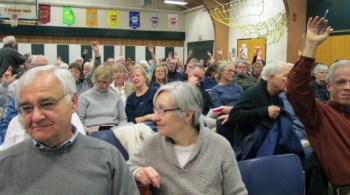
The audience at an annual town meeting in my town. We’re a very engaged bunch.

For most writers most of the time, the audience is not physically present while we’re writing, but that doesn’t mean it isn’t there. Even when we’re writing primarily for ourselves, we’re consciously or unconsciously choosing our words with someone or someones in mind. These imaginary readers (who may include people we know in real life) help us focus our work.

Here’s an example: My fiction is set on Martha’s Vineyard, where I live, but I’m writing for an audience that includes readers who don’t live here, have never been here, and maybe have never heard of the place. So I need to bring the place alive for those people without boring local readers with too much information or pissing them off with generalizations that don’t hold up to close scrutiny.

As an editor, I work on fiction, general nonfiction, and academic nonfiction. I like the variety, in part because it forces me to think about audience. I recently worked on a academic paper about the evolution of a particular concept in Egyptian literature. The target audience can be expected to have interest in and considerable knowledge about the Middle East in general but not necessarily about Egypt or Arabic literature or the period being examined.

Another recent project was a book about artificial intelligence. It was written for a general audience, which made me a good editor for it because I’m interested in the subject but don’t know much about it, and I’m pretty much lost when it comes to physics and computer science. The author did an excellent job of presenting complex ideas for a lay audience. When something was unclear to me, I asked myself whether this was due to the writing or to my lack of knowledge; in many instances, I’d do a Google search to find out how familiar the point might be to a general audience and how readily readers could fill in their own knowledge gaps.

The idea of audience can be paralyzing to writers who’ve rarely taken their work out in public. This is why I encourage writers who want to eventually see their work in print to start sharing it as soon as they, and it, are ready, and maybe a little sooner than that.

You’re probably already thinking about audience when you write. The audience in your mind is helping guide your decisions about what needs explaining and what can be left out. By testing your work on real people, you may discover that this or that point isn’t as clear as you thought it was, or that two equally astute readers may have different ideas about a character’s motivation. What you do with this information is, of course, up to you.

Coming soon: “B is for . . .”


Three Reasons I Could Stop Writing Memoir But Won’t

Here’s an eloquent example of “write what you need to write” (part of a truth I stole from Alice Walker). Your writing will tell you what you need to know, but you have to be willing to listen, and brave enough to follow.

Dinty W. Moore's avatarThe Brevity Blog

zz ronitBy Ronit Feinglass Plank

I had been writing fiction and wanted to try nonfiction, so I began with personal essays. I didn’t think memoir was for me; in fact I was deliberately avoiding it. I didn’t see a reason to revisit the facts of my confusing childhood and thought memoir wouldn’t be as challenging as creating a world from scratch and putting characters in it. To tell my own story, the story I knew by heart, seemed almost too easy.

I could not have been more wrong. I was about to discover that looking at something you think you know pretty well with fresh eyes and trying to understand it in a new way is definitely not easy. I did try writing several personal essays but the history of how I grew up kept barging in, taking up more and more space. It seemed part of me really wanted to…

View original post 1,039 more words

The Power of Place

As a writer, I love revising and rewriting. As an editor, I do almost none of it. Critiques, yes. When a writer I don’t know asks me to edit a book-length manuscript, I generally suggest critique as a first step. I read the ms., make suggestions about plot, characterization, structure, and all that good big-picture stuff, but then the writer does the heavy lifting, not me.

For me, revising and rewriting is like first-drafting in that the ms. takes up residence in my head. My mind works on it when I’m not paying conscious attention. This is why character insights and solutions to plot snags often come to me when I’m walking with the dog or kneading bread.

I’ve learned that when I take on a revise-or-rewrite job as an editor, it often pushes my own writing out of my head. So I avoid developmental and structural editing and stick to stylistic editing, copyediting, and proofreading. (All these things go by different names. In “Editing? What’s Editing?” I explain what I more or less mean by them.)

But I recently (very recently, like this past week) took on a rewrite job for a client. It was short: a new, five-page prologue to a novel that’s been accepted for publication. I also knew the novel well, having worked on it in its earlier stages, and I believe in it.

I read the author’s five pages through. The plot was solid. It introduced key themes and characters that would be developed later. It segued neatly into chapter 1. Yeah, the point of view jumped around a bit, and there was a chunk of historical context recounted in a narrative voice that didn’t belong to any of the characters, but my rewriterly mind was already in gear, working out possible alternatives.

I called up the file. A 10-year-old boy is stretched out on the roof of his uncle’s house, using his BB gun to keep birds away from the abundant ripening grapes hanging from a trellis. I knew this kid well: the novel is his story. I could hear his older sister playing hopscotch in front of the house. But I couldn’t see what he was seeing because I’ve never been there and never even seen pictures of what this house, this neighborhood, this small town in Lebanon’s Bekaa Valley, might have looked like in 1975, which is when the story begins.

For me as a writer, place is crucial. As I blogged in “The Importance of Place“; “Every story, remembered or made-up, takes place somewhere. Where it takes place affects what takes place, deeply, profoundly, deeply, indelibly. Characters, both fictional and nonfictional, are deeply affected by where they are and where they’ve come from. Images, characters, and whole plots grow out of the soil they take root in.”

Both place and time are critical to this particular novel: Lebanon in the spring of 1975 was on the brink of a bloody civil war that devastated the country for 15 years. That 10-year-old boy’s life will be radically transformed by this war, and the incident in the prologue is a harbinger of things to come. The prologue needed to show readers what he was seeing and hearing. How could that happen if I couldn’t see and hear it myself?

I emailed the author. We talked on the phone. How close together are the houses? How long is the driveway? Are the grapes used for eating or winemaking? What do the birds look like? Where have all the grownups gone? Is the garden in front of the house or in back? How big is the garden pond?

Finally, finally the scene began to play out in my head. My fingers moved on the keyboard and words appeared or rearranged themselves on my laptop screen. The scene stayed in the 10-year-old’s point of view. The historical context can be worked into a later chapter, but I couldn’t help noticing that it is subtly suggested here in the ripening grapes being threatened by birds while a boy tries to scare them off with his BB gun.

At this point I’m rarely surprised when place turns out to be the key to a scene, but I’m awed by writers who routinely bring to life periods they didn’t live in, places they’ve never been, and times and places that never existed. The research, the extrapolation, the imagination, the finessing of details that can’t be known for sure — it all has to be there, and seem so complete and inevitable that most readers barely notice.

My First Meme

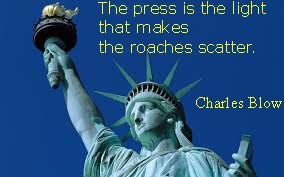
I just created my first meme, and wouldn’t you know it’s about the power of words?

press-meme

I’ve been itching to do this for some time, but my graphics ability is minimal so I procrastinated.

Then the other day I read New York Times columnist Charles Blow’s “Trump, Archenemy of Truth,” about the current U.S. administration’s relationship with the press. The whole column was good, but the next to line deserved to be on a banner or a T-shirt or something.

So with the help of a free image and Serif PhotoPlus 7 I made my first meme.

Like many another word worker, I’ve been looking for ways to put my skills to use in resisting the current U.S. administration and encouraging the opposition. On a less political note, some of Sturgis’s Laws might work well as memes.

This was my first, but I don’t think it’ll be my last. (Feel free to download the image and pass it along.)

Sturgis’s Law #9

Some while back I started an occasional series devoted to Sturgis’s Laws. “Sturgis” is me. The “Laws” aren’t Rules That Must Be Obeyed. Gods forbid, we writers and editors have enough of those circling in our heads and ready to pounce at any moment. These laws are more like hypotheses based on my observations over the years. They’re mostly about writing and editing. None of them can be proven, but they do come in handy from time to time. As I blog about them, I add them to Sturgis’s Laws on the drop-down from the menu bar.

Guidelines are not godlines.

Is middle school (junior high for us older folk) particularly hazardous to future writers and editors? This seems to be when admonitions to never do this or always do that put down deep roots in our heads.

  • Never split an infinitive
  • Never begin a sentence with a conjunction.
  • Always use a comma before “too” at the end of a sentence.
  • Never end a sentence with a preposition.

Etc.

Plenty of us get the idea that written English is a minefield laid with rules they’ll never remember, let alone understand. When you’re afraid something’s going to blow up in your face, it’s hard to construct a coherent sentence. A whole story or essay? No way.

In the late 1990s, when I started hanging out online with more people who weren’t writers or editors, I often encountered a strange defensiveness from people I hardly knew. They apologized in advance for their posts: “Maybe I’m saying it wrong . . .”

My sig lines at that time identified me as a copyeditor and proofreader. I deleted those words from the sigs I used when communicating with people outside the word trades. And the defensiveness disappeared.

Those of us who work with words for a living eventually realize that language is not a minefield, but plenty of us have got a Thou shalt or Thou shalt not or two embedded in our heads. On the editors’ lists I’m on, it’s not unusual for someone to ask whether it’s really OK to break some “rule” or another. Generally the rule isn’t a rule at all.

English grammar does have its rules, and if you break or ignore them, intentionally or not, you may have a hard time making yourself understood. But many of the “rules” we learn in school aren’t about grammar at all. They’re about style. Style is more flexible than grammar — and grammar isn’t as static as some people think it is.

Sturgis’s Law #9 came about because even working editors sometimes confuse style guidelines with Rules That Must Be Obeyed.

Arbiters of style.

Arbiters of style.

Let me back up a bit. Book publishers, magazines, newspapers, academic disciplines, and businesses generally develop or adopt a style guide to impose some consistency on their publications. For U.S. journalists it’s the Associated Press Stylebook. For trade publishers and university presses it’s usually the Chicago Manual of Style. In the social and behavioral sciences it’s APA Style, developed by the American Psychological Association. And so on.

These style guides do deal in grammar and usage — Chicago has a whole grammar chapter — but much of what they recommend is discretionary. It’s about style. For instance, Associated Press (AP) style generally uses figures for numbers 10 and up; Chicago spells out most numbers up to a hundred. When I start editing a book manuscript, I can tell within a few pages if the author is accustomed to AP style.

I’ve been using Chicago since the 12th edition (it’s now up to the 16th). I can’t say I know it by heart, but Chicago style is my default setting. No way do I want to invent guidelines from scratch for every manuscript I work on, especially when it comes to documentation: the styling of endnotes, footnotes, bibliographies, and reference lists.

Default settings, however, can be changed as need or preference dictates. They really are guidelines, not godlines. Chicago can be useful for any English-language prose writer, but keep in mind that it was developed for scholarly nonfiction and the further you stray from that, the more leeway you should allow in applying its guidelines.

If you use different style guides, or move between American English (AmE) and British English (BrE), you’ll see plenty of variation in things like capitalization, hyphenation, and the punctuation of dialogue. There’s even considerable variation between dictionaries. When I’m working, I’ve usually got Merriam-Webster’s, American Heritage, and Oxford (the UK/World English edition) open in my browser.

Maybe the most important thing to remember about guidelines is that they aren’t landmines waiting to blow up in your face. They’re on your side. They help your words get across to readers the way you want them to. Following guidelines can be like automating routine tasks: it frees your mind to deal with the more important stuff.

They can also help establish your credibility with agents, editors, and readers. There’s nothing wrong with a manuscript that isn’t double-spaced in 12-point type with one-inch margins all around, but a manuscript that is so formatted will enhance your credibility with any publishing pro who sees it for the first time. And the further it deviates from “the usual,” the more likely doubts are to creep into the reader’s mind.
Learn the Biggest Secret of Every Good Writer

This is good. No short-cuts. I’d add that growing as a writer means becoming more observant and more attentive to the world around you — and learning how to translate all that into words.

Maja Todorovic's avatarBusiness in Rhyme

secret_goodwriter

We all know that nobody is born as a good writer. It is a constant process of becoming. And I do believe that the difference between good and bad writers it’s not about the skill or gift. It’s not even about the number of written or published pieces. The key word we are looking for is persistence.

Good writer is writing – no matter how many times he fails or writes crappy work. He is there showing up every day, practicing and trying to improve himself. Not only writing, but everything that goes with writing.

In that sense, I think that biggest secret every good writer knows and we often forget is how good writer treats his bad writing. First, he takes time to write, erase, rewrite, edit, tailor every word to what’s need to be written. And how does he know what’s need to be written? He is…

View original post 363 more words