In Praise of Readers

If a tree falls in a forest and no one hears it, did it make a sound?

I think it did. I also suspect that when we repeat the question, we’re not just talking about trees. Trees don’t care if they make a sound. They’re going to fall, and rustle, and crack, whether we hear them or not.

For me, writing is part of a conversation. I do want people to hear the rustling and cracking of my words, and more than that: I want to hear what they have to say in response. I’ve had three one-act plays produced, and I love giving readings. Nothing beats the thrill of seeing and hearing people respond to my words.

mud-cover-smIt’s a rare audience that will sit still for a book-length work, but I’m lucky: I’ve experienced what has to be the next-best thing. Last Wednesday and the Wednesday before, I got to sit down and talk with a group of women all of whom had read my novel, The Mud of the Place, and were interested in what I was writing about, the lives of year-round residents in a seasonal resort.

Minnesota Women's Press publishes a bimonthly newsletter that's all about books, writers, and readers.

Minnesota Women’s Press publishes a bimonthly newsletter that’s all about books, writers, and readers.

These women, who came from all around the U.S. and Canada too, were participants in Books Afoot, also known as Reading on the Road, a program of the Minnesota Women’s Press. As organizer Mollie Hoben described it in an email, “The basic idea is that reading and travel make a rewarding combination. We pick a destination, learn about women writers from that place (which always involves exciting discoveries), select books to read beforehand, then travel there with interested reader-travelers for exploration and book discussion. Participants come from all over the country.”

I first learned about Books Afoot a year and a half ago, when Mollie contacted me out of the blue. Three Books Afoot groups would be coming to Martha’s Vineyard in the fall, and my novel was one of the four “required reading” books. Would I be willing to meet with any or (ideally) all of the groups?

One of the 2013 Books Afoot groups, meeting in the outdoor café at a local bookstore

One of the 2013 Books Afoot groups, meeting in the outdoor café at a local bookstore

Would I?? This was a fantasy come true, and the reality surpassed my wildest expectations. (I blogged about it here.) I’d pretty much decided that writing a second novel was a waste of time. These women changed my mind.

This year we were joined by my writer friend Shirley Mayhew, whose wonderful Looking Back: My Long Life on Martha’s Vineyard came out early this summer — too late for the travelers to have read it before they got here, but plenty of them bought a copy to take home with them. Shirley moved here as a young bride in 1947; I arrived solo in 1985. Our books and our very different but overlapping experiences became gateways for the visitors to enter a place that many people know about but few actually know.

Last month I concluded a blog post, “Who Do You Write For?,” with this description of the kind of reader I’d like to be: “one who’s brave enough to venture into unfamiliar territory as long as she trusts her guide, and one who appreciates the effort that goes into the writing.”

When a book goes out into the world, does it make a sound? If it does, will I hear it through all the cacophonous competition? Having sat down and talked with dozens of such adventurous readers, I know you’re out there. I’m writing for you.

The 2014 Books Afoot women each picked a postcard from wherever they were from and wrote a favorite book recommendation or two on the back. Here are a few of them.

The 2014 Books Afoot women each picked a postcard from wherever they were from and wrote a favorite book recommendation or two on the back. Here are a few of them.
Who Do You Write For?

I’ve been struggling with this one. “Who do you write for?” keeps getting tangled up with “who’s your audience?” They’re related, but they’re not the same. Who are you writing for before you have an audience out there? Let’s leave the out there audience aside for now. We’ll come back to it soon, I promise.

Aside: Yes, I do know that purists will insist on “Whom do you write for?” or “For whom do you write?” At the moment I’m not writing primarily for purists. Be warned.

So the other morning, while procrastinating warming up, I went over to Brevity’s Nonfiction Blog and found “When Words Stop” by Beth Taylor. Beth Taylor was writing for me, whether she knew it or not, so I had to write back:

Been there . . . For me writing is a conversation. If no one’s listening and (maybe more important) if no one’s speaking back and otherwise responding, the words dry up. Any actor can tell you that monologues are hard to pull off. One-person shows are even harder. In a one-person show, the actor is rarely talking just to her- or himself. Sometimes she’s talking to the audience, or a particular person in the audience. Other times she’s addressing a character that only she can see at first, but in doing so she makes that character visible to the audience. Writers can do that — we’re often doing it without knowing it.

When I write, I write alone -- but there's always someone there.

When I write, I write alone — but there’s always someone there.

Aha. That’s who I’m writing for: someone that only I can see but that I’m in continual conversation with when I write. That someone has evolved over the years. She wasn’t always there.

At first I wrote to keep from cracking up. I also wrote to turn myself on — remember the desert fantasies? This was back in the day when writing on paper was the only option. Most of the paper I wrote on got burned in my parents’ fireplace or, later, ripped to shreds and put out with the trash. This was a big clue that I wasn’t writing for anyone else. I destroyed most of what I wrote because I was afraid someone else would find it and think I was crazy.

The time came — and it came pretty quickly — when writing for myself wasn’t enough. I wanted people to read at least some of what I wrote. I thought it was worth reading. In college I reviewed books and the occasional concert. I wrote regular op-ed columns, mostly political commentary. Most of my published writing since then has consisted of reviews and commentary, with significant forays into poetry, journalism, theater, and, most recently, fiction.

But that doesn’t explain why I sometimes hesitate over a phrase and think: No, that’s not right or That’s going too far. Or why I make choices that I know bloody well aren’t commercial: they limit my publication options, which weren’t all that great to start with. Who do I write for?

Turns out that the choices I make are clues to the identity of this mysterious entity, the reader who makes writing worthwhile.

I’m writing for the person who’s willing to read about and even identify with characters who aren’t like them in some ways.

I’m writing for the person who’s willing to be momentarily perplexed or even pissed off but doesn’t want to be hoodwinked for no reason.

I’m writing for the person who once in a while will be struck by a turn of phrase and think, That’s exactly right. Who might even toy with possible alternatives and finally conclude, Yeah, you made the right choice.

All of which, come to think of it, describes the sort of reader I’d like to be, and try to be: one who’s brave enough to venture into unfamiliar territory as long as she trusts her guide, and one who appreciates the effort that goes into the writing.

Let's see where the road goes, huh?

Let’s see where the road goes, huh?

Gatekeepers

In a Facebook discussion about my recent blog post “Shibboleths and Other Pitfalls,” my friend Greg Feeley, writer, critic, and adjunct professor of writing, posed a question: “What about ‘like’ / ‘as if’ (or ‘as though’)? I still teach my students the distinction, because they should know formal English — the kind the people who read their interview cover letters will judge them by — as well as the English they already speak perfectly well.”

He’s right, both about “like” the conjunction and about the general principle. I grew up with the ad campaign for Winston cigarettes whose key sentence was “Winston tastes good like a cigarette should.” I remember English teachers and other adults going up in the air about “like a cigarette should.”

“As!” they’d yell. “It should be ‘as’!”

They probably said stuff like “the youth of America is going to hell in a handbasket,” or maybe western civilization was going to hell in a handbasket, and all because of this damned cigarette ad.

I probably went around saying stuff like “Say it like you mean it” just to piss them off.

“Like” the conjunction may have been around since Chaucer’s time, as the American Heritage Dictionary notes, but plenty of well-educated English-speakers don’t like it at all. They may dislike split infinitives, place great value on the which/that distinction, or subscribe to other shibboleths and zombie rules whose justification is shaky . . .

But, as Greg points out, they may be the ones reading your interview cover letters, or your agent queries, or your grant proposals.

They’re the gatekeepers, in other words. Gatekeepers are the ones you have to get past in order to get what you want: an agent, a publishing contract, a job, a grant, whatever it is.

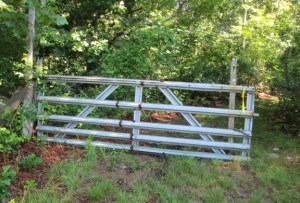
You can get by this gate, but not in a car.

You can get by this gate, but not in a car.

I was a gatekeeper once. Between 1989 and 1991 I edited three original anthologies of women’s fantasy and science fiction: Memories and Visions, The Women Who Walk Through Fire, and Tales of Magic Realism by Women (Dreams in a Minor Key). Over three years I read nearly a thousand stories — and accepted a grand total of 46.

Think about it. For every story I accepted, I rejected about 21. At first, I considered every good story — and there were a lot of them — a possible YES. Before long, the numbers got to me. My attitude changed. When I started reading each story, I was looking for reasons to say NO.

Before that, I’d heard editors and agents say that within a very few paragraphs of a story, a very few pages of a novel, they knew whether the work was publishable. How unfair! I thought. How could they possibly tell?

I read most of those thousand f/sf stories through to the end. I learned to trust my snap judgments. A story had to be more than “good” to make it into the YES or even the MAYBE pile. I learned to look for intangibles: energy, originality, clues that I’d never read anything like this before.

After that I had much more sympathy for the gatekeepers.

Even the ones who are using shibboleths and zombie rules to stick your query or cover letter or proposal in the NO pile. They’re probably swamped with good letters and applications. Their “sort” parameters may be flawed, but they’ve got to keep the MAYBE pile down to manageable size.

The moral of the story is that when you’re dealing with gatekeepers, give the gatekeepers as few reasons as possible to say NO. Follow the appropriate guidelines. Use standard formatting, or whatever format the organization or publication prescribes. And avoid the shibboleths and other pitfalls that may set the gatekeepers off. Pay attention to your teacher, your editor, and all those handy “10 things to never do in your writing” lists that are all over the Web. (Yes, I just split an infinitive. This is why I like being my own gatekeeper.)

If you’re an editor, teacher, reader of grant proposals, or other gatekeeper, you can do your bit too. Placate the shibboleths but don’t use them to sort people into SMART and STUPID, YES and NO.

Think of the language as your wardrobe. When you dress for a cocktail party, you don’t put on the same clothes you wear to do barn chores. Clothes don’t make the person, and neither does word choice, but there are plenty of people out there who think otherwise. Be prepared.

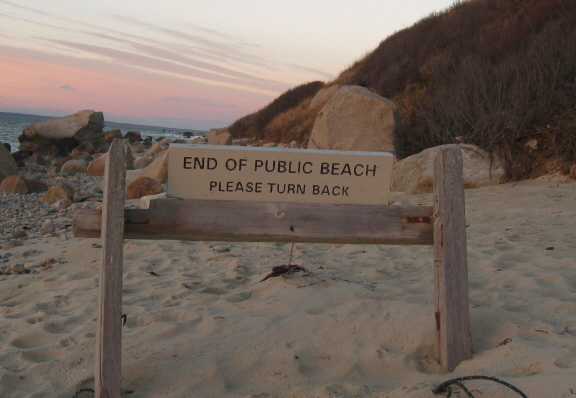
turn back

At least they’re polite about it.

Shibboleths and Other Pitfalls

For all too many people, the English language is a minefield. They’re afraid that if they take one wrong step, something will blow up in their face.

hidden cove NTIt gets worse when they learn you’re a writer, a teacher, or (gods forbid) an editor. Some people laugh nervously. Others clam up.

Many of those explosive devices we’re so afraid of are shibboleths. Like “Never end a sentence with a preposition” and “Don’t split infinitives.”

What’s a shibboleth? Here’s what the American Heritage Dictionary had to say:

  1. A word or pronunciation that distinguishes people of one group or class from those of another.
  2. a. A word or phrase identified with a particular group or cause; a catchword.
    b. A commonplace saying or idea.
  3. A custom or practice that betrays one as an outsider.

old courthouse rd 2Readers and writers, teachers and editors, are forever getting them mixed up with rules. How to tell a rule from a shibboleth? Rules usually further the cause of clarity: verbs should agree with their subjects in number; pronouns should agree with the nouns they refer to. Shibboleths often don’t. No surprise there: their main purpose isn’t to facilitate communication; it’s to separate those who know them from those who don’t.

To complicate matters even further, the language is continually evolving. New words are born. Meanings morph. Nouns get verbed and verbs get nouned. If you’re too far ahead of the pack in adopting a new usage, someone‘s not going to be happy about it.

If that’s not enough, we’ve also got such everyday confusables like ensure/insure/assure, affect/effect — and is it irrespective that’s OK and irregardless that’s verboten, or is it the other way round?

No wonder English starts to look like a minefield, even to native speakers who use it all the time.

Editors have been known to make it worse. Been there, done that. It’s an occupational hazard. An example:

As an apprentice editor, I was initiated into the mysteries of the which/that distinction. “That” was for restrictive (essential) clauses: “The sweater that I’m wearing was made by my mother.” (This implies that I have other sweaters and my mother probably didn’t make all of them.) “Which” was for non-restrictive clauses: “The house, which was built in 1850, has been in his family for decades.” (The building date is extra information. It doesn’t specify which house has been in his family for decades.)

security signHoo boy, did I go wild or what. Anyone who hadn’t mastered the which/that distinction was an ignoramus. I got to look down my snoot at them. I got to educate them.

Then I learned that British English (BrE) was managing to get along quite nicely without the which/that distinction. BrE writers liberally used which” for restrictive clauses.  Their editors weren’t changing every “which” to “that.”

Wonder of wonders, I had no trouble understanding which clauses were restrictive and which weren’t.

By that time I’d so internalized the which/that distinction that it came naturally to me. This was an asset when I started copyediting for U.S. publishers, many of whom require copyeditors to change every restrictive “which” to “that.” Fortunately most writers won’t fight about this. Many have internalized the which/that distinction just the way I did. When editing the work of a BrE writer, I’ll generally stet the restrictive “which” and note it in my style sheet so the proofreader will realize that this was a conscious decision on my part, not a (gods forbid) mistake.

Another shibboleth is the widespread notion among U.S. copyeditors that “toward” is American English and “towards” is British English. They mechanically knock the “s” off every “towards” they come to. A few years back, Jonathon Owen, linguist, writer, and editor, did his master’s thesis on this very subject. As reported in his excellent blog, Arrant Pedantry, his research suggested that U.S. editors are creating the perception that “toward” is AmE and “towards” is BrE. For writers, it’s six of one, half dozen of the other. In edited manuscripts, however, “toward” overwhelmed “towards,” 90% to 10%.

In a recent online discussion, an assortment of editors took on the difference between “such as” and “like.” (If you haven’t heard of it, worry not: I’d been editing for 10 years before I was initiated into this particular mystery. Till then I thought “such as” was simply a more formal synonym for “like.”) According to those who observe the distinction, if I refer to “movies such as Lawrence of Arabia,” I am including Lawrence in the group. If I write “movies like Lawrence of Arabia,” I’m not.

Most of the editors participating in the discussion thought the such as/like distinction was a made-up “rule” — a shibboleth. I rarely use “such as”; when I use “like,” I’m not excluding the item(s) that follow from the group. I’ll wager that most writers do likewise, and — even more important — so do most readers. What this means is that if it’s important to know whether the item(s) are included or not, you better not rely on the such as/like distinction alone to get the message across. (The discussion suggested that readers of scientific literature were alert to the distinction, so if that’s your audience you’d best observe it.)

A caveat: English is riddled with sound-alike and look-alike words that don’t mean the same thing. These aren’t shibboleths. They facilitate communication. If you write or read, they’re worth learning. As an editor, I’m always on the lookout for them. The very capable author of a recent editing job consistently confused “imply” and “infer.” (A speaker implies that something is true. Her listeners may infer the truth from what she said.) I made the necessary changes and explained the difference to the author. He said he had a hard time keeping those two words straight.

Why does any of this matter? Here I turn to “Rules That Eat Your Brain,” by Geoffrey Pullum, linguist and frequent writer on English grammar and usage. “Zombie rules” are shibboleths by another name.

Though dead, they shamble mindlessly on. The worst thing about zombie rules, I believe, is not the pomposity of those advocating them, or the time-wasting character of the associated gotcha games, but the way they actually make people’s writing worse. They promote insecurity, and nervous people worrying about their language write worse than relaxed people enjoying their language.

If the language really were a minefield, what fool would venture out into it? Be brave. Write on.


Furry Dog Story

An excerpt from my novel in progress, working title Wolfie, has just been posted to the Writers & Other Animals blog.

Writers & Other Animals features regular guest bloggers, most of whom are writing about animals — especially dogs! While you’re over there, browse the previous posts. You’ll make the acquaintance of some good writers, and probably pick up a few ideas for further reading.

The excerpt, “Close Call,” features both Shannon and Pixel from my first novel, The Mud of the Place. This takes place about 10 years later. Pixel is based on the late, great Rhodry Malamutt and Wolfie (who isn’t named in the story) is based on my Travvy. Trav was born the day after Rhodry died, so the only way I could introduce them to each other was in fiction.

I usually don’t let my writing out in public until it’s pretty close to done. Wolfie is nowhere close to done: I’m maybe 50 pages into a first draft. “Close Call” represents about four of those pages. Since it comes near the beginning, it doesn’t need a lot of explanation, and it’s self-contained enough to stand on its own.

See what you think!

Travvy woos at the waves, Lambert's Cove Beach, January 2014

Travvy woos at the waves, Lambert’s Cove Beach, January 2014

Rhodry and Dis Kitty, Malabar Farm, ca. 2005

Rhodry and Dis Kitty, Malabar Farm, ca. 2005

Guidelines, Not Godlines

I cringe whenever writers and editors start talking about “rules.”

What I really love about these rules is that there's never anyone around to enforce them.

What I really love about these rules is that there’s never anyone around to enforce them.

The real problem, though, isn’t the innocent little word “rules.” It’s that so many of us grow up thinking that rules are not to be broken. If we break them, bad things will happen. We’ll get a big red X on our paper. We’ll flunk the course. People will laugh at us.

Bending the rules is possible, of course, but it carries the tinge of unethical behavior, if not outright sleaziness.

Instead of rules, I think of conventions and guidelines.

Conventions and guidelines are worth knowing. They’re worth knowing well. They help you write better, and — probably more important — they help make what you write comprehensible to others.

But guidelines are not godlines. They are not graven in stone. Lightning will not strike you dead if you adapt them to your own purposes, or ignore them completely. If you ignore them too completely, however, readers may ignore your writing.

grammar policeCome to think of it, this is yet another way that writing and editing are like driving. Some people observe speed limits and use their turn signals because they’re afraid they’ll get a ticket if they don’t. True, they might — but seriously, how many cops are on the road at any one time? Not enough to ticket more than a tiny percentage of scofflaws.

Most of us figure this out pretty damn quick. We observe speed limits less for fear of getting caught speeding and more because they make it easier to control our vehicle. We use turn signals because they reduce our chance of getting rear-ended.

Learn the conventions and guidelines. Respect them. Internalize them. But bowing and scraping and trembling in fear are all optional. Guidelines aren’t godlines. The choices are yours.

Writers’ Groups

Writers’ groups are like workshops, only less compressed and more ongoing. Writers’ groups are generally free. This is a big plus when you don’t have much in the way of disposable income. Unlike workshops and classes, they usually don’t have instructors. They may have a leader, official or unofficial, but that person’s job is generally to keep things on track, not to teach. In writers’ groups we learn from each other.

You may have had bad experiences in writers’ groups. If you hang out with other writers, you’ve almost certainly heard about a Writers’ Group from Hell. I know they’re out there.

Nevertheless, I’ve been in several writers’ groups over the years, formal and informal, and they’ve taught me a lot. If you aspire to write for an audience of more than one, i.e., yourself, a writers’ group can be beneficial in so many ways. Each meeting is a deadline for you to meet — very helpful if your writing is always taking a backseat to everything else going on in your life. The more work you share with other writers, the braver you’ll get about sharing your work. Other writers’ comments can help you see your own work from different angles — and your comments will help them likewise.

My first writers’ group included mostly poets and fiction writers, all women. Our numbers fluctuated, but there were about six regulars. At each meeting we’d talk about how our writerly lives were going and discuss the work of two or three members. Ideally we’d each get copies of our work to the others before the meeting, but this was long before email so this wasn’t always possible. Once we produced a potluck group reading in which more than 60 women crowded into a smallish community space to enjoy good food and good writing. This was the first public reading I’d ever done. It was wonderful.

A group I was in several years later usually met in the cozy kitchen of one of its members. The kitchen had a fireplace; except in the warmest weather, there’d usually be a fire going. We sat around the kitchen table, sipping coffee (and sometimes Black Bush whiskey), nibbling homemade chocolate chip cookies, and discussing our writing, which included short essays, one-act plays, memoir, and fiction.

At each meeting we’d do some freewriting, all with pen or pencil on paper. We took turns giving a starting word or phrase and setting a time limit — usually 10, 15, or 20 minutes. Then we’d read what we’d written aloud. We didn’t have to, but we nearly always did.

The group I’m in now meets weekly in the sitting room of its leader. She provides popcorn and beverages (usually wine, fruit juice, and water, with hot cider in season); members often contribute other goodies. At each meeting, we pass out copies of our work to everyone else and then read it aloud. As we listen, we mark our hardcopies — a check mark or “good!” for things that stand out, a question mark for things we find puzzling, perhaps an alternative word or wording if one pops into our heads. Then we discuss the work, and when everyone’s had their say, we pass the marked-up hardcopies back to the writer.

As you can see, writers’ groups vary a lot.  No one group is going to be everything to all its members. My current group doesn’t lend itself to in-depth critique: we’re all hearing each piece for the first time, and each piece gets about 20 minutes of our attention. Since most of us are writing book-length works — fiction, history, and memoir — we only see a small chunk of it each week. For comments on overall structure, we have to wait till we’ve finished a complete draft, then enlist volunteer readers or a professional editor to read the whole thing. But the weekly deadline has been invaluable, and so is reading my work aloud, and hearing others read theirs.

Yes, I have been in some groups that weren’t so helpful and that sooner or later fell apart. Keeping a group together is a group effort. I could go on, but instead I’ll quote from Marge Piercy’s poem “For the Young Who Want To”: “The real writer is one / who really writes.” If a group is monopolized by writers who talk incessantly about the writing they didn’t do, or were going to do, or mean to do before the next meeting, it will quickly become useless to the writers who are really writing.

So how to find a writers’ group? Libraries and bookstores are a good place to start looking. I know of groups that have spun off from adult ed classes: the course ended, but the writers decided to keep meeting on their own. If you can’t find one, or one that’s currently open to new members — it’s definitely possible for a group to get too big — try starting one. Start small, say with one or two or three writer friends.

And please share your experiences and tips in the comments!

Aside: “The Good, the Bad, and the Ugly, or How to Choose a Writers’ Group,” by the novelist and teacher Holly Lisle, is a wonderfully detailed guide, not just to choosing a group but for starting one.


Genres and Dump Dogs

Literary genres weren’t invented by writers. They were invented by publishers. Writing is notoriously hard to categorize. Each book is unique, even books written by the same author. Publishers’ marketing departments hate this. Promote each book as a unique entity? That’s no way to do business.

So publishers identify niches, big groups of potential readers with similar interests, and market to them. Much easier, much more efficient, and (from the marketers’ perspective) much more effective.

At first the boundaries between niches are flexible, barely perceptible even. But with time they harden into walls. The niches become genres, and the genres subdivide into subgenres. The walls get higher, so that readers can barely see over them.

Reading Ray and Lorna Coppinger’s book Dogs: A Startling New Understanding of Canine Origin, Behavior, and Evolution, I got the idea that the evolution of literature has a lot in common with the evolution of dogs.

The Coppingers believe that canids domesticated themselves (and evolved into dogs) after humans started settling into stationary villages, which featured on their outskirts stationary dumps — good foraging for those canids who didn’t mind being that close to people. These “village dogs,” both in history and in the present, developed certain common characteristics, e.g., a medium size that was big enough to defend itself but small enough to thrive on the food available. Physical differentiation started to happen when some humans figured out that dogs could be useful at certain tasks, such as herding or guarding livestock and pulling sleds.

“Breeds” as we know them, however, are relatively recent developments. Until a couple of centuries ago, a retriever was a dog that retrieved well — not necessarily a dog with retrievers on both sides of its pedigree. Whether a dog could retrieve well depended partly on its parents (did it have the right physical characteristics for the job?) and partly on how it was raised and trained. A Labrador retriever pedigree alone does not a good retriever make. The modern emphasis on “pure” breeds (meaning the stud books are closed, meaning genetic diversity takes a wallop), especially in the show ring, tends to divorce function from appearance and to focus heavily on the latter.

Literary genres are like breeds — of relatively recent development, especially the notion that there are clear lines between them and everything has to fit into one category. “Literature” is more like those village dogs of indeterminate breed: it adapts to the climate and food sources available, and maybe it looks a little like this, a little like that, but you can’t say for sure that it’s a beagle or a foxhound (or a mystery or a romance). When you’re trying to tell a story, you scavenge and steal from whatever’s in the vicinity and if it works you keep it.

All of which is not to say that genres aren’t useful to writers. Faced with a whole boundless ocean of possibilities, it’s easy to choke. Why not focus on the weather and currents, the flora and fauna, of a particular inlet or harbor or archipelago? By all means go ahead. Each genre has its tropes and conventions. Because readers are familiar with them, you don’t have to justify, say, the dead body that turns up in chapter 1 or the FTL (faster-than-light) starship that enables your characters to get from one planet to another. You can devote your writerly attention to other things.

Just keep in mind that many stories worth telling don’t fit neatly, or even messily, into one genre or another. In the attempt to squeeze them in, sacrifices have to be made. Genetic diversity may be lost. The end result might be a dog that looks sharp in the show ring but can’t do the job its ancestors did.


Workshop

In the summer of 1984, having saved my pennies and summoned my courage, I headed off to Ithaca, New York, for the Feminist Women’s Writing Workshop. Was I ready? Was I good enough?

My poetry chapbook (1989). Cover design by Maggie MacCarty.

I’d never been to a workshop. I’d never taken a writing class. I didn’t know what to expect. Junior year of high school, though, I’d won the school’s writing prize. Since then I’d done lots and lots of self-teaching. The college newspapers had published my op-eds and reviews. More recently, my reviews and essays had appeared in feminist and gay publications. I’d written most of the poems that eventually appeared in my chapbook, Leaving the Island (1989). I was working on a novel.

Maybe most important of all, I was the book buyer for Lammas, Washington, D.C.’s feminist bookstore. For years I’d been immersed in a movement, a community, for which books and magazines and newspapers were crucial, life-sustaining stuff. I saw it every day at work: women discovering words that inspired them, strengthened them, and even changed their lives.

Words were my only instrument, writing and editing my only useful skills. It was time, I thought, to test my vocation.

Me standing on the boathouse deck during a break, ca. 1987

Me standing on the boathouse deck during a break, ca. 1987

The heart of the workshop was our morning critique sessions. At each two-hour session, an hour would be devoted to the work of one participant. In those days the workshop was held at Wells College in tiny Aurora, New York, about 30 miles from Ithaca. These meetings were held on the second floor of the boathouse, overlooking Cayuga Lake.

The day before, the scheduled writers would put copies of their work out for everyone to read. (“Copies” meant paper in those days. In 1984 we all still had typewriters.) We took our homework seriously. When we gathered in a big circle at 9 every morning, everyone was prepared. The scheduled writers were usually at least a little bit nervous.

The ground rules were simple. For the first part of the session, the writer was invisible. Critiquers were to discuss the work with each other, as if she weren’t there. Her job was to listen. She wasn’t to speak. The workshop director got the discussion going by asking a question about the work, then she’d keep the discussion on track by asking more questions, making comments, and when necessary reminding us of the ground rules. With 10 or 15 minutes to go in the hour, she’d close the discussion and give the floor to the writer. The writer could then answer whatever questions had been raised, ask some of her own, and generally respond to the comments made.

Talking writing on the Wells College lawn, ca. 1987

Talking writing on the Wells College lawn, ca. 1987

Taking part in these sessions morning after morning was a powerful experience. As the writer being critiqued, I listened to 18 of my peers focusing all their attention on my work. My work had to stand on its own, apart from me. Sometimes my peers would argue about a particular line. They’d disagree, sometimes heatedly, about what it meant and whether it worked. Gradually it dawned on me that I couldn’t take any single comment, supportive or critical, as the final word. I had to sort through all the feedback and decide how to use it.

As a critiquer, this meant my job was to tell the writer whatever I could about her work, even if I thought my idea was off-the-wall or too personal or even negative. “I don’t understand what’s going on here” is my take on the work, no more, no less. Maybe the writer will find it useful, maybe not. Either way it’s her call. Sometimes as a critique session began, I’d be on the verge of panic because a work had left me cold, or angry, or frustrated. Some works were more polished than others. I learned that I could nearly always come up with something the writer might find useful.

For better or worse, my vocation passed the test. I returned to the workshop for the next three years as one of two assistant directors. By 1988, however, I’d been sucked into the seasonal economy of Martha’s Vineyard, to which I’d moved in 1985, and could no longer escape for 10 days in the summer. The Feminist Women’s Writing Workshop no longer exists, but the critique process I learned there can be replicated anywhere — if the workshop leader (if there is one) and participants are willing to create a safe space for critiquing and being critiqued.

Get Me Rewrite

Many writers hate rewriting. I love it. First-drafting is like breaking trail. Breaking trail is exhausting. (We’ve had a lot of snow this winter. My dog and I have broken a lot of trail. We’re both tired when we get home.)

Rewriting is more like pruning branches, tossing rocks out of the path, and notching trees to mark a trail. Even when it means rerouting a trail to avoid a fallen tree, I’d rather be rewriting than breaking trail.

For now I’m lumping editing and revising in with rewriting, even though they aren’t exactly the same thing. Rewriting means “messing with your first draft.” It can include anything from minor tweaks to a total overhaul.

If you hate rewriting, why should you do it? Good question. Maybe a better question is when should you do it? Not everything needs to be rewritten. Journal entries don’t. Freewriting exercises don’t. Most personal correspondence doesn’t — which is not to say that you shouldn’t reread the letter before you seal the envelope or the email before you hit Send. You should.

Irish playwright Richard Brinsley Sheridan nailed one of the whys with these much-quoted and -misquoted lines:

You write with ease, to shew your breeding;
But easy writing’s curst hard reading.

When you rewrite, you focus on your intended audience. That can be your boss, your publisher, your teacher, your writers’ group, your legion of fans — whoever you want your writing to reach. My audience includes myself. Yours probably does too. (I just learned from a Richard Nordquist column that Sheridan wrote “vile,” not “curst,” but I sort of like “curst” better.)

At the moment I’m taking a break from Squatters’ Speakeasy, the novel in progress, to work on an essay about The Sleepwalker, a statue whose temporary installation at Wellesley College is causing much discussion at Wellesley and elsewhere. No one’s waiting for this essay. I have no deadline and no length limit. I’m writing it because the placement of the statue raises several issues that have fascinated me for a long time, like risk and feminism and the purpose of art.

I’m writing primarily to clarify my own thinking, though if I can inspire other people to consider these issues from different angles, that’s more than OK with me. This purpose is what guides me as I rewrite.

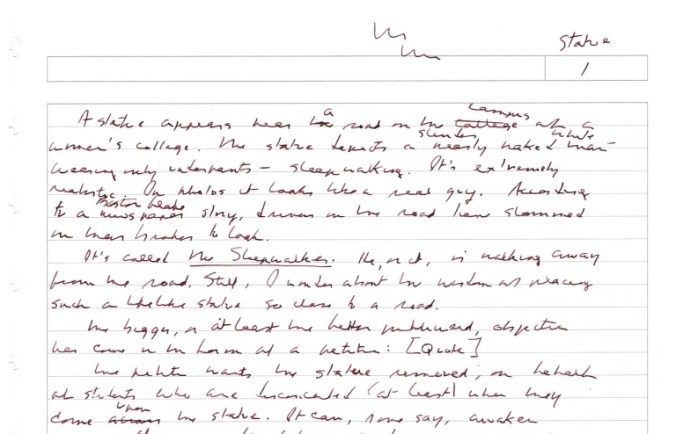
Here’s what the beginning of the first draft looked like:

statue ms

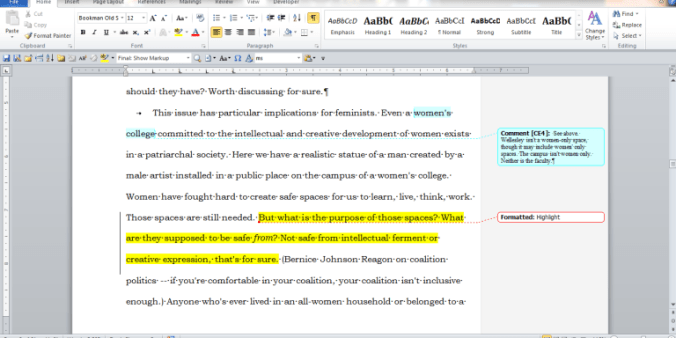
After 13 pages, I figured I had enough good raw material to proceed to the next draft. So I typed my handwritten pages into Word (Word 2010 on a Windows 7 laptop, for those who are wondering). The first two paragraphs look like this:

statue screenshot

The words are almost the same, but they look different, don’t they? Seeing those nice crisp letters, words, and paragraphs triggers my internal editor. At this point, I welcome her on board.

This draft is 21 pages long — considerably longer than its predecessor. At this stage the essay is still expanding. A phrase might trigger an elaboration or a detour: I go with it, not worrying about how it’s going to fit into the final version. At the same time, the internal editor is noting that a paragraph toward the end might be more effective near the beginning, and that I’ve discussed the same point in three different places — could they be consolidated?

Now I’m working on the third draft. My internal editor is having a field day. Word’s various features come in very, very handy. Internal editor is making comments for the writer to consider. She’s highlighting key phrases and sentences that will help structure the next draft. She’s also making additions and deletions, always with changes tracked. Nothing’s set in stone at this point. The writer likes how it looks.

statue screenshot 2