C Is for Comma

As noted in “A Is for Audience,” I started this A-to-Z challenge a little late. C should have been posted on the 4th, but it’s currently the 6th. I’m backdating this post to the 4th to make myself look good. I will catch up, I promise.

According to Sturgis’s Law #5, “Hyphens are responsible for at least 90 percent of all trips to the dictionary. Commas are responsible for at least 90 percent of all trips to the style guide.”

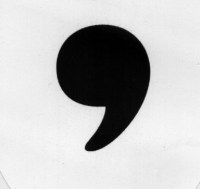
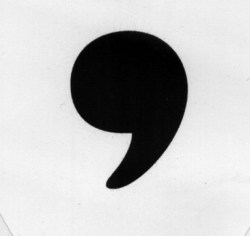
Is it a comma, or is it an apostrophe? Without more context, like maybe a baseline, it’s hard to tell.

Commas drive many writers and editors crazy, mostly because they are convinced that there are places where commas must always be used and places where commas must never be used, and the rules that specify which places are which are both inscrutable and shifty, which is to say they swap places in the night just to mess with people’s heads.

Commas are useful little buggers. Writing that consists of long comma-less sentences is devilish hard to read, and besides, we usually talk in phrases, emphasizing some words and not others. Commas, and punctuation generally, help shape your sentences so they’ll be read, understood, and heard the way you want them to be.

Yes, it’s usually a good idea to put a comma before the conjunction that separates two independent clauses:

She dashed down the stairs and into the street, but the car was already disappearing around the corner.

But when the clauses are short, a comma might feel like overkill:

Michaela went into the garden and Joan left the party.

But a comma wouldn’t be wrong in the sentence just above, nor would it be wrong to omit it in “She dashed down the stairs . . .” Much depends on how the writer hears the sentence, and how she wants readers to hear it. A comma does suggest, or at least permit, a pause.

Not all writers hear the words we write, but some of us definitely do. When I’m editing and come to a comma in an unconventional place, or an absence where convention thinks a comma should be, I read the sentence aloud with and without the comma. Do the two versions feel different? If so, which works better in context?

Commas are small but powerful. Don’t be afraid of them. Put them to work.

For more of my thoughts on commas, check out “Dot Comma.” And if you have any questions or advice about commas, let me know.

Proofreading Poetry

Me and my IWD sign, which says “The common woman is as common as the best of bread / and will rise.” I am, you may have guessed, a regular bread baker. Photo by Albert Fischer.

I’ve been thinking about this because, you guessed it, I recently proofread a book-length collection of poems.

Prompted by the poster I made for an International Women’s Day rally on March 8, featuring a quote from one of Judy Grahn’s Common Woman poems, I’ve also been rereading Grahn’s early work, collected in The Work of a Common Woman (St. Martin’s, 1977). So I’ve got poetry on my mind.

A 250-page book of poetry contains many fewer words than a 250-page work of fiction or nonfiction, but this does not mean that you’ll get through it faster.  Not if you’re reading for pleasure, and certainly not if you’re proofreading. With poetry, the rules and conventions generally applied to prose  may apply — or they may not. It depends on the poems, and on the poet.

Poetry also offers some tools that prose does not, among them line breaks, stanza breaks, rhyme, and meter. (These techniques and variations thereof can come in very handy for prose writers and editors, by the way.) The work I was proofreading also includes several “concrete poems,” in which the very shape of the poem on the page reflects and/or influences its meaning. “Sneakers” was shaped like, you guessed it, a sneaker; “Monarchs” like a butterfly; “Kite” like a kite.

Errors are still errors, of course. When the name Tammy Faye Baker appeared in one poem, I added the absent k to “Baker” — checking the spelling online, of course, even though I was 99 percent sure I was right. Sometimes a word seemed to be missing or a verb didn’t agree with its subject. In a few cases, the title given in the table of contents differed somewhat from the title given in the text.

Often the matter was less clear-cut. English allows a tremendous amount of leeway in certain areas, notably hyphenation and punctuation, and that’s without even getting into the differences between British English (BrE) and American English (AmE). Dictionaries and style guides try to impose some order on the unruliness, but style guides and dictionaries differ and sometimes even contradict each other.

If you’ve been following Write Through It for a while, you know that I’ve got a running argument going with copyeditors, teachers, and everyone else who mistakes guidelines for “rules” and applies any of  them too rigidly. See Sturgis’s Law #9, “Guidelines are not godlines,” for details, or type “rules” into this blog’s search bar.

Imposing consistency makes good sense up to a point. For serial publications like newspapers or journals, consistency of style and design helps transform the work of multiple writers and editors into a coherent whole. But each poem is entitled to its own style and voice, depending on its content and the poet’s intent. Short poems and long poems, sonnets, villanelles, and poems in free verse, can happily coexist in the same collection.

What does this mean for the proofreader? For me it means second-guessing everything, especially matters of hyphenation and punctuation. Remember Sturgis’s Law #5? “Hyphens are responsible for at least 90 percent of all trips to the dictionary. Commas are responsible for at least 90 percent of all trips to the style guide.”

But dictionaries and style guides shouldn’t automatically override the preferences of a poet or careful prose writer. The styling of a word may affect how it’s heard, seen, or understood. When  I came upon “cast iron pot,” my first impulse was to insert a hyphen in “cast-iron,” and my second was No — wait. Omitting the hyphen does subtly call attention to the casting process; my hunch, though, based on context, was that this was not the poet’s intent. I flagged it for the poet’s attention when she reads the proofs.

Another one was “ground hog.” I can’t recall ever seeing “groundhog” spelled as two words, though it may well have been decades or centuries ago. However, in the first instance “ground hog” broke over a line, with “ground” at the end of one line and “hog” at the beginning of the next. In prose such an end-of-line break would be indicated with a hyphen, but this poet generally avoided using punctuation at the ends of lines, instead letting the line break itself do the work, except for sentence-ending periods. “Ground hog” recurred several times in the poem, so consistency within the poem was an issue. It was the poet’s call, so again I flagged this for her attention.

One last example: Reading aloud a poem whose every line rhymed with “to,” I was startled to encounter “slough,” a noun I’ve always pronounced to rhyme with “cow” (the verb rhymes with “huff”). When I looked it up, I learned that in most of the U.S. “slough” in the sense of “a deep place of mud or mire” (which was how it was being used here) is indeed generally pronounced like “slew.” The exception is New England, which is where I grew up and have lived most of my life. There, and in British English as well, “slough” often rhymes with “cow” in both its literal and figurative meanings. (For the latter, think “Slough of Despond.”)

All of the above probably makes proofreading poetry seem like a monumental pain in the butt, but for me it’s a valuable reminder that English is remarkably flexible and that many deviations from convention work just fine. At the same time, although I can usually suss out a writer’s preferences in a book-length work, I can’t know for sure whether an unconventional styling is intentional or not, so sometimes I’ll query rather than correct, knowing that the writer gets to review the edited manuscript or the proofs after I’m done with them.

The other thing is that while unconventional stylings may well add nuance to a word or phrase, they rarely interfere with comprehension. Copyeditors sometimes fall back on “Readers won’t understand . . .” to justify making a mechanical change. When it comes to style, this often isn’t true. My eye may startle at first at an unfamiliar styling or usage, but when the writer knows what she’s doing I get used to it pretty quickly.

The above examples come from Mary Hood’s All the Spectral Fractures: New and Selected Poems, forthcoming this fall from Shade Mountain Press. It’s a wonderful collection, and I highly recommend it. Established in 2014, Shade Mountain Press is committed to publishing literature by women. Since it’s young, I can say that I’ve read and heartily recommend all of their titles, which so far include three novels, a short-fiction anthology, and a single-author collection of short stories. All the Spectral Fractures is their first poetry book. I rarely mention by title the books that I work on, but Rosalie said it was OK so here it is.

Proofreading English English

British flagGeorge Bernard Shaw oh-so-famously said that “England and America are two countries separated by a common language.”

Ha ha ha. Clever, but a bit overstated, don’t you think? True, this native speaker of American English (AmE) usually turns the captions on when watching British TV shows like Sally Wainwright’s (awesome) Happy Valley because, between the Yorkshire accent, the colloquialisms, and the speed of conversation, my unaccustomed American ear can miss as much as half of what the characters are saying.

Also true: Accents and colloquialisms can trip me up in AmE as well.

Written English seems to cross the ocean more easily. Accents don’t interfere with the printed page, and print stands still so I can pore and puzzle over anything I don’t get the first time. If I don’t understand a word, I can look it up.

The biography I’m proofreading at the moment is being published simultaneously in the US and the UK. It was written and edited in British English (BrE), so that’s what I’m reading. I have no trouble understanding the text. The big challenge is that I’m so fascinated by the differences between AmE and BrE style, spelling, usage, and punctuation that I have to keep reminding myself that I’m proofreading. “They went to the the museum” is a goof on both sides of the Atlantic and it’s my job to catch it.

I’ve long been familiar with the general differences between BrE and AmE spelling. AmE generally drops the “u” from words like “favour” (but retains it in “glamour,” damned if I know why), spells “civilise” with a “z,” and doesn’t double the consonant in verbs like “travelled” unless the stress falls on the second syllable, as in “admitted.” In BrE it’s “tyre,” not “tire”; “kerb,” not “curb”; “sceptical,” not “skeptical”; and “manoeuvre,” not “maneuver.” (The “oe” in “amoeba” doesn’t bother me at all, but “manoeuvre” looks very, very strange.)

To my eye the most obvious difference between AmE and BrE is the quotation marks. A quick glance at a book or manuscript can usually tell me whether it was written and edited in AmE or BrE. In AmE, quoted material and dialogue are enclosed in double quotation marks; quotes within the quote are enclosed in single. Like this: “Before long we came to a sign that said ‘Go no further,’ so we turned back.” BrE does the opposite: single quotes on the outside, double on the inside.

That part’s easy. What’s tricky is that in AmE, commas and periods invariably go inside the quote marks, but in BrE it depends on whether the quoted bit is a complete sentence or not. If it is, the comma or full stop goes inside the quotes; if it isn’t, the comma or full stop goes outside. What makes it even trickier is that British newspapers and fiction publishers often follow AmE style on this. My current proofread follows the traditional BrE style, and does so very consistently. Thank heavens.

BrE is more tolerant of hyphens than AmE, or at least AmE as codified by Merriam-Webster’s Collegiate Dictionary and the Chicago Manual of Style and enforced by the copyeditors who treat them as rulebooks. I like this tolerance. (For more about my take on hyphens, see  Sturgis’s Law #5.)

BrE also commonly uses “which” for both restrictive and non-restrictive clauses. This also is fine with me, although as a novice editor I was so vigorously inculcated with the which/that distinction that it’s now second nature. Some AmE copyeditors insist that without the which/that distinction one can’t tell whether a clause is restrictive or not. This is a crock. Almost anything can be misunderstood if one tries hard enough to misunderstand it. Besides, non-restrictive clauses are generally preceded by a comma.

In my current proofread, however, I encountered a sentence like this: “She watched the arrival of the bulldozers, that were to transform the neighborhood.” “That” is seldom used for non-restrictive clauses, and a clause like this could go either way, restrictive or non-restrictive, depending on the author’s intent. Context gave me no clues about this, so I queried.

comma

A comma (willing to moonlight as an apostrophe)

Speaking of misunderstanding, remember “I’d like to thank my parents, Ayn Rand and God”? Some copyeditors and armchair grammarians consider this proof that the serial or Oxford comma — the one that precedes the conjunction in a series of three or more — is necessary to avoid misunderstanding. As I blogged in “Serialissima,” I’m a fan of the serial comma, most of what I edit uses the serial comma, but the book I’m proofreading doesn’t use the serial comma and it didn’t me long to get used to its absence.

BrE uses capital letters more liberally than AmE, or at least AmE as represented by Chicago, which recommends a “down style” — that is, it uses caps sparingly. In my current proofread, it’s the King, the Queen, the young Princesses, the Prime Minister, and, often, the Gallery, even when gallery’s full name is not used. Chicago would lowercase the lot of them.

I knew that BrE punctuates certain abbreviations differently than AmE, but I was a little fuzzy on how it worked, so I consulted New Hart’s Rules, online access to which comes with my subscription to the Oxford Dictionaries. If Chicago has a BrE equivalent, New Hart’s Rules is it. In BrE, I learned, no full point (that’s BrE for “period”) is used for contractions, i.e., abbreviations that include the first and last letter of the complete word. Hence: Dr for Doctor, Ltd for Limited, St for Street, and so on. When the abbreviation consists of the first part of a word, the full point is used, hence Sun, for Sunday and Sept. for September.

Thus enlightened, I nevertheless skidded to a full stop at the sight of “B.Litt,” short for the old academic degree Bachelor of Letters. Surely it should have either two points or none, either BLitt or B.Litt.? I queried that too.

AmE is my home turf. I know Chicago cold and can recognize other styles when they’re in play. I know the rules and conventions of AmE spelling, usage, and style, and (probably more important) I know the difference between rules and conventions. In BrE I’m in territory familiar in some ways, unfamiliar in others. I pay closer attention. I look more things up. I’m reminded that, among other things, neither the serial comma nor the which/that distinction is essential for clarity. Proofreading in BrE throws me off-balance. This is a good thing. The editor who feels too sure of herself is an editor who’s losing her edge.

Serialissima

If you hang out with editors and armchair grammarians, you soon learn that the serial comma is a contested issue.

You will hear some defend to the death their right not to use it, while others insist that every time it’s omitted the English language teeters closer to the brink of collapse.

If you hang out with editors and armchair grammarians or count them among your Facebook friends, it’s best to keep Sturgis’s Law #16 in mind. In the annotation of Sturgis’s Laws I haven’t got there yet , but here’s a sneak preview:

The amount of discussion devoted to an issue is inversely proportional to the issue’s importance and to the preparation required to say anything meaningful about it.

So what exactly is this little mite that inspires such passion?

comma

Commas in isolation are hard to distinguish from apostrophes.

The serial comma is also called the Oxford comma, but I prefer “serial,” and not just because I live on the left side of the Atlantic. The serial comma, after all, is about how one punctuates series of three or more items, specifically about whether one should use a comma before the conjunction that precedes the last element.

This sentence is widely circulated by serial-comma fans to prove their point: “I’d like to thank my parents, Ayn Rand and God.” You’ve probably seen it, or one very like it.

Without the serial comma, “Ayn Rand and God” could be an appositive phrase. Is the writer really saying that Ayn Rand and God are his/her parents? Ha ha ha.

As an argument for the serial comma, however, this example is less than persuasive. Take any sentence out of context and myriad misreadings become possible. The Associated Press style guide, widely used by newspapers and businesses across the U.S., generally doesn’t recommend the serial comma unless confusion might result from its absence. The sky hasn’t fallen in yet, and besides, if one fears confusion might result from “my parents, Ayn Rand and God,” one is free to insert a comma after “Rand.”

That said, I’m a serial-comma fan. This has as much to do with habit as anything else. I don’t recall anyone making a big deal about serial commas when I was in school, but when I was an apprentice editor in the very late 1970s, “Chicago style” — currently codified in The Chicago Manual of Style, 16th edition — was drummed into my head. Chicago recommends the serial comma, as do most U.S. publishers.

As a result, I’m used to it. I notice when it’s not there. Here’s a sentence chosen at random from my novel in progress. The speaker is referring to Moshup, the giant of Wampanoag legend.

“He caught whales one-handed, cooked them up here, and shared the meat with the resident Wampanoags.”

To my eye and ear, the comma after “here” makes clear that there are three elements here, not two. If that comma isn’t there, my eye slides to the end of the sentence without registering the slight break that separates the third element from the second. A reader who doesn’t expect a comma there probably isn’t going to miss it.

Sometimes, however, I want my eye to slide to the end of a phrase. The U.S. flag is often called “the Red, White and Blue.” We say it almost as if it’s one word: “the RedWhiteandBlue.” With a comma after “White” I visualize three distinct colors, not a single flag. If I wrote “The flag is red, white, and blue,” would I use the serial comma? Yes, I would. (I just did.)

The serial comma is rarely used, by the way, when the conjunction “and” is represented by an ampersand: “The flag is red, white & blue.” Ampersands are rarely used in formal or even informal writing, so this comes up more often in display type, like advertisements, posters, and headlines. Why is this? Damned if I know, but the big ampersand dwarfs the tiny comma so I don’t blame the comma for wanting outta there.

But it’s more than habit and long experience that makes me a serial-comma fan. Because I generally use it, I can use its omission to shape the meaning of a phrase. Here’s a simple example:

Gathered in the foyer were colleagues, writers, and editors she’d known for years.

“Colleagues, writers, and editors” are three distinct groups, right? Now remove the commas after “writers”:

Gathered in the foyer were colleagues, writers and editors she’d known for years.

“Writers and editors” is now in apposition to “colleagues.” In other words, the writers and editors are her colleagues.

To a non-serial-comma user the second sentence could go either way: two groups or three? The astute non-serial-comma user might insert a serial comma here if three groups were meant, realizing that this is an instance where the serial comma serves a purpose. With any luck the non-serial-comma-using copyeditor would realize as much and not delete it.

So I use the serial comma regularly because if I do, its omission becomes a tool in my toolkit. Even if I only use it a few times a month, I like knowing it’s there.

Squeaky Clean

Sturgis’s Law #4 warns editors to be skeptical when anyone comes to them swearing that “all this manuscript needs is a light edit.”

The skepticism is warranted, but in all fairness — light edits do happen. I’m working on one now. In my post about Sturgis’s Law #4 I wrote that light edits “are generally prepared by fairly experienced writers who have already run them by a few astute colleagues for comments and corrections.” This particular manuscript was prepared by extremely experienced writers, and it’s being published by a reputable trade house. I copyedit regularly for this house, but this ms. is clean even by their standards.

Cleaning bucket

Cleaning bucket

To editors and others engaged in the publishing process, “clean” means, more or less, in very good shape. Whether edited on paper or on screen, the ms. doesn’t have a lot of markup showing. If an editor who’s reviewed your ms. tells you it’s very clean, that’s high praise. It doesn’t mean that the ms. won’t benefit from editing, but it does mean that the editing will mostly involve fine-tuning and polishing, not a remedial overhaul.

“Squeaky clean” to me goes a step further. A squeaky clean ms. could probably go straight to press without embarrassing anybody. No, it’s not perfect. Yes, I’ve caught a few typos and formatting glitches, a missing endnote, and one instance where a character is 17 years old on one page and 16 a few pages later. But this is not stuff that most readers notice. In gravity or quantity, these are not errors that would prompt even the perfectionists among us to toss the book aside as sloppily edited. The writing is just too good.

Squeaky clean mss., like well-edited proofs, can be a little scary. That perfectionist in the back of my head is sure I’m missing something. Maybe my eyesight has deteriorated overnight?

They also lead us into temptation — the temptation to fiddle where fiddling is not called for. The impulse to make our mark runs strong in most of us, and the manuscript where minimal marking is needed can be profoundly frustrating.  Doesn’t it mean that all the knowledge of grammar, punctuation, usage, and sentence structure crammed into our heads is going to waste?

No, it doesn’t. I adapted the familiar Serenity Prayer for editorial use. It goes like this: “Grant me the serenity to recognize the prose I should not change, the ability to improve the prose I can, and the wisdom to know the difference.”

That wisdom, and the self-restraint that comes with it, is an essential editorial skill. Most of us take a while to develop it. Novices are notorious for fiddling with what doesn’t need fiddling with, usually because we’re afraid we’re not doing our job if we aren’t making marks on page or screen. (When this persists and spins out of control, I call it “piss-on-fire-hydrant syndrome.” One of these days I should blog about that.)

Over the years I’ve come to realize that these squeaky clean manuscripts are a gift. When the prose is already clear and graceful, attentive to sound, pacing, and nuance, I get to focus on the finest of the fine points: Does this particular word, though definitely OK, perhaps have connotations that get in the way? How about a comma here, to slow somewhat the headlong rush to the end of the sentence?

With a ms. this clean, the competent editor quickly comes to trust the writer’s judgment, and even to sense why the writer has phrased something this way and not that. At the same time — well, this particular ms. is almost 500 pages long and contains more than 180,000 words. Even the most experienced and careful stylists can’t devote equal attention to every one of those words. So I suggest the occasional change, suspecting that the writer will appreciate the suggestion even if s/he decides not to act on it.

serenity prayer

Dot Comma

This is part 2 of “Sturgis’s Law #5.” I got carried away with hyphens and didn’t get around to commas till the word count was edging toward the stratosphere. Here’s Sturgis’s Law #5 redux.

Hyphens are responsible for at least 90 percent of all trips to the dictionary. Commas are responsible for at least 90 percent of all trips to the style guide.

Commas drive people crazy. They’re small but they’re powerful. They can be used for so many things. Teachers, editors, and the authors of style guides often try to wrangle them into some sort of order, which is fine, but when the guidelines harden into rules, writers and other editors may get feisty.

I suspect that it’s not the poor commas that drive people crazy; it’s the notion that there are a gazillion iron-clad rules about the right and wrong way to use them and if you get any of them wrong someone will think you’re stupid.
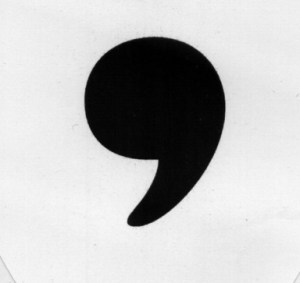
Context matters. Is this a comma or an apostrophe? Actually it's the bottom half of a semicolon, but it's impersonating a comma.

Context matters. Is this a comma or an apostrophe? Actually it’s the bottom half of a semicolon, but it’s impersonating a comma.

Take my sentence above: “They’re small but they’re powerful.” To comma or not to comma? It’s actually OK either way: convention sensibly advises a comma before the conjunction that separates two independent clauses, but an equally sensible corollary notes that the comma may be dropped when the clauses are short.

So I went back and forth a half-dozen times between “They’re small, but they’re powerful” and “They’re small but they’re powerful.” To avoid settling on one or the other, I actually contemplated “They’re small but powerful” and “They’re small — but they’re powerful.” All four options are well within the pale of acceptable usage, but each reads a little differently.

Sentences like this can send us running to the style guide, and when the oracle responds with “It depends,” that’s when we start to lose it.

This, however, is no reason to throw the comma conventions out. Writing that consists of long comma-less sentences is devilish hard to read, and besides, we usually talk in phrases, emphasizing some words and not others. Commas, and punctuation generally, help shape your sentences so they’ll be read, understood, and heard the way you want them to be. Learn the basics so well that they become your default settings. At that point you’re ready to change the defaults when it best serves your writing.

Here’s a short paragraph plucked at random from my novel in progress. Shannon is explaining to the selectmen in her town* why Wolfie, a dog who’s been running amok and maybe killing livestock, should be allowed to remain in her house. No surprise, the paragraph has a lot of commas in it, doing common comma duties.

Shannon smiled. “You might say so,” she said. “When Wolfie’s confined to a crate, he tries to get out, and when he can’t get out, he howls. We’re making progress on that, but, well, I don’t think he would do well at the kennel.”

The first comma is standard in punctuating dialogue in American English (AmE). Use a comma before or after a dialogue tag, depending on its placement in the sentence. If you want, you can turn that sentence around:

She said, “You might say so.”

The second comma follows a dependent clause at the beginning of a sentence. Commas are also used to set off introductory phrases, especially when they’re fairly long. How long? I remember learning that any introductory phrase or clause of at least seven words should be followed by a comma, but please, don’t be making your decisions on word count alone. The main purpose of that comma is to keep the introductory phrase or clause from bleeding into the main sentence.

The third comma, the one before and, separates two independent clauses. The fourth, like the second, sets off an introductory clause. This sentence is both compound (it comprises two independent clauses) and complex (it includes dependent clauses). In such sentences, commas help the reader figure out what goes with what.

Next comes another before-the-conjunction comma, and then we’ve got an interjection: well. When interjections — well, oh, good heavens, and the like — come at the beginning of a sentence they are almost always followed by a comma. When they come in the middle, you usually want commas fore and aft. Say the sentence out loud. You pause before and/or after the interjection, right?

Good writers often use commas to help pace our sentences, perhaps to signal a slight pause. I hear a subtle difference between She shut the door then opened it again and She shut the door, then opened it again. In the former, the opening follows hard on the shutting. In the latter she hesitates; maybe she’s had second thoughts. Some people don’t hear any difference at all between the two. When an editor who doesn’t hear the difference meets up with a writer who does, things can get ugly.

When they approach commas that can’t be neatly explained by one of “the rules,” some editors ask “Is it necessary?” When I’m editing, my own work or someone else’s, I ask instead “Is it useful?” and “What purpose is it serving?” If it’s serving a purpose, I generally leave it alone.

This is not to say that I pause to ponder every comma I come to. In most book-length copyediting jobs I put a bunch in and take a bunch out on the fly. If asked, though, I can nearly always explain what I did and why: this is a knack that comes with experience, lots of experience.
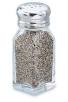
Commas ready for recycling

Commas ready for recycling

Some writing, even good writing, is peppered with commas. I remove the excess and save them in a pepper shaker, so I’ll have them on hand when I come to a work with too many long, breathless sentences.

When a sentence or whole passage is overpunctuated — it contains so many commas and other punctuation marks that you barely notice the words — this is often a sign that the sentence itself needs work. The writer is trying to tame the sentence with commas when the real problem lies with the words, phrases, and/or clauses and the arrangement thereof.

OK? Commas may be small and powerful, but they don’t have to be scary. Play around with them. See what works and what doesn’t. And if you’ve got a comma question or observation, post it in the comments or use the “Got a Question?” form at the top of this page.


* This town, like most small to middling towns in New England, runs by the town meeting system. Town meeting, in which all the town’s registered voters can participate, functions like a legislature. In addition to the big annual town meeting, usually in the spring, there are usually two or three special town meetings during the year. The board of selectmen takes care of business in between.

Sturgis’s Law #5

This past spring I started an occasional series devoted to Sturgis’s Laws. “Sturgis” is me. The “Laws” aren’t Rules That Must Be Obeyed. Gods forbid, we writers and editors have enough of those circling in our heads and ready to pounce at any moment. These laws are more like hypotheses based on my observations over the years. They’re mostly about writing and editing. None of them can be proven, but they do come in handy from time to time. Here’s #5:

Hyphens are responsible for at least 90 percent of all trips to the dictionary. Commas are responsible for at least 90 percent of all trips to the style guide.

Policy making, policy-making, or policymaking? If “policy making” is the noun version, do you hyphenate “policy-making process”? How about “policymaker”? One word, two words, or hyphenated word? “Prodemocracy forces” or “pro-democracy forces”? “Back-seat driver” or “backseat driver”?

So you trot off to the dictionary. This is where the real fun starts. Dictionaries can be internally inconsistent: “policyholder” is one word, but “policy maker” is nowhere to be found, which generally means it’s two. The American Heritage Dictionary offers “policymaking or policy-making” but recommends “policymaker” for the person who makes the policy.

For even more fun, consult a second dictionary. Merriam-Webster’s Collegiate, aka MW, makes “backseat” one word, both as noun and adjective: “The dog sat in the backseat” and “He’s a terrible backseat driver.” American Heritage doesn’t list “backseat,” so it’s safe to assume that it considers it two words: “The dog sat in the back seat” and (probably) “He’s a terrible back-seat driver.”

My dog sits in the front seat.

My dog sits in the front seat. He is not a backseat driver.

Note that MW doesn’t list “frontseat” anywhere, so presumably it considers it two words. So what if you’ve got “front seat” and “back seat” in the same story, the same paragraph, even the same sentence? Do you follow the dictionary into an inconsistency that makes no sense? Not me.  In my own writing, it’s “The dog sat in the back seat” and “He’s a terrible backseat [or back-seat] driver.” (My dog sits in the front seat, by the way. It’s all I can do to keep him out of the driver’s seat.)

When you’ve sorted out “backseat” and “front seat,” you can move on to “backyard” and “front yard.” What’s sauce for the seat is sauce for the yard — or maybe not.

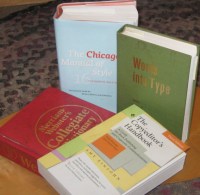
The Chicago Manual of Style has a handy-dandy several-page hyphenation chart. It’s extremely useful, it really is: you really don’t need to be deciding all this stuff from scratch. But if you use it a lot, as I do, pretty soon you’ll notice that it and your dictionary of choice don’t always agree. You’ll notice that different genres and different disciplines often have their own conventions, and these conventions are perfectly OK even if they don’t agree with Chicago or Merriam-Webster’s.

Here’s an example: Chicago often recommends hyphenating compound adjectives when they appear before a noun but leaving them open when they follow the verb. “A well-known proverb” but “The proverb is well known.” The catch here is that “well-known” appears in most English-language dictionaries. This makes it a word, and English words don’t generally change form according to their position in a sentence. So it depends on whether you think of “well-known” as a word or as a temporary compound — two or more words yoked together to serve a common purpose and that may be unyoked after that purpose is satisfied.

Arbiters of style.

Arbiters of style.

Here’s another one: Both Chicago and Merriam-Webster’s generally recommend dropping the hyphen after prefixes and before suffixes: multitask, flowerlike, and so on. (Yes, there are exceptions. No one recommends dropping the hyphen in “bell-like,” which would give you three l‘s in a row.) However, I’ve also noticed, both in my own writing and in what I edit, that the hyphen can call attention to the root word in a way that makes sense and may even aid understanding.

One of my current jobs refers several times to “pro-democracy activists.” Consider “prodemocracy” and “pro-democracy,” or “antichoice” and “anti-choice.” To me,  whether I’m reading or writing, the hyphenated version gives a little more weight to the root. This can be especially useful when the prefix is something like pro- or anti-, non-, or counter- and the compound is a temporary one, not an established word like “antifreeze.” Consciously or not, plenty of good writers seem to feel likewise. When I’m editing, I’m loath to delete hyphens where they’re consistently used and serve a purpose, even when Chicago and Merriam-Webster’s recommend against them.

American Heritage is more hyphen-friendly than Merriam-Webster’s, and British English is more hyphen-friendly than its American cousin. This is why I usually have American Heritage, MW, and Oxford open in my browser when I’m working. I’ve set my Oxford default to “British and World English,” which seems to be why I keep getting billed in pounds. No, I don’t live in the UK, but I do like the reality check when it comes to hyphens.

The short version: Hyphens are responsible for [insert large number of your choice] percent of our trips to the dictionary because we think there’s a right and a wrong way to do it and the dictionary has the answer. When it comes to hyphens, there may be more than one right answer, and different dictionaries may give different advice. Learn the guidelines, pay attention to what hyphens can do, and don’t get too hung up on it.

So I’m closing in on 1,000 words and have said almost nothing about commas. The comm part of Sturgis’s Law #5 can be found here.

Monologue About Dialogue

The catalyst for this post was a recent musing about “How Do You Create Realistic Dialogue?” on the Creative Writing for Me blog.

At the time I was reworking a chapter from Wolfie that’s nearly all dialogue. Almost 30 manuscript pages of nearly all dialogue. The warning lights were flashing: It’s too long! It’ll put readers to sleep! Readers want action action action, and talk is not action!

Aside: That “readers won’t like it” mantra gets embedded in our heads. It’s not just editors we have to talk back to: it’s ourselves.

But full-length plays are virtually all dialogue. We can be riveted for two hours by people talking.

So how to create dialogue that’s not only realistic but riveting? Dialogue that develops characters, moves the plot along, and gives the reader a break from one narrative paragraph after another?

Listen to people talk. Listen to yourself talk. Listen to the self-talk that goes on inside your head. Pay attention to how they talk as well as what they’re saying. Some people speak carefully, weighing every word. Others rush headlong into a sentence and don’t get to the end till five minutes later. In a conversation of more than two people, there’s usually one who says almost nothing. People use words to evade and conceal as well as to communicate.

Pay attention to the interactions. People in conversation react to each other. Sometimes it’s obvious: one person interrupts another, or two people complete each other’s sentences. Other times it’s subtle: one person has something to say but holds back, maybe waiting for the right opening, maybe from self-doubt. Or one person has zoned out of the conversation completely and is just itching to get out of there.

Read everything aloud. I read everything aloud, even narrative passages, even essays and reviews, but with dialogue and monologue (like the thoughts swirling inside a character’s head) it’s crucial. I read my long conversational chapter aloud to my writers’ group, Because of its length I did it in two parts. To my surprise and delight, they weren’t bored.

Let it flow. My dialogue usually starts when I point two or more characters at each other and let them talk. In first-draft mode I let them go on, and on and on and on. Often it’s not till they’ve gone on for a while that they get to the point, and often I don’t recognize it until they get there.

Shape your dialogue. People in books, plays, movies, and TV shows generally don’t talk like people you overhear on the bus or at the grocery store, but their conversations still sound “realistic.” You the writer have to actively distill the way people really talk into dialogue that sounds natural but gets to the point more efficiently than any real-life conversation. This takes practice, and a lot of it. Here are some things to keep in mind.

• What do you want this scene or this bit of dialogue to accomplish? Usually it’ll be more than one thing: disclose a bit of information, reveal something about a character, show how the relationship between two characters is developing, etc.

• Even more important, what does each of the speakers want to accomplish? What does each want from the other(s)? Send each character into the conversation with a goal. My very long conversation involved several characters, all of whom already knew most of the others. I had an agenda — Amira has to reveal to Shannon a crucial bit of backstory about someone who isn’t there — and so did each character. Giles, a successful artist, wants to encourage Shannon, a chronic procrastinator, to keep painting. Shannon is trying not to fall in love with Amira. Amira is troubled by a traumatic family event. Jay wants to watch the Celtics game on TV.

• People are not talking heads, even when we’re sitting at the supper table or watching TV. We fidget with our clothing, we gaze off into the distance. In theater, film, and TV, the actors show us all this. In a story or a novel, the writer has to do the showing. Pay as much attention to what your characters do as to what they say.

• People often talk in slang, sentence fragments, and anything other than neatly constructed sentences.  Punctuation conventions are generally aimed at producing neatly constructed sentences. Beware the editor what wants to punctuate your dialogue according to The Chicago Manual of Style or the precepts of some grammar guru. At the same time, you needn’t rely entirely on punctuation to shape your dialogue the way you want readers to hear it. You’ve got other tools in your toolkit. Pay attention to how words sound, and how sentence structure affects what words are emphasized. (When a writer overuses italics, it’s often because she’s not paying enough attention to the pacing and cadence of her sentences.)  Where you put the “tag” — the he said/she said — in a piece of dialogue can have a big effect on how your readers hear it.

A couple of my previous blog posts deal with dialogue. See “Of Dots and Dashes” and “Editing Workshop, 1.” Both focus on punctuation, which is an essential tool in shaping dialogue.

So — have you got any bits of dialogue that are giving you trouble? Other Write Through It readers can learn from your questions — and from the bits that work especially well too. Send them along using the contact form below.

Go back

Your message has been sent

Warning
Warning
Warning
Warning

Warning.


Editing Workshop, 3

This one’s about sentences.

I just finished copyediting a long nonfiction book on a tight schedule. The author has many years of high-pressure writing experience, but this is his first book. The manuscript felt like it was a couple of drafts short of final — not uncommon when a rush to deadline is involved. A glaring symptom of this was sloppy sentences. If sentences come out sloppy in early drafts, it’s no big deal. You’ll clean them up when you start revising — right? right??

In this particular manuscript, the author probably didn’t have the time to make them clearer or more effective. So yours truly the copyeditor did it, pruning some elements, rearranging others, and querying whatever I couldn’t figure out either from context or from a quick Google search.

There are plenty of books out there on how to construct a sentence. You know the basics: subjects, verbs, and objects, phrases and clauses. The tricky thing is that sentences can be grammatically impeccable and at the same time unclear, ambiguous, or downright misleading.

Here are some hints on how to make sentences more effective, whether you’re writing, revising your own work, or editing someone else’s.

Clotheslines tend to droop in the middle. So do long sentences.

Clotheslines tend to droop in the middle. So do long sentences.

Sentences are like clotheslines: they tend to droop in the middle. In the middle of a long sentence, the reader’s attention starts to wander. So if you’re trying to get across an important point or detail, don’t bury it in the middle. Placed at the beginning and the end, it’s more likely to catch the reader’s attention, and to connect with the sentences before and after.

This is also true of paragraphs, by the way. Paragraphs that take up a whole page of text are daunting. KEEP OUT! they say. Or maybe WELCOME TO THE LABYRINTH.

What poets do with line and stanza breaks, prose writers can do with sentences and paragraphs.

I love long loopy sentences, but when one long loopy sentence follows another and another and another, nothing stands out. It’s also easier for subjects and verbs, or nouns and pronouns, to come adrift from each other. Confusion often results.

The closer together words are in a sentence, the stronger — and clearer — the relationship between them. The opposite is also true: the further apart they are, the more tenuous the connection. Here’s an example adapted from the book I just edited:

Smith requested and received permission to publish the translation from Jones in 2005. . . . Smith, in an interview, described the text as boring.

I skidded to a halt at the end of the first sentence: who? what? when?

It took me a few moments to sort it out: It wasn’t the translation that came from Jones but the permission, and what happened in 2005 wasn’t the publishing but the requesting and receiving of permission. (It was made clear elsewhere that the work was published in 2008.) In the second sentence, the parenthetical “in an interview” unnecessarily separates subject from verb.

Here is my edit:

In 2005, Smith requested and received permission from Jones to publish the translation. . . . In an interview, Smith described the text as boring.

Be especially careful with pronouns. “Antecedent unclear” and “unclear referent” are among the most common editorial queries, in both fiction and nonfiction. They mean we can’t figure out for sure whom a he, she, it, or they is referring to. In the job I just finished, the vast majority of the players were men — as is often the case in books about politics and international affairs, which this one was.  Often a he, his, or him could have referred to either of the two fellows mentioned in the preceding clause or sentence.

Authors often miss these unclear antecedents because the antecedents aren’t unclear to them. They know exactly who’s being referred to. Readers, however, aren’t in the same loop. We need a little help. Better to repeat a name than leave it ambiguous. This is one reason second readers can be so important: they come to the manuscript without knowing what you mean. They just read what’s there.

Have you got an unruly sentence that could use some untangling, or one that you’ve successfully untangled yourself? Send it along! The best way to develop an eye for what works and what doesn’t is to pay close attention to how sentences work. We can do this in our reading, in our writing, and in our revising.

Go back

Your message has been sent

Warning
Warning
Warning
Warning

Warning.

People Talking

People talking. Dialogue. Here’s what the American Heritage Dictionary (online) has to say about it:

1. a. A conversation between two or more people. b. A discussion of positions or beliefs, especially between groups to resolve a disagreement.
2. a. Conversation between characters in a drama or narrative. b. The lines or passages in a script that are intended to be spoken.

Here we’re mainly concerned with #2, but as you’ll see, #1 is also important, especially #1a.

Writers of technical and scholarly material may not have to bother with dialogue. They can write papers and whole books in which people don’t talk to each other. For fiction writers, memoirists, and writers of nonfiction of a more personal kind, dialogue is almost indispensable. It also comes in handy for journalists and academics who incorporate interviews with real people into their work. They don’t make the dialogue up, but it takes skill and sensitivity to make effective use of it.

I say “almost indispensable” because it’s definitely possible to write a story, a personal essay, or even a novel or book-length memoir with no dialogue in it. But think of all the wonderful things that good dialogue can do:

  • It moves the story forward.
  • It reveals character, and the relationships between characters.
  • It breaks up the text so the reader isn’t confronted by a wall of print on every page.

Don’t discount this last one. Page after page of solid, often lengthy paragraphs can make a book look pretty forbidding. That’s one reason good writers, editors, and designers of technical manuals and academic books use paragraph breaks, headings, illustrations, and other graphic devices to break up their pages.

Listen to people talk. Eavesdrop shamelessly but be discreet. Think twice about writing things down. (Recording people without their consent is definitely unethical and possibly illegal. Don’t do it.) You don’t need the exact words. Pay attention to tone, facial expression, body language.

Listen to the voices talking in your head.

Pay particular attention to conversations where one person is trying to persuade another of something, or trying to get that person to do something.

If you have an opportunity to watch an improv troupe at work, in person or online, use it.

Read everything you write out loud. Especially dialogue. Try it this way and that way till the reader is likely to hear it the way you do.

Lesson #1: The dialogue in novels, memoirs, and even plays sounds real, but it doesn’t sound the way real people talk. Real conversations meander all over the place. Often they never get to the point — or they do, but it’s not obvious what the point is. Sometimes the point is just to keep silence at bay. Sometimes it’s to keep another person from talking.

Lesson #2: Wonderful, vivid dialogue can be crafted from this raw material. Some writers take to it naturally, others have to work harder at it — but it’s like most things to do with writing: the more you practice, and the more observant you are, the better you’ll get at it.

A couple of my previous blog posts deal with dialogue. See “Of Dots and Dashes” and “Editing Workshop, 1.” Both focus on punctuation, which is an essential tool in shaping dialogue.

So — have you got any bits of dialogue that are giving you trouble? Other Write Through It readers can learn from your questions — and from the bits that work especially well too. Send them along using the contact form below.

Go back

Your message has been sent

Warning
Warning
Warning
Warning

Warning.