Revision as Improv

I’m in deep revision mode on Wolfie, the novel in progress, so ‘ve been thinking a lot about how I know what needs to be added or subtracted or completely rewritten.  The truth is, I don’t know. In an early Write Through It post, I write that editing was “Like Driving.” Revision is like that too.

Early this year, I started a second draft before I’d finished the first. As I blogged in “On to Draft 2!” a couple of plot threads had emerged in the writing. Those threads were going to affect the novel’s climax and conclusion, but until I developed them more fully I wouldn’t know how.

A sound foundation

A sound foundation

The same thing happened with my first novel, The Mud of the Place. I thought I was writing a tragedy. Then around page 300 of the first draft, a minor character said something that took me by surprise. Suddenly I could see a way out for a main character who was digging himself deeper and deeper into a hole. I tried to keep going — “I’ll fix the first 300 pages in the next draft,” I told myself — but I couldn’t. It was like building a house on a crumbling foundation.

So I went back to the beginning and started again. The rewriting wasn’t as hard as I’d feared. I didn’t have to throw everything out. That minor character’s words revealed new possibilities in the story that was already unfolding; they’d always been there, but I hadn’t noticed.

Since I can’t tell you how to revise, I’ll start by telling you how not to revise: Don’t return to page one and immediately start fiddling with punctuation and word choice. Revision starts with the big picture: structure, organization, plot and character development, that sort of thing. The little stuff is frosting on the cake. Mix the batter and bake the cake first.

To see the big picture, you have to step back — to approach your own work as if you’ve never seen it before. Of course you have seen it before, but if you let it sit for a while — a couple of weeks, maybe even a couple of months — you may be amazed how different it looks when you come back to it.

While you’re letting it sit, start a new project or wake up one that’s gestating in a notebook or computer file somewhere. If nothing tempts you, use your usual writing time to scribble whatever pops into your head. Chances are it’ll lead somewhere interesting.

If the work is far enough long, you might even draft a colleague or two to read and comment on it at this point. We all have different ideas of when the best time is to do this. I generally wait till I’ve gone as far as I can on my own.

When you’re ready, save your current draft with a new filename. The old draft is your safety net. Then start reading. Read like a reader or a reviewer — and not the kind of reader who pounces on every typo! Notice where you get impatient, or confused, or curious.  I’m always on the alert for clues that something interesting is happening offstage. This is like walking by a closet and suddenly there’s loud pounding and thumping coming from behind the closed door. Something is demanding to be let out. See “Free the Scene!” for more about this.
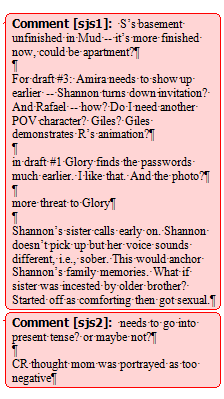
Word's Comments feature is a handy way to make notes for revision. Here I'm looking forward to draft #3 while working on #2.

Word’s Comments feature is a handy way to make notes for revision. Here I’m looking forward to draft #3 while working on #2.

Make notes as you’re working about scenes that need trimming, or expanding, or moving to somewhere else. If you know what needs doing, go ahead and do it. Microsoft Word’s Track Changes feature enables you to make tentative additions and deletions, then revisit them later.

Look for “soft ice” — the words, sentences, and whole paragraphs that don’t carry their own weight. Look for the pathways that led you into a scene but that become less important once you know where you are. They’re like ladders and scaffolding: crucial to the construction process, but dispensable when the job is done.

You’ve heard the standard advice “Kill your darlings,” right? It means different things to different people, and I’ve got mixed feelings about it. I’ve got mixed feelings about most “standard advice.” Most of it’s useful on occasion, but none of it is one-size-fits-all. Take what you like and leave the rest.

But sooner or later when you’re revising you will come to a stretch of drop-dead perfect dialogue or a scintillating anecdote and realize that it just doesn’t belong in the manuscript. Maybe it’s too much of a digression. Maybe it calls too much attention to itself. Maybe it duplicates something better said earlier. It’s hard to let these things go. Track Changes comes in especially handy here. You can zap it provisionally and gradually get used to the idea that it really does have to go.

When you’re slash-and-burning and filling in gaps, don’t worry too much about the transitions between paragraphs and scenes. If the right segue comes to you, by all means go with it, but if it doesn’t, move on. You can smooth it out later.

If you can’t solve a problem while you’re staring at it, stop staring, make a note, and move on. My thorniest problems tend to solve themselves when I’m out walking or kneading bread, falling asleep or just waking up. Solutions sometimes appear for problems you haven’t come to yet. Writing is weird.

When I started draft #2, I swore I’d get to the end before I started draft #3, but now, at page 238, I’m pretty sure I won’t. At present I’ve got  two viewpoint characters. To develop an important but currently underdeveloped plot thread, I need to add a third. He’s already a player, but adding his point of view is going to change the book’s balance a lot.

There’s also an incident I need to stage near the beginning of the book: my central character, Shannon, listens to an answering-machine message from her long-estranged younger sister. Shannon never picks up or returns these calls because her sister is always drunk or strung out. This time, however, her sister sounds sober and lucid. Shannon doesn’t pick up this time either, but the call ripples through the narrative. The ripples were already there; I just didn’t know what had prompted them.

So I’ve got a little farther to go in draft #2, then it’s back to the beginning to start on draft #3.

Monologue About Dialogue

The catalyst for this post was a recent musing about “How Do You Create Realistic Dialogue?” on the Creative Writing for Me blog.

At the time I was reworking a chapter from Wolfie that’s nearly all dialogue. Almost 30 manuscript pages of nearly all dialogue. The warning lights were flashing: It’s too long! It’ll put readers to sleep! Readers want action action action, and talk is not action!

Aside: That “readers won’t like it” mantra gets embedded in our heads. It’s not just editors we have to talk back to: it’s ourselves.

But full-length plays are virtually all dialogue. We can be riveted for two hours by people talking.

So how to create dialogue that’s not only realistic but riveting? Dialogue that develops characters, moves the plot along, and gives the reader a break from one narrative paragraph after another?

Listen to people talk. Listen to yourself talk. Listen to the self-talk that goes on inside your head. Pay attention to how they talk as well as what they’re saying. Some people speak carefully, weighing every word. Others rush headlong into a sentence and don’t get to the end till five minutes later. In a conversation of more than two people, there’s usually one who says almost nothing. People use words to evade and conceal as well as to communicate.

Pay attention to the interactions. People in conversation react to each other. Sometimes it’s obvious: one person interrupts another, or two people complete each other’s sentences. Other times it’s subtle: one person has something to say but holds back, maybe waiting for the right opening, maybe from self-doubt. Or one person has zoned out of the conversation completely and is just itching to get out of there.

Read everything aloud. I read everything aloud, even narrative passages, even essays and reviews, but with dialogue and monologue (like the thoughts swirling inside a character’s head) it’s crucial. I read my long conversational chapter aloud to my writers’ group, Because of its length I did it in two parts. To my surprise and delight, they weren’t bored.

Let it flow. My dialogue usually starts when I point two or more characters at each other and let them talk. In first-draft mode I let them go on, and on and on and on. Often it’s not till they’ve gone on for a while that they get to the point, and often I don’t recognize it until they get there.

Shape your dialogue. People in books, plays, movies, and TV shows generally don’t talk like people you overhear on the bus or at the grocery store, but their conversations still sound “realistic.” You the writer have to actively distill the way people really talk into dialogue that sounds natural but gets to the point more efficiently than any real-life conversation. This takes practice, and a lot of it. Here are some things to keep in mind.

• What do you want this scene or this bit of dialogue to accomplish? Usually it’ll be more than one thing: disclose a bit of information, reveal something about a character, show how the relationship between two characters is developing, etc.

• Even more important, what does each of the speakers want to accomplish? What does each want from the other(s)? Send each character into the conversation with a goal. My very long conversation involved several characters, all of whom already knew most of the others. I had an agenda — Amira has to reveal to Shannon a crucial bit of backstory about someone who isn’t there — and so did each character. Giles, a successful artist, wants to encourage Shannon, a chronic procrastinator, to keep painting. Shannon is trying not to fall in love with Amira. Amira is troubled by a traumatic family event. Jay wants to watch the Celtics game on TV.

• People are not talking heads, even when we’re sitting at the supper table or watching TV. We fidget with our clothing, we gaze off into the distance. In theater, film, and TV, the actors show us all this. In a story or a novel, the writer has to do the showing. Pay as much attention to what your characters do as to what they say.

• People often talk in slang, sentence fragments, and anything other than neatly constructed sentences.  Punctuation conventions are generally aimed at producing neatly constructed sentences. Beware the editor what wants to punctuate your dialogue according to The Chicago Manual of Style or the precepts of some grammar guru. At the same time, you needn’t rely entirely on punctuation to shape your dialogue the way you want readers to hear it. You’ve got other tools in your toolkit. Pay attention to how words sound, and how sentence structure affects what words are emphasized. (When a writer overuses italics, it’s often because she’s not paying enough attention to the pacing and cadence of her sentences.)  Where you put the “tag” — the he said/she said — in a piece of dialogue can have a big effect on how your readers hear it.

A couple of my previous blog posts deal with dialogue. See “Of Dots and Dashes” and “Editing Workshop, 1.” Both focus on punctuation, which is an essential tool in shaping dialogue.

So — have you got any bits of dialogue that are giving you trouble? Other Write Through It readers can learn from your questions — and from the bits that work especially well too. Send them along using the contact form below.

← Back

Thank you for your response. ✨

Warning
Warning
Warning
Warning

Warning.


Go Set a Watchman

Plenty of people have reviewed or written about Harper Lee’s Go Set a Watchman, but my friend and mystery writer Cynthia Riggs pinpoints what I think is the most important issue raised by the contrast between Watchman and the classic that grew from it, To Kill a Mockingbird: the importance of editing. Not just copy and line editing, but the kind of editing that sees the potential in a manuscript that isn’t “there” yet and then coaxes, browbeats, and otherwise persuades the writer to make it real.

It’s rare these days that a publisher will invest this kind of time and expertise in a book, especially a first novel. Writers have to do much of the work ourselves, with the help of workshops and writers’  groups and, if we’ve got the money and can find the right person, an editor. But it’s always possible to improve even the drafts that we’re sure are done.

Cynthia Riggs's avatarMartha's Vineyard Mysteries

To All Who Plan to Read or Have Read “Go Set a Watchman”:

Cynthia and Howie comparing copies of Cynthia and Howie compare “Go Set a Watchman” with “To Kill a Mockingbird”
photo by Lynn Christoffers

“Go Set a Watchman” was Harper Lee’s first book, and first books are usually unpublishable, as was “Watchman.”  While it has brilliant writing in patches, it has inconsistencies, improbable passages, repetitions, unnecessary divergences, too much back story, ramblings, boring passages, too much overwriting, and almost every error a new writer can make.

Tay Hohoff, an editor at Lippincott, saw promise in the work, saying the “spark of the true writer flashed in every line.”  She urged Harper Lee to scrap “Watchman” and start all over, write a new book with an entirely different story.  Hohoff saw Scout’s young voice, one of several back stories in “Watchman,” as the potential for a great book once it was rewritten, and, of course…

View original post 208 more words

Sturgis’s Law #4

This past spring I started an occasional series devoted to Sturgis’s Laws. “Sturgis” is me. The “Laws” aren’t Rules That Must Be Obeyed. Gods forbid, we writers and editors have enough of those circling in our heads and ready to pounce at any moment. These laws are more like hypotheses based on my observations over the years. They’re mostly about writing and editing. None of them can be proven, but they do come in handy from time to time. Here’s #4:

“The check’s in the mail,” “I gave at the office,” “All this manuscript needs is a light edit”: Caveat Editor.

If you’ve forgotten all the Latin you ever learned or never studied it in the first place, “Caveat” means, roughly, “Watch out!”

brochure cover cropWhen someone tells you “The check is in the mail” or “I gave at the office,” your most likely response is skepticism. You know this because you have used variations on the same excuses yourself, right? I sure have.

It is true that all some manuscripts need is a “light edit.” These manuscripts are generally prepared by fairly experienced writers who have already run them by a few astute colleagues for comments and corrections.

When I and most of the working editors I know roll our eyes at “All this manuscript needs is a light edit,” it’s because the manuscript in question usually needs considerably more.

So what does “light edit” mean?

Nothing associated with editing has one clear-cut, hard-and-fast, universally understood definition, but “light edit” generally means copyedit, as described in “Editing? What’s Editing?”:

Let’s say here that copyediting focuses on the mechanics: spelling, punctuation, grammar, formatting, and the like. With nonfiction, it includes ensuring that footnotes and endnotes, bibliographies and reference lists, are accurate, consistent with each other, and properly formatted.

Once one starts dealing with matters of style and structure — snarly sentences, internal inconsistency, abrupt paragraph transitions, missing information, and so on — one has moved beyond the realm of the light edit.

Most of us are not the best judges of our own work. Good writers know this. When we think a story or essay is done, the very best we can do, we set it aside for a week or a month. When we come back to it, we see it with fresh eyes. Problems we missed before are now glaringly obvious, from typos to dangling participles to plot holes that could swallow a truck.  Often the fixes are just as obvious, thank heavens.

Outside editors come to the work with even fresher eyes, along with considerable experience in identifying and fixing problems in all sorts of manuscripts. They haven’t seen the previous drafts. They don’t know what you meant to say. They see only what’s there on the page.

So when you approach a prospective editor, don’t lead off with “All this manuscript needs is a light edit.” Describe the work and let the editor know what you want to do with it: submit it to a literary magazine or academic journal? find an agent? self-publish?

With a book-length work, fiction or nonfiction, an evaluation or critique is often the best place to start. Editing a book-length work takes time. This means it isn’t cheap. A good critique will point out the strengths of your ms. as well as any weaknesses that may exist. It will identify problems that you can fix yourself. It will let you know if this particular editor is a good match for you and your manuscript.

And if you’re an editor, the next time a prospective client approaches you with “All this manuscript needs is a light edit,” don’t snigger, raise your eyebrows, or roll on the floor laughing.

Because this time the author may be right.

Divide and Conquer (Your Prose)

This focuses specifically on blogging, but the message applies to all kinds of writing, fiction and nonfiction. In my novel in progress, the sections are scenes. Each has a beginning, middle, and end. Each links what precedes to what follows. Check out the two examples cited. They’re good.

Why Structure Matters

This is a review I just wrote of Martha’s Vineyard Basketball (Lanham, MD: Rowman & Littlefield, 2015). Even if you have zero interest in Martha’s Vineyard or basketball, the comments on structural editing might be useful, especially to nonfiction writers. Moral of story: Your research may be impeccable and your sentences reasonably well crafted, but if your book isn’t sensibly organized your readers are going to have a hard time getting through it.

Susanna J. Sturgis's avatarFrom the Seasonally Occupied Territories . . .

Slightly adapted from the review I just posted on Goodreads . . .

MV Basketball coverNo, I’m not a sports fan, but my fascination with the Vineyard and anything related to race and class is insatiable, so I had such hopes for this book. Class is a shifty thing on Martha’s Vineyard. It doesn’t look like what one reads about in textbooks or sees in urban areas. Here, as elsewhere in the U.S., we bend over backwards to avoid seeing it. It’s complicated by the distinction between the year-round population and the “summer people”; by the ethnic groups with deep roots here (especially Wampanoag, Anglo, Portuguese, and Cape Verdean); and by the long history of African Americans on the island.

What a great idea, I thought: to explore “notions of race and class” by focusing on basketball, specifically the summer basketball program that started in 1970. Basketball does bring together people from…

View original post 639 more words

Sturgis’s Law #3

Early last month I started an occasional series devoted to Sturgis’s Laws. “Sturgis” is me. The “Laws” aren’t Rules That Must Be Obeyed. Gods forbid, we writers and editors have enough of those circling in our heads and ready to pounce at any moment. These laws are more like hypotheses based on my observations over the years. They’re mostly about writing and editing. None of them can be proven, but they do come in handy from time to time. Here’s #3:

A good sentence is more than the sum of its parts.

We talk about “constructing” sentences as if sentences can be built block by block like houses and bridges, and in a way they can.

We learn the building blocks early on. A sentence must have a subject and a verb. It can then be dressed up with direct objects, indirect objects, prepositional phrases, and clauses of various kinds. The component parts can be dressed up with adjectives and adverbs. Two complete sentences can be linked with a conjunction — the most common ones are and, but, and or — a semicolon, or a colon.

To make matters more complicated, or more fun, depending on how you think of it, sentences are rarely entire of themselves. They exist in relation to other sentences. They can be joined into paragraphs. Even when a sentence stands alone on a line, a paragraph unto itself, the reader connects them as she moves from one to another.

Sentences can be grammatical and unclear at the same time. Here’s a snippet I quoted in “Editing Workshop, 3,” which focused on sentences:

Smith requested and received permission to publish the translation from Jones in 2005. . . . Smith, in an interview, described the text as boring.

This comes from a long nonfiction manuscript I edited earlier this year. I skidded to a halt at the end of that first sentence. It wasn’t the translation that came from Jones but the permission, and the work wasn’t published till 2008. In the second sentence, “in an interview” weakens the connection between subject and verb by coming between them. Here’s my edit:

In 2005, Smith requested and received permission from Jones to publish the translation. . . . In an interview, Smith described the text as boring.

None of the words have been changed. They’ve just been rearranged.

We can critique sentences in isolation, but often we can’t tell what’s unclear or clear enough, what’s more effective and what’s less so, unless we see it in context. Here’s an example from my novel in progress. “She” is a sixth-grader swinging on the school playground. “It” is a dog trotting down the path behind the school. She’s never seen it before.

She watched it as the swing descended and then rose again. Its head snapped to the left, then it took off up the path at a flat-out run.

Nothing wrong with that, although an overly meticulous copyeditor might argue that the “its” at the beginning of the second sentence could be taken to refer to the swing. Most readers know that swings rarely have heads, so this “it” must be the same as the one in the first sentence. But I turned the first sentence around:

As the swing descended and then rose again, she watched it. Its head snapped to the left, then it took off up the path at a flat-out run.

Moving the dependent clause to the beginning emphasizes the motion of the girl on the swing. Then the movement stops for a moment before starting up again, this time following the dog. I also liked the way the revision brought “it” and “its” together.

Play with your sentences. Rearrange them. Read them out loud, in isolation and with the sentences that precede and follow them.

Once in a while I’ll screech to a halt and gawk at a beautifully constructed sentence. Casual readers don’t generally do this, but writers and editors can be forgiven for taking a second look at an admirable sentence.

Or a not-so-admirable one. I don’t know about you, but I probably learn more from the sentences that don’t work than from the sentences that do. Identifying what doesn’t work is easy. Understanding what makes a sentence clear, effective, eloquent, whatever — this is hard. Awkward and unclear sentences clamor for attention. Good sentences just flow on by. This may be one reason editors and teachers get a reputation for being negative and critical: we naturally focus on the sentences that don’t work so well.

Remind me to flag a couple of really, really good sentences in the next manuscript I edit!

Sturgis’s Law #2

Earlier this month I started an occasional series devoted to Sturgis’s Laws. “Sturgis” is me. The “Laws” aren’t Rules That Must Be Obeyed. Gods forbid, we writers and editors have enough of those circling in our heads and ready to pounce at any moment. These laws are more like hypotheses based on my observations over the years. They’re mostly about writing and editing. None of them can be proven, but they do come in handy from time to time. Here’s #2:

Given enough time to fill, even the most intelligent commentator will wind up making stupid statements.

When I was growing up, we had the news at 6 and the news at 10 (or 11), and it didn’t last more than an hour. On Sunday we had talking-head shows like Meet the Press. They didn’t last more than an hour either.

With the advent of cable TV came channels that delivered news and commentary 24/7. The quantity increased, but not the quality. Blather is cheap. Investigation and analysis are hard. There’s good stuff out there for sure, but you have to wade through a flood of drivel to find it.

Print journalism, like print in general, imposes limits. The space available is finite and the words have to fit into it. In my newspaper days, ads would often come in or be cancelled at the last minute. I’d have to cut a story on the fly to make room or figure out how to fill the hole. I learned, among other things, that no matter how well-written and well-edited a story was, I could nearly always cut two or three or four column inches out of it without doing serious harm.

sufferedThe web doesn’t impose space limits. Bloggers and others writing for the web could theoretically go on forever — but we don’t. Paradoxically perhaps, when it comes to the web the standard advice is “keep it short.” We could go on forever, but most readers won’t stick with us that long. There are limits, but they aren’t spatial.
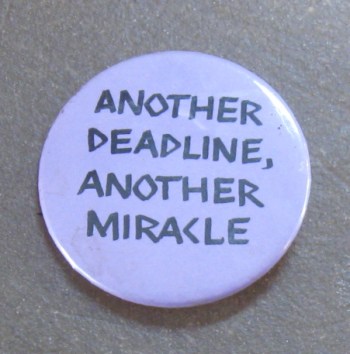
We writers like to kick against the restrictions imposed on us by circumstance and by (you’re way ahead of me) editors, but restrictions are often a good thing. Think about it.

Tasks with deadlines usually get done before tasks without.

Cutting a 3,000-word draft to fit a 1,000-word limit often sharpens the focus and tightens the prose.

Poets make every word count because they have to. Not only do poems usually have fewer words than stories and essays (even flash fiction and nonfiction), they’re also shaped by the limitations of rhyme, rhythm, and/or meter.

Early drafts can sprawl. Sprawling is good — it sure beats being blocked. But it’s revising and editing that make the piece, whether poetry or prose, by shaping and focusing — by imposing limits.

deadline miracle

Free the Scene!

Here’s a revision tip for you. I’m currently working on the second draft of my second novel, and it just came in handy (again).

When reading your early drafts, keep an eye out for the potentially interesting scene that happens off-stage. Maybe you were in a hurry when you wrote that part. Maybe you didn’t see the possibilities. Maybe you did, but they were a little bit unsettling and you didn’t want to go there — yet.

Open the door. Let the scene out. Give it room to breathe. See what happens.

These things are little gifts from the Muses, or your subconscious, or wherever you think your writing comes from. They’re the treasures you find at the bottom of a heap at the thrift shop, or in your own closet.

Here’s one of mine. In draft #1, Shannon, one of the novel’s two viewpoint characters, gets a phone call. It goes like this:

Meanwhile, Shannon had had a call from some busybody on the conservation commission, whose members apparently cruised around looking for unsightly objects that detracted from what they called “the character of the town.” The busybody objected to the snow fencing Shannon and Ben [Shannon’s next-door neighbor] had put up to reinforce the post-and-rail fence in the back yard. Shannon explained about Wolfie [the dog she’s just rescued], and how the post-and-rail alone wouldn’t keep Wolfie in for a minute. The busybody was not impressed: the fence did not conform to the town’s fence bylaw and that was that.

This phone call had the makings of a fun scene, and I was ready for a little comic relief. What if the busybody showed up in person? What if she caught Shannon in the act of installing the fence?

snow fence 1Consulting the town’s zoning bylaws — the scene takes place in the town I live in — I discovered that the snow fencing didn’t violate any bylaws, but this wouldn’t stop some of the busybodies I’ve run into in my time. I also decided that she wasn’t actually on the conservation commission. She had appointed herself guardian of the character of a neighborhood she didn’t even live in.

This is what the phone call turned into this morning. Note that I’m still in early-draft mode. I strongly suspect that the scene will appear in the novel’s final draft, but I don’t know what it will look like. Will this woman appear again? No idea. It’s up to the Muses.

[Shannon] was halfway done when a white Honda Pilot passed on the road, heading toward the intersection with the Edgartown Road. She didn’t recognize it. Not that she knew every vehicle that lived between here and Sepiessa, but her mind half-consciously sorted them into familiar and unfamiliar and this one she’d never seen before.

Even more unusual, two minutes later it passed by again in the opposite direction. Shortly after that it rolled to a halt on the grassy shoulder opposite her driveway. Looking for directions?

The driver got out of the car, looked both ways, and crossed the road. She carried a cane but walked briskly, barely tapping it on the pavement. Her mostly gray hair was done up in a french twist and her garb said “country gentry”: heavy wool cardigan with leather elbow patches, an ample wool skirt that hung just below the knee, and sturdy walking shoes, all in autumnal browns and russets. She did not look lost. She caught Shannon’s eye briefly then rapped the top rail of the roadside fence with her cane.

Taking this as a summons, Shannon wiggled the stake she had just driven into the ground to make sure it was steady, laid mallet and zip ties on the ground, and walked up to greet the visitor.

The visitor wasted no time on introductions. “Do you have a permit for that fence?” she asked, in a clipped accent that sounded somewhat English but wasn’t.

Loaded for bear, thought Shannon, but with no bears in sight. “That fence has been there for over fifteen years,” she said pleasantly. “I don’t believe I need a permit.”

“That orange fence” — the woman pronounced the word with obvious distaste — “has not been there for fifteen years. You are just now putting it up.”

Caught red-handed, Shannon thought. “I don’t believe I need a permit for that either,” she said. “It’s temporary. I’m fostering a dog for a few days, and I don’t want him getting loose.” She resisted the temptation to tell the woman why she didn’t want Wolfie getting loose. Maybe the woman did know someone on the road. Maybe she kept chickens.

“It is unsightly,” said the woman. “It is not in keeping with the character of the neighborhood.” She rapped the railing with the head of her cane for emphasis.

snow fence 2

In Shannon’s fourth grade Sister Mary Clement had habitually rapped her eighteen-inch ruler on the desktop while fixing the latest class miscreant with a glare that promised trouble. Shannon hadn’t thought of her in twenty years. Her visitor wasn’t a nun but she was cast from the same mold.

Shannon conceded that the blaze-orange snow fencing was not especially attractive but noted that it was only visible from the road if you slowed down to about five miles an hour and stared out the passenger-side window. She did not ask the woman if she’d ever been down this road before, and if not, how she knew so much about the character of the neighborhood. The character of this neighborhood was more disturbed by big gray dogs running loose than by blaze-orange snow fencing in someone’s back yard.

“The town bylaws are quite clear what sorts of fence are allowed,” the woman said, “and this is not one of them.”

Shannon had no idea what the town bylaws said about fences, but Ben had once served on the zoning board. If he thought snow fencing might be a problem, he wouldn’t have suggested it. Besides, it was past the middle of October. No one who came down this road at this time of year would be bothered by snow fencing. Those with more delicate sensibilities had mostly gone home. “I’ll see what I can do,” said Shannon, turning back toward her interrupted labor.

“I intend to communicate this to the conservation commission,” the woman called after her.

“You do that,” Shannon muttered, not quite audibly. She heard the staccato whack whack whack of the woman’s cane on the asphalt. The car door opened and slammed shut. A moment later the engine rumbled. Shannon zip-tied the snow fencing to the new post and set about pounding the next one into the ground.

Editing Workshop, 3

This one’s about sentences.

I just finished copyediting a long nonfiction book on a tight schedule. The author has many years of high-pressure writing experience, but this is his first book. The manuscript felt like it was a couple of drafts short of final — not uncommon when a rush to deadline is involved. A glaring symptom of this was sloppy sentences. If sentences come out sloppy in early drafts, it’s no big deal. You’ll clean them up when you start revising — right? right??

In this particular manuscript, the author probably didn’t have the time to make them clearer or more effective. So yours truly the copyeditor did it, pruning some elements, rearranging others, and querying whatever I couldn’t figure out either from context or from a quick Google search.

There are plenty of books out there on how to construct a sentence. You know the basics: subjects, verbs, and objects, phrases and clauses. The tricky thing is that sentences can be grammatically impeccable and at the same time unclear, ambiguous, or downright misleading.

Here are some hints on how to make sentences more effective, whether you’re writing, revising your own work, or editing someone else’s.

Clotheslines tend to droop in the middle. So do long sentences.

Clotheslines tend to droop in the middle. So do long sentences.

Sentences are like clotheslines: they tend to droop in the middle. In the middle of a long sentence, the reader’s attention starts to wander. So if you’re trying to get across an important point or detail, don’t bury it in the middle. Placed at the beginning and the end, it’s more likely to catch the reader’s attention, and to connect with the sentences before and after.

This is also true of paragraphs, by the way. Paragraphs that take up a whole page of text are daunting. KEEP OUT! they say. Or maybe WELCOME TO THE LABYRINTH.

What poets do with line and stanza breaks, prose writers can do with sentences and paragraphs.

I love long loopy sentences, but when one long loopy sentence follows another and another and another, nothing stands out. It’s also easier for subjects and verbs, or nouns and pronouns, to come adrift from each other. Confusion often results.

The closer together words are in a sentence, the stronger — and clearer — the relationship between them. The opposite is also true: the further apart they are, the more tenuous the connection. Here’s an example adapted from the book I just edited:

Smith requested and received permission to publish the translation from Jones in 2005. . . . Smith, in an interview, described the text as boring.

I skidded to a halt at the end of the first sentence: who? what? when?

It took me a few moments to sort it out: It wasn’t the translation that came from Jones but the permission, and what happened in 2005 wasn’t the publishing but the requesting and receiving of permission. (It was made clear elsewhere that the work was published in 2008.) In the second sentence, the parenthetical “in an interview” unnecessarily separates subject from verb.

Here is my edit:

In 2005, Smith requested and received permission from Jones to publish the translation. . . . In an interview, Smith described the text as boring.

Be especially careful with pronouns. “Antecedent unclear” and “unclear referent” are among the most common editorial queries, in both fiction and nonfiction. They mean we can’t figure out for sure whom a he, she, it, or they is referring to. In the job I just finished, the vast majority of the players were men — as is often the case in books about politics and international affairs, which this one was.  Often a he, his, or him could have referred to either of the two fellows mentioned in the preceding clause or sentence.

Authors often miss these unclear antecedents because the antecedents aren’t unclear to them. They know exactly who’s being referred to. Readers, however, aren’t in the same loop. We need a little help. Better to repeat a name than leave it ambiguous. This is one reason second readers can be so important: they come to the manuscript without knowing what you mean. They just read what’s there.

Have you got an unruly sentence that could use some untangling, or one that you’ve successfully untangled yourself? Send it along! The best way to develop an eye for what works and what doesn’t is to pay close attention to how sentences work. We can do this in our reading, in our writing, and in our revising.

← Back

Thank you for your response. ✨

Warning
Warning
Warning
Warning

Warning.