Breakthrough

I’m walking toward a wall. The wall is solid. It stretches upward, leftward, and rightward as far as I can see. It looks like the Great Wall of China.

The closer I get, the more slowly I walk. Small steps turn to baby steps turn to walking in place. If I don’t turn around, I’m going to break my nose on the wall.

I keep walking. A crack appears in the wall. As I walk, it gets taller and wider. I glimpse what’s on the other side.

I sit down, pen in hand, and start writing. The other side gets clearer and clearer. When I look back, I can’t see the wall at all.

20160730 breakthrough

The other side of the wall

Eulogy for a Novel

Word came earlier this week that a member of my writers’ group passed last Sunday night. Following a serious illness Allen was in an assisted-living place in the Boston area, so he’d missed several weeks’ worth of group meetings (which, coincidentally, take place on Sunday evening), but we assumed he would be back, sooner better than later, but later would do.

In the Sunday night group we’re all working on book-length works, history, memoir, or fiction. Each of us brings a chunk of the work-in-progress to each meeting, passes out copies, and reads it aloud (or has another member read it). Then we discuss it, mark up our hardcopies, and pass them back to the writer. Each week we hear a new installment of eight different works, history or memoir or novel.

Allen’s novel is set in and around Berlin in the early 1960s, a time of heightened Cold War tensions — the Berlin Wall went up in 1961. Its protagonist, Faust, is a young, idealistic army lieutenant newly arrived in Berlin and assigned as a press officer. His father is a small-town newspaper editor in the U.S. Midwest, but high-stakes Cold War journalism looks little like journalism back home. Gradually Faust learns the ropes, dealing with, among others, his superiors, a taciturn noncom who knows much more than he does, a CIA operative, and the international press corps. He falls in love with the civilian employee assigned to tutor him in German — she turns out to be a high-level spy for the USSR.

To say that we were caught up in the story is an understatement. Faust’s growth from naïve idealism into sober experience and the beginning of wisdom is well handled, and the setting, the evocation of the times — well, we kept wondering out loud how Allen knew so much, but Allen would smile enigmatically and a little self-deprecatingly and we would move on. As writers we all know better than to press too hard. (Faust’s war-correspondent friends would have pressed harder.)

And now — we know from the history books how the political crisis was resolved, but what became of Faust? How did he assimilate all he was learning and reconcile its myriad contradictions? Did he remain in the military, become a war correspondent himself, or perhaps return home to become a newspaper publisher like, and in some ways very unlike, his father? We’ll never know.

So I’m thinking of all the novels out there left unfinished, or finished and unpublished, by the death of their authors.

A writer friend of mine died suddenly last December. Don and I never met in person, but we’d been corresponding online for 17 or 18 years. When I was close to done with The Mud of the Place, we swapped manuscripts. His Summer Blues was based on his experiences as a gay man in the military stationed in Germany in the late 1960s, a politically turbulent time in both Europe and the U.S. It was quite wonderful. He submitted it to a couple of independent presses specializing in gay lit, got no takers, and set it aside.

My first thought after learning of Don’s death was for Summer Blues. The publishing world has changed considerably since the early years of the last decade. Would he have wanted it published? I suspected that yes, he would have, or at least he’d have been OK with the idea, but pretty soon reality reasserted itself. Transforming a manuscript into a book is hard enough, and costly in both time and money, but publishing also involves getting the book into the hands of readers. That means distribution and marketing.

I have been thinking the same thing about Allen’s novel. It’s not quite finished, but it’s publishable, and perhaps Allen had either reworked the problematic ending or left notes about what he was thinking?

But with Allen’s novel, as with Don’s, I looked myself in the eye and realized that I have the time and money and commitment for my own work (I hope), but not for anyone else’s.

Long time ago, 20 or 25 years ago, I worked with Virginia, a local writer, on her novel, which was based on her own life, growing up in Mississippi in the 1920s, living in New York in the 1940s, eventually moving to Martha’s Vineyard, losing a daughter to suicide. It’s beautifully written, moving, honest. This writer too made a couple of attempts to find an agent then gave up.

Not long after she died,  I was telling another writer about this wonderful novel I had on my hard drive that no one but close friends and family members even knew about. My friend shook her head sagely. “We all have one of those,” she said.

It seemed callous at first, even dismissive, but then I got it. Counting only the completed or nearly completed publishable manuscripts I’ve read, I’ve now got several, in head or heart or hard drive. For each one, we, the lucky few who’ve read them, form a sort of secret society: we’re privy to something special that no one else knows about.

For a few moments I’m overwhelmed with sadness at the loss.

Then Mother Jones’s famous words surface in my head: “Pray for the dead, and fight like hell for the living.”

blank paper

Orthographic Musing

In the novel-in-progress excerpt I took to my writers’ group last night, one character (Glory’s mother, Felicia, for anyone who’s keeping track) spoke of a onetime band member who had ODed.

That’s the way I spelled it: ODed.

Several of my fellow writers thought it should be OD’d. That made sense too.

At my writers’ group meetings, we bring enough copies for everybody — at the moment we’re seven, with the eighth on sick leave — then the writer reads aloud while everyone else marks up the hardcopy. My Monday morning tasks include opening the active file (draft2.doc), going through the marked-up copies, and making revisions, corrections, or notes as needed or desired.

So I came to “ODed”, remembered what the others had said, and changed it to “OD’d”.

Being terminally curious, I then had to look it up. Being an editor, I had to look it up in three dictionaries, not one.

Merriam-Webster’s Collegiate (online) gave both “OD’d” and “ODed”.

American Heritage said “OD’ed” — with both the -ed and the apostrophe.

Oxford, both the UK/World and the US editions, had “OD’d”.

This drives some writers and editors crazy. Not me. I love it. The variation reminds me that when it comes to orthography, there’s often a right way and a wrong way to spell a word, but other times it depends. It’s “sceptic” in British English (BrE), “skeptic” in American English (AmE), but neither one is wrong. Newspapers and magazines usually have a house style that, in the interest of consistency, specifies a preference in cases where several choices exist.

Publishers do too, but the better ones generally allow more variation than magazines and newspapers. Books don’t have to be consistent with each other. They should, however, be internally consistent. If “OD’d” comes up more than once, spell it the same way each time. Make your choice, enter it on your style sheet, then stick to it. (Style sheets are a copyeditor’s best friend and secret weapon. Wise writers use them too. For more about style sheets, check out my blog post “What’s a Style Sheet?”)

While writing the above, I took a break to look up “orthography”. Here’s Merriam-Webster’s first definition: “the art of writing words with the proper letters according to standard usage”. I see two loopholes I could drive my car through: “proper” and “standard usage”. And that’s OK (okay?). MW calls it an “art”, after all, and in art the right answer is often “it depends”.

So what am I going to do about ODed / OD’ed / OD’d? For now I’m going with “OD’d”, but that may change.

On Selfish Reading

I’m pretty much self-taught as a writer. As an editor, I had a mentor who taught me to think systematically about the words, sentences, and paragraphs in front of me, how to recognize, diagnose, and fix problems. In my first editorial job, in the publications office of a big nonprofit, I had to clear every manuscript I edited with the person who wrote it. Often these people weren’t professional writers. They didn’t have long experience to fall back on. Some of them were downright touchy. They taught me the importance of knowing what I was doing and being able to explain it. I still do that in my head even when I have no direct contact with the author (as when I edit for big publishers) and when the author isn’t likely to ask me to explain everything I’ve done.

About writing, though — the downside of being self-taught is that though I can review, critique, and coach pretty well, I don’t have a clue about how to teach writing. My syllabus boils down to “Read lots of stuff. Keep writing.” This blog post from Brevity does a fine job of showing how and how much writers (and editors too, I do believe) can learn from reading.

Dinty W. Moore's avatarThe Brevity Blog

By Anna Leahy, adapted from the forthcoming anthology, What We Talk about When We Talk about Creative Writing:

Anna Leahy Anna Leahy

In Reading Like a Writer, Francine Prose talks about reading as part of how writers learn, perhaps the most important way we learn such things as “the love of language” and “a gift of story-telling.” Of course, a writer must write, but Prose says, “For any writer, the ability to look at a sentence and see what’s superfluous, what can be altered, revised, expanded, and, especially, cut, is essential.” That ability is cultivated by reading.

“I read for pleasure, first,” Prose goes on to say, “but also more analytically, conscious of style, of diction, of how sentences were formed and information was being conveyed, how the writer was structuring plot, creating characters, employing detail and dialogue. […] I read closely, word by word, sentence by sentence, pondering each…

View original post 668 more words

On Inspiration

Truth. Nothing is wasted, everything is compost, and exploring within is at least as important as having exotic experiences. Another good one from the Business in Rhyme blog.

Where is the inexhaustible source of inspiration for your writing?

Maja Todorovic's avatarBusiness in Rhyme

disraeli

I’m going to be quite bold in my next statement and say that it lies in you. You are your most valuable and inexhaustible well of inspiration for any story, poem, article or blog post you want to write. Sounds strange? Now, before you dismiss the rest of the article, let me elaborate a bit:

Often times, we look for external stimulants, information for guidance and ideas for our writing. But I believe that our own actual, raw and vivid experiences are our truest guides in which direction our writing should go. Every event, relationship, travel, struggle, joy, pain, suffering, reasons to be happy…are our best source of inspiration. When you share sincere bits of your personalities, these are the parts that people can relate to most.

You can write a beautiful poem about your ordinary everyday trip to a grocery store (like an ode to strawberries 🙂 ), you can…

View original post 381 more words

Proofreading English English

British flagGeorge Bernard Shaw oh-so-famously said that “England and America are two countries separated by a common language.”

Ha ha ha. Clever, but a bit overstated, don’t you think? True, this native speaker of American English (AmE) usually turns the captions on when watching British TV shows like Sally Wainwright’s (awesome) Happy Valley because, between the Yorkshire accent, the colloquialisms, and the speed of conversation, my unaccustomed American ear can miss as much as half of what the characters are saying.

Also true: Accents and colloquialisms can trip me up in AmE as well.

Written English seems to cross the ocean more easily. Accents don’t interfere with the printed page, and print stands still so I can pore and puzzle over anything I don’t get the first time. If I don’t understand a word, I can look it up.

The biography I’m proofreading at the moment is being published simultaneously in the US and the UK. It was written and edited in British English (BrE), so that’s what I’m reading. I have no trouble understanding the text. The big challenge is that I’m so fascinated by the differences between AmE and BrE style, spelling, usage, and punctuation that I have to keep reminding myself that I’m proofreading. “They went to the the museum” is a goof on both sides of the Atlantic and it’s my job to catch it.

I’ve long been familiar with the general differences between BrE and AmE spelling. AmE generally drops the “u” from words like “favour” (but retains it in “glamour,” damned if I know why), spells “civilise” with a “z,” and doesn’t double the consonant in verbs like “travelled” unless the stress falls on the second syllable, as in “admitted.” In BrE it’s “tyre,” not “tire”; “kerb,” not “curb”; “sceptical,” not “skeptical”; and “manoeuvre,” not “maneuver.” (The “oe” in “amoeba” doesn’t bother me at all, but “manoeuvre” looks very, very strange.)

To my eye the most obvious difference between AmE and BrE is the quotation marks. A quick glance at a book or manuscript can usually tell me whether it was written and edited in AmE or BrE. In AmE, quoted material and dialogue are enclosed in double quotation marks; quotes within the quote are enclosed in single. Like this: “Before long we came to a sign that said ‘Go no further,’ so we turned back.” BrE does the opposite: single quotes on the outside, double on the inside.

That part’s easy. What’s tricky is that in AmE, commas and periods invariably go inside the quote marks, but in BrE it depends on whether the quoted bit is a complete sentence or not. If it is, the comma or full stop goes inside the quotes; if it isn’t, the comma or full stop goes outside. What makes it even trickier is that British newspapers and fiction publishers often follow AmE style on this. My current proofread follows the traditional BrE style, and does so very consistently. Thank heavens.

BrE is more tolerant of hyphens than AmE, or at least AmE as codified by Merriam-Webster’s Collegiate Dictionary and the Chicago Manual of Style and enforced by the copyeditors who treat them as rulebooks. I like this tolerance. (For more about my take on hyphens, see  Sturgis’s Law #5.)

BrE also commonly uses “which” for both restrictive and non-restrictive clauses. This also is fine with me, although as a novice editor I was so vigorously inculcated with the which/that distinction that it’s now second nature. Some AmE copyeditors insist that without the which/that distinction one can’t tell whether a clause is restrictive or not. This is a crock. Almost anything can be misunderstood if one tries hard enough to misunderstand it. Besides, non-restrictive clauses are generally preceded by a comma.

In my current proofread, however, I encountered a sentence like this: “She watched the arrival of the bulldozers, that were to transform the neighborhood.” “That” is seldom used for non-restrictive clauses, and a clause like this could go either way, restrictive or non-restrictive, depending on the author’s intent. Context gave me no clues about this, so I queried.

comma

A comma (willing to moonlight as an apostrophe)

Speaking of misunderstanding, remember “I’d like to thank my parents, Ayn Rand and God”? Some copyeditors and armchair grammarians consider this proof that the serial or Oxford comma — the one that precedes the conjunction in a series of three or more — is necessary to avoid misunderstanding. As I blogged in “Serialissima,” I’m a fan of the serial comma, most of what I edit uses the serial comma, but the book I’m proofreading doesn’t use the serial comma and it didn’t me long to get used to its absence.

BrE uses capital letters more liberally than AmE, or at least AmE as represented by Chicago, which recommends a “down style” — that is, it uses caps sparingly. In my current proofread, it’s the King, the Queen, the young Princesses, the Prime Minister, and, often, the Gallery, even when gallery’s full name is not used. Chicago would lowercase the lot of them.

I knew that BrE punctuates certain abbreviations differently than AmE, but I was a little fuzzy on how it worked, so I consulted New Hart’s Rules, online access to which comes with my subscription to the Oxford Dictionaries. If Chicago has a BrE equivalent, New Hart’s Rules is it. In BrE, I learned, no full point (that’s BrE for “period”) is used for contractions, i.e., abbreviations that include the first and last letter of the complete word. Hence: Dr for Doctor, Ltd for Limited, St for Street, and so on. When the abbreviation consists of the first part of a word, the full point is used, hence Sun, for Sunday and Sept. for September.

Thus enlightened, I nevertheless skidded to a full stop at the sight of “B.Litt,” short for the old academic degree Bachelor of Letters. Surely it should have either two points or none, either BLitt or B.Litt.? I queried that too.

AmE is my home turf. I know Chicago cold and can recognize other styles when they’re in play. I know the rules and conventions of AmE spelling, usage, and style, and (probably more important) I know the difference between rules and conventions. In BrE I’m in territory familiar in some ways, unfamiliar in others. I pay closer attention. I look more things up. I’m reminded that, among other things, neither the serial comma nor the which/that distinction is essential for clarity. Proofreading in BrE throws me off-balance. This is a good thing. The editor who feels too sure of herself is an editor who’s losing her edge.

Simplify: A Key to Revision

Here’s a wonderful quote that arrived this morning from the Business in Rhyme blog:

The ability to simplify means to eliminate the unnecessary so that the necessary may speak.

— Hans Hofmann

I don’t know about you, but my early drafts sprawl. I’m currently working on a nonfiction piece that’s supposed to weigh in at 800–1,200 words. It’s currently at least 3,000 words and counting. (Since I do my first-drafting in longhand, I’ve no idea how many words there are. This is one reason I do my first-drafting in longhand.) Once I figure out what I want to say (in nonfiction) or what the real story is (in fiction), I can start cutting back.

This quote aptly describes what I’m doing when I’m line-editing my own work or someone else’s: clearing away the excess so the “necessary may speak.” I’m not much of a gardener, but I often describe this as pruning or weeding. Often the excess was necessary to help you get to where you’re going, but once you get there it’s not necessary any more and it may get in the way.

What’s “necessary”? That’s up to you, of course. If you’re like me, you’ll probably find that when you step back from a work in progress — when you come back to it after a week or two or three away — some words and phrases and whole sentences will no longer seem as necessary as they once did. A good editor or astute second reader can come in very handy here.

Writing poetry, especially poetry in traditional forms, taught me to make every word count, and to recognize words that weren’t carrying their weight. Writing prose with length limits has done likewise. But I’ve also learned that the words that get cut from the final draft were necessary to help me get there, so I’m happy to let the words sprawl across page after page until I run out of steam.

Just the Facts

Several of my current or recent jobs involve a fair amount of fact-checking, so I’m feeling both heroic about the errors and inconsistencies I’ve caught and anxious about the ones I know for absolute sure I’m missing.

You know how it goes: You’re reading along in a pretty good book and you screech to a halt at something that’s flat-out wrong. Not a typo or a misplaced modifier or a grammatical goof: a genuine error of fact. Maybe you know the right answer because it’s about your hometown, the car you drive, a subject you’ve been studying for years, or the work you do for a living.

“Where was the editor?” you cry. “Any idiot knows that’s not right.”

The editor and the proofreader would probably be mortified to learn that this error had slipped through. The more significant the error, the more mortified they’d be. At the same time, it’s ultimately the author’s job to get it right, so let’s not be blaming it all on the poor editor — not least because the reader of a published book has no way of knowing how many errors and inconsistencies the editor and proofreader caught.

Pick up a good book, fiction or nonfiction, and read a few pages. Notice how many matters of fact there are, how many opportunities there are to get something wrong or not quite right?

As an editor I don’t do the kind of rigorous fact-checking done by good journalists and others, where everything that isn’t common knowledge (like the law of gravity) has to be confirmed by at least two independent sources. “Fact-checking” is a task in its own right. It overlaps copyediting, but it’s not the same.

I do routinely check the spellings of place and personal names, especially when I’m not familiar with them. I’m currently editing a book about an eminent classical musician of the last century. This isn’t a field I know well, so I’m looking almost everything up. This is how I learned that Goosens was supposed to be Goossens and something else: that three successive generations of this musical family included a Eugene. The elder two spelled their first name Eugène but the youngest had dropped the accent. I couldn’t tell for sure which Eugene/Eugène Goossens was being referred to, so I asked the author. The youngest, she informed me. “Eugene” it was.

I’m also proofreading a long nonfiction book with many, many names, dates, and other details. This is a “cold read,” which means that though I do have access to the copyedited manuscript, I am not reading the proofs against it. When a book’s been competently edited and copyedited, errors and inconsistencies are generally few and relatively minor, but they are there. I was quite pleased with myself when I realized that a fellow who was survived by eight children when he died on September 13 had been the father of nine on September 9.

What did I do next? From context I knew that there was virtually no chance that a child had died between the 9th and the 13th; in other words, this was an error. Because  this fellow was not famous and the number of children he had was irrelevant to the story, I didn’t even think to look it up. (Fact-checking in the digital age can be a terrible time sink. There are a helluva lot of fascinating facts out there.) I noted the discrepancy on the proofs and left it to the author to deal with.

Reading the same proofs, I came to a sentence that ended with a series of organization names: “the House of Representatives, the New York Urban League, the National Legal Aid, the Defender Association, and the Buffalo Council of Churches.” “The National Legal Aid” looked odd. What was the “the” doing there? So I looked it up — and discovered that “the National Legal Aid” and “the Defender Association” were not two organizations but one: the National Legal Aid and Defender Association (NLADA). Which of course I had to read up on — see what I mean about time sinks?

This is what’s known in the trade as a “good catch.” I’m still feeling a little smug about it.

How about when an error goes beyond an easily verifiable fact? Some things we catch because we have knowledge of the subject matter. Editors bring their personal histories as well as their editorial experience to each new job, so we’ll catch things in the areas we know well and speed on by things in areas we don’t.

Checking street maps to make sure a driver can make a left turn from Street A onto Avenue B? Verifying appropriate technology in a historical novel, or customs in a place far from home? Basically it’s the author’s job to get this stuff right. When the editor, copyeditor, or proofreader catches an impossibility, an anachronism, or a cultural improbability, it’s great, but editors are not fact-checkers and we’re usually working on deadline.

An obvious gaffe can undermine a book’s credibility. Competent editing and proofreading will greatly reduce the number of errors, inconsistencies, and unclarities that slip through, but in this, as in everything else, perfection is not possible.

If you’re the writer, however, it’s your name in the byline or on the book cover. There’s a reason for that. You’re the one with the most power to get the facts right.

Every Damn Day

From the third week in March I’ve been swamped with work. April was already looking busy when I was offered a proofread about the Attica prison uprising of 1971. I’m going to turn that down? No way. So what if the text was almost 600 pages long, with another 100 pages of notes.

No matter how you look at it, editing and proofreading are time-intensive. You’ve got to put in the hours, and you can’t add more hours to the day. If you’re anything like me, you can’t devote all your waking hours to reading as closely as a copyeditor or proofreader has to read. Nowhere close. The brain gets tired. The eyes glaze over. The body needs to get up and move.

As March gave way to April, I wasn’t sure I could meet all these deadlines, some of which were firm, others of which were flexible, none of which were “whenever.” So I decided to give over my writing time to editing.

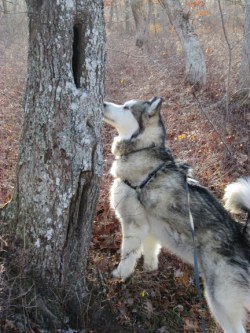
Travvy looks for a squirrel in a tree.

Travvy looks for a squirrel in a tree.

I’m a morning person. I write best in the morning, usually from 7 or 7:30 to 9 or 9:30. Then Travvy, my malamute roommate, and I go for an hour-long walk. I do a fair amount of writing-related mulling on these walks. Ideas, insights, and solutions to plot snags pop into my head the way they usually don’t when I’m sitting at the keyboard.

So Monday morning I gave over my writing time to proofreading. After Travvy and I got back from our walk, I checked email, played a little on Facebook, then got back to work. I did the same on Tuesday, and on Wednesday, and on Thursday. While out walking with Trav, I noticed that when it wasn’t just enjoying the sunshine or whining about the rain, my mind was occupied with one or another of my various editing projects. A plot snag was approaching in Wolfie, the novel in progress, but my mind was not interested in mulling about that.

By Wednesday afternoon I knew I was in trouble. The plot snag was looming larger and larger, so large and so daunting that I couldn’t even imagine the short transition scene that leads into the one where the snag had to be resolved. I couldn’t even imagine imagining that short transition scene.

In short order I regressed from I can’t figure this out to I’ll never figure this out to I’ve bitten off way more than I can chew here and who needs this stupid novel anyway?

This was drowning out the little voice in my head repeating two of my main mantras: “The way out is through” and “Your writing will teach you what you need to know.”

What I was having, in other words, was yet another crisis of faith.

By Thursday it had gotten so bad that I was sure I’d have nothing to take to writers’ group on Sunday. This reminded me that what I’d taken to writers’ group last Sunday was really good. It was also the culmination of an extended sequence that had taken several weeks to finish and worn me out in the process.

Aha, I thought. Maybe the well is just temporarily dry.

Right. It does happen, but you don’t know if the well’s been replenished unless you drop your bucket into it. For me this means picking up a pen and moving my hand across sheets of paper, but I wasn’t doing this because I was editing or proofreading during my best writing time.

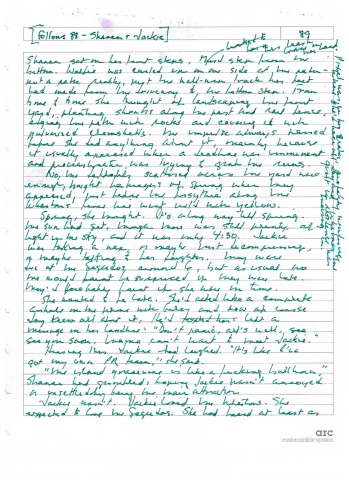
So this morning I took pen in hand, fully ready to start with “I can’t write this scene because . . . ,” but instead there was my protagonist, sitting on her front step in the twilight, accompanied by her two dogs, thinking about the momentous conversation she’d just had with her estranged sister.

Writing every damn day really is the answer. My faith wobbles if I don’t.

This is what came out of the pen this morning, and two and a half more just like it.

ms page 3

Pen Magic

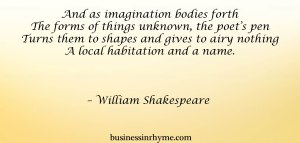
This so eloquently and elegantly describes what writing is about, and not just poetry either. Check out Businessinrhyme.com for daily nudges, prods, and general inspiration for writers.

Maja Todorovic's avatarBusiness in Rhyme

shakespeare1

Need some more poetic inspiration? Sign up for a free bimonthly newsletter.

View original post