Sturgis’s Law #5

This past spring I started an occasional series devoted to Sturgis’s Laws. “Sturgis” is me. The “Laws” aren’t Rules That Must Be Obeyed. Gods forbid, we writers and editors have enough of those circling in our heads and ready to pounce at any moment. These laws are more like hypotheses based on my observations over the years. They’re mostly about writing and editing. None of them can be proven, but they do come in handy from time to time. Here’s #5:

Hyphens are responsible for at least 90 percent of all trips to the dictionary. Commas are responsible for at least 90 percent of all trips to the style guide.

Policy making, policy-making, or policymaking? If “policy making” is the noun version, do you hyphenate “policy-making process”? How about “policymaker”? One word, two words, or hyphenated word? “Prodemocracy forces” or “pro-democracy forces”? “Back-seat driver” or “backseat driver”?

So you trot off to the dictionary. This is where the real fun starts. Dictionaries can be internally inconsistent: “policyholder” is one word, but “policy maker” is nowhere to be found, which generally means it’s two. The American Heritage Dictionary offers “policymaking or policy-making” but recommends “policymaker” for the person who makes the policy.

For even more fun, consult a second dictionary. Merriam-Webster’s Collegiate, aka MW, makes “backseat” one word, both as noun and adjective: “The dog sat in the backseat” and “He’s a terrible backseat driver.” American Heritage doesn’t list “backseat,” so it’s safe to assume that it considers it two words: “The dog sat in the back seat” and (probably) “He’s a terrible back-seat driver.”

My dog sits in the front seat.

My dog sits in the front seat. He is not a backseat driver.

Note that MW doesn’t list “frontseat” anywhere, so presumably it considers it two words. So what if you’ve got “front seat” and “back seat” in the same story, the same paragraph, even the same sentence? Do you follow the dictionary into an inconsistency that makes no sense? Not me.  In my own writing, it’s “The dog sat in the back seat” and “He’s a terrible backseat [or back-seat] driver.” (My dog sits in the front seat, by the way. It’s all I can do to keep him out of the driver’s seat.)

When you’ve sorted out “backseat” and “front seat,” you can move on to “backyard” and “front yard.” What’s sauce for the seat is sauce for the yard — or maybe not.

The Chicago Manual of Style has a handy-dandy several-page hyphenation chart. It’s extremely useful, it really is: you really don’t need to be deciding all this stuff from scratch. But if you use it a lot, as I do, pretty soon you’ll notice that it and your dictionary of choice don’t always agree. You’ll notice that different genres and different disciplines often have their own conventions, and these conventions are perfectly OK even if they don’t agree with Chicago or Merriam-Webster’s.

Here’s an example: Chicago often recommends hyphenating compound adjectives when they appear before a noun but leaving them open when they follow the verb. “A well-known proverb” but “The proverb is well known.” The catch here is that “well-known” appears in most English-language dictionaries. This makes it a word, and English words don’t generally change form according to their position in a sentence. So it depends on whether you think of “well-known” as a word or as a temporary compound — two or more words yoked together to serve a common purpose and that may be unyoked after that purpose is satisfied.
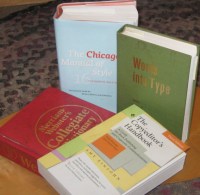
Arbiters of style.

Arbiters of style.

Here’s another one: Both Chicago and Merriam-Webster’s generally recommend dropping the hyphen after prefixes and before suffixes: multitask, flowerlike, and so on. (Yes, there are exceptions. No one recommends dropping the hyphen in “bell-like,” which would give you three l‘s in a row.) However, I’ve also noticed, both in my own writing and in what I edit, that the hyphen can call attention to the root word in a way that makes sense and may even aid understanding.

One of my current jobs refers several times to “pro-democracy activists.” Consider “prodemocracy” and “pro-democracy,” or “antichoice” and “anti-choice.” To me,  whether I’m reading or writing, the hyphenated version gives a little more weight to the root. This can be especially useful when the prefix is something like pro- or anti-, non-, or counter- and the compound is a temporary one, not an established word like “antifreeze.” Consciously or not, plenty of good writers seem to feel likewise. When I’m editing, I’m loath to delete hyphens where they’re consistently used and serve a purpose, even when Chicago and Merriam-Webster’s recommend against them.

American Heritage is more hyphen-friendly than Merriam-Webster’s, and British English is more hyphen-friendly than its American cousin. This is why I usually have American Heritage, MW, and Oxford open in my browser when I’m working. I’ve set my Oxford default to “British and World English,” which seems to be why I keep getting billed in pounds. No, I don’t live in the UK, but I do like the reality check when it comes to hyphens.

The short version: Hyphens are responsible for [insert large number of your choice] percent of our trips to the dictionary because we think there’s a right and a wrong way to do it and the dictionary has the answer. When it comes to hyphens, there may be more than one right answer, and different dictionaries may give different advice. Learn the guidelines, pay attention to what hyphens can do, and don’t get too hung up on it.

So I’m closing in on 1,000 words and have said almost nothing about commas. The comm part of Sturgis’s Law #5 can be found here.

“Tag!” She Scowled

Let’s talk about dialogue tags: the “he saids” and “she saids” that you can’t do without if you’re writing fiction or memoir or anything that includes people talking. (Except play and film scripts: those are different.)

How did they come to be called that? I don’t know. “Tag” to me suggests a bit of paper attached by string, wire, or plastic to an item for sale at a yard sale or in a store. Or a children’s game in which one kid catches up with another and yells “Tag, you’re it.” I think of them as “attributions,” because they attribute speech to one speaker or another, but “tag” is shorter so I’ll stick with that.

There’s plenty of hoohah out there about dialogue in general and tags in particular. I’ve contributed a bit to the hoohah: “Monologue About Dialogue” and “Of Dots and Dashes.” Here’s a bit more.

Most of the style guides, how-tos, and freelance pontificators agree on two points:

  • Tags are supposed to be unobtrusive.
  • “Said” is usually the best choice.

As guidelines these are fine. As rules? Not so much. “Said” is often the best choice, but by no means always, and “unobtrusive” does not mean “invisible” or (maybe more important) “inaudible.”

Dialogue tags can do so much more than attach words to speakers. Depending on what you choose and where you put it, they can help convey how your character is saying whatever s/he’s saying and where s/he pauses to breathe or think.

Take a scene from Wolfie, my novel in progress. It involves several speakers and a lot of dialogue. Having  written it in longhand, I typed it into the Word file, doing a very light edit as I typed and paying particular attention to the tags. Most of the tags are “said,” but we’ve also got “stage-whispered,” “admitted,” “called out,” “muttered,” “advised” (twice), “agreed,” “added” (twice), “ordered,” “protested,” “continued,” “told,” “hissed,” and “wondered.”

Here’s a sample. The scene is a big bash celebrating Lorna’s retirement. Shannon has just arrived. Not to worry: the tags aren’t italicized in the original. I just want to call attention to them here. (“Seemed” in the first para is italicized in the original.)

Lorna gave Shannon a big hug then held her at arm’s length. Lorna was actually shorter than Shannon: she only seemed six feet tall. “Looking good, girl,” she said, then she leaned in closer and stage-whispered, “Is that love light in your eyes?”

“Lorna, darlin’,” Shannon said, shaking her head, “you need to make an appointment with your eye doctor.”

Lorna wagged a stubby, impeccably manicured finger at her, setting her beaded bracelets to clinking merrily. “You don’t fool me for a minute,” she said. “I know that look.”

“Well, I do have a new dog,” Shannon admitted. “I can’t believe you’re really leaving.”

When I write dialogue, I’m usually transcribing a scene playing out in my head. I use tags and punctuation to convey it the way I hear it, the cadence, the facial expressions, the body language of each speaker, but without weighing the passage down with detailed description.

When I write, I just write. When I edit, I play around with alternatives. Go ahead: play around with that passage. Would said work better than stage-whispered or admitted? How about changing one of the saids to something less neutral? Experiment with tag placement. See how it changes the pacing of the sentence?

In this particular passage, all the tags have the same structure: Shannon said, not said Shannon. In what follows there’s a said Lorna and a said Shannon. No problem. Recently I fell in with some editors discussing online whether”John said” or “said John” was better. One asked if one was more “correct” than the other, and someone else surmised that one was more typical of British English than American.  When editors start talking like this, it’s time to run in the opposite direction.

Whether “John said” or “said John” is better depends on whether it precedes, follows, or comes in the middle of the spoken part. And on what’s being said. And on whether the speech is being attributed to a noun or a pronoun: “said she” calls attention to itself in a way that “said Shannon” does not. If it suits the tone of whatever you’re writing, by all means go with it.

Choose whatever works best in context. What you do want to avoid is using the same structure every time.

One more thing about tags and editors: Some editors take exception to using words like “smile” or “scowl” or “grimace” as dialogue tags. Hence the title of this post. These aren’t synonyms for said, they argue. No, they’re not, but they can (I argue) convey how something is said — and heard. A phrase said with a smile on the face doesn’t sound like the same phrase said with a scowl. So (say these editors) write “she said, with a smile” instead of “she smiled.” Sorry, no. That separates the smile from the sound. Sometimes that’s fine. Other times it’s not what you want.

The scene excerpted above includes this line:

“What, you’re not retiring to Florida?” Shannon grinned.

Here the question mark fudges the issue of whether grinned is a tag or not. I don’t believe it is. As I see and hear it, Shannon asks the question, then grins. But say that line was followed by this one:

“No way,” Lorna scowled.

It isn’t, but to my mind and ear it’s fine, and neither Lorna said, scowling nor Lorna said with a scowl conveys quite the same thing. The difference is subtle, but if you hear it, don’t let a tin-eared editor talk you out of it.


More About Song Lyrics

In a post a couple of weeks ago, “My Epigraph,” I touched on the subject of “fair use”:

Fair use” is a contested area. If you plan to quote other writers in your work, read up on it. I believe there is, and should be, a huge middle ground between “anything goes” and “consult a lawyer,” Do learn the lay of the land, because the cost of putting a foot wrong can be high. Word on the street for a long time has been “don’t ever quote from popular song lyrics without getting permission.” This has nothing to do with ethics and everything to do with the fact that the big music publishers have been zealous about defending their turf. Your use of two lines from a popular song may be fair by any reasonable definition, but it takes very deep pockets to defend it in court. Might often does make right, and it makes us jumpy too.

Note especially the sentence in bold. Here’s something better than “word on the street”: a link to novelist-blogger David Hewson’s October 23 blog post, “Never quote a rock lyric in a book unless you’re rich.” It’s his grueling first-person discovery of how permissions work in the music biz.

Do read through to the end. Musician Bruce Hornsby did grant Hewson permission to use a line from his lyrics, and all he asked in return was a signed copy of the finished novel. I like to think there are more Bruce Hornsbys out there, though perhaps they’re more often found in the less glamorous corners of the music world.

The real moral of the story is this: Assume nothing. Do your homework — especially when you’re dealing with lyrics.


Those Pesky Details

Once upon a time I copyedited a novel set in 19th-century New England that had cranberries being shipped to market in May.

Uh — no.

cranberries

Cranberries

I grew up in Massachusetts and have lived here most of my life. When fresh cranberries reach the market in early to mid fall, I stock my freezer with them because they aren’t available earlier in the year. That’s true in the 21st century, it was true in the late 20th (which was when I copyedited this novel), and it was surely true in the 19th, when transportation, storage, and other technologies were a good deal less sophisticated than they are today.

That’s known in the trade as a “good catch”: I caught something that the author, the book’s editor, and everyone who had already read the manuscript missed. Copyeditors are always catching things that everyone else missed, but this was an especially good one. That’s why I remember it more than 15 years later. (Tellingly, I can’t for the life of me remember the title of the novel or the name of its author.)

We copyeditors quite justifiably pat ourselves on the back for these catches and crow about the best ones to our colleagues.

Readers crow about them too when they find what they consider a glaring error in a published book. “Where was the copyeditor?” they cry. “Where was the proofreader?” This is often followed by a lament about how publishing, the English language, and/or western civilization is going to hell in a handbasket.

Well, if there are several glaring errors in a book, coupled with infelicities of spelling, usage, and style, it may be that it wasn’t properly copyedited or proofread at all. But errors do crop up in even the most conscientiously written, edited, and proofread works. The overwhelming majority of them, thank heavens, are minor.

Think of how many factual details go into any book-length work, fiction or nonfiction. Pity the poor author, who must focus on the whole forest while remaining acutely aware of each tree in the forest, each branch on each tree, each twig on each branch, each bud on each twig. Say you’re an expert in a particular sort of bud. Chances are good that you’ll eventually catch the author out — “No, no, no! Those buds never appear before May in the Upper Midwest!” — but chances are even better that most readers won’t notice. It won’t, and shouldn’t, undermine the credibility of the work.

Unless, of course, the work is about trees in the Upper Midwest. Then you may have a case.

swans on the Mill Pond

There’s a lot more to Martha’s Vineyard than swans on the Mill Pond, but we’ve got that too.

I live on Martha’s Vineyard, a place that is so often misrepresented in both fiction and nonfiction that much of my own writing is devoted to countering those misrepresentations. At the same time, I know that some errors are more significant than others. I don’t care (too much) if someone has a ferry sailing from Vineyard Haven at 5:15 instead of 5:00. Recently, though, I reviewed a book that got some of the geography wrong and misspelled several names that could have been verified without much trouble. Editor fail, I thought.

I do get really, really angry when someone assumes that what they’ve seen on the news is the whole truth and nothing but; that everyone here is wealthy when our median income is one of the state’s lowest.

“Write what you know” is a truism quoted ad nauseam, but I don’t mind it when it’s accompanied by its obvious corollary: “And if you don’t know it now, do your research.

This is why I was so impressed when I was contacted a couple of months ago by a writer whose novel in progress was partly set on the Vineyard. Could he ask me a few questions? Ask away, said I.

His questions were the sort that would only be asked by someone who had at least a passing acquaintance with the place. The larger world wouldn’t notice if he got these things wrong, but many Vineyarders would. I was thrilled to be asked and impressed that he cared enough to get it right. I answered as thoughtfully as I could. (Note to anyone who’s writing about Martha’s Vineyard: Contact me. I’m not kidding. If I can’t answer your questions, I can probably put you in touch with someone who can.)

This has inspired me. If I didn’t mind answering this writer’s questions — hell, no! I’m glad to be asked! — other people won’t mind answering mine. I’m not going to get all the details right, and even if I do, some people are going to disagree with me. But if I get out there and ask the questions, I’m probably going to meet some cool people and get into interesting conversations.

It’s all good.

The Lovely Bones: Structure In Memoir

This blog post is about writing a memoir, but as a writer whose fiction doesn’t follow a “tried-and-true” plot structure, I find its advice very helpful. Maybe you will too.

Dinty W. Moore's avatarThe Brevity Blog

A Halloween-themed blog post from Janice Gary:

GHOSTSYou could say I’m a ghostwriter. All memoirists are. We commune with the spirits of the past, inhabit old haunts, sift through the bones of the people we once were (and once knew) in an attempt to reanimate what was and illuminate what is.

Our ghosts are real. Or at least as real as we remember them. One thing we cannot do is make stuff up. And we don’t need to. We have more than enough material to conjure life on the page. But that’s part of the problem. What do you do with it all – all that experience, all that emotion?  What spooks those of us who write from life the most is this dilemma: how to wrangle this vast, unwieldy life of ours into a well-shaped story.

Fiction writers have the old tried and true (and yes, trite) basic plot triangle…

View original post 597 more words

My Epigraph

Discussion recently turned to epigraphs on an editors’ board I’m on (Editors Association of Earth — if you’re an editor and you’re on Facebook, check it out).

Academic publishers, it seems, are OK with epigraphs for books, and chapters of multi-author books, but they frown on epigraphs used for sections or even chapters of single-author books.

Self-publishers in some genres — how-to was mentioned — are apparently prone to excess in the epigraph department. They’re also prone to misquoting and sloppy sourcing. Given the number of erroneous and sloppily sourced quotations floating around the internet, this is not surprising.

Epigraphs may not be covered under “fair use,” the conventions that guide when it’s OK to use quotes and excerpts from a copyrighted work without the copyright holder’s permission. This was a surprise to some of us, including me. The argument is that epigraphs are not essential to a work the way, say, quotations from a book are essential to a review of that book.

Aside:Fair use” is a contested area. If you plan to quote other writers in your work, read up on it. I believe there is, and should be, a huge middle ground between “anything goes” and “consult a lawyer,” Do learn the lay of the land, because the cost of putting a foot wrong can be high. Word on the street for a long time has been “don’t ever quote from popular song lyrics without getting permission.” This has nothing to do with ethics and everything to do with the fact that the big music publishers have been zealous about defending their turf. Your use of two lines from a popular song may be fair by any reasonable definition, but it takes very deep pockets to defend it in court. Might often does make right, and it makes us jumpy too.

I’ve used epigraphs in some of my essays, one-act plays, and even poems over the years, without ever asking permission and without ever being threatened with a lawsuit. My works generally circulate in areas that aren’t bristling with lawyers, and the works I’ve quoted from are usually written and published by people whose approach to fair use is probably similar to mine.

The epigraph for my novel, The Mud of the Placewas different. I knew I had to get permission. Not for legal reasons, though novels do tend to travel further than essays, poems, and one-act plays, and I didn’t want the source of my epigraph to find out accidentally that I’d used her words. The big reason was that her words had inspired me to write the novel — which meant overcoming my fear of attempting anything longer than 40 pages.

The story: I live on Martha’s Vineyard. Much of what’s written about Martha’s Vineyard in books and the national press is incomplete, distorted, and even flat-out wrong. In August 1993, President Bill Clinton came here for a three-week vacation. I got to watch the national press corps and others swarming all over the island and getting it wrong wrong wrong. It was infuriating.

Paley TNY clip sm

From the May 16, 1994, New Yorker

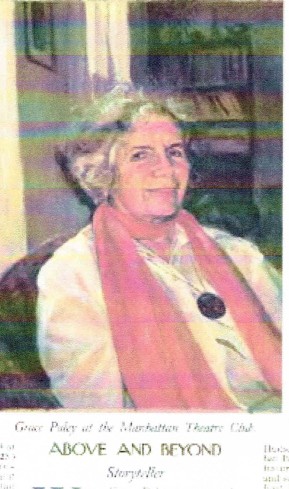
The following May, a little squib leapt out at me from the Talk of the Town section of The New Yorker. What caught my eye was the painting of poet-writer-activist Grace Paley at the top. What changed my life were her words: “If your feet aren’t in the mud of a place, you’d better watch where your mouth is.”

It came in response to an interviewer’s question: Would she comment on the situation in South Africa? (Nelson Mandela had been released from prison only four years earlier.)

If only the journalists and novelists and travel writers who wrote about Martha’s Vineyard were that wise! For a while I kept fuming at them because they weren’t. Then it dawned on me: I’m a writer, and my feet are  in the mud of this place. If not me, who?

Paley’s words kept me going while I slogged through the mud, not of Martha’s Vineyard but of doubting the importance of what I was doing and my ability to pull it off. They gave the manuscript its working title and eventually its actual title and, of course, its epigraph.

The Mud of the Place finally made it into print in December 2008. Grace Paley had died of cancer on August 22, 2007. I regret to this day that I didn’t try to contact her during the years I was working on it, but, well, I just wasn’t that confident that I’d ever finish it or that it would ever see the light of day.

Once we entered the tunnel to publication, with definite light at the end of it, I knew I needed someone‘s OK. My epigraph didn’t come from one of Paley’s books. It was an off-the-cuff comment, and maybe something she would have revised if she’d had the chance? Not to mention, it had given my novel its title. Plus — well, Grace Paley’s words and example had inspired so many people over the years. I was one of them, and I wanted to acknowledge the debt. I located and contacted Nora Paley, Grace’s daughter and literary executor. I enclosed the clipping and told the story. I was thrilled when she said yes, go ahead.

So when anyone argues that epigraphs aren’t essential to a work, I shake my head and think, But sometimes they are.

Revision as Improv

I’m in deep revision mode on Wolfie, the novel in progress, so ‘ve been thinking a lot about how I know what needs to be added or subtracted or completely rewritten.  The truth is, I don’t know. In an early Write Through It post, I write that editing was “Like Driving.” Revision is like that too.

Early this year, I started a second draft before I’d finished the first. As I blogged in “On to Draft 2!” a couple of plot threads had emerged in the writing. Those threads were going to affect the novel’s climax and conclusion, but until I developed them more fully I wouldn’t know how.

A sound foundation

A sound foundation

The same thing happened with my first novel, The Mud of the Place. I thought I was writing a tragedy. Then around page 300 of the first draft, a minor character said something that took me by surprise. Suddenly I could see a way out for a main character who was digging himself deeper and deeper into a hole. I tried to keep going — “I’ll fix the first 300 pages in the next draft,” I told myself — but I couldn’t. It was like building a house on a crumbling foundation.

So I went back to the beginning and started again. The rewriting wasn’t as hard as I’d feared. I didn’t have to throw everything out. That minor character’s words revealed new possibilities in the story that was already unfolding; they’d always been there, but I hadn’t noticed.

Since I can’t tell you how to revise, I’ll start by telling you how not to revise: Don’t return to page one and immediately start fiddling with punctuation and word choice. Revision starts with the big picture: structure, organization, plot and character development, that sort of thing. The little stuff is frosting on the cake. Mix the batter and bake the cake first.

To see the big picture, you have to step back — to approach your own work as if you’ve never seen it before. Of course you have seen it before, but if you let it sit for a while — a couple of weeks, maybe even a couple of months — you may be amazed how different it looks when you come back to it.

While you’re letting it sit, start a new project or wake up one that’s gestating in a notebook or computer file somewhere. If nothing tempts you, use your usual writing time to scribble whatever pops into your head. Chances are it’ll lead somewhere interesting.

If the work is far enough long, you might even draft a colleague or two to read and comment on it at this point. We all have different ideas of when the best time is to do this. I generally wait till I’ve gone as far as I can on my own.

When you’re ready, save your current draft with a new filename. The old draft is your safety net. Then start reading. Read like a reader or a reviewer — and not the kind of reader who pounces on every typo! Notice where you get impatient, or confused, or curious.  I’m always on the alert for clues that something interesting is happening offstage. This is like walking by a closet and suddenly there’s loud pounding and thumping coming from behind the closed door. Something is demanding to be let out. See “Free the Scene!” for more about this.

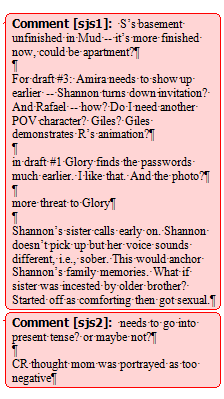
Word's Comments feature is a handy way to make notes for revision. Here I'm looking forward to draft #3 while working on #2.

Word’s Comments feature is a handy way to make notes for revision. Here I’m looking forward to draft #3 while working on #2.

Make notes as you’re working about scenes that need trimming, or expanding, or moving to somewhere else. If you know what needs doing, go ahead and do it. Microsoft Word’s Track Changes feature enables you to make tentative additions and deletions, then revisit them later.

Look for “soft ice” — the words, sentences, and whole paragraphs that don’t carry their own weight. Look for the pathways that led you into a scene but that become less important once you know where you are. They’re like ladders and scaffolding: crucial to the construction process, but dispensable when the job is done.

You’ve heard the standard advice “Kill your darlings,” right? It means different things to different people, and I’ve got mixed feelings about it. I’ve got mixed feelings about most “standard advice.” Most of it’s useful on occasion, but none of it is one-size-fits-all. Take what you like and leave the rest.

But sooner or later when you’re revising you will come to a stretch of drop-dead perfect dialogue or a scintillating anecdote and realize that it just doesn’t belong in the manuscript. Maybe it’s too much of a digression. Maybe it calls too much attention to itself. Maybe it duplicates something better said earlier. It’s hard to let these things go. Track Changes comes in especially handy here. You can zap it provisionally and gradually get used to the idea that it really does have to go.

When you’re slash-and-burning and filling in gaps, don’t worry too much about the transitions between paragraphs and scenes. If the right segue comes to you, by all means go with it, but if it doesn’t, move on. You can smooth it out later.

If you can’t solve a problem while you’re staring at it, stop staring, make a note, and move on. My thorniest problems tend to solve themselves when I’m out walking or kneading bread, falling asleep or just waking up. Solutions sometimes appear for problems you haven’t come to yet. Writing is weird.

When I started draft #2, I swore I’d get to the end before I started draft #3, but now, at page 238, I’m pretty sure I won’t. At present I’ve got  two viewpoint characters. To develop an important but currently underdeveloped plot thread, I need to add a third. He’s already a player, but adding his point of view is going to change the book’s balance a lot.

There’s also an incident I need to stage near the beginning of the book: my central character, Shannon, listens to an answering-machine message from her long-estranged younger sister. Shannon never picks up or returns these calls because her sister is always drunk or strung out. This time, however, her sister sounds sober and lucid. Shannon doesn’t pick up this time either, but the call ripples through the narrative. The ripples were already there; I just didn’t know what had prompted them.

So I’ve got a little farther to go in draft #2, then it’s back to the beginning to start on draft #3.

Why I Proofread

Most of what I do for a living is content editing, also called stylistic editing, line editing, and copyediting.

For more about the different levels of editing, see “Editing? What’s Editing?

I go through each manuscript line by line, asking whether each sentence says what the author wanted it to say, and in the most effective way possible. (Good editors are at least a little bit psychic: usually we can figure out what the author was getting at even when the words get in the way.) Along the way I catch spelling mistakes, awkward punctuation, and usage gaffes, sure, but this is only part of the job.

prooffreadingIn the last few months I’ve had two big proofreading gigs. When I’m proofreading, catching spelling mistakes, missing words, awkward punctuation, and dubious usage is what the job is about. You don’t have to be psychic to be a good proofreader. When you’re proofreading, the book is in proofs, meaning the pages look pretty much the way the reader will see them. The book has already been edited, and the editor was not you.
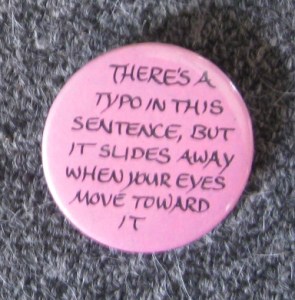
In other words, you want to change as little as possible.

For more about what proofreading is and isn’t, see “Proofreading 101.”

Proofreading generally pays a little less per hour than the editing I usually do, so why do I bother with it? I ask myself that whenever I accept a proofreading job. Here are some of my answers.

• When I’m editing, I often have to untangle snarly sentences. This can be exhausting. When I’m proofreading, someone else has done it for me.

• Proofreading demands that I focus on each and every word. When I’m editing, I often catch myself focusing on the sentences and overlooking the words that make them up. Proofreading reminds me that each word is important.

• When I’m proofreading, I’m following in another editor’s footsteps. Editors rarely get to see each other’s work. One of my recent proofreading jobs was a novel that included plenty of street slang and police shoptalk. Not only did I learn a few new words, I noted how author and editor had punctuated the kind of dialogue that isn’t covered in standard style guides. It gave me some ideas.

• Like many editors, I’m often tempted to meddle where meddling is not called for. Proofreaders must keep meddling to a minimum. I consider this a valuable spiritual practice.

• I get to proofread stuff that I wouldn’t be qualified to edit. A just-completed job was a multi-author essay collection dealing with the aftermath of the Arab Spring. I’ve edited a fair number of works, fiction and nonfiction, dealing with the Arab world, but this one included charts, tables, and lots of statistics. I’m in the “real life can’t be quantified” camp, but I don’t mind statistics too much when I’m proofreading.

That said, the next couple of months look like editing, editing, and more editing. Toward the end of November, I will definitely be ready for another proofread.

typo

Monologue About Dialogue

The catalyst for this post was a recent musing about “How Do You Create Realistic Dialogue?” on the Creative Writing for Me blog.

At the time I was reworking a chapter from Wolfie that’s nearly all dialogue. Almost 30 manuscript pages of nearly all dialogue. The warning lights were flashing: It’s too long! It’ll put readers to sleep! Readers want action action action, and talk is not action!

Aside: That “readers won’t like it” mantra gets embedded in our heads. It’s not just editors we have to talk back to: it’s ourselves.

But full-length plays are virtually all dialogue. We can be riveted for two hours by people talking.

So how to create dialogue that’s not only realistic but riveting? Dialogue that develops characters, moves the plot along, and gives the reader a break from one narrative paragraph after another?

Listen to people talk. Listen to yourself talk. Listen to the self-talk that goes on inside your head. Pay attention to how they talk as well as what they’re saying. Some people speak carefully, weighing every word. Others rush headlong into a sentence and don’t get to the end till five minutes later. In a conversation of more than two people, there’s usually one who says almost nothing. People use words to evade and conceal as well as to communicate.

Pay attention to the interactions. People in conversation react to each other. Sometimes it’s obvious: one person interrupts another, or two people complete each other’s sentences. Other times it’s subtle: one person has something to say but holds back, maybe waiting for the right opening, maybe from self-doubt. Or one person has zoned out of the conversation completely and is just itching to get out of there.

Read everything aloud. I read everything aloud, even narrative passages, even essays and reviews, but with dialogue and monologue (like the thoughts swirling inside a character’s head) it’s crucial. I read my long conversational chapter aloud to my writers’ group, Because of its length I did it in two parts. To my surprise and delight, they weren’t bored.

Let it flow. My dialogue usually starts when I point two or more characters at each other and let them talk. In first-draft mode I let them go on, and on and on and on. Often it’s not till they’ve gone on for a while that they get to the point, and often I don’t recognize it until they get there.

Shape your dialogue. People in books, plays, movies, and TV shows generally don’t talk like people you overhear on the bus or at the grocery store, but their conversations still sound “realistic.” You the writer have to actively distill the way people really talk into dialogue that sounds natural but gets to the point more efficiently than any real-life conversation. This takes practice, and a lot of it. Here are some things to keep in mind.

• What do you want this scene or this bit of dialogue to accomplish? Usually it’ll be more than one thing: disclose a bit of information, reveal something about a character, show how the relationship between two characters is developing, etc.

• Even more important, what does each of the speakers want to accomplish? What does each want from the other(s)? Send each character into the conversation with a goal. My very long conversation involved several characters, all of whom already knew most of the others. I had an agenda — Amira has to reveal to Shannon a crucial bit of backstory about someone who isn’t there — and so did each character. Giles, a successful artist, wants to encourage Shannon, a chronic procrastinator, to keep painting. Shannon is trying not to fall in love with Amira. Amira is troubled by a traumatic family event. Jay wants to watch the Celtics game on TV.

• People are not talking heads, even when we’re sitting at the supper table or watching TV. We fidget with our clothing, we gaze off into the distance. In theater, film, and TV, the actors show us all this. In a story or a novel, the writer has to do the showing. Pay as much attention to what your characters do as to what they say.

• People often talk in slang, sentence fragments, and anything other than neatly constructed sentences.  Punctuation conventions are generally aimed at producing neatly constructed sentences. Beware the editor what wants to punctuate your dialogue according to The Chicago Manual of Style or the precepts of some grammar guru. At the same time, you needn’t rely entirely on punctuation to shape your dialogue the way you want readers to hear it. You’ve got other tools in your toolkit. Pay attention to how words sound, and how sentence structure affects what words are emphasized. (When a writer overuses italics, it’s often because she’s not paying enough attention to the pacing and cadence of her sentences.)  Where you put the “tag” — the he said/she said — in a piece of dialogue can have a big effect on how your readers hear it.

A couple of my previous blog posts deal with dialogue. See “Of Dots and Dashes” and “Editing Workshop, 1.” Both focus on punctuation, which is an essential tool in shaping dialogue.

So — have you got any bits of dialogue that are giving you trouble? Other Write Through It readers can learn from your questions — and from the bits that work especially well too. Send them along using the contact form below.

← Back

Thank you for your response. ✨


Readers Won’t Like It If . . .

“Readers won’t stand for it.”

“It’ll trip readers up.”

“Readers expect mysteries to start off with a bang.”

Hang around editors for any length of time and you’ll hear umpteen variations on the theme: readers demand this and they won’t put up with that. You may even hear it from the editor you’ve engaged to work on your manuscript.

Here’s why you should take generalizations about “readers” with about a half ton of salt.

When editors, agents, teachers, and other gatekeepers claim to speak for “readers,” they’re hiding behind an authority that doesn’t exist. Readers are not homogeneous. They do not constitute a godlike authority that must be obeyed and can’t be contradicted or even verified.

Good editors don’t need to hide. We’ll say things like “I stumbled over this bit” or “Given the conventions of [insert genre here], you might consider picking up the pace in chapter one.” Take your editor’s observations and suggestions seriously, but remember that the choice is yours —

Unless, of course, a desirable contract hangs in the balance. When dubious advice is backed up by threat, it’s often best to take it. It’s still your call. Most experienced writers have gone along with editorial decisions that we didn’t agree with. The work survived, and so did we. And sometimes in hindsight the decision looks better than it did at the time.

When an editor tells you that readers won’t stand for something, don’t be afraid to talk back and stand your ground.

My mystery-writing friend Cynthia Riggs was told by her editor that readers would balk at a character’s using the word “bastard” in Bloodroot, the forthcoming title in her Martha’s Vineyard Mystery Series. Not one to take this lying down, Cynthia created a table of the “naughty words” used in the (so far) 12-book series. “Bastard” has appeared 41 times in the series, and 14 of them were in one particular book.

naughty words

True,  Cynthia did once receive an email from a fan who wrote that she didn’t “enjoy the language used by the police.” This reader also noted that she had already read four books in the series and had started on her fifth, so the use of strong language doesn’t seem to have been a deal-breaker for her.

For sure it may be a deal-breaker for some. All of us have likes, dislikes, and expectations that will prompt us to put a book down or never pick it up in the first place. Editors can’t predict how “readers” will respond to a particular scene or character or word because “readers” as a generic category doesn’t exist.

Neither can writers. When we attempt to please all of the readers all of the time — or even all of the readers in a particular sub-subgenre — our writing tends to become formulaic and predictable. Fortunately, and whether we know it or not, many of us have a more specific reader in mind. That’s who we’re writing for. Often this reader looks at least somewhat like us.

Left to our own devices, writers are hard to pigeonhole. So are readers. So are books. Unfortunately, we aren’t left to our own devices. Books can be unique, unpredictable, hard to describe in 25 words or less. This makes them hard to market.  Widgets, in contrast, are easy to sell because, being mass-produced, they’re consistent and predictable.  Aha! thought the commercial publishers. We’ll treat books like widgets!

And for several decades they’ve been doing exactly that: sorting books into genres, subgenres, and sub-subgenres so that customers can — so the thinking goes — buy books the way they buy toilet paper. (For more about this, see “Genres and Dump Dogs.”)

In my bookselling days, I found this endlessly frustrating. Where to shelve books that fit into two, three, or more categories? Shelving a book in one place would make it easier for some readers to find, but what about the readers who wouldn’t think to look there? What about the readers who were convinced that no book in that section could possibly interest them?

The marketing departments have trained us well. Many readers make a beeline for [insert subgenre here] and won’t stray from it. Writers whose top priority is selling, maybe even writing for a living, ignore this at their financial peril — but if they heed it, what happens to their writing? Often it becomes predictable — like a good widget. If they want to do something different, they’ll often do it under a pseudonym, to avoid disappointing their widget-hunting readers.

So when an editor or an agent or a writer you admire tells you that “readers won’t stand for it,” they may mean well, or think they do. It’s still your call. Readers aren’t homogeneous. Write for the ones who are willing to take chances. Write for yourself.