E Is for Ellipsis

An ellipsis is three dots.

An ellipsis comprises three dots. (See, I have to show that I know how to use “comprise” in what used to be considered the correct manner.)

An ellipsis consists of three dots with spaces between them.

. . .

not

I don’t get feisty about the things some editors get feisty about. I mean, I’m behind the serial comma, but I don’t believe those who don’t use it are trying to destroy the English language, western civilization, or some other cosmic entity. Ellipses, on the other hand . . .

Aside: That wasn’t an ellipsis. Those were suspension points. Read on for clarification.

I get feisty about ellipses. In my mind, for instance, there is no such thing as a “four-dot ellipsis.” An ellipsis comprises three dots. The fourth dot is a period — “full stop” if you’re working in British English (BrE).

Let me back up a bit. When you’re quoting from someone else’s work and you decide to skip some of the original writer’s words, you use an ellipsis to indicate the omission. Say I wanted to quote from the previous paragraph, but I wanted to drop “for instance.” I might write this: “In my mind . . . there is no such thing as a ‘four-dot ellipsis.'”

When would you use a four-dot ellipsisperiod followed by an ellipsis? When what you decide to drop follows a complete sentence. The complete sentence ends with a period, you add the ellipsis, then you carry on with your quotation.

Here I part company with the Chicago Manual of Style (CMS), so if you’re a dedicated follower of Chicago you better clap your hands over your ears. I want my readers to figure out as much as possible about the source of my abridged quote, so I don’t insert a period where there wasn’t one in the original, even if the remnant is a complete sentence. A capital letter signifies where the next complete sentence begins, and that’s enough.

So — suspension points. What are they? Suspension points indicate a trailing off, a suspension. Whatever was going to be said is suspended — it hangs in the air. I like the common convention in American English (AmE) that three dots indicate a trailing off, but a dash indicates an interruption. A while back I wrote about this in “Of Dots and Dashes.” Do note that at that time I either didn’t know or didn’t care about the distinction between ellipses and suspension points. 🙂

D Is for Deadline

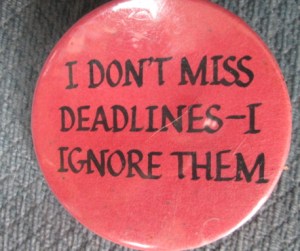
I was thinking “D is for Dictionary,” but I’m in deadline hell at the moment so Deadline won.

Most editors and writers have mixed feelings about deadlines. We love them when we’ve met them, not least because if this is a paid gig  the check will shortly be in the mail or payment will land in our bank account.

Until then, however, deadlines are swords of Damocles hanging over our heads and dominating our thoughts even when we’re not supposed to be thinking about work.

I’m never more focused than when I’m on deadline. Deadlines make it easier to set priorities: “No, I can’t drop everything and go to lunch. This has to be done by tomorrow.”

Deadlines also make it easier to get out of stuff you don’t want to do anyway. It’s so much easier to say “Sorry, I can’t — deadlines!” than “No, I really don’t want to sit through another three-hour meeting where nothing gets done.” (I hope I didn’t blow my, or your, cover with that one.)

My years working for a weekly newspaper taught me a lot about deadlines. Web-based publications may have rolling deadlines, but print is less flexible. During much of my time at the paper it was not flexible at all: “the boards” from which the paper was printed had to be on a certain boat or a certain plane to make their rendezvous with the printer’s representative on the other side of Vineyard Sound. (Living on an island does complicate things somewhat.) The adrenaline surge on Wednesday afternoon was exhilarating, especially if a story broke late: the reporter might be typing furiously at 3 p.m. while Production rearranged pages to make room for new copy.

Don’t be like this. Please.

As an editor, I learned just how annoying it can be when writers blow off deadlines without advance warning, or turn in copy that’s longer, shorter, or sloppier than expected.

Being a fairly slow writer, I learned to appreciate my colleague whose copy might be sloppy but who could crank out anything if it was needed to fill a gap, maybe because an ad was cancelled or a story pulled or another writer didn’t make his or her deadline.  I could clean up sloppy copy much faster than I could turn out something that didn’t need editing.

Sometimes an impending newspaper deadline made me buckle down and write something that I would cheerfully have given up on under any other circumstances. Once I had to review a local production of Samuel Beckett’s play Happy Days.  The acting was fine, but I had no idea what the play was about — and this was before the digital age, when an hour or so online would have given me enough background to BS semi-intelligently about Beckett.

So in desperation I transcribed and embellished the notes I’d taken during the play, which were sort of a stream-of-consciousness attempt to make sense of what I was seeing. Then I knocked them into paragraphs and called it a review. After the review appeared in print, the actress who’d played Winnie told me that she thought I really “got” what the play was about. Go figure. Maybe the desperation born of deadlines can make you smarter than you think you are.

For me the biggest challenge is having no deadline at all. Projects without deadlines tend to get pushed down the priority list again and again. How to keep going when your own enthusiasm flags or you hit a roadblock that you can’t see around?

No one’s waiting for my novel in progress, but two mini-deadlines keep me going. One is to write “every damn day.” (That blog post is about what happened when I let work deadlines take too much precedence over my own writing. It wasn’t pretty, but I know what to do when I get into that kind of trouble.) The other is my writers’ group, the Sunday Writers, which meets (you guessed it) every Sunday evening. All of us bring pages to nearly every meeting, and many’s the time that deadline has made me keep writing or revising till I had something coherent enough to bring to group.

C Is for Comma

As noted in “A Is for Audience,” I started this A-to-Z challenge a little late. C should have been posted on the 4th, but it’s currently the 6th. I’m backdating this post to the 4th to make myself look good. I will catch up, I promise.

According to Sturgis’s Law #5, “Hyphens are responsible for at least 90 percent of all trips to the dictionary. Commas are responsible for at least 90 percent of all trips to the style guide.”

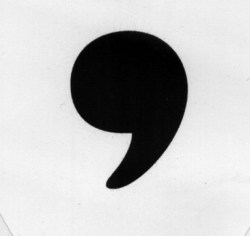
Is it a comma, or is it an apostrophe? Without more context, like maybe a baseline, it’s hard to tell.

Commas drive many writers and editors crazy, mostly because they are convinced that there are places where commas must always be used and places where commas must never be used, and the rules that specify which places are which are both inscrutable and shifty, which is to say they swap places in the night just to mess with people’s heads.

Commas are useful little buggers. Writing that consists of long comma-less sentences is devilish hard to read, and besides, we usually talk in phrases, emphasizing some words and not others. Commas, and punctuation generally, help shape your sentences so they’ll be read, understood, and heard the way you want them to be.

Yes, it’s usually a good idea to put a comma before the conjunction that separates two independent clauses:

She dashed down the stairs and into the street, but the car was already disappearing around the corner.

But when the clauses are short, a comma might feel like overkill:

Michaela went into the garden and Joan left the party.

But a comma wouldn’t be wrong in the sentence just above, nor would it be wrong to omit it in “She dashed down the stairs . . .” Much depends on how the writer hears the sentence, and how she wants readers to hear it. A comma does suggest, or at least permit, a pause.

Not all writers hear the words we write, but some of us definitely do. When I’m editing and come to a comma in an unconventional place, or an absence where convention thinks a comma should be, I read the sentence aloud with and without the comma. Do the two versions feel different? If so, which works better in context?

Commas are small but powerful. Don’t be afraid of them. Put them to work.

For more of my thoughts on commas, check out “Dot Comma.” And if you have any questions or advice about commas, let me know.

B Is for Backmatter

Yeah, both Merriam-Webster’s and American Heritage make it two words, but it’s my blog and they’re not telling me what to do. Hmm. I have this hunch that D is gonna be for Dictionary . . .

As noted in “A Is for Audience,” I started this A-to-Z challenge a little late. B should have been posted on the 3rd, but it’s currently the 5th. I’m backdating this post to the 3rd to make myself look good.

So what’s backmatter (or back matter)? It’s what follows the main text in a published book. With fiction the backmatter is usually short. It might comprise acknowledgments (which sometimes appear in the frontmatter — guess what that is?), the author’s bio, and — a regular feature of one trade publisher for which I edit regularly — “A Note About the Type.” Meaning the history of the typeface the designer chose to set the book in. Print geeks like me love this stuff.

Nonfiction, especially academic nonfiction, is a whole other (excuse my English) matter. In histories, biographies, and any nonfiction that involves any kind of research, the backmatter can make up a quarter or more of the book’s total pages. In a nonfiction work, the backmatter often includes endnotes, bibliographies or reference lists, and indexes. It may include a glossary or an appendix or two.

Citations — meaning especially endnotes, footnotes, and bibliographies — drive grad students, professors, journalists, and others crazy. They especially drive editors crazy, especially when authors have been inconsistent in the formatting or inaccurate in the details. Almost every assertion in an academic work has to be sourced: the author has to tell the reader where it came from, so the reader can, if so inclined, check it out. This sourcing is done in endnotes and footnotes (which aren’t considered backmatter because they aren’t in the back), and then all the works cited in the notes are compiled in a bibliography or reference list.

There are, in other words, good reasons for confusing “backmatter” with “dark matter.”

When I start a copyediting job, it doesn’t take me long to figure out whether the author is careful or careless.  Sometimes I can tell at a glance whether a cited work’s publication info is correct. Other times I have to look it up. If the author is careful, I spot-check the occasional reference and don’t worry too much. If not — I look up a lot, gnashing my teeth all the while.

Asked to provide an estimate for a nonfiction job, some editors will provide an estimate for the main text but then say they’ll charge by the hour for the backmatter. I totally get it. Backmatter words and main-text words are not created equal. Charging by the hour motivates some authors to do more of the heavy lifting themselves instead of expecting the editor to do it.

It’s when I’m editing backmatter that I most appreciate the Chicago Manual of Style or whatever other style guide I’m supposed to be following. Who wants to invent citation style from scratch? Not me. Here is one area where I’m grateful to have “rules” to follow, and I’m happy to follow those rules.

A Is for Audience

Eek! I was reminded on Sunday, April 2, that I fully intended to take part in the Blogging from A to Z Challenge. The challenge was supposed to begin on April 1. The idea is to blog every day except Sunday, with each post taking as its theme a letter of the alphabet, starting with A. Taking Sundays off leaves 26 days in April, there are 26 letters in the alphabet — brilliant idea.

However . . .

Travvy waits

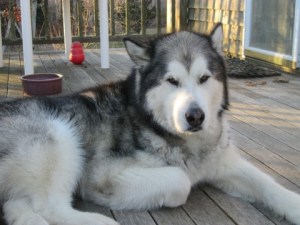
Trav spends a lot of time waiting for me to get home or get up from the computer.

My Sunday looked like one one I blogged about in “Calendars Rule“: I left the apartment at quarter to one and didn’t return home to stay till quarter past nine, having spent the time between at a political meeting, a rehearsal, a mailing party for a local political candidate, and my weekly writers’ group meeting. I did manage to return home long enough to take a walk with Travvy, give him his supper, and print out the pages I was taking to writers’ group.

Since then I’ve been in book review hell, which transforms all other writing into a guilty pleasure I should not indulge until the review is done.

However #2 . . .

I really want to do this A to Z thing. I want to blog shorter and more regularly, and deadlines really do help. (See, there’s an idea for D!) So I’m starting late. This post is backdated to April 1, although it’s being written on the 5th. I’ll catch up, I promise.

So — A is for Audience.

Actors in a theater and singers and musicians in a concert hall or coffeehouse can see, hear, and feel their audience. Even when they’re separated by rows of seats and what actors call the “fourth wall,” audience and performers are interacting. Not only are audiences moved by what’s happening onstage, the performers can be powerfully affected by the presence of audience.

town meeting audience

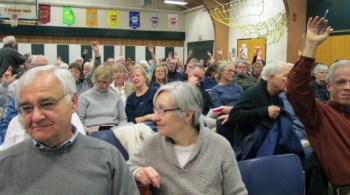
The audience at an annual town meeting in my town. We’re a very engaged bunch.

For most writers most of the time, the audience is not physically present while we’re writing, but that doesn’t mean it isn’t there. Even when we’re writing primarily for ourselves, we’re consciously or unconsciously choosing our words with someone or someones in mind. These imaginary readers (who may include people we know in real life) help us focus our work.

Here’s an example: My fiction is set on Martha’s Vineyard, where I live, but I’m writing for an audience that includes readers who don’t live here, have never been here, and maybe have never heard of the place. So I need to bring the place alive for those people without boring local readers with too much information or pissing them off with generalizations that don’t hold up to close scrutiny.

As an editor, I work on fiction, general nonfiction, and academic nonfiction. I like the variety, in part because it forces me to think about audience. I recently worked on a academic paper about the evolution of a particular concept in Egyptian literature. The target audience can be expected to have interest in and considerable knowledge about the Middle East in general but not necessarily about Egypt or Arabic literature or the period being examined.

Another recent project was a book about artificial intelligence. It was written for a general audience, which made me a good editor for it because I’m interested in the subject but don’t know much about it, and I’m pretty much lost when it comes to physics and computer science. The author did an excellent job of presenting complex ideas for a lay audience. When something was unclear to me, I asked myself whether this was due to the writing or to my lack of knowledge; in many instances, I’d do a Google search to find out how familiar the point might be to a general audience and how readily readers could fill in their own knowledge gaps.

The idea of audience can be paralyzing to writers who’ve rarely taken their work out in public. This is why I encourage writers who want to eventually see their work in print to start sharing it as soon as they, and it, are ready, and maybe a little sooner than that.

You’re probably already thinking about audience when you write. The audience in your mind is helping guide your decisions about what needs explaining and what can be left out. By testing your work on real people, you may discover that this or that point isn’t as clear as you thought it was, or that two equally astute readers may have different ideas about a character’s motivation. What you do with this information is, of course, up to you.

Coming soon: “B is for . . .”


Proofreading Poetry

Me and my IWD sign, which says “The common woman is as common as the best of bread / and will rise.” I am, you may have guessed, a regular bread baker. Photo by Albert Fischer.

I’ve been thinking about this because, you guessed it, I recently proofread a book-length collection of poems.

Prompted by the poster I made for an International Women’s Day rally on March 8, featuring a quote from one of Judy Grahn’s Common Woman poems, I’ve also been rereading Grahn’s early work, collected in The Work of a Common Woman (St. Martin’s, 1977). So I’ve got poetry on my mind.

A 250-page book of poetry contains many fewer words than a 250-page work of fiction or nonfiction, but this does not mean that you’ll get through it faster.  Not if you’re reading for pleasure, and certainly not if you’re proofreading. With poetry, the rules and conventions generally applied to prose  may apply — or they may not. It depends on the poems, and on the poet.

Poetry also offers some tools that prose does not, among them line breaks, stanza breaks, rhyme, and meter. (These techniques and variations thereof can come in very handy for prose writers and editors, by the way.) The work I was proofreading also includes several “concrete poems,” in which the very shape of the poem on the page reflects and/or influences its meaning. “Sneakers” was shaped like, you guessed it, a sneaker; “Monarchs” like a butterfly; “Kite” like a kite.

Errors are still errors, of course. When the name Tammy Faye Baker appeared in one poem, I added the absent k to “Baker” — checking the spelling online, of course, even though I was 99 percent sure I was right. Sometimes a word seemed to be missing or a verb didn’t agree with its subject. In a few cases, the title given in the table of contents differed somewhat from the title given in the text.

Often the matter was less clear-cut. English allows a tremendous amount of leeway in certain areas, notably hyphenation and punctuation, and that’s without even getting into the differences between British English (BrE) and American English (AmE). Dictionaries and style guides try to impose some order on the unruliness, but style guides and dictionaries differ and sometimes even contradict each other.

If you’ve been following Write Through It for a while, you know that I’ve got a running argument going with copyeditors, teachers, and everyone else who mistakes guidelines for “rules” and applies any of  them too rigidly. See Sturgis’s Law #9, “Guidelines are not godlines,” for details, or type “rules” into this blog’s search bar.

Imposing consistency makes good sense up to a point. For serial publications like newspapers or journals, consistency of style and design helps transform the work of multiple writers and editors into a coherent whole. But each poem is entitled to its own style and voice, depending on its content and the poet’s intent. Short poems and long poems, sonnets, villanelles, and poems in free verse, can happily coexist in the same collection.

What does this mean for the proofreader? For me it means second-guessing everything, especially matters of hyphenation and punctuation. Remember Sturgis’s Law #5? “Hyphens are responsible for at least 90 percent of all trips to the dictionary. Commas are responsible for at least 90 percent of all trips to the style guide.”

But dictionaries and style guides shouldn’t automatically override the preferences of a poet or careful prose writer. The styling of a word may affect how it’s heard, seen, or understood. When  I came upon “cast iron pot,” my first impulse was to insert a hyphen in “cast-iron,” and my second was No — wait. Omitting the hyphen does subtly call attention to the casting process; my hunch, though, based on context, was that this was not the poet’s intent. I flagged it for the poet’s attention when she reads the proofs.

Another one was “ground hog.” I can’t recall ever seeing “groundhog” spelled as two words, though it may well have been decades or centuries ago. However, in the first instance “ground hog” broke over a line, with “ground” at the end of one line and “hog” at the beginning of the next. In prose such an end-of-line break would be indicated with a hyphen, but this poet generally avoided using punctuation at the ends of lines, instead letting the line break itself do the work, except for sentence-ending periods. “Ground hog” recurred several times in the poem, so consistency within the poem was an issue. It was the poet’s call, so again I flagged this for her attention.

One last example: Reading aloud a poem whose every line rhymed with “to,” I was startled to encounter “slough,” a noun I’ve always pronounced to rhyme with “cow” (the verb rhymes with “huff”). When I looked it up, I learned that in most of the U.S. “slough” in the sense of “a deep place of mud or mire” (which was how it was being used here) is indeed generally pronounced like “slew.” The exception is New England, which is where I grew up and have lived most of my life. There, and in British English as well, “slough” often rhymes with “cow” in both its literal and figurative meanings. (For the latter, think “Slough of Despond.”)

All of the above probably makes proofreading poetry seem like a monumental pain in the butt, but for me it’s a valuable reminder that English is remarkably flexible and that many deviations from convention work just fine. At the same time, although I can usually suss out a writer’s preferences in a book-length work, I can’t know for sure whether an unconventional styling is intentional or not, so sometimes I’ll query rather than correct, knowing that the writer gets to review the edited manuscript or the proofs after I’m done with them.

The other thing is that while unconventional stylings may well add nuance to a word or phrase, they rarely interfere with comprehension. Copyeditors sometimes fall back on “Readers won’t understand . . .” to justify making a mechanical change. When it comes to style, this often isn’t true. My eye may startle at first at an unfamiliar styling or usage, but when the writer knows what she’s doing I get used to it pretty quickly.

The above examples come from Mary Hood’s All the Spectral Fractures: New and Selected Poems, forthcoming this fall from Shade Mountain Press. It’s a wonderful collection, and I highly recommend it. Established in 2014, Shade Mountain Press is committed to publishing literature by women. Since it’s young, I can say that I’ve read and heartily recommend all of their titles, which so far include three novels, a short-fiction anthology, and a single-author collection of short stories. All the Spectral Fractures is their first poetry book. I rarely mention by title the books that I work on, but Rosalie said it was OK so here it is.
The Power of Place

As a writer, I love revising and rewriting. As an editor, I do almost none of it. Critiques, yes. When a writer I don’t know asks me to edit a book-length manuscript, I generally suggest critique as a first step. I read the ms., make suggestions about plot, characterization, structure, and all that good big-picture stuff, but then the writer does the heavy lifting, not me.

For me, revising and rewriting is like first-drafting in that the ms. takes up residence in my head. My mind works on it when I’m not paying conscious attention. This is why character insights and solutions to plot snags often come to me when I’m walking with the dog or kneading bread.

I’ve learned that when I take on a revise-or-rewrite job as an editor, it often pushes my own writing out of my head. So I avoid developmental and structural editing and stick to stylistic editing, copyediting, and proofreading. (All these things go by different names. In “Editing? What’s Editing?” I explain what I more or less mean by them.)

But I recently (very recently, like this past week) took on a rewrite job for a client. It was short: a new, five-page prologue to a novel that’s been accepted for publication. I also knew the novel well, having worked on it in its earlier stages, and I believe in it.

I read the author’s five pages through. The plot was solid. It introduced key themes and characters that would be developed later. It segued neatly into chapter 1. Yeah, the point of view jumped around a bit, and there was a chunk of historical context recounted in a narrative voice that didn’t belong to any of the characters, but my rewriterly mind was already in gear, working out possible alternatives.

I called up the file. A 10-year-old boy is stretched out on the roof of his uncle’s house, using his BB gun to keep birds away from the abundant ripening grapes hanging from a trellis. I knew this kid well: the novel is his story. I could hear his older sister playing hopscotch in front of the house. But I couldn’t see what he was seeing because I’ve never been there and never even seen pictures of what this house, this neighborhood, this small town in Lebanon’s Bekaa Valley, might have looked like in 1975, which is when the story begins.

For me as a writer, place is crucial. As I blogged in “The Importance of Place“; “Every story, remembered or made-up, takes place somewhere. Where it takes place affects what takes place, deeply, profoundly, deeply, indelibly. Characters, both fictional and nonfictional, are deeply affected by where they are and where they’ve come from. Images, characters, and whole plots grow out of the soil they take root in.”

Both place and time are critical to this particular novel: Lebanon in the spring of 1975 was on the brink of a bloody civil war that devastated the country for 15 years. That 10-year-old boy’s life will be radically transformed by this war, and the incident in the prologue is a harbinger of things to come. The prologue needed to show readers what he was seeing and hearing. How could that happen if I couldn’t see and hear it myself?

I emailed the author. We talked on the phone. How close together are the houses? How long is the driveway? Are the grapes used for eating or winemaking? What do the birds look like? Where have all the grownups gone? Is the garden in front of the house or in back? How big is the garden pond?

Finally, finally the scene began to play out in my head. My fingers moved on the keyboard and words appeared or rearranged themselves on my laptop screen. The scene stayed in the 10-year-old’s point of view. The historical context can be worked into a later chapter, but I couldn’t help noticing that it is subtly suggested here in the ripening grapes being threatened by birds while a boy tries to scare them off with his BB gun.

At this point I’m rarely surprised when place turns out to be the key to a scene, but I’m awed by writers who routinely bring to life periods they didn’t live in, places they’ve never been, and times and places that never existed. The research, the extrapolation, the imagination, the finessing of details that can’t be known for sure — it all has to be there, and seem so complete and inevitable that most readers barely notice.

Sturgis’s Law #9

Some while back I started an occasional series devoted to Sturgis’s Laws. “Sturgis” is me. The “Laws” aren’t Rules That Must Be Obeyed. Gods forbid, we writers and editors have enough of those circling in our heads and ready to pounce at any moment. These laws are more like hypotheses based on my observations over the years. They’re mostly about writing and editing. None of them can be proven, but they do come in handy from time to time. As I blog about them, I add them to Sturgis’s Laws on the drop-down from the menu bar.

Guidelines are not godlines.

Is middle school (junior high for us older folk) particularly hazardous to future writers and editors? This seems to be when admonitions to never do this or always do that put down deep roots in our heads.

  • Never split an infinitive
  • Never begin a sentence with a conjunction.
  • Always use a comma before “too” at the end of a sentence.
  • Never end a sentence with a preposition.

Etc.

Plenty of us get the idea that written English is a minefield laid with rules they’ll never remember, let alone understand. When you’re afraid something’s going to blow up in your face, it’s hard to construct a coherent sentence. A whole story or essay? No way.

In the late 1990s, when I started hanging out online with more people who weren’t writers or editors, I often encountered a strange defensiveness from people I hardly knew. They apologized in advance for their posts: “Maybe I’m saying it wrong . . .”

My sig lines at that time identified me as a copyeditor and proofreader. I deleted those words from the sigs I used when communicating with people outside the word trades. And the defensiveness disappeared.

Those of us who work with words for a living eventually realize that language is not a minefield, but plenty of us have got a Thou shalt or Thou shalt not or two embedded in our heads. On the editors’ lists I’m on, it’s not unusual for someone to ask whether it’s really OK to break some “rule” or another. Generally the rule isn’t a rule at all.

English grammar does have its rules, and if you break or ignore them, intentionally or not, you may have a hard time making yourself understood. But many of the “rules” we learn in school aren’t about grammar at all. They’re about style. Style is more flexible than grammar — and grammar isn’t as static as some people think it is.

Sturgis’s Law #9 came about because even working editors sometimes confuse style guidelines with Rules That Must Be Obeyed.

Arbiters of style.

Arbiters of style.

Let me back up a bit. Book publishers, magazines, newspapers, academic disciplines, and businesses generally develop or adopt a style guide to impose some consistency on their publications. For U.S. journalists it’s the Associated Press Stylebook. For trade publishers and university presses it’s usually the Chicago Manual of Style. In the social and behavioral sciences it’s APA Style, developed by the American Psychological Association. And so on.

These style guides do deal in grammar and usage — Chicago has a whole grammar chapter — but much of what they recommend is discretionary. It’s about style. For instance, Associated Press (AP) style generally uses figures for numbers 10 and up; Chicago spells out most numbers up to a hundred. When I start editing a book manuscript, I can tell within a few pages if the author is accustomed to AP style.

I’ve been using Chicago since the 12th edition (it’s now up to the 16th). I can’t say I know it by heart, but Chicago style is my default setting. No way do I want to invent guidelines from scratch for every manuscript I work on, especially when it comes to documentation: the styling of endnotes, footnotes, bibliographies, and reference lists.

Default settings, however, can be changed as need or preference dictates. They really are guidelines, not godlines. Chicago can be useful for any English-language prose writer, but keep in mind that it was developed for scholarly nonfiction and the further you stray from that, the more leeway you should allow in applying its guidelines.

If you use different style guides, or move between American English (AmE) and British English (BrE), you’ll see plenty of variation in things like capitalization, hyphenation, and the punctuation of dialogue. There’s even considerable variation between dictionaries. When I’m working, I’ve usually got Merriam-Webster’s, American Heritage, and Oxford (the UK/World English edition) open in my browser.

Maybe the most important thing to remember about guidelines is that they aren’t landmines waiting to blow up in your face. They’re on your side. They help your words get across to readers the way you want them to. Following guidelines can be like automating routine tasks: it frees your mind to deal with the more important stuff.

They can also help establish your credibility with agents, editors, and readers. There’s nothing wrong with a manuscript that isn’t double-spaced in 12-point type with one-inch margins all around, but a manuscript that is so formatted will enhance your credibility with any publishing pro who sees it for the first time. And the further it deviates from “the usual,” the more likely doubts are to creep into the reader’s mind.

When Chitchat Takes the Wheel

Dialogue is a challenge. It’s got to sound real, but it can’t be too real because in real life people often go on at great length without saying much of anything. If your characters go on at great length without moving the plot forward in some way, your readers will zone out. (For some tips about writing dialogue, see “4 Ways to Write Better Dialogue” and “Monologue About Dialogue.“)

I recently critiqued two first-novel manuscripts. Both were rich with promising material, and both bogged down in endless stretches of what I can only call chitchat: the protagonist talking with friends, relatives, and casual acquaintances about things that had nothing to do with plot or subplot.

What to do when you come upon long rambling dialogue while revising your own work or critiquing someone else’s? Here’s an idea: Ask what the writer is avoiding. (The writer, need I say, can be you.)

In one of the manuscripts I was working on, the chitchat was occasionally interrupted by passionate monologues by different characters (rarely the protagonist). These monologues had plenty to do with the plot, but they read like position papers, not fiction.

Travvy tries to persuade a tractor to move.

Travvy carries on a one-sided dialogue with an offstage tractor.

These monologues did serve an important purpose, however: they made it clear that the characters disagreed with each other strenuously and eloquently on issues that were not only important in themselves but closely related to major themes in the novel. I knew that this material could fuel riveting, even dramatic dialogue — if only the writer would let the characters engage with each other.

It wasn’t hard to see why this writer was reluctant to do this. Both she and her protagonist are dealing with explosive issues that people have a hard time talking about without blowing up.

Writing takes courage. Often when we set out on a journey we don’t know how much will be asked of us. If we did know, we might not take the first step. But as we travel, we become braver, more willing to open closed doors and break new trail. Revision works the same way: in revision, we develop not only the skill but the courage to grapple with the questions we’re asking of ourselves and our characters.

In the other manuscript I was critiquing, the same symptom — endless chitchat on topics peripheral to the novel — had a different cause. The protagonist remembered nothing of her traumatic childhood and early adolescence, and she was so ashamed of her later adolescence and young womanhood that she wouldn’t talk about it even to her husband and closest friends. This gave her little to talk about besides chitchat.

Worse, because her repressive upbringing was key to the plot, it made her a sitting duck for the villain, who wasn’t hampered by amnesia or reticence.

Survivors of violent and traumatic events often repress memories of those events, but though it’s possible that someone might have no memories of her first 15 years, it’s certainly not inevitable. Most important, it wasn’t an interesting choice for this particular character in this particular novel. Interesting choices open up possibilities. This particular choice closed them off.

I suggested that this writer give her protagonist increased access to her own past and the willingness to share some of the grim details with those she trusts. At the very least, it will give the protagonist something to talk about, and greatly cut down on the chitchat.

Letting Go, with a Safety Net

cut-chapter-4This morning I deleted chapter 4. Selected the whole damn thing and zapped it. The old chapter 5 is the new chapter 4. Viva chapter 4!

When reading through the printout of draft #2, I couldn’t help noticing that chapter 3 segued nicely into chapter 5 and chapter 4 felt like an extended detour. At present Wolfie has two point-of-view (POV) characters. Chapters 3 and 5 were from the POV of the 50-something woman. Chapter 4 was from the POV of the sixth-grade girl.

When the timing is right, the POV switch works. The idea is to switch just when the reader wants to know what the other character is up to. This time it was more like a TV thriller cutting to a commercial in the middle of a high-intensity scene.

Another thing: When I wrote draft 2, chapter 4, I wasn’t a big fan of Felicia, the sixth-grader’s mother.  Dead giveaway: The woman won’t use linguiça in her kale soup because she thinks it’s unhealthy. In my world that’s a deal-breaker. But Felicia has become deeper, more sympathetic. She’s caught in the middle of a difficult situation, but she seems to be on her daughter’s side. So I was more than ready to jettison all evidence that I was underestimating Felicia.

So I did. I jettisoned the whole chapter.

However, I’ve got a safety net: If at some point I have regrets, or a vague hunch that there’s something in old chapter 4 that might come in handy, draft 2 remains on my hard drive, and it includes old chapter 4.

If experience is any guide, I won’t go back, but knowing that I can gives me permission to be ruthless. When revising, sometimes you really do have to be ruthless.

A bit of Wolfie, draft 2, chapter 1, with changes tracked

A bit of Wolfie, draft 2, chapter 1, with changes tracked

Recently I introduced a client to the wonders of Microsoft Word’s Track Changes feature. Like many Word users, she wasn’t aware of its wonders. (As a longtime user of Word, I sometimes become so obsessed with its PITAs that I forget how wonderful its wonders are.) With Track Changes you can delete a word, a phrase, a sentence, a whole paragraph and see how your text reads without it. You can flip back and forth between with and without, or leave it to deal with some other time.

You can experiment. You can play with your prose. If ruthlessness is sometimes called for when you’re revising, so is playfulness. Revision is creative work. Don’t let anyone tell you different. Be ruthless. Be playful. Be brave. You can always go back to an earlier version, but if you’re anything like me you usually won’t want to.