You’ve probably heard it so often, repeated with such authority, that you’re ready to throttle the next person who says it: Write what you know.
Likely you’ve also heard, or even yourself said, the common rejoinder, which goes something like That’s crap. Haven’t you ever heard of research?
Well, of course. What we know is fluid, expanding and deepening even without any conscious effort on our part. For writers, research is ongoing. We read, we listen, we travel to a new place, we walk down a street we’ve walked down many times before, noticing some things for the first time.
My hunch is that Write what you know surfaced at least in part as a response to the notion that one could only be a real writer if one had had certain experiences. The requisite experiences — being in combat, for instance — were almost invariably skewed male. At a women’s writing workshop in the late 1980s, a bunch of us got to talking about this. We couldn’t help noticing that experiences common to women, from childbirth to housework to caregiving, weren’t considered worthy subjects for serious literature.
One of us remarked, half-facetiously, that “the only suitable subjects for academic poetry were bullfighting and war,” whereupon several of us set out to write about bullfighting, which, need I say, none of us had ever done. My contribution grew into “The Bullfight Sonnets,” which was published by Sinister Wisdom in 1988. It includes these lines:
. . . Novelists extol
the crowd, the sun, the blood, the kill, the role
of manhood challenged and found worthy. I
am less enthralled. Instead, I wonder why
cerebral critics desperately admire
heroes who hold their shit when under fire.
Can you tell we had Ernest Hemingway on the brain? Not so much Hemingway, however, as the “cerebral critics,” English teachers, and others who held Hemingway’s spare style up as the pinnacle of literary excellence. At the time, writing about New York, published in New York, and taken up by an audience of New York–based literati was also elevated a step or two above “regional” writing. Take that, Willa Cather, Flannery O’Connor, and Eudora Welty.
I think that the English-language “canon” has gotten more regional, more international, and a lot less white since then. Nevertheless, I continue to take Write what you know as encouragement to start wherever we are, in place, time, and subject matter. Themes of universal — or at least widespread — concern can be reached from anywhere.
One of my favorite axioms is Your writing will teach you what you need to know.
A corollary to that is Your readers will teach you what you need to know more about.
I live on Martha’s Vineyard, an island off the coast of New England that you have probably heard of whether you’ve been here or not because it gets written about a lot, by journalists, novelists, poets, and others. Most of them don’t live here year-round, or haven’t lived here long. It’s not hard to tell which of these writers have been listening to the place and the people in it and which either didn’t take the time or just don’t know what they don’t know.
It really is OK to write about places where you haven’t spent much time and people with lives and backgrounds very different from yours. Hell, historians and historical-fiction writers regularly write about times where they’ve never been, and plenty of them do it very well. (On the other hand, if we’ve never been there either, who are we to tell them that they’ve got it wrong?) Research is required for sure, but it can only get us so far: there’s more to recreating a place or time than avoiding anachronisms and getting the street names right. Imagination and empathy are also necessary, along with an awareness that no matter how much we know, there’s always a lot that we don’t.



 By Allison Coffelt
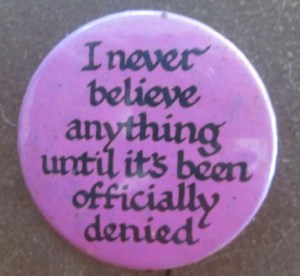
 In the Age of Google, you can find almost anything on the Web, but plenty of it hasn’t been subjected to either fact-checking or editing. As you’ve probably learned for yourself, verifying the attribution of a quotation is a particular challenge because misattributions seem to multiply exponentially — giving rise to memes like the classic at left (variations of which have also been attributed to Mark Twain, among others).
 In this age of spin and “fake news” each of us has to do our own fact-checking. Because we rarely have the time or inclination to check every fact, we generally focus on the source, the news outlet: if it’s got a good track record, it’s probably because its reporters, editors, and fact-checkers are on the ball. When they screw up, our faith is shaken. Was this an aberration, or are they going down the tubes?
 Last spring I started an occasional series devoted to Sturgis’s Laws. “Sturgis” is me. The “Laws” aren’t Rules That Must Be Obeyed. Gods forbid, we writers and editors have enough of those circling in our heads and ready to pounce at any moment. These laws are more like hypotheses based on my observations over the years. They’re mostly about writing and editing. None of them can be proven, but they do come in handy from time to time. Here’s #7:
 Write Through It