“A fantasy is a journey. It is a journey into the subconscious mind, just as psychoanalysis is. Like psychoanalysis, it can be dangerous; and it will change you.”
 That’s Ursula K. Le Guin in “Talking About Writing” which you can find in her Language of the Night: Essays on Fantasy and Science Fiction (1979). I don’t write fantasy, but I’ve read a lot of it, which may explain why fantasy elements keep sneaking into my real-time fiction.
It may also explain why for me writing is a journey, especially writing fiction, and everything Le Guin says about fantasy applies. The journey I’ve been on for three years now started with a dog running through the woods and a girl sitting on a playground swing. As I wrote my way toward them, I began to understand who they were and how they were connected.
I also ventured deep and deeper into my own subconscious, or memory, or imagination, whatever it is, and found images and questions that preoccupied me in the past but that I’d set aside. Rescue — both rescuing and being rescued — was a big one. In my novel in progress, the rescue of the dog turned out to be pretty easy. The rescue of the girl is still working itself out. I’m still not 100% sure of what she needs to be rescued from, but it’s a lot clearer — and more unsettling — than it was when I started. So are the stories and motivations of the would-be rescuers.
One of my mantras is “Your writing will teach you what you need to know.” It will, but the catch is that you have to keep doing it. My hunch is that a fair amount of what’s called “writer’s block” stems from the cautious mind’s fear of those subconscious places where reason has to relinquish control. The fear is totally justified because, as Le Guin wrote, the journey will change you.
It may change you in ways you don’t expect and can’t control, that may sharpen or blur your vision enough to unsettle your view of the world. It’s a wild magic, writing.
As the letter J drew closer in my passage through the alphabet, I couldn’t decide between “journey” and “journal.” The two words had to be closely related, I thought, and so they are: both stem from the Latin word for “day,” diurnis, by way of the Anglo-French. If you know any French, or even if you don’t, the “jour-” in “journey” and “journal” probably suggests jour, the French word for “day.”
“Journey,” it seems, originally suggested a day’s travel. Now a journey can take much longer, especially if you’re working on a book-length work, but breaking it down into days isn’t a bad idea. The journey may indeed lead into dangerous places, but the closer you get, the less scary they seem — because you’re getting braver with every step you take, every word you write.

The journey continues.


 Not to worry about all this flux and multiplicity, at least not too much. A couple of things to keep in mind, however, when someone accuses you or not knowing your grammar or when, gods forbid, you are tempted to accuse someone else: (1) spelling and punctuation are not grammar, and (2) some of the rules you know are bogus.
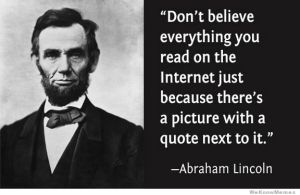 In the Age of Google, you can find almost anything on the Web, but plenty of it hasn’t been subjected to either fact-checking or editing. As you’ve probably learned for yourself, verifying the attribution of a quotation is a particular challenge because misattributions seem to multiply exponentially — giving rise to memes like the classic at left (variations of which have also been attributed to Mark Twain, among others).
 In this age of spin and “fake news” each of us has to do our own fact-checking. Because we rarely have the time or inclination to check every fact, we generally focus on the source, the news outlet: if it’s got a good track record, it’s probably because its reporters, editors, and fact-checkers are on the ball. When they screw up, our faith is shaken. Was this an aberration, or are they going down the tubes?
 Most editors and writers have mixed feelings about deadlines. We love them when we’ve met them, not least because if this is a paid gig the check will shortly be in the mail or payment will land in our bank account.


 Write Through It