Trust

Punctuation seems to me one of the few human inventions without bad side-effects, and I am so fond of all the little dots and curls that I once taught a whole writing course devoted to them.

— Ursula K. Le Guin

I was tempted to post that quote all by its own self because (1) I agree with it, and (2) Ursula K. Le Guin wrote it, but reading Le Guin reminds me continually to pay attention to context, and I’m continually railing at online memes that encourage us to do the opposite.

So, context: The quote comes in “Examples of Dignity: Thoughts on the Work of José Saramago,”  in her most recent nonfiction collection, Words Are My Matter: Writings About Life and Books, 2000–2016 (Easthampton, MA: Small Beer Press, 2016).

Saramago, the 1998 Nobel laureate in literature, was not a big fan of punctuation. Writes Le Guin: “So a Saramago page, one dense thicket from top to bottom with only commas to indicate the path, was hard going for me, and I was inclined to resent it.”

After a couple of attempts, I bailed on Joyce’s Ulysses for similar reasons. Saramago had been commended to Le Guin not only by his reputation but by a friend whose opinion she trusted, so she didn’t stop with resentment. If she was going to persevere through this difficult book, Blindness, she had to trust the author, her guide, and “the only way to find out if he deserved such trust was to read his other books. So I did.”

This worked. “I returned to Blindness and began it again from the beginning,” she writes, “by now used to the thicket and confident that wherever Saramago took me, however hard the going, it would be worth it.”

She doesn’t learn to love Saramago’s ways with punctuation: she “learned to accept them, but without enthusiasm.” She also notes that she has little difficulty when she reads his work aloud, “probably because it slows me down.”

All of which reminds me of Richard Brinsley Sheridan’s much-quoted (and -misquoted) lines:

You write with ease to show your breeding,
But easy writing’s curst hard reading.

It doesn’t seem that Saramago wrote with particular ease, and “breeding” in Sheridan’s sense he certainly did not have, but — point taken. At the same time there are editors out there who think any irregularity that slows the reader down is anathema, and readers who want to barrel through one book after another without engaging with any of them or remembering them later.

I like Le Guin’s approach. She’s willing to put out considerable effort if she trusts her guide.

Me too — but I did give up on Ulysses, although I’d liked some of Joyce’s other work. The trouble was that too many other guides were clamoring for my attention.

Z Is for Zipped

Some book-length jobs arrive in a single file. Others have a file for each chapter, plus frontmatter, backmatter, author’s bio, and maybe captions and other stuff. Multiple files can be attached to a single email, so the client zips them into a single compressed file and sends it that way.

When I receive it, I save the file in the appropriate folder and unzip it. Voilà, all the individual files are there in their own folder, waiting to be opened and worked on.

Z also stands for zed, which is in fact how the last letter of the alphabet is pronounced in lots of places. And here are, on the last day of April, at the end of the alphabet.

Wow. I did it!

A couple of days ago I panicked. In the A–Z Challenge you were supposed to get Sundays off, but  Saturday was “Y Is for You” so Z was going to have to come on either Sunday or the first of May. Had I missed a day, or a letter? I grabbed my chairside calendar and counted. Three times I counted, and every time Z fell on Sunday, April 30.

Whew.

The lesson for me here is that I can come up with stuff to say almost every day of the month. I don’t have time and I have nothing to say and I’m too tired and I’m not inspired today and That’s too obvious and I said that already are just excuses. Start writing and the words will come.

I knew that already, right? So do you. That’s what this blog is about. But it’s something we have to keep learning and relearning. The alphabet may come to an end, but the writing doesn’t.

Write on!

Y Is for You

Why (Y?) doesn’t “you” begin with U? Why isn’t it spelled “U”? U and I — how symmetrical, how perfect. Twitterspeak finally got it right.

You is the second person. I’m talking to you. You’re the one I’m talking to. You are being talked to by me.

You is the second person. (You are the second person?) The second-person point of view is rare in fiction, unlike the first and third persons (people?), which are all over the place.

I’ve copyedited two novels in second person, both by the same author: Zoran Drvenkar. The first, Sorry, was the first second-person novel I’d ever read and it blew me away. It’s a thriller and as the story coalesced and came clearer I felt pinned to the wall (if you’ve read the book you’ll understand why I shouldn’t have said that) and blinded by headlights at the same time.

Would it have been so riveting in third person or first? I don’t think so.

Drvenkar’s second novel was titled, oddly enough, You. It was good, fascinating, but not as riveting as Sorry, possibly because this time I was wary and less willing to be riveted.

You know, I’d never seriously considered writing in second person before I started this blog post, but now I’m thinking some second-person freewriting exercises might be useful for the novel in progress.

This is Wolfie‘s very first paragraph in second person:

You dash toward the leftmost swing while your friend Hayden dawdles along behind, scoping out the playground action as she walks. Several other swings are free, but the one on the end is yours. By the time Hayden catches up, you have freed your thick nearly black hair from its red scrunchie and are shaking it loose.

Hah. I could get into this.

W Is for Write

There’s a verb for you.

By writing the writer spins a thread of written words from some mysterious place in her brain.

Your writing will teach you what you need to know.

Maybe what you most need to know is whether you’re a writer or not, a real writer. Writers wonder about this a lot, especially writers who don’t make a living writing or aspire to make a living or even part of a living from writing. Also writers who can’t point to books — ideally several books — that have their name on the cover, or a sheaf of clippings with their byline at the top.

Writers are ingenious at coming up with reasons they’re not real writers. Do nurses and carpenters and cooks and teachers keep coming up with reasons that they’re not real nurses and carpenters, cooks and teachers?

I blogged about this a while back, in “What Makes a Real Writer?” I don’t have a whole lot to add to that, and once again I’d refer all worried writers everywhere to Marge Piercy’s classic poem “For the Young Who Want To.”

For me the key is, was, and always will be “The real writer is one / who really writes.” But read the whole thing anyway.

These days I’m not all that worried about whether I’m a writer or not. Whatever else I am, I’m someone who can write well, who has writing in her toolkit, well honed and ready for action. I see myriad ways out there that this particular skill can be useful, from telling stories to reporting or analyzing news to blogging to trying to keep political discussions on social media reasonably focused and civil.

Writing is important, whether you call yourself a writer or not.

It’s a rare writer who can do all the things that writers collectively can do, but it’s an equally rare writer who can do only one thing.

Another Piercy classic is “To Be of Use.” You can probably infer the gist from the title alone, but again — read the whole thing. Here’s the stanza that grabbed me by both hands this time through:

I want to be with people who submerge
in the task, who go into the fields to harvest
and work in a row and pass the bags along,
who are not parlor generals and field deserters
but move in a common rhythm
when the food must come in or the fire be put out.


In the world these days we’ve got fires to put out and fires to keep going and fires to rekindle from scratch. Writing can do all these things.

Write.

Write.

Write.

V Is for Verb

This one’s going to be short because I’ve got a job due today. It isn’t an especially long or complicated job, and I’ve had plenty of time to get it done, but as usual it was contending with other jobs that had earlier deadlines.

So — verbs. Verbs are indispensable. You pretty much can’t have a sentence without a verb, but a verb can be a sentence with no help from any other parts of speech: Stop! Go! Read!

They’re also versatile. From verbs grow gerunds, which function as nouns and can actually turn into nouns: Reading is fundamental. I haven’t finished the reading.

From verbs grow participles, past and present, which can function as adjectives: After the baked loaves came out of the oven, she put her baking utensils away.

Dangling participles are something editors and writers have to watch out for, but I hope they never go away because some of them are very funny. Here’s one from the Oxford Dictionaries online: “If found guilty, the lawsuit could cost the company $12 billion.” The default subject for “found” is “the lawsuit,” but lawsuits are generally not tried in court. If it’s the company on trial, then make it “If the company is found guilty, the lawsuit could cost it $12 billion” — but without more context we don’t know that for sure. It might be one of the company’s higher-ups.

Infinitives can dangle too — to submit your manuscript, it must have one-inch margins on all sides — but what makes many people nervous about infinitives is the splitting, not the dangling. This worry arose because in other languages, notably Latin, infinitives are one word and can’t be split. In English the infinitive includes to: “to submit,” It’s definitely possible to slip another word or two between “to” and its verb, and often it’s a good idea. Placement of an adverb, say, can affect the cadence or emphasis of a sentence or line of poetry.

Infinitives are versatile little buggers. Don’t be afraid of them.

What turns some ordinarily mild-mannered editors and teachers into wild-eyed partisans these days is the verbing of nouns. “Verbing weirds language,” says Calvin in a classic Calvin & Hobbes strip from January 25, 1993.

My editorial mentor, ca. 1980, couldn’t abide the verbing of “target.” Some while later I took up the cudgel against “impact.” Some while even later than that, it dawned on me that it wasn’t a big step from “to aim at a target” to “to target,” or from “to have an impact” to “to impact.” Sure, “affect” means pretty much the same thing, but “impact” makes a bigger boom.

Where I do draw the line is when a verb spawns a noun that is then unnecessarily verbed: administer -> administration -> administrate. No no no no.

The manuscript that’s due back at the publisher’s today isn’t a cookbook, but it does contain some recipes. One suggests that you “may brulee the marshmallows until golden brown” before putting them on top of your spiked hot chocolate.

I screeched to a halt. “Crème brûlée” I knew: a custard with a layer of caramelized sugar on top. I knew enough French to recognize “brûlée” as the feminine past participle of brûler, to burn. Since I don’t edit cookbooks but I do know that cookbookery has its own conventions, I wondered if “brulee” had been verbed in cookbook English, and if so, should the diacritics be included?

Off I trotted to the Editors Association of Earth group on Facebook, whose members include editors in myriad fields who speak a daunting array of languages. What I learned was that diacritics are customarily used in good cookbooks but that “brulee” didn’t seem to have been verbed in English.

At this point I realized that the big problem had nothing to do with verbing or diacritics. The big problem is that the author hadn’t made it clear what you were supposed to do with the marshmallows. Unlike crème brûlée, marshmallows aren’t sprinkled with a layer of sugar that can be caramelized with a torch. Around campfires or fireplaces marshmallows are generally toasted, but how about in the kitchen?

Clearly it was time to go back to Q for query, so that’s what I’ve done.

U Is for Usage

People are regularly accused of not knowing their grammar when the real issue is a possibly shaky grasp of usage.

Here’s Bryan Garner, whom I’ve invoked more often in the last week or so than in the previous 10 years, on grammar: “Grammar consists of the rules governing how words are put together into sentences” (Chicago Manual of Style, 16th ed., section 5.1).

And here he is on usage: “The great mass of linguistic issues that writers and editors wrestle with don’t really concern grammar at all — they concern usage: the collective habits of a language’s native speakers” (CMS 16, section 5.216).

Language eddies and ripples and never stops moving.

Those collective habits tend to change a lot faster than the underlying rules. Think of a river, a pond, or the ocean: the surface sparkles and ripples and can be quite turbulent, while what’s underneath moves more sedately or maybe not at all.

Usage isn’t uniform across speakers of a particular language either. Nowhere close. Much has been made of the differences between British English (BrE) and American English (AmE), but both BrE and AmE include great internal diversity, by nation, region, and other factors.

Usage that raises no eyebrows in a particular field may seem clunky, appalling, or even incomprehensible in another. Recently an editor queried the editors’ e-list we’re both on about a use of “interrogate” that raised her hackles; in her experience, suspects could be interrogated but not theories, Those of us who regularly edit in certain academic disciplines assured her that in those fields theories can be interrogated too.

The editors’ groups I’m in are not only international, they include editors from many fields, genres, and disciplines. So when we ask if a certain usage is OK or not, we mention the intended audience for whatever we’re working on: fiction or nonfiction? AmE or BrE? academic discipline? subject matter? Is the tone informal or formal?

Colloquialisms and, especially, slang can be especially tricky. Slang often arises within a particular group, and part of its purpose is to set that group off from others. A word that means one thing in the wider world may mean something else within the group. By the time the wider world catches on, it’s passé within the group. This poses a challenge for, say, novelists writing for teenagers and young adults, who in every generation come up with words and phrases that set the adults’ teeth on edge: how to come across as credible when by the time the book appears in print (usually at least a year after it’s turned in to the publisher), the dialogue may come across as ridiculously outdated to its target audience.

Dog in driver's seat

I’ll assure my insurance company that I’m wise enough to ensure my safety by not letting Travvy drive my car.

In English, usage gaffes often result when words sound alike; when their meanings are related, the potential for confusion grows. Consider this sentence: “I assured my friends that I’d ensured my own safety by insuring my car against theft.” “Insure” appears regularly for “ensure,” which means, more or less, “guarantee,” and to make it even more fun, my car is insured through Plymouth Rock Assurance — which works, sort of, because they’re assuring me that I’ll be covered in case of an accident.

By Googling frequently confused words I turned up lots of lists, including this one from the Oxford Dictionaries site. I see most of them pretty regularly, the exceptions being the ones that involve distinctively BrE spellings or words, like “draught,” “kerb,” and “barmy.” It’s missing one that I see a lot: reign/rein. The expression “rein in” has come adrift from its origin, which has to do with horses. “Reign in” sounds exactly the same, but written down it doesn’t make sense.

Working editors, especially copyeditors, store all these frequently confused words in our heads. We’re always adding to the collection — and discussing whether a particular word has graduated from confusable to acceptable, at least in certain quarters. These discussions can get quite heated.

The English-language dictionaries most commonly used these days are descriptive, not prescriptive. That is, they describe how speakers are actually using the words, not how they should be using the words. Take “imply” and “infer”: I can imply (suggest or hint) that something is true, but you can infer (deduce or understand) that I don’t believe it. “Infer” is used to mean “imply” often enough that this is listed as a meaning in both Merriam-Webster’s and American Heritage, though both dictionaries include a cautionary note about this usage.

My editorial mentor, circa 1980, railed against the use of “target” as a verb, which to me at the time, a generation younger, seemed unexceptional. A few years later, however, I and others were railing against the use of “impact” as a verb. What the hell’s wrong with “affect”? we asked. I’ve pretty much given up on that one, though I don’t use it myself.

I cheer loudly whenever an author uses “comprise” correctly, which isn’t very often, but mostly I’ve given up on that one too. Once upon a time the whole comprised the parts, and the list of parts was assumed to be comprehensive. If it wasn’t, you used “include.” So few people remember that distinction that if it’s important that readers know that the list of parts is comprehensive, you better not rely on “comprise” alone to get the idea across.

Similarly, I was well on in my editorial career when I learned that “dogs such as Alaskan malamutes and Siberian huskies” was assumed to include malamutes and huskies, whereas “dogs like Alaskan malamutes and Siberian huskies” did not, presumably with the rationale that malamutes are not like malamutes; they are malamutes. No way would I expect a general readership, even a literate, well-informed readership, to know this.

At the same time, I do occasionally feel a little smug because I’ve got all this esoterica stored in my head. But I do try to keep it under control when I’m editing.
T Is for That

That is a handy and versatile word. It can be an adjective:

That puppy followed me home.

Or an adverb:

Are you that sure of yourself?

Or a pronoun, standing in for a person, place, thing, event, or anything else that is clear from context:

That is the way we’ve always done it.

Or a conjunction:

She insisted that we show up on time.

Or a relative pronoun, which is sort of a cross between a pronoun and a conjunction:

Any map that shows my road as two-way needs to be updated.

In the grammar and usage section of the Chicago Manual of Style (CMS), Bryan Garner puts it more elegantly: “A relative pronoun is one that introduces a dependent (or relative) clause and relates it to the independent clause. Relative pronouns in common use are who, which, what, and that” (CMS 16th ed., section 5.54).

Here’s where things get interesting, maybe a little confusing, and sometimes even contentious. These “dependent (or relative) clauses” can be either restrictive or nonrestrictive, or, as they’re sometimes called, essential or nonessential. Borrowing from CMS again: “A relative cause is said to be restrictive if it provides information that is essential to the meaning of the sentence. . . . A relative clause is said to be nonrestrictive if it could be omitted without obscuring the identity of the noun to which it refers or otherwise changing the meaning of the rest of the sentence” (CMS 16, section 6.22).

Here’s a restrictive clause:

The novel that we’re reading this month can be found in the library.

And here’s a nonrestrictive one:

Margaret Atwood’s The Handmaid’s Tale, which we’re reading for class, was published in 1985.

Here’s where the contentiousness comes in. Have you in your travels come across the “which/that distinction”? I don’t believe I was aware of it before I got my first editing job, in the publications office of a big nonprofit in Washington, D.C. My mentor was a crackerjack editor with decades of experience in New York publishing. Thanks to her I’ve been able to more or less support myself as an editor all these years. She was a stickler for correct usage, and as her apprentice I internalized most of her thou shalts and thou shalt nots.

High among the thou shalts was Thou shalt use only “that” for restrictive clauses and only “which” for nonrestrictive clauses, and “which” must be preceded by a comma.

This is the which/that distinction, and like many another novice editor I became a zealous enforcer of it. Worse, I became a tad smug about it. As I like to say, “everyone’s the hero of their own story,” and for copyeditors, whose brains are crammed with rules and guidelines, this sometimes leads to a conviction that it’s our esoteric knowledge that stands between us and the collapse of civilization, or at least the English language.

In other words, I looked down my snoot at any writer who used “which” for restrictive clauses.

Until I noticed, before too many years had passed, that writers of British English (BrE) regularly used “which” for restrictive clauses without their prose collapsing into a muddle.

And that speakers of American English (AmE) often don’t make the distinction in conversation.

Hmmm. By this point, the which/that distinction was so ingrained that I applied it without thinking in my own writing and in editing as well. This stands me in good stead in U.S. trade publishing, where which/that is still a thou shalt in many quarters.  Nearly all of the AmE writers whose work I edit apply it automatically, so I don’t have to change anything.

With BrE writers, at first I’d diligently change all the restrictive whiches to thats, but then I started getting uneasy. The which/that distinction is a convention, not a rule. I wasn’t improving the prose in any way by enforcing it. Most important, by diligently enforcing a distinction that didn’t need to be enforced, I was pretty sure I was missing more important stuff. Like many other editors and proofreaders I learned early on that the mistakes I missed usually came in close proximity to the ones I caught. It’s as if the editorial brain takes a self-congratulatory pause after each good catch, and in that moment an obvious error can slip through.

So I stopped automatically changing all those whiches to thats. I’d note on my style sheet “which OK for restrictive clauses” so the proofreader wouldn’t flip out and think the copyeditor was asleep at the keyboard. So far the language hasn’t collapsed and my publisher clients haven’t dumped me, but it still feels a little daring so I look over my shoulder a lot to see who’s watching.

Garner notes that the restrictive that is used “in polished American prose,” but that “in British English, writers and editors seldom observe the distinction between the two words.”

Says the usage note in Merriam-Webster’s:

Although some handbooks say otherwise, that and which are both regularly used to introduce restrictive clauses in edited prose. Which is also used to introduce nonrestrictive clauses. That was formerly used to introduce nonrestrictive clauses; such use is virtually nonexistent in present-day edited prose, though it may occasionally be found in poetry.

In its much lengthier usage noteAmerican Heritage comes round to more or less the same conclusion: “But this [restrictive] use of which with restrictive clauses is very common, even in edited prose.” The whole note is an excellent introduction to which/that and restrictive/nonrestrictive. Check it out.

S Is for Spelling

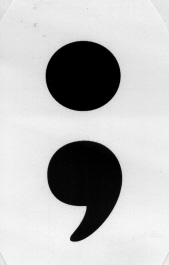
semicolonAll week, as drew closer in my saunter through the alphabet, I assumed it was going to be “S Is for Semicolon.” I like semicolons; you already knew that, right? I blogged about why I like them (and how I don’t really understand why some people hate them so much) in “Praisesong for the Semicolon.” True, that was almost three years ago, but the post holds up pretty well.

Plus it includes a link to where you can buy semicolon swag on Cafepress. I’ve already got the T-shirt, but I could use some more stickers.

S offered several other possibilities, though not nearly as many as C or P — slash (aka solidus), symbol, signature, serif, sans serif (which I just learned can be spelled as one word), schedule, speech, sentence, style sheet . . .

Spelling! Aha, thought I, that’s a big one!

Almost too big, I think a few minutes later, staring at the screen and wondering where to start, where to start?

With a trip to the dictionary, of course. Here’s what the American Heritage Dictionary (AHD) has to say about spelling:

1. a. The forming of words with letters in an accepted order; orthography.
b. The art or study of orthography.
2. The way in which a word is spelled.
3. A person’s ability to spell words: a writer plagued by bad spelling.

English-language spelling is a bear, but I’ve always been good at it, probably because (at least as a kid) I had a good eye and memory for detail. In fifth grade my nickname was Walking Encyclopedia. A few years later I was a killer at Trivial Pursuit, especially when partnered with someone who knew TV and sports a lot better than I did.

Since everyone’s the hero of their own story, including me, I early on assumed that anyone who couldn’t spell well either wasn’t paying attention or wasn’t too bright.

After I learned about dyslexia, I got a lot more tolerant. I also learned that many smart people and some very good writers are “plagued by bad spelling.” You probably won’t meet any copyeditors or proofreaders who are similarly impaired, but I know a few very capable developmental or substantive editors whose grasp of spelling and punctuation is somewhat shaky. They deal with the big picture. Copyeditor and proofreader come in their wake to tend to the details.

AHD refers to “letters in an accepted order.” Right. Even when we spell words wrong, we generally agree on how they should be spelled. If necessary, we consult a dictionary. British English (BrE) and American English (AmE) spell quite a few words differently, but in nearly all cases an AmE spelling is intelligible to a BrE speaker and vice versa: traveler/traveller, check/cheque, defense/defence, curb/kerb.

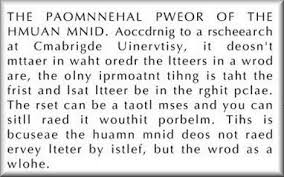
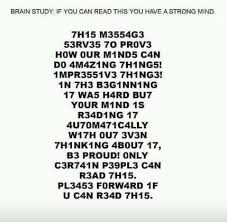
So why is spelling important? Is spelling important? Memes circulate on Facebook with the most atrocious spelling, intentionally atrocious spelling, like these:


And my favorite of all, this:

And we can read them. It’s true that the huamn mnid deos not raed ervey lteter by istlef, unless it’s proofreading, of course, but would you want to raed page after page of any of the above? Probably not. It’s exhausting. You put so much effort into deciphering the text that you’re barely taking in what it’s trying to tell you. The texts above are mainly trying to tell you that you can understand short passages of atrociously spelled words.

When words are spelled in “an accepted order,” we can devote more attention to how they’re strung together in sentences and paragraphs and what they’re trying to say. Sentence structure and punctuation serve the same purpose, by the way. They’re not trying to flummox you or make you feel stupid. If you’re trying to tell a story or get an idea across to readers, they’re on your side.

Spelling errors and typos don’t mean you’re stupid, but when you’re trying to make a good impression on, say, an agent or editor who has to wade through dozens of query letters in a week (or even a day), they don’t inspire confidence. They may even create the impression that you’re careless or clueless or less than competent. Take excruciating care with any document on which much depends.

And yes, digital spell checkers can be helpful. I use mine when I’m in a hurry, and when I’m typing on a virtual keyboard. But a proofreader, copyeditor, or careful reader can usually tell within a paragraph or two or three when a document has been spell-checked but not proofread. The spell checker knows that “reed” is spelled correctly, but it doesn’t know that you don’t reed books.

R Is for Readers

Writers may write in solitude, but there’s nearly always at least one other person in the room. Maybe we see them. Maybe we don’t. Maybe we see them but try to ignore their existence. Maybe they’re in our own head.

Readers.

Editors are test readers of writing that hasn’t gone out into the world yet. Our job is to help prepare the writing for its debut. We’re hired because we’re adept in the ways of spelling, punctuation, grammar, usage, structure, and so on, but on the other hand we’re supposed to be professionally stupid: if the writing isn’t clear enough, if gaps and inconsistencies exist in the sentences and paragraphs we’re reading, we aren’t supposed to fill them in from what we already know. The writing is supposed to do the work.

This is fine as far as it goes, but sometimes editors forget that despite our expertise and the fact that we’re getting paid, we can’t speak for all readers. If an editor tells you that “readers won’t like it if you . . .” listen carefully but keep the salt handy: you may need it. Editors should be able to explain our reservations about a word or a plot twist or a character’s motivation without hiding behind an anonymous, unverifiable mass of readers.

readers at outdoor café

One of the big highs of my writing life was when my Mud of the Place was featured by the several Books Afoot groups who traveled to Martha’s Vineyard in 2013 and 2014.

Readers can and often do take very different things away from the same passage, the same poem, the same essay, the same story. At my very first writers’ workshop (the 1984 Feminist Women’s Writing Workshop, Aurora, New York), day after day I listened as 18 of us disagreed, often passionately, about whether a line “worked” and whether a character’s action made sense or not and whether a particular description was effective or not. It was thrilling to see readers so engaged with each other’s work, but also a little unsettling: no matter how capable and careful we writers are with our writing, we can’t control how “readers” are going to read it.

This is a big reason I advise writers to find or create themselves a writers’ group — and to develop the skill and courage to give other writers their honest readings of a work in progress. This may be the greatest gift one writer can give another.

I just came to “Teasing Myself Out of Thought” in Ursula K. Le Guin’s Words Are My Matter: Writings About Life and Books, 2000–2016 (Easthampton, MA: Small Beer Press, 2016), and what do you know, it articulates eloquently and clearly some of what I’m feeling my way toward here.

“Most writing is indeed a means to an end,” she writes — but not all of it. Not her own stories and poems. They’re not trying to get a point across: “What the story or the poem means to you — its ‘message’ to you — may be entirely different from what it means to me.”

She compares “a well-made piece of writing” to “a well-made clay pot”: the pot is put to different uses and filled with different things by people who didn’t make it. What she’s suggesting, I think (maybe because I agree with her), is that readers participate actively in the creation of what the story or poem means. Readers are “free to use the work in ways the author never intended. Think of how we read Sophocles or Euripides.”  What readers and playgoers have discovered in the Greek tragedies has evolved considerably over the last 3,000 years, and it’s a good guess that Sophocles and Euripides didn’t embed all those things in their works.

“A story or poem,” writes Le Guin, “may reveal truths to me as I write it. I don’t put them there. I find them in the story as I work.”

If this reminds you of “J Is for Journey,” it does me too. And notice where that particular blog post started.

And finally this: “What my reader gets out of my pot is what she needs, and she knows her needs better than I do.”

That’s a pretty amazing and generous statement, and one editors might consider occasionally, especially when we’re editing works that aren’t simply means to an end.

P Is for Point of View

When you’re blogging A to Z about writing and editing, P, like C, offers a dizzying array of options: place, placement, paragraph, period, periodical, prose, poetry, parallelism, proofreading, page, point of view, parenthesis, person, persona, present tense, past tense, prize,  production, project, projection, picture, photograph, pronoun, pseudonym . . .

Gay Head Cliffs

This is what I see when I think “point of view”: a vantage point from which you can see a lot but there’s a lot you don’t know. These are the Gay Head Cliffs, where a crucial scene takes place late in my novel in progress.

I settled on point of view (POV) because it’s playing a significant role in Wolfie, my novel in progress. Wolfie has two POV characters: Shannon, an artist and graphic designer in her 50s; and Glory, an artistically gifted sixth-grader who loves dogs. I’m writing both in what’s called a limited or close third-person POV, meaning that each character’s scenes are shown through her eyes and first-person pronouns appear only in dialogue.

In omniscient third-person the usually disembodied narrator knows everything, including what’s going on in people’s heads. A couple of times while in Shannon’s head I’ve caught myself writing something that boils down to “Little did she know . . .” This suggests either some form of omniscience or that Shannon is looking back at these particular events from some point in the future.

In a previous draft I started to write Shannon’s first chapter as if she already knew what was going to happen, or at least most of it, but this didn’t ring true to me so I jettisoned this approach. In the novel, Shannon and eventually other characters are feeling their way toward a piece of knowledge — a secret or a mystery, if you will — and because of the nature of that knowledge they can’t afford to be wrong.

“Hindsight is always 20-20,” so the saying goes, and for Shannon to know too much too soon would undercut the uncertainty that is driving the story. The other thing is that I still don’t know how the story ends. If Shannon knows and is holding back on me, I’m going to be pissed.

Only one person knows the secret and he’s not speaking to me, Shannon, or Glory. What Glory knows is buried deep in her subconscious; she has no words for it. Shannon is growing uneasy, but in the absence of clear evidence she fears she is projecting from her own childhood experience and her work as an adult sheltering and advocating for abused women. So without words or clear evidence how do I figure it out and convey it all to my readers?

As it turns out, my two limited-POV characters were giving me clues before I caught on to what they were doing. In giving Glory an aptitude for drawing and an interest in web design, I was cleverer than I knew. Clues appear indirectly in the actions and occasionally words of the characters, but the most direct clues come in the form of images, some created by the characters and some drawn from the story. (For more about where images come from, see my 2014 blog post “Grow Your Images.”)

In writing it so often happens that limitations foster ingenuity. A length limit can impose focus on prose that wants to sprawl. The discipline of rhyme and meter forces the poet to pay attention to the sound and placement of each word, to make each word count. (Prose writers can learn a lot from writing and reading poetry.) And in Wolfie the limitations imposed by the incomplete knowledge of my two POV characters are stretching me as a writer and helping me find new ways to tell a story.