N Is for Narrative

Like many other word people, the cataclysmic 2016 U.S. presidential election campaign and its ongoing aftermath got me wondering whether my particular skills as a writer and editor could be useful and, if so, how. Clarity and accuracy seemed way down low on the country’s priority list.

Then in late January, I found Theodora Goss’s blog post “The Politics of Narrative Patterns.” It began like this:

There are all sorts of reasons the American election went the way it did, but I think one of them, and perhaps quite an important one, was the way in which our thinking is determined by narrative patterns. What do I mean by narrative patterns? I mean that in narratives, in stories, there are underlying patterns we are familiar with. They recur from story to story: stories are often variations on these patterns. When we encounter these patterns, we feel fulfilled, comfortable — we recognize them, we like to read about them. We like variation, but only a certain amount of variation. Too much variation makes us feel unsatisfied, as though somehow the story is written “wrong.”

After discussing some narrative patterns popular in our culture, Goss notes that male characters have more archetypal options than female characters. Right, thought I, thinking of the path-breaking work writers of f/sf (fantasy and science fiction, hands-down my #1 go-to choice for fiction) have been doing since the 1970s and earlier to expand the possibilities for female characters.

Then Goss ties this to presidential elections, past and present. “People did not get so excited by Barack Obama, when he first ran, because of his policies,” she writes. “No, he was the young hero who had overcome adversity and triumphed.”

And Donald Trump? “He fit another narrative pattern: the stranger who rides into town and imposes order, bringing justice to the frontier. . . . It did not hurt him that he was not morally pure, because we do not expect the gunslinger to be morally pure — no, that’s reserved for heroes.”

Immediately it dawned on me that the wise old man in the race, the Gandalf, Obi-Wan Kenobi, and maybe Walter Cronkite character, was clearly Bernie Sanders. Wise old(er) men have loomed large in my fantasy life since I was a kid, but I never “felt the Bern.” The more I researched his record, the less impressed I was. But I had such a hard time conveying my reservations to my many, many Sanders-supporting friends that I finally stopped trying.

When a narrative pattern takes hold, facts take a back seat. This applies to writing as well as politics: novels that capture the public imagination and become runaway best-sellers seldom do it on their literary merits alone. Don’t tell me the gatekeepers of the publishing world, the agents, editors, publishers, reviewers, et al., are impervious to the power of narrative patterns!

What about women? asks Theodora Goss. Plucky girls are OK, but what happens when they grow up? “We only have two patterns for older women who want political power. One is the Virgin Queen, like Elizabeth I: a woman is fit to wield power if she is willing to give up other aspects of being a woman, such as marital relationships or children.”

Hillary Rodham Clinton didn’t  fit this pattern. “What was left?” Goss asks. “The Wicked Queen. We know what she does — she seizes power (illegitimately) for her own gain, to satisfy her own ambition. She kills people or has them killed (this too was a criticism lodged against Clinton). And the Wicked Queen cannot be allowed to gain power — she must be defeated. All of our stories have told us that, from childhood on.”

Walk around that for a while. It resonates.

It also brings me round to the question of what can we word people do in this world where it seems our skills are only valued if we put them in the service of spin, obfuscation, manipulation, and outright lying.

It brought Theodora Goss around to a similar place. At first she thought (feared?) that writing had no use and maybe she should have gone into another line of work. “But now I think that one of our most important tasks is telling stories, and I am a storyteller. I am a perpetuator and creator of narrative patterns. That means I have an obligation to be aware of the patterns, to wield them in ways that are good, and true, and useful. And I can create new patterns.”

That’s the key: the old patterns won’t lose their power with the wave of a pen, but they can be undermined and transformed, and new patterns can be created. I saw it happening in f/sf, where women went from being add-ons and sidekicks to having their own adventures.

Well into the 1960s, lesbian characters in pulp fiction had basically two options: go straight or die. Cracks began to appear in the pattern before the end of the ’50s, and over the following decades, thanks in large part to lesbian and feminist writers, presses, and readers, new patterns were created. In many quarters these days “go straight or die” is an anachronism.

Note my inclusion of “readers” here. The culture’s narrative patterns are very strong, and the gatekeepers, often citing “market forces,” have a vested interest in perpetuating them. Books that break or undermine the dominant patterns are unsettling, and plenty of people don’t like being unsettled. It wasn’t a commercial press that broke the back of the “go straight or die” lesbian stereotype: it was Daughters., Inc., the small lesbian press that in 1973 published Rita Mae Brown’s Rubyfruit Jungle. The novel’s “underground” popularity caught the attention of mainstream publishers, and Rubyfruit Jungle went on to become a mass-market best-seller — and a cultural icon for a lot of us.

Narrative patterns are deeply rooted in all our heads. They’re our default settings when we read, when we write, when we choose among political candidates. They’re powerful for sure, but they aren’t invincible. Words, our words, can change them, one story at a time.


Questions, Anyone?

Got a question or comment about editing or writing? Send it along! Here’s a handy-dandy form to make it easy. You can also find one up on the menu bar. Both of them go to the same place.

← Back

Thank you for your response. ✨

When I started this blog, I hoped it would be at least partly driven by questions and comments from other writers and editors. I’ve got plenty of experience packed in my head, but where to start, where to start? What I’m loving most about this A–Z Challenge is the way it helps me focus on a specific topic and carry on from there.

In the online editors’ groups I’m in, threads often start when an editor posts a snarly sentence that she’s not sure how to fix, or maybe asks about the usage of a particular word. Other editors will weigh in with their suggestions. Sometimes the thread will take off in a different but equally interesting direction. I can’t begin to tell how much I’ve learned about, for starters, English spoken in other countries and in different regions of the U.S., and editing in fields about which I know little or nothing.

So if you’ve got a snarly sentence, a dubious usage, or a structural problem that’s bugging you, either in what you’re writing, what you’re editing, or something you’ve read, send it along. The chances are good that whatever it is, others, including me, have dealt with it too.

M Is for Manuscript

“Manuscript” literally means “written by hand.” Sounds like “handwriting,” doesn’t it? Not all that long ago most manuscripts (“mss.” for short; the singular is “ms.”) were handwritten. Some of us still do a fair amount of first-drafting in longhand.

These days, however, when we talk about manuscripts, we’re usually referring to the finished (at least for the time being) product that we circulate to our writer friends, hand over to an editor, or submit to a publisher. That manuscript had better not be handwritten. Go back to “H Is for Handwriting” (or take a close look at the photo at the top of this page) and you’ll see why.

Some manuscripts are handwritten, of course. They are generally found in archives and libraries, where they are pored over by scholars, not read by the general public.

Though often hard to read, handwritten manuscripts are undeniably full of personality. Standard manuscript format isn’t. That’s part of its point. It says little about the writer’s personality, but what it does say is important. It tells the agent or editor who reads it “This writer knows what she’s doing. She’s prepared a manuscript that makes it possible for you to focus on the writing.”

So what is “standard manuscript format”? Most how-to-get-published books and websites will tell you, but here are the basics:

  • Double-spaced
  • One-inch margins all around
  • Serif font (sometimes a particular font is specified, like Times New Roman)
  • 12 point type
  • A header that includes the author’s surname, a word or two from the title, and the page number

My writers’ group members bring paper pages to our weekly meetings. Here’s one of mine. It illustrates all of the above points, plus the convention that the first page of a new chapter begins some ways down the page, usually between a third and a half. Note also that the header includes “draft 3.” Version control — keeping track of revisions and rewrites — deserves a post of its own. Maybe when we get to V?

manuscript page

Manuscripts submitted electronically can of course be reformatted by the recipient, but you want to create a good first impression. Freelance editors often wind up tweaking (at least) the mss. submitted by our less experienced clients, but we’re generally charging for the time we spend doing this. Unless you already have a big name or a hot topic, agents and publishers are doing you a favor by reading your work. Make it easy for them.

Cranky editor

For both fiction and nonfiction writers, the Chicago Manual of Style‘s section “Manuscript Preparation for Authors” is  a good place to start. Different genres, journals, and academic disciplines often have their own requirements, some of which are very specific and should be followed to the letter.

Learn the conventions and expectations that prevail in whatever field you’re in. This is especially true if your ms. includes citations — footnotes and/or endnotes, bibliography or reference list. As I noted in “B Is for Backmatter,” messily formatted citations make editors very cranky. Writers are well advised to avoid this whenever possible.

L Is for Literary

At first glance “literary” looks straightforward. Merriam-Webster’s Collegiate Dictionary starts off with this: “of, relating to, or having the characteristics of humane learning or literature”.

Move on to “literature,” however, and fault lines begin to emerge:

a (1) :  writings in prose or verse; especially :  writings having excellence of form or expression and expressing ideas of permanent or universal interest

The American Heritage Dictionary definition of “literary” progresses from 1., “Of, relating to, or dealing with literature: literary criticism,” to 4a, “Appropriate to literature rather than everyday speech or writing,” and finally 4b, “Bookish; pedantic.”

For “literature” AHD moves briskly from the inclusive — “1. The body of written works of a language, period, or culture” — to something less generous: “2. Imaginative or creative writing, especially of recognized artistic value.”

In other words, value judgments lurk not far below the surface of both “literary” and “literature,” and it’s not hard to see how they stir up uneasiness and outright opposition.  In some quarters “literary” suggests not only bookish and pedantic, but pretentious, snobbish, affected, esoteric, incomprehensible . . .

As a longtime reader of fantasy and science fiction, I’m particularly intrigued by the way “literary” is used to characterize anything that doesn’t fit into a genre. This leads to grand generalizations, judgments, and arguments that generate plenty of heat but not much light. What it misses is that genres are primarily marketing categories developed by publishers in order to treat books as products. Categorize a novel and it’s easier to promote and sell. Writers aren’t stupid: if they want to sell, they’ll write what the publishers are buying.

Genres have been around long enough at this point that they’re embedded in readers’ heads. Audiences have developed for particular genres, subgenres, and sub-subgenres, and self-publishers who want to sell ignore this at their financial peril.
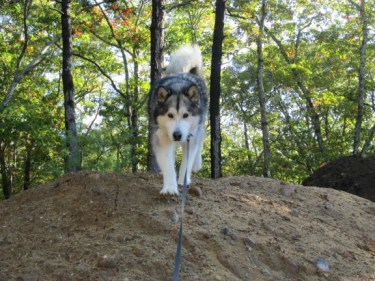
Writers who want to sell will often write to the specs of a particular genre, at least until (if they’re lucky) they develop enough of a following that their byline becomes the brand. Unfortunately, the byline brand can become as restrictive as a genre category, which is why some well-known writers who want to strike off in a different direction do so under a pseudonym.

Without market pressures, though, writing often doesn’t fit neatly into categories. A while back, in “Genres and Dump Dogs,” I wrote this:

Literary genres are like breeds — of relatively recent development, especially the notion that there are clear lines between them and everything has to fit into one category. “Literature” is more like those village dogs of indeterminate breed: it adapts to the climate and food sources available, and maybe it looks a little like this, a little like that, but you can’t say for sure that it’s a beagle or a foxhound (or a mystery or a romance). When you’re trying to tell a story, you scavenge and steal from whatever’s in the vicinity and if it works you keep it.

If “literary” came to mean “willing to scavenge and steal from whatever’s in the vicinity, all in the interest of the work,” that would be OK with me. The sky, or maybe the ocean, is the limit.

Dog at edge of ocean

Travvy confronts the infinite.

K Is for Knowledge

My mind was drawing a blank on K. All the English words that should begin with K begin with C instead. I could fill a whole month with words: convention, collection, character, colon, critique, computer, creativity, chapter, capitalization, coda, classics, copyright . . .

All I could come up with for K were “kern” (a typographical term) and “knotty” (characteristic of prose that needs to be untangled), neither of which inspired me. “Knotty,” however, got me to thinking about words that begin with K but don’t sound like it. Up popped a granddaddy of writerly clichés: “Write what you know.” Aha! “Knowledge” begins with K!

dog coming down hill

Travvy on a mission

I’m more likely to write what I want to find out, but it’s true, things I know and things I’d forgotten I know keep showing up in my writing.

It’s also true that so far I’ve chosen to set my fiction on Martha’s Vineyard, partly because I know it pretty well and partly because I want to know it better.

Wolfie, the title character of the novel in progress, is based on Travvy, my Alaskan malamute, because Travvy has taught me a fair amount about dogs and dog training and what’s a writer to do with the interesting stuff she’s learned besides write about it?

But I don’t know how to rescue a sixth-grade girl who’s been incested by her stepfather, and I don’t know how the stepfather can look himself in the mirror having done what he’s almost certainly done. That’s part of what I’m trying to find out.

Ursula Le Guin’s essay collection Language of the Night was at hand because I’d quoted it in “J Is for Journey,” so I flipped through a couple of my favorite essays and came to this, in “Talking About Writing”:

I invite  you  to meditate on a pair of sisters, Emily and Charlotte. Their life experience was an isolated vcarage in a small, dreary English village, a couple of bad years at a girls’ school, another year or two in Brussels, which is surely the dullest city in all Europe, and a lot of housework. Out of that seething mass of raw, vital, brutal, gutsy Experiece they made two of the greatest novels ever written: Jane Eyre and Wuthering Heights.

This struck me with special force because I’d recently watched To Walk Invisible, Sally Wainwright’s wonderful film about the Brontë sisters, Emily, Charlotte, and Anne.

Le Guin goes on:

Now of course they were writing from experience; writing about what they knew, which is what people always tell you to do; but what was their experience? What was it they knew? Very little about ‘life.’ They knew their own souls, they knew their own minds and hearts; and it was not a knowledge lightly or easily gained.

A writer can learn plenty by doing research, whether this involves extensive reading or spending time in a place or interviewing lots of people. But to do justice to all this knowledge, she has to know her own soul, her own mind and heart. That’s what enables her to make sense of her research, to understand or create characters that are not like her at all.

J Is for Journey

“A fantasy is a journey. It is a journey into the subconscious mind, just as psychoanalysis is. Like psychoanalysis, it can be dangerous; and it will change you.

That’s Ursula K. Le Guin in “Talking About Writing” which you can find in her Language of the Night: Essays on Fantasy and Science Fiction (1979). I don’t write fantasy, but I’ve read a lot of it, which may explain why fantasy elements keep sneaking into my real-time fiction.

It may also explain why for me writing is a journey, especially writing fiction, and everything Le Guin says about fantasy applies. The journey I’ve been on for three years now started with a dog running through the woods and a girl sitting on a playground swing. As I wrote my way toward them, I began to understand who they were and how they were connected.

I also ventured deep and deeper into my own subconscious, or memory, or imagination, whatever it is, and found images and questions that preoccupied me in the past but that I’d set aside. Rescue — both rescuing and being rescued — was a big one. In my novel in progress, the rescue of the dog turned out to be pretty easy. The rescue of the girl is still working itself out. I’m still not 100% sure of what she needs to be rescued from, but it’s a lot clearer — and more unsettling — than it was when I started. So are the stories and motivations of the would-be rescuers.

One of my mantras is “Your writing will teach you what you need to know.” It will, but the catch is that you have to keep doing it. My hunch is that a fair amount of what’s called “writer’s block” stems from the cautious mind’s fear of those subconscious places where reason has to relinquish control. The fear is totally justified because, as Le Guin wrote, the journey will change you.

It may change you in ways you don’t expect and can’t control, that may sharpen or blur your vision enough to unsettle your view of the world. It’s a wild magic, writing.

As the letter J drew closer in my passage through the alphabet, I couldn’t decide between “journey” and “journal.” The two words had to be closely related, I thought, and so they are: both stem from the Latin word for “day,” diurnis, by way of the Anglo-French. If you know any French, or even if you don’t, the “jour-” in “journey” and “journal” probably suggests jour, the French word for “day.”

“Journey,” it seems, originally suggested a day’s travel. Now a journey can take much longer, especially if you’re working on a book-length work, but breaking it down into days isn’t a bad idea. The journey may indeed lead into dangerous places, but the closer you get, the less scary they seem — because you’re getting braver with every step you take, every word you write.

The journey continues.


I Is for Italics

After reading “E Is for Ellipsis,” my friend the mystery writer Cynthia Riggs emailed me. “I can hardly wait until u get to I,” she wrote. “I, I hope, will stand for ‘italics.'”

This sentence is set in italics. In typographical terms, type that isn’t italicized is called “roman.” Most of this blog post – and most of most books — is set in roman type. For most fonts, roman is the default setting. Italics and bold are among its variations.

Cynthia is currently one of the jurors in a major mystery award’s first-novel category. The novels she has read so far are, to put it tactfully, a mixed bag. She went on:

The current book I am reviewing has alternate chapters printed in italics. ALL italics, page after page. It’s like reading someone’s handwritten manuscript. The chapters jump from one where I’m not even aware of the printed word, where the author’s voice goes directly into my brain, to a sudden slow-down where I must decipher each wiggly word and consider what the words mean when put together.

In another first-novel entrant, “each character’s words [were set] in a distinctive typeface so we, the readers, would know who’s speaking.”

Curious, I inspected these titles at the next opportunity, which arose PDQ because my Sunday-night writers’ group meets at Cynthia’s house. As I suspected, they were self-published. Self-publishing authors not only produce the manuscript; they also assemble the production team that sees it into print and markets it. Novice self-publishers often skimp on the professional editing and design that make a book readable.

A capable, experienced book designer knows  that in general the goal is to produce pages where, as Cynthia put it, readers are “not even aware of the printed word, where the author’s voice goes directly into [the reader’s] brain.” When the type calls attention to itself, it’s because the designer intended it to. In typography, less is often more. Any technique used to excess becomes, well, excessive. It loses impact and annoys the reader.

The digital age makes excess all too easy. Even the fairly basic options that WordPress offers bloggers include bold, italics, bold italics, strikeout, and lots of pretty colors. Word-processing apps like Word and LibreOffice offer a gazillion fonts in an array of sizes, most of which you would not want to read a whole book in, or even a short chapter.

Newspapers and other publications following the Associated Press (AP) stylebook have managed to get by without italics since forever. Before the age of digital composition, italics were hard to produce and couldn’t be transmitted by wire, which is how news stories were transmitted from the wire services to their subscribers around the world. However, as noted on the AP Stylebook‘s website, “Publications that adhere to AP editing style make their own decisions on graphics and design, including use of italics.”

That said, thanks to various widely accepted conventions,  italics do come in handy for conveying meaning, and good writers, editors, and designers learn to use them — and other typographical devices — wisely. Here are a few instances where the Chicago Manual of Style (CMS or CMoS) recommends the use of italics:

  • Titles of books and other full-length creative works. Short works, such as songs, poems, and short stories,  and the component parts of longer ones are set in roman with quotation marks. Example: “Natural Resources” is included in The Dream of a Common Language: Poems, 1974–1977, by Adrienne Rich.
  • Names of newspapers, e.g., the Martha’s Vineyard Times and the Vineyard Gazette. CMS  recommends setting “the” lowercase roman even when it’s part of the official title. Publications following AP style often initial-cap and italicize the whole official title, “the” included.
  • Foreign-language words that aren’t included in English-language dictionaries. For example, “raison d’être” comes from the French but is well established in English usage, so no italics. The Gaelic word uisge appears in one of my current copyediting projects. It’s not widely used in English, though the familiar word “whiskey” (also spelled “whisky”) is derived from it, so it’s italicized.

Many fiction writers use italics to indicate what a character is thinking, to distinguish it from what the character says out loud, which is set in roman with quotation marks on either side. Other writers stick with roman type but without the quotes. Either method can work, but keep in mind my friend Cynthia’s words. The goal is for the author’s voice to go directly into the reader’s brain. Typographical style can aid this process without calling attention to itself.

When writers rely too heavily on typography to get the point across, it’s often because the writing itself needs attention. Changes in speaker can be conveyed in words alone. Italics can be used to let readers know when a character is thinking to herself, but when the italics run on for a long paragraph or even a whole page or two, it’s time to take another look at the writing.

H Is for Handwriting

My handwriting sucks. Here’s a sample:

This is why I do nearly all my first-drafting in longhand: because I can’t read my own writing unless I slow way down and focus on each word.

It took me a while to figure out why I’d sometimes get so blocked — paralyzed! — when I did nearly all my writing on the computer. Maybe it’s because I’m an editor as well as a writer, or maybe it’s because I’m a recovering perfectionist who has occasional slips, but sometimes I’d stare at those crystal-clear words on the screen and think, No, that’s not right, and then get stuck trying to fix it instead of moving on.

Eventually I figured out that the best way to break through these blocks was to grab a pad of paper and a pen and get away from the computer. At the top of the paper I’d writing something like “I can’t write this scene because . . .”

And out would flow whatever I needed to know, and eventually the scene itself.

This was also a handy way of getting to know characters better. Whatever I wrote in longhand on a yellow pad wasn’t part of The Manuscript. I loosened up. No pressure. I could write anything I wanted.

My messy handwriting was an asset. What the internal editor couldn’t read, she couldn’t edit. Without the internal editor looking over my shoulder, I could write write write, not expecting anything to be perfect, knowing that there would be a second or third or fourth draft to get it just right.

So why wait till I got stuck to bring out the pen and paper? Why not start out that way?

I tried it. It worked. It’s still working. I do most of my first-drafting in longhand.

Pretty soon, however, the scrawl of a ballpoint pen across lined yellow paper was looking rather dull. I started acquiring fountain pens and bottles of different colored ink. I’ve currently got about a dozen of each. It’s a little ridiculous, but I couldn’t live without them.

The bonus is that ink blottings on paper towels are really pretty. I use them as coasters for my tea mugs and my beer steins. They make me happy.

ink blot


G Is for Grammar

We’re so quick to say that someone “doesn’t know their grammar” that it might be surprising how many of us aren’t entirely sure just what “grammar” is. This would include me. I just had to look it up (again). Here is what Bryan A. Garner, author of the “Grammar and Usage” chapter of the Chicago Manual of Style, has to say:

Grammar defined. Grammar consists of the rules governing how words are put together into sentences. These rules, which native speakers of a language learn largely by osmosis, govern most constructions in a given language. The small minority of constructions that lie outside these rules fall mostly into the category of idiom and usage.

In the very next paragraph he notes that “there are many schools of grammatical thought,” that “grammatical theories have been in great flux in recent years,” and that “the more we learn the less we seem to know.”

button: grammar police enforce the syntaxNot to worry about all this flux and multiplicity, at least not too much. A couple of things to keep in mind, however, when someone accuses you or not knowing your grammar or when, gods forbid, you are tempted to accuse someone else: (1) spelling and punctuation are not grammar, and (2) some of the rules you know are bogus.
If you’re not sure which of the rules you know are bogus — well, I just Googled bogus grammar rules (without quote marks) and got 338,000 hits. Bogus rules are the ones we generally don’t learn by osmosis. They are stuffed down our throats by those in authority, often teachers or parents.

At the top of almost everybody’s list are the injunctions against splitting an infinitive and ending a sentence with a preposition. They’ve both been roundly debunked, but I still get asked about one or the other from time to time so I’m pretty sure they’re not dead yet. Plenty of writers and even editors still get anxious when a “to” is split from its verb or a preposition bumps up against a period/full stop.

The general purpose of bogus rules is not to help one write more clearly; it’s to separate those who know them from those who don’t. As literacy spread and anyone could learn to read and write, the excruciatingly well educated upper classes confronted a dilemma: how in heaven’s name can we tell US from THEM? Hence the rules — about language, etiquette, and various other things.

Note, however, that the uppermost class can generally get away with anything, so the ones who follow and strive to enforce the bogus rules are often those a notch or two below in the pecking order. That’s how they demonstrate their loyalty to those at the top. Watch out for them.

F Is for Fact-Checking

Fact-checking is much in the news these days — or perhaps it’s the absence of it that’s much in the news.

It used to be, and may still be, that top-quality magazines had fact-checkers whose job was to go through every story accepted for publication and check all the facts. They weren’t responsible for the quality of the prose — just the facts.

Editing — specifically copyediting, which includes excruciating attention to detail — and fact-checking are two distinct tasks, but inevitably they overlap. Imprecise writing can lead to readerly misunderstanding, and those misunderstandings may have to do with facts. A trade publisher I’ve been working for regularly for many years directs copyeditors to check dates, the spelling of names, and anything that can be easily verified as long as it doesn’t add to billable time.

Before the World Wide Web, freelance copyeditors were limited to biographical dictionaries, atlases, specialized reference books, and such. Because these had been subjected to a rigorous editing process, they were reliable, but they were also limited in scope. Print references start going out of date even before they’re published, and the further your interests strayed from white male English-speakers, the harder it was to find any facts, verified or not.

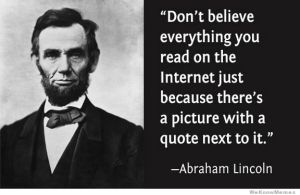
In the Age of Google, you can find almost anything on the Web, but plenty of it hasn’t been subjected to either fact-checking or editing. As you’ve probably learned for yourself, verifying the attribution of a quotation is a particular challenge because misattributions seem to multiply exponentially — giving rise to memes like the classic at left (variations of which have also been attributed to Mark Twain, among others).
Copyeditors generally do our fact-checking on the fly and with the help of a search engine. We develop a sixth sense for determining the reliability of sites we’ve never visited before. (Hint: This often involves the quality of both writing and design. If the copy is riddled with typos and strange punctuation, I’ll move on PDQ. Ditto with any site that uses white type against a dark background.)

We also develop a sixth sense for what facts in a manuscript need to be checked. When starting a new job, I’ll fact-check a few names and dates to get a feel for how careful the author is. If the author seems reliable (as is usually the case in the stuff I work on), I’ll look up anything that smells funny and spot-check facts here and there just for the hell of it.

Ultimately writers are responsible for the accuracy of their facts, but a book-length work of nonfiction involves a myriad of facts, and it’s all too easy to transpose letters in a name or figures in a number and wind up with a goof.

Writers whose work is based on research do plenty of fact-checking while they’re writing. Written sources may contain errors, or contradict each other, or be superseded by later works.

I think the journalists have it hardest. Many of their sources are living people talking about events that have just happened. These informants bring different perspectives to the event, they see it from different angles, some are more observant than others — and some may be deliberately shading or hiding what they know, for reasons they’re unlikely to be upfront about and may even be unaware of. And the journalists are generally working on deadlines that don’t leave time for leisurely fact-checking.

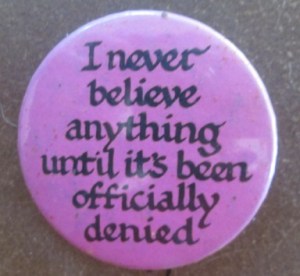
Button: I never believe anything until it's been officially denied.In this age of spin and “fake news” each of us has to do our own fact-checking. Because we rarely have the time or inclination to check every fact, we generally focus on the source, the news outlet: if it’s got a good track record, it’s probably because its reporters, editors, and fact-checkers are on the ball. When they screw up, our faith is shaken. Was this an aberration, or are they going down the tubes?

At least in our wiser moments, good editors and writers know that 100% accuracy is impossible, but that doesn’t stop us from expecting it of ourselves and of those we respect, and from turning on anyone who doesn’t live up to our expectations.

In my weekly newspaper days I quickly learned that if we spelled the name of someone’s child or grandchild wrong, that person would remember it forever. Worse, it could easily become a cornerstone in that person’s conviction that the paper was careless with facts. It’s not hard to understand: misspellings and factual errors are easier to recognize than sloppy sourcing or sloppy writing, and they stick in the mind longer. It’s not fair, but there’s an upside to it: if you’re scrupulously accurate with your easy-to-check facts, your work will be more credible.

And when the liars, spammers, and misrepresenters catch on, we’re all in big trouble.